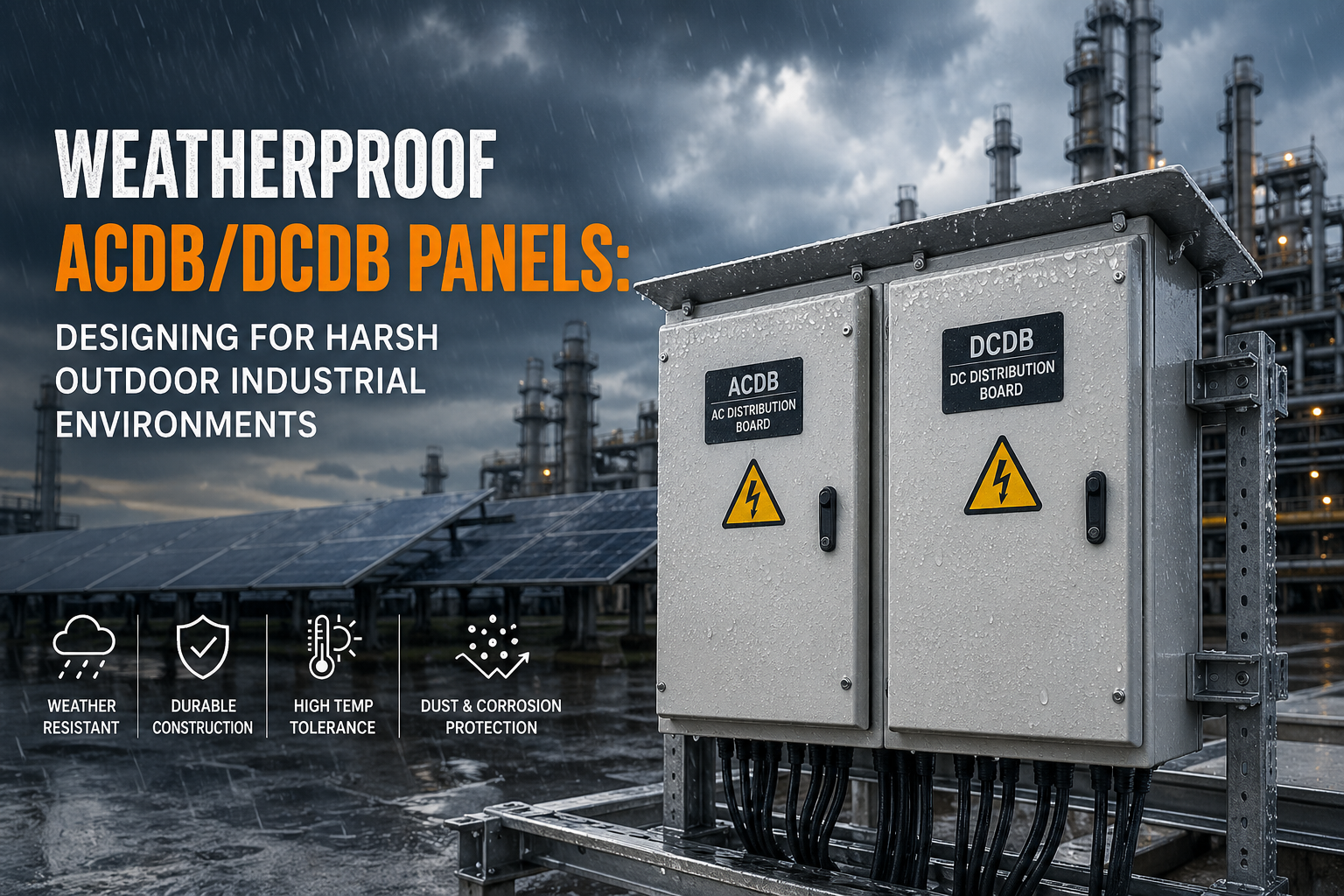
Weatherproof ACDB/DCDB Panels: Designing for Harsh Outdoor Industrial Environments

Outdoor electrical installations face challenges that indoor systems rarely encounter. Dust, moisture, extreme temperatures, and continuous exposure to environmental elements can severely affect electrical distribution systems. In such demanding conditions, weatherproof ACDB DCDB panels play a critical role in maintaining safe and reliable power distribution.

Industries such as solar power plants, infrastructure projects, telecom installations, water treatment facilities, and outdoor manufacturing units depend on durable ACDB DCDB panels designed specifically for harsh outdoor environments. A well-engineered weatherproof ACDB DCDB panel ensures protection against environmental damage while maintaining uninterrupted electrical performance.

For companies installing outdoor electrical infrastructure, selecting the right ACDB/DCDB panels for outdoor industrial installations is not just a technical decision—it is a long-term reliability investment.

Why Outdoor Industrial Installations Require Weatherproof ACDB/DCDB Panels

Unlike indoor electrical control systems, outdoor installations operate in unpredictable environments. Rain, humidity, dust storms, and fluctuating temperatures can compromise electrical components if proper protection is not in place.

Weatherproof ACDB DCDB panels are specifically designed to safeguard power distribution systems in such environments. These panels house critical components like MCBs, MCCBs, surge protection devices, and isolators, ensuring that solar arrays or power systems operate safely.

In solar plants, especially, ACDB panels distribute alternating current from inverters, while DCDB panels manage direct current from solar modules. If these panels are not properly protected, environmental exposure can lead to corrosion, short circuits, or system failures.

This is why modern outdoor ACDB DCDB panels incorporate specialized enclosures, sealing systems, and corrosion-resistant materials to maintain long-term performance.

Environmental Factors That Influence ACDB/DCDB Panel Design

Designing weatherproof ACDB DCDB panels requires careful consideration of environmental conditions. Each outdoor location presents different risks, which must be addressed through proper panel engineering.

Common environmental challenges include:

  • Heavy rainfall and humidity that may cause moisture intrusion
  • Dust and sand exposure in industrial zones or desert areas
  • Extreme heat and UV radiation affecting panel materials
  • Corrosion risks in coastal or chemical industrial areas
  • Temperature fluctuations causing expansion and condensation

A well-designed weatherproof electrical distribution panel protects internal components from these conditions while ensuring stable operation of the entire electrical system.

Key Design Features of Weatherproof ACDB/DCDB Panels

High-quality ACDB DCDB panels for outdoor industrial environments incorporate multiple protective features. These features are essential to ensure safety, durability, and efficient power distribution.

Important design elements include:

1. High IP Protection Rating

Outdoor ACDB/DCDB panels typically feature IP65 or IP66 protection, preventing dust and water ingress. This protection level ensures the panel remains operational even during heavy rain or dusty conditions.

2. Corrosion-Resistant Enclosures

Panels are often built using powder-coated CRCA steel or stainless steel enclosures. This prevents rust and corrosion in harsh industrial environments.

3. UV-Resistant Coatings

Continuous sun exposure can degrade conventional materials. UV-resistant coatings increase the lifespan of weatherproof ACDB DCDB panels used in solar installations.

4. Advanced Sealing and Gasketing

High-quality rubber gaskets prevent moisture from entering the enclosure, ensuring that sensitive electrical components remain protected.

5. Efficient Cable Management

Outdoor ACDB DCDB panels are designed with proper cable glands and entry points to maintain sealing integrity while allowing safe cable routing.

Where Weatherproof ACDB/DCDB Panels Are Commonly Used

Many industries depend on outdoor electrical distribution panels to manage power safely in exposed environments. These panels are especially critical in infrastructure where environmental exposure cannot be avoided.

Major industrial applications include:

  • Solar power plants and photovoltaic installations
  • Telecommunication towers
  • Water treatment and pumping stations
  • Outdoor manufacturing units
  • Infrastructure and construction projects

In solar power plants, DCDB panels collect power from solar modules, while ACDB panels distribute power from inverters to the grid. Weatherproof panel design ensures these operations remain stable regardless of environmental conditions.

Safety Considerations in Outdoor Electrical Panel Design

Electrical safety becomes even more important in outdoor installations. Exposure to moisture or dust can increase the risk of electrical faults if panels are not properly designed.

A reliable weatherproof ACDB DCDB panel must include protective features such as proper earthing systems, surge protection devices, circuit breakers, and insulated busbars. These safety mechanisms prevent electrical hazards while protecting connected equipment.

In solar installations, surge protection is particularly important, as lightning strikes or grid disturbances can cause significant damage to electrical systems.

Well-designed ACDB DCDB panels therefore, act as both distribution systems and safety barriers, protecting the entire electrical network.

Engineering Reliability for Long-Term Outdoor Performance

Outdoor electrical panels must perform reliably for years with minimal maintenance. This requires careful attention to material quality, ventilation design, and component selection.

Engineers must ensure that weatherproof ACDB DCDB panels maintain proper heat dissipation, as enclosed environments can trap heat. Ventilation systems, heat-resistant materials, and efficient layout designs help maintain optimal internal temperatures.

In large solar or infrastructure projects, the durability of ACDB DCDB panels directly affects system uptime and operational efficiency. Poorly designed panels may lead to frequent maintenance issues, affecting productivity and increasing operational costs.

Why Industries Trust Synchro Electricals for Weatherproof ACDB/DCDB Panels

Synchro Electricals has built a reputation for delivering high-performance industrial electrical panels designed for demanding environments. The company specializes in manufacturing weatherproof ACDB DCDB panels for outdoor industrial installations, ensuring reliable power distribution in challenging conditions.

Each ACDB/DCDB panel from Synchro Electricals is engineered with a focus on durability, safety, and long-term performance. From solar power projects to industrial infrastructure, the panels are designed to withstand harsh environmental exposure while maintaining electrical reliability.

With expertise in industrial electrical panel manufacturing and power distribution solutions, Synchro Electricals continues to support industries with dependable and technically advanced panel systems.

Conclusion

Outdoor electrical installations demand equipment that can withstand environmental stress while delivering consistent performance. Weatherproof ACDB DCDB panels provide the protection required to ensure safe and reliable power distribution in harsh industrial environments.

From solar plants to telecom infrastructure, these panels play a crucial role in safeguarding electrical systems against dust, moisture, and temperature extremes. By investing in high-quality weatherproof ACDB/DCDB panels, industries can ensure long-term operational stability and reduced maintenance challenges.

For businesses seeking robust ACDB DCDB panels for outdoor industrial installations, partnering with experienced manufacturers like Synchro Electricals ensures both reliability and performance in even the toughest environments.

FAQs

  1. 1. What is a weatherproof ACDB/DCDB panel?

    A weatherproof ACDB/DCDB panel is an outdoor electrical distribution panel designed to protect solar and industrial power systems from dust, rain, humidity, and harsh environmental conditions.

  2. 2. Where are ACDB and DCDB panels commonly used?

    ACDB/DCDB panels are widely used in solar power plants, telecom towers, water pumping stations, and outdoor industrial installations where safe power distribution is required.

  3. 3. What IP rating is recommended for outdoor ACDB/DCDB panels?

    Most outdoor installations require IP65 or IP66 rated ACDB/DCDB panels to ensure complete protection against dust ingress and heavy rain.

  4. 4. Why are weatherproof panels important for solar installations?

    Weatherproof ACDB/DCDB panels protect critical electrical components from environmental damage, ensuring stable power flow from solar modules to inverters and the grid.

  5. 5. What materials are used in weatherproof ACDB/DCDB panels?

    These panels are typically built with powder-coated CRCA steel or stainless steel enclosures along with sealed gaskets to prevent moisture and corrosion.
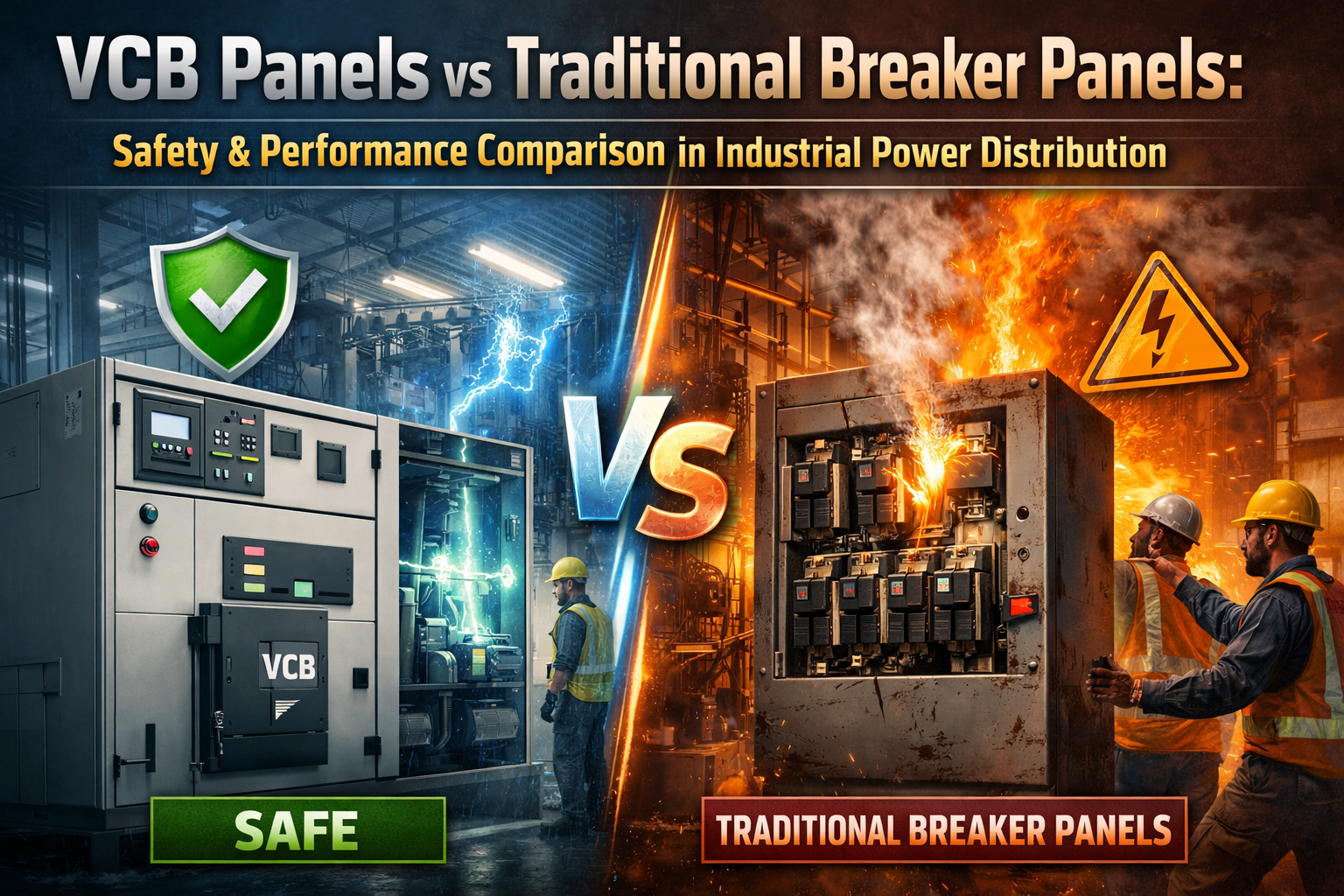

VCB Panels vs Traditional Breaker Panels: Safety & Performance Comparison in Industrial Power Distribution

Industrial power distribution systems operate under demanding electrical conditions. Manufacturing plants, processing industries, utilities, and heavy industrial facilities require switchgear solutions that can handle high fault levels, continuous operation, and strict safety standards. As electrical infrastructure evolves, many facilities are transitioning from traditional breaker panels to modern vacuum circuit breaker solutions.

When evaluating VCB panels vs conventional breakers, industrial engineers often focus on safety, reliability, and operational performance. Vacuum circuit breaker (VCB) panels are increasingly used in industrial power distribution networks, medium-voltage switchgear systems, and critical infrastructure facilities because they offer enhanced protection and faster fault interruption compared to older breaker technologies.

Understanding the differences between VCB panels vs conventional breakers helps plant operators and electrical engineers select the right switchgear for modern industrial environments.

How Industrial Switchgear Has Evolved

Traditional breaker panels were widely used in older industrial power distribution systems, particularly where electrical networks were smaller and fault levels were lower. These breaker panels relied on oil-based or air-based interruption mechanisms to clear electrical faults.

Modern industrial facilities, however, operate with larger transformers, heavy machinery, automation systems, and higher short-circuit levels. These changes have driven the adoption of vacuum circuit breaker panels in medium-voltage switchgear systems.

When comparing VCB panels vs conventional breakers, the main difference lies in how faults are interrupted. VCB panels use vacuum interrupters to extinguish arcs quickly and efficiently, which improves both safety and performance in industrial electrical networks.

Safety Considerations in Industrial Power Distribution

Safety is one of the primary reasons industries upgrade from traditional breaker panels to vacuum circuit breaker panels. Electrical faults in industrial power distribution systems can generate high arc energy, which poses serious risks to equipment and personnel.

VCB panels improve safety in several ways because the vacuum interrupter extinguishes arcs faster and contains the arc within a sealed environment. In comparison, conventional breaker panels may allow longer arc duration, increasing thermal stress on equipment.

When examining VCB panels vs conventional breakers, industrial engineers often highlight the following safety advantages of VCB technology:

  • Faster arc extinction in medium-voltage circuits
  • Reduced risk of arc flash in industrial switchgear systems
  • Improved operational safety for maintenance personnel
  • Better containment of fault energy inside switchgear panels

These features make VCB panels a preferred choice in modern industrial power distribution infrastructure.

Performance Differences in Industrial Electrical Systems

Performance is another key factor when comparing VCB panels vs conventional breakers. Industrial facilities require switchgear that can operate reliably under heavy electrical loads and frequent switching operations.

Traditional breaker panels may struggle in environments with frequent fault clearing or high switching cycles. VCB panels, on the other hand, are designed to handle repeated operations without significant wear.

In industrial medium-voltage distribution systems, VCB panels provide advantages such as improved switching reliability and reduced maintenance requirements. Because the arc is extinguished in vacuum, there is minimal contact erosion, which extends the service life of the breaker.

This improved durability makes VCB panels particularly valuable in industries with high operational demand.

Maintenance and Operational Efficiency

Maintenance is a major operational consideration in industrial facilities. Electrical switchgear that requires frequent servicing increases maintenance costs and production downtime.

In the comparison of VCB panels vs conventional breakers, vacuum circuit breaker panels typically require less maintenance because the interruption mechanism does not rely on oil or air insulation systems. Traditional breaker panels may require periodic oil replacement, contact maintenance, or cleaning to maintain reliable operation.

Industrial facilities, therefore, often favor VCB panels for their lower maintenance burden and longer operational lifespan.

Applications Across Industrial Power Distribution

Both types of breaker panels are used in industrial environments, but their applications vary depending on power system requirements.

Typical industrial environments where VCB panels are increasingly used include:

  • Medium-voltage distribution in manufacturing plants
  • Industrial substations and power distribution networks
  • Process industries such as steel, cement, and petrochemicals
  • Large motor control and heavy equipment power systems

These environments demand reliable protection systems capable of handling high electrical stress, which is why VCB panels are widely adopted.

Choosing Between VCB Panels and Conventional Breakers

Selecting between VCB panels vs conventional breakers depends on factors such as system voltage, fault levels, and long-term operational requirements. Older facilities with lower electrical demand may still operate effectively with traditional breaker panels, while modern industrial plants typically require the advanced protection capabilities of VCB switchgear.

As industrial power distribution systems become more complex, the need for faster fault clearing, higher safety standards, and improved reliability continues to increase.

Supporting Modern Industrial Power Infrastructure

Synchro Electricals develops vacuum circuit breaker panels designed for modern industrial power distribution environments. Their solutions support reliable fault interruption, improved operational safety, and long-term performance across manufacturing plants, processing industries, and infrastructure facilities.

Conclusion

The comparison of VCB panels vs conventional breakers highlights how industrial switchgear technology has evolved to meet the demands of modern power distribution systems. While traditional breaker panels served earlier industrial networks effectively, vacuum circuit breaker panels now offer improved safety, reliability, and operational efficiency.

For industries operating under heavy electrical loads and strict safety requirements, VCB panels provide a robust solution for protecting equipment and maintaining stable industrial power distribution.

FAQs

1. What is the main difference between VCB panels vs conventional breakers?

VCB panels use vacuum interrupters to extinguish arcs quickly, while conventional breakers typically rely on air or oil interruption methods.

2. Are VCB panels safer than traditional breaker panels?

Yes. Vacuum arc interruption reduces arc flash risk and improves safety in industrial switchgear systems.

3. Do VCB panels require less maintenance than conventional breakers?

Generally yes, because vacuum interrupters experience less contact wear and do not require oil handling.

4. Where are VCB panels commonly used in industry?

They are widely used in medium-voltage switchgear systems, industrial substations, and heavy manufacturing facilities.

5. Can existing plants upgrade from conventional breakers to VCB panels?

Yes. Many industrial facilities replace older breaker panels with VCB panels to improve reliability and safety.

PCC Panels for Textile Dyeing Units: Handling Heavy Load Fluctuations

Textile dyeing units are among the most power-sensitive environments in the textile and apparel industry. Dyeing machines, jet dyeing systems, drying units, pumps, compressors, and chemical processing equipment create continuous and fluctuating electrical loads. Managing this electrical demand requires a stable power distribution system, and that is where PCC Panels become essential.

In modern textile dyeing plants, PCC Panels for Textile Industry serve as the main electrical distribution backbone, ensuring stable power delivery, controlled load distribution, and safe operation across dyeing machines and textile processing equipment. Without properly designed textile dyeing units often face voltage instability, equipment shutdowns, and production delays.

Power Challenges Inside Textile Dyeing Units

Textile dyeing operations involve complex electrical loads that fluctuate throughout the production cycle. Dyeing machines, textile processing motors, water pumps, chemical dosing systems, and drying equipment frequently start and stop depending on production stages.

These load variations place significant stress on the plant’s electrical infrastructure. Textile factories require PCC Panels for the textile industry that can manage heavy load fluctuations while maintaining stable voltage and power distribution. When dyeing machines operate simultaneously, power demand can increase rapidly, making it reliable for maintaining consistent plant operations.

In textile processing plants, improper power distribution often leads to machine faults, uneven dyeing processes, and unexpected production interruptions.

Managing High Load Variations in Textile Dyeing Plants

Dyeing plants rarely operate under constant load conditions. During heating cycles, dyeing machines draw large amounts of power, while auxiliary systems such as circulation pumps and dryers create additional demand.

PCC Panels are designed to manage these heavy and variable loads by distributing power across different sections of the textile plant. By balancing electrical loads and preventing overload conditions, panels help textile dyeing units operate efficiently even during peak production hours.

Reliable power distribution allows dyeing machines, textile dryers, and processing equipment to run smoothly without electrical disturbances that could affect product quality.

Supporting Continuous Textile Production

Textile manufacturing facilities typically operate for long production shifts, often running machines continuously to meet production targets. Power interruptions during dyeing processes can lead to material waste, inconsistent dye quality, and significant production losses.

This is why PCC Panels for the Textile Industry are designed to support continuous plant operation. By maintaining controlled power flow and preventing electrical overloads, PCC Panels ensure an uninterrupted power supply to textile dyeing machines, processing equipment, and plant utilities.

Stable electrical infrastructure allows textile manufacturers to maintain production consistency and avoid costly downtime.

Coordinating Multiple Systems in Textile Processing Plants

Textile dyeing plants include multiple electrical systems operating together. Dyeing machines, air compressors, water treatment systems, effluent treatment plants, ventilation systems, and heating equipment all rely on coordinated power distribution.

They act as the central control point that manages these systems. By distributing power safely across the textile facility, PCC Panels for the Textile Industry help ensure that both production equipment and supporting infrastructure operate reliably.

Without properly engineered PCC panels, electrical imbalances can disrupt entire textile processing lines.

Power Stability for Quality Dyeing Operations

Consistent electrical supply is crucial for maintaining dyeing quality. Variations in voltage or power supply can affect heating elements, circulation pumps, and automated control systems used in textile dyeing.

PCC Panels for the Textile Industry help maintain power stability by regulating electrical distribution and protecting textile machines from overload or fault conditions. This stability ensures that dyeing processes remain consistent, helping textile manufacturers achieve uniform color quality across production batches.

Expanding Textile Manufacturing Capacity

Many textile manufacturers expand their dyeing capacity by adding new machines or increasing production lines. Electrical infrastructure must support this growth without requiring major redesign.

PCC Panels are typically designed with scalability in mind, allowing textile plants to add new dyeing machines, dryers, and auxiliary equipment as production demand increases. This flexibility makes PCC panels a long-term solution for growing textile facilities.

Reliable Power Infrastructure for Textile Plants

Synchro Electricals develops PCC Panels for the Textile Industry designed specifically for textile manufacturing environments, including dyeing plants, processing units, and textile production facilities. Their solutions help textile manufacturers manage high electrical loads while ensuring safe and efficient plant operations.

Conclusion

Textile dyeing units require reliable electrical systems capable of handling heavy and fluctuating power loads. PCC Panels for the Textile Industry provide the structured power distribution necessary to support dyeing machines, textile processing equipment, and plant utilities.

By stabilizing electrical supply, managing load variations, and supporting continuous production, PCC Panels for Textile Industry play a vital role in ensuring efficient and reliable operations across textile dyeing plants.

FAQs

1. Why are PCC Panels for Textile Industry important in textile dyeing units?

They manage high electrical loads from dyeing machines, pumps, dryers, and processing equipment, ensuring stable power distribution.

2. How do PCC Panels for the Textile Industry handle load fluctuations?

They distribute electrical loads across multiple feeders, preventing overload conditions during peak production.

3. Can PCC Panels for the Textile Industry reduce downtime in textile plants?

Yes. Reliable power distribution helps prevent machine shutdowns caused by electrical faults.

4. Are PCC Panels for the Textile Industry suitable for large textile factories?

Yes. They are designed to support heavy industrial loads and large-scale textile manufacturing operations.

5. Can PCC panels support expansion in textile dyeing plants?

Yes. PCC Panels for the Textile Industry are typically designed to allow additional machines and production lines to be integrated easily.

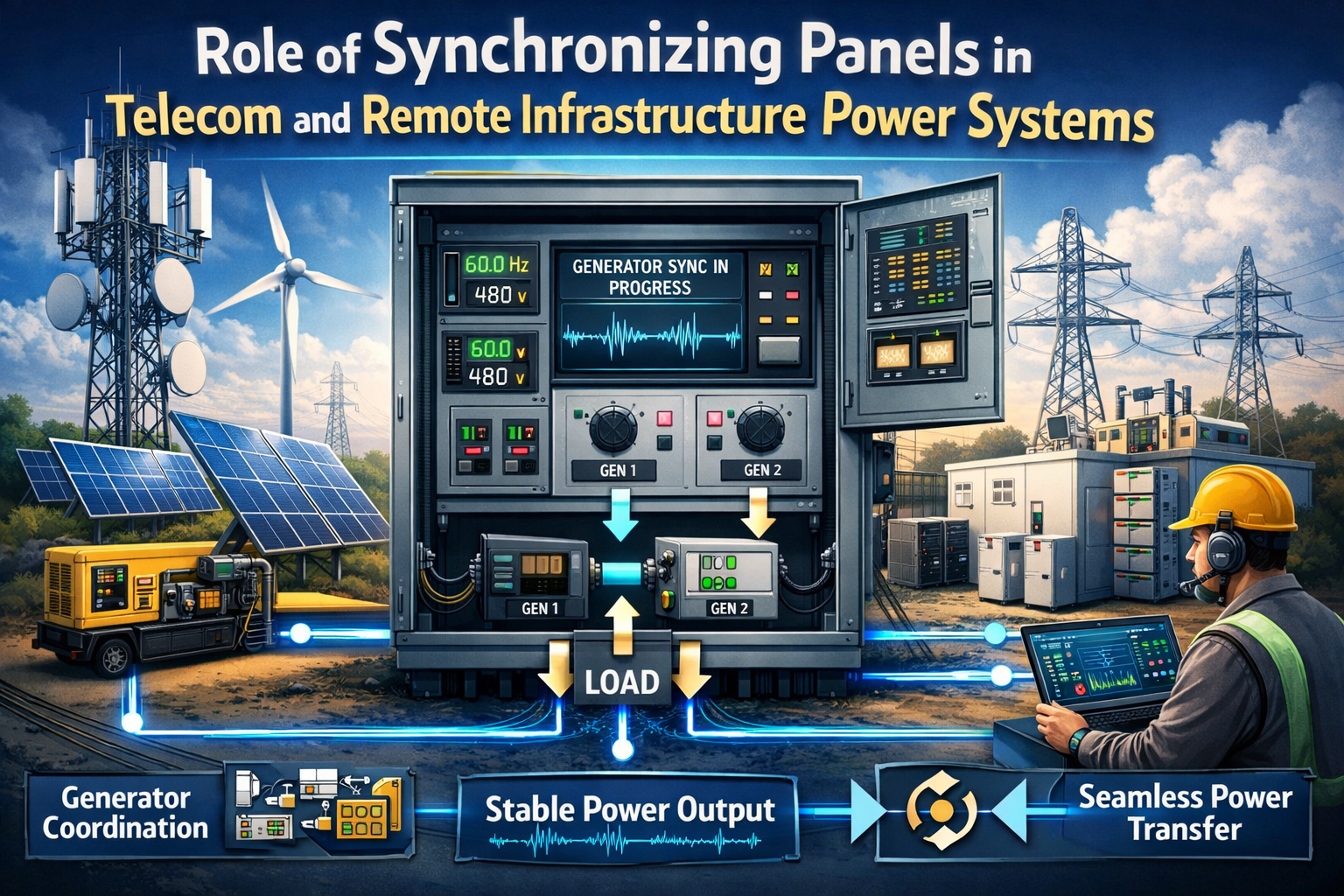
Role of Synchronizing Panels in Telecom and Remote Infrastructure Power Systems

Telecom networks operate in environments where uninterrupted power is not just desirable—it is mandatory. Telecom towers, remote telecom stations, and telecom data transmission hubs depend on reliable electrical infrastructure to maintain network connectivity 24/7. From rural telecom towers and mobile base stations to remote communication sites and fiber network hubs, power reliability directly determines service availability.

In these critical telecom environments, Synchronizing Panels for Telecom play a vital role in managing multiple power sources such as utility supply, diesel generators, and backup energy systems. Telecom power systems often operate in remote locations where grid supply may be unstable or unavailable. Synchronizing panels ensures that telecom infrastructure power systems can switch or operate between multiple sources without disruption.

Telecom Infrastructure Depends on Multi-Source Power Systems

Telecom networks rarely rely on a single power source. Most telecom towers and remote telecom infrastructure sites operate with a combination of grid power, diesel generator backup, and sometimes renewable energy systems such as solar hybrid telecom power solutions.

Managing these multiple sources requires careful coordination. Synchronizing Panels for Telecom enables telecom power systems to operate multiple generators in parallel, coordinate generator start-up, and maintain stable power for telecom equipment. Without proper synchronization, switching between power sources can cause voltage disturbances that may affect sensitive telecom electronics and communication hardware.

For telecom network operators, reliable synchronization is essential for ensuring uninterrupted connectivity.

Power Challenges in Remote Telecom Infrastructure

Remote telecom towers face unique electrical challenges. Many telecom sites are located in rural or hard-to-access areas where grid power reliability is limited. Frequent voltage fluctuations, unexpected outages, and inconsistent grid supply make backup power systems a necessity.

In these conditions, Synchronizing Panels for Telecom help telecom operators maintain stable operations by coordinating generator systems and managing load sharing between power sources. Telecom base stations often run critical equipment such as transmission radios, network routers, and cooling systems that cannot tolerate sudden power interruptions.

By enabling seamless transitions between generators and grid supply, synchronizing panels helps telecom infrastructure maintain operational continuity even during unstable power conditions.

How Synchronizing Panels Support Telecom Power Reliability

Telecom power systems must support continuous operation without manual intervention. When grid power fails, backup generators must start automatically and synchronize before taking over the telecom load.

Synchronizing Panels for Telecom manage this process by ensuring voltage, frequency, and phase alignment before connecting generators to the telecom power bus. This prevents electrical disturbances and protects sensitive telecom equipment.

In telecom tower infrastructure, synchronizing panels also enable multiple generators to operate in parallel. This allows telecom operators to distribute load efficiently across generator units, reducing fuel consumption and improving generator lifespan.

Reliable synchronization helps telecom operators maintain stable communication networks even in challenging operating environments.

Supporting Continuous Operation of Telecom Networks

Telecom infrastructure operates continuously, often without onsite operators. Automated power management, therefore, becomes essential. Synchronizing panels help telecom facilities run unattended by managing generator operation automatically.

With Synchronizing Panels for Telecom, telecom operators can maintain power continuity across:

  • Remote telecom towers
  • Cellular base stations
  • Telecom switching facilities
  • Fiber network hubs
  • Rural communication sites

These systems ensure telecom equipment receives stable power even when the grid supply is unavailable.

Ensuring Efficient Power Management in Telecom Sites

Energy efficiency is also a major concern for telecom operators. Running multiple generators inefficiently increases operational costs and maintenance requirements.

Synchronizing Panels for telecom improves efficiency by balancing loads across generators and preventing unnecessary generator operation. By optimizing generator usage, telecom infrastructure operators can reduce fuel consumption and extend equipment life.

Efficient power synchronization also supports hybrid telecom energy systems that combine solar power, battery storage, and diesel generators.

Scalability for Expanding Telecom Networks

Telecom networks continue to expand as demand for mobile connectivity, broadband services, and rural communication infrastructure increases. Power systems must be capable of supporting additional equipment and expanded network loads.

Synchronizing Panels for Telecom allows telecom operators to scale power infrastructure by integrating additional generators or energy sources without disrupting existing operations. This scalability is especially valuable for telecom providers expanding coverage in rural and remote regions.

Power Infrastructure Solutions for Telecom Environments

Synchro Electricals develops Synchronizing Panels for Telecom designed specifically for remote telecom infrastructure, telecom towers, and communication network facilities. Their synchronizing solutions support reliable power coordination, stable generator operation, and uninterrupted telecom network performance.

Conclusion

Telecom networks depend on reliable power infrastructure to maintain continuous communication services. In remote telecom sites and distributed telecom networks, managing multiple power sources effectively is essential.

Synchronizing Panels for telecom ensures seamless coordination between grid supply, generators, and backup systems, enabling telecom operators to maintain uninterrupted service even in challenging power environments. As telecom infrastructure continues to expand, synchronizing panels remains a key component of reliable telecom power systems.

FAQs

1. Why are Synchronizing Panels for Telecom important in telecom towers?

They coordinate multiple power sources, such as generators and grid supply, to ensure continuous power for telecom equipment.

2. How do Synchronizing Panels for Telecom improve telecom network reliability?

They allow seamless switching and parallel operation of generators, preventing power interruptions in telecom infrastructure.

3. Can synchronizing panels support remote telecom sites without operators?

Yes. Synchronizing Panels for Telecom enable automated power management in unattended telecom stations.

4. Do telecom power systems require multiple generators?

Many telecom towers and communication sites use multiple generators for redundancy, which are managed through synchronizing panels.

5. Can Synchronizing Panels for Telecom support hybrid energy systems?

Yes. They can coordinate generators with renewable energy sources such as solar systems used in telecom infrastructure.

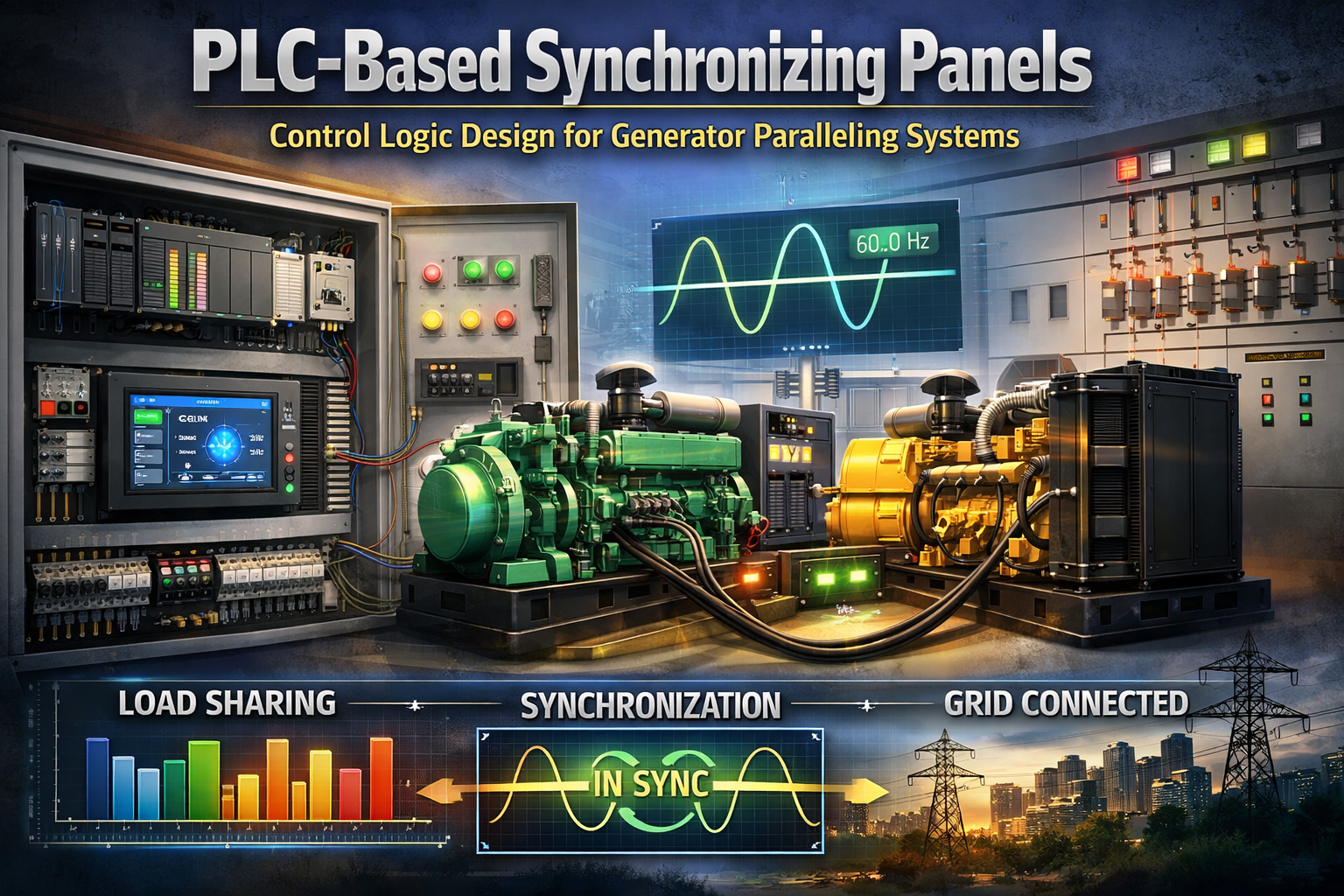
PLC-Based Synchronizing Panels: Control Logic Design for Generator Paralleling Systems

In industrial power systems, generator paralleling is no longer a niche requirement limited to large power plants. Manufacturing facilities, process industries, data centers, and critical infrastructure increasingly rely on multiple generators operating in parallel with each other and with the utility grid. In these environments, the reliability of synchronization is defined not by hardware alone, but by the intelligence of the control system behind it.

This is where a PLC – Based Synchronizing Panel becomes central. Unlike conventional relay-based systems, PLC-driven synchronizing panels offer deterministic logic execution, advanced sequencing capability, and full adaptability to complex operating scenarios. For engineers, the real value lies in how the control logic is designed, validated, and coordinated with generator dynamics.

Why PLC-Based Synchronizing Panels Are Preferred in Industrial Power Systems

Traditional synchronizing relays are effective for basic voltage, frequency, and phase matching, but they are inherently limited in flexibility. Industrial power systems often require conditional logic, multi-mode operation, and interaction with auxiliary systems such as fuel management, load shedding, and process interlocks.

A PLC Based Synchronizing Panel allows synchronization to be treated as a control problem rather than a discrete event. The PLC continuously evaluates system states, generator availability, breaker status, and grid conditions before executing synchronization decisions. This capability is essential when paralleling multiple generators with varying ratings, response characteristics, and operating priorities.

Control Architecture of a PLC-Based Synchronizing Panel

At the core of a PLC-based system is a real-time control loop that monitors electrical parameters and system status. Voltage, frequency, and phase angle are acquired through transducers or digital meters, while breaker status, generator readiness, and fault signals are processed as discrete inputs.

The PLC executes synchronization logic cyclically, ensuring that decisions are based on current system conditions rather than static thresholds. This architecture enables coordinated control across generators, grid incomers, and bus couplers within a single control platform.

Crucially, the PLC does not replace protective relays; instead, it coordinates with them. Protection remains autonomous and fast, while the PLC manages sequencing, permissive logic, and operational control.

Synchronization Logic Design Using PLC

PLC-Based Synchronizing Panel – Pre-Synchronization Logic

Before synchronization, the PLC verifies that the generator is electrically and mechanically ready. This includes confirmation of rated voltage buildup, stable frequency, correct phase rotation, and acceptable governor and AVR response.

Speed and voltage ramping are controlled gradually to avoid overshoot. Unlike relay-based systems that wait passively for alignment, PLC logic actively drives the generator toward synchronism using feedback control. This reduces synchronization time while minimizing transient stress.

PLC-Based Synchronizing Panel – Breaker Closing and Validation Logic

Once synchronization criteria are met within defined tolerances, the PLC issues a breaker close command. However, advanced PLC logic also validates post-closure conditions. It checks for successful breaker operation, confirms that slip frequency collapses as expected, and ensures that no abnormal current or power flow is detected.

If post-synchronization conditions deviate from expected behavior, the PLC can initiate corrective action or controlled disconnection, preventing unstable operation from propagating into the system.

Load Sharing and Post-Synchronization Control

Synchronization is only the first step. In generator paralleling systems, stability depends heavily on how load is shared after connection. PLC-based panels integrate load-sharing algorithms that coordinate governor and AVR references to distribute active and reactive power proportionally.

The PLC continuously monitors real power, reactive power, and frequency deviation to damp oscillations and prevent hunting between generators. This is particularly important in industrial systems with fluctuating loads or large motor starts, where poor load sharing can lead to instability or nuisance tripping.

Handling Multiple Operating Modes

One of the strongest advantages of a PLC Based Synchronizing Panel is its ability to manage multiple operating modes within the same logic framework. These may include island mode operation, grid-parallel operation, generator-only mode, or black-start scenarios.

Each mode requires different synchronization permissives, sequencing rules, and protection coordination. PLC logic enables these modes to coexist without hardware modification, allowing operators to transition between configurations safely and predictably.

Failure Handling and Logic Robustness

In real-world systems, synchronization does not always succeed on the first attempt. Voltage instability, governor lag, or grid disturbances can interrupt the process. PLC-based logic handles these scenarios deterministically by aborting synchronization sequences, resetting conditions, and retrying only when stability is restored.

This approach avoids repeated mechanical stress and uncontrolled breaker operations, which are common failure modes in poorly designed systems.

Engineering Approach of Synchro Electricals

Synchro Electricals designs PLC-based synchronizing panels with a control-engineering-first philosophy. Synchronization logic is developed as a structured sequence with clearly defined states, transitions, and failure responses. Generator dynamics, grid behavior, and operational requirements are modeled into the PLC logic rather than handled as afterthoughts.

This approach ensures that the PLC-based synchronizing panel performs reliably under complex industrial conditions, including multi-generator operation, weak grids, and variable load profiles.

Conclusion

In modern industrial power systems, synchronization is no longer a single moment of alignment but a continuous control function. A PLC-based synchronizing panel provides the intelligence, flexibility, and determinism required to manage generator paralleling safely and efficiently.

By focusing on robust control logic design—covering pre-synchronization, breaker control, load sharing, and failure handling—engineers can build systems that remain stable under real operating stress. PLC-based synchronization is not simply an upgrade in technology; it is a fundamental shift toward system-level power control.

FAQs

1. What differentiates a PLC Based Synchronizing Panel from relay-based systems?

A PLC Based Synchronizing Panel uses deterministic control logic to manage synchronization, sequencing, and load sharing, whereas relay-based systems are limited to threshold-based matching of voltage, frequency, and phase.

2. Can a PLC Based Synchronizing Panel handle multiple generators with different ratings?

Yes. PLC logic can be customized to account for generator capacity, response characteristics, and priority, enabling stable paralleling of unequal machines.

3. How does PLC logic improve synchronization reliability?

PLC logic actively controls speed and voltage ramping, validates post-breaker conditions, and aborts unsafe sequences, reducing transient stress and synchronization failures.

4. Is PLC-based synchronization dependent on protection relays?

Protection relays operate independently for fault clearing. The PLC coordinates operational logic but does not replace protection functions.

5. Can PLC Based Synchronizing Panels support island and grid-parallel operation?

Yes. Multiple operating modes can be implemented within the same PLC program, allowing seamless transitions between islanded and grid-connected states.

Welcome to Synchro Electricals

We provide trusted, high-performance electrical solutions tailored for every industry.

Apply For Job