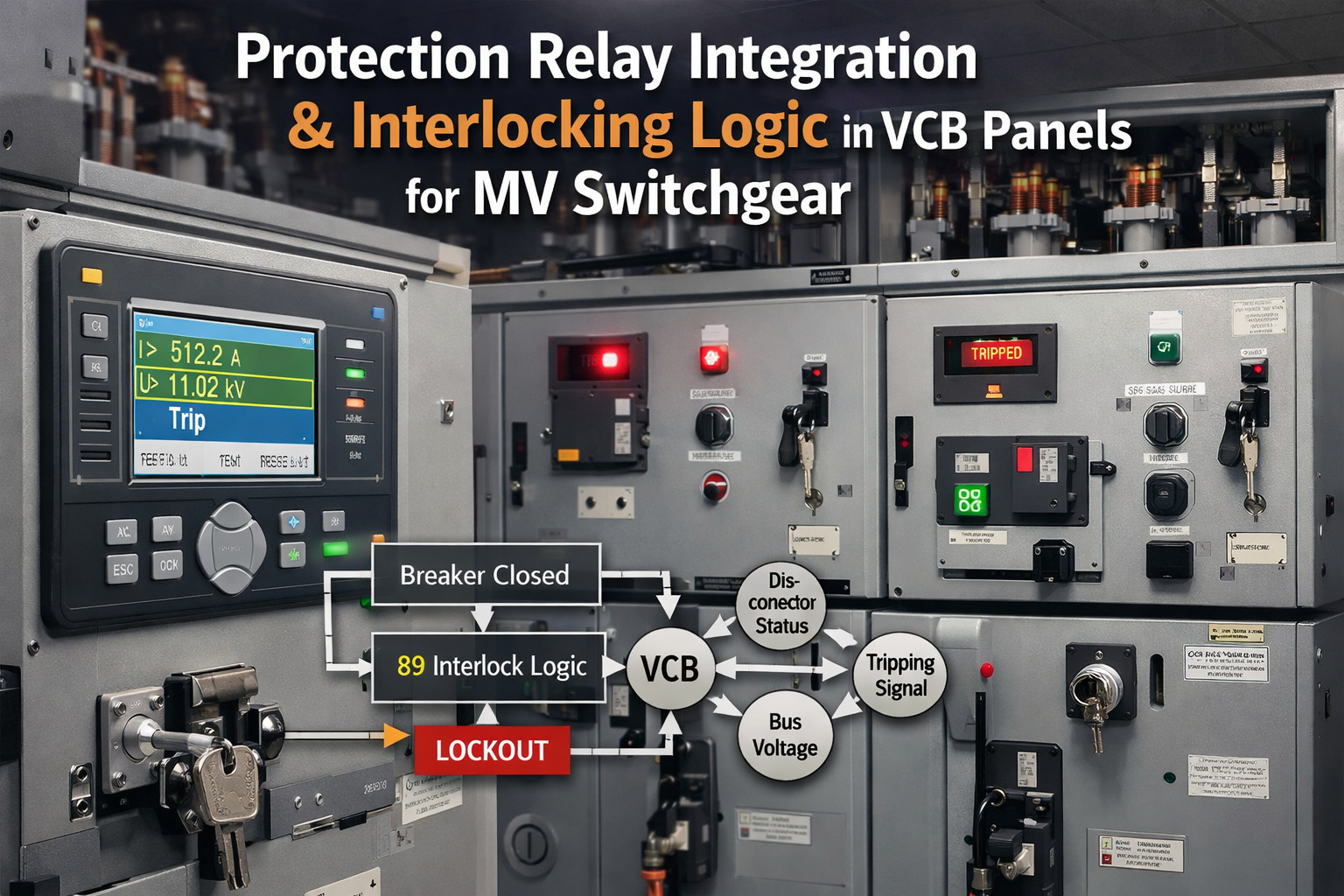
Protection Relay Integration and Interlocking Logic in VCB Panels for MV Switchgear

In utility and substation environments, medium-voltage (MV) switchgear is expected to operate under high fault levels, dynamic grid conditions, and strict reliability requirements. At the center of this infrastructure, VCB panels serve as both the switching and protection interface between the grid and downstream networks. However, the true effectiveness of a VCB panel is determined not by the breaker alone, but by the robustness of its VCB Panel Protection Relay Scheme.

Modern substations rely on numerical protection relays, intelligent control logic, and fail-safe interlocking philosophies to ensure that faults are detected, isolated, and cleared without compromising system stability or personnel safety. Protection relay integration and interlocking logic, therefore form the backbone of MV switchgear design.

Role of Protection Relay Integration in VCB Panels

Protection relay integration in VCB panels involves coordinating multiple protection functions—overcurrent, earth fault, feeder protection, breaker failure protection, and inter-tripping—within a unified control and protection architecture. In utility-grade MV switchgear, this integration must align with overall substation protection philosophy and grid code requirements.

Numerical protection relays for VCB panels continuously monitor current, voltage, and status inputs, converting raw electrical quantities into protection decisions. These relays must interface seamlessly with trip circuits, breaker mechanisms, and control relays, ensuring deterministic operation during fault conditions. Poor relay integration can result in delayed tripping, unwanted breaker operation, or complete failure to clear faults.

VCB Panel Protection Relay Scheme Architecture

A typical VCB panel protection relay scheme is structured around functional separation. Protection relays handle fault detection and tripping logic, while control circuits manage breaker operation, indication, and SCADA interfacing. This separation ensures that protection functions remain operational even if control or communication systems fail.

In 11kV and 33kV applications, feeder protection relay schemes are commonly implemented using numerical relays with configurable settings and communication capability. These relays coordinate with upstream and downstream devices to maintain selectivity, while also supporting redundancy where required by utility standards.

Integration increasingly includes IEC 61850 communication, allowing protection relays to exchange signals through GOOSE messaging rather than hardwired interconnections. While this improves speed and flexibility, it also places higher demands on interlocking logic design.

Interlocking Logic Design in VCB Panels

Interlocking logic is the mechanism that prevents unsafe operations within MV switchgear. In VCB panels, interlocking exists at multiple levels—mechanical, electrical, and logical.

Electrical and logical interlocking ensure that breaker closing is permitted only when predefined conditions are satisfied. These conditions may include correct isolator position, absence of earth switch engagement, healthy trip circuit supervision, and valid protection relay status. Logical interlocking implemented within numerical relays or control relays adds an additional layer of safety by enforcing operational sequences.

In substation environments, interlocking logic design must consider normal operation, maintenance conditions, and abnormal scenarios such as breaker failure or protection malfunctions. A poorly defined interlock can be as dangerous as no interlock at all.

Protection Relay Coordination and Interlocking Interaction

Protection relay coordination and interlocking logic are closely linked. For example, breaker failure protection relies on both relay logic and interlocking to initiate upstream tripping when a breaker fails to clear a fault. Similarly, inter-trip and blocking schemes require precise coordination between relays across multiple VCB panels.

In MV switchgear protection design, the interlocking philosophy must support fast fault clearance without allowing incorrect or premature breaker operation. This is particularly important in busbar and feeder interlocking logic, where incorrect coordination can lead to bus outages or equipment damage.

Fail-Safe Philosophy in Utility-Grade MV Switchgear

Utility and substation applications demand a fail-safe approach to protection and control. The VCB panel protection and control philosophy must ensure that any failure—loss of auxiliary supply, relay malfunction, communication failure—results in a safe system state.

This is achieved through redundancy in protection relay schemes, supervised trip circuits, and permissive logic that defaults to blocking unsafe operations. Control relay vs protection relay coordination is critical here; protection must always take precedence over control commands.

SCADA and Communication Integration

Modern substations require seamless SCADA integration with protection relays for monitoring, event analysis, and remote operation. However, SCADA must remain supervisory in nature. Protection decisions within the VCB panel protection relay scheme must remain local and autonomous to avoid dependency on external systems.

IEC 61850-based architectures enhance visibility and coordination but must be implemented with strict cybersecurity and reliability considerations, especially in grid-connected MV protection systems.

Engineering Perspective of Synchro Electricals

Synchro Electricals designs VCB panels with a protection-first philosophy. Relay integration, interlocking logic, and fail-safe design are treated as core engineering disciplines rather than wiring exercises. Each VCB panel protection relay scheme is developed in alignment with utility protection standards, substation operating practices, and real-world fault behavior.

Conclusion

In utilities and substations, MV switchgear reliability is defined by the quality of its protection and interlocking design. A well-engineered VCB Panel Protection Relay Scheme ensures that faults are cleared selectively, unsafe operations are prevented, and system stability is preserved under all operating conditions.

Protection relay integration and interlocking logic are not independent elements—they function as a unified system. When designed correctly, they transform VCB panels into intelligent, fail-safe components of modern power transmission infrastructure.

FAQs

1. What is a protection relay in VCB panels?

<p

2. Why is relay integration important in MV switchgear?

Relay integration ensures accurate fault detection, faster response time, and coordinated protection across the entire medium voltage system.

3. What is interlocking logic in VCB panels?

Interlocking logic is a safety mechanism that prevents incorrect operations, such as closing a breaker under unsafe conditions or opening during load transfer.

4. How does interlocking improve safety in switchgear systems?

It prevents human errors and ensures that operations follow a safe sequence, reducing the risk of equipment damage and electrical hazards.

5. What types of protection relays are used in MV switchgear?

Common relays include overcurrent relays, earth fault relays, differential relays, distance relays, and numerical relays.
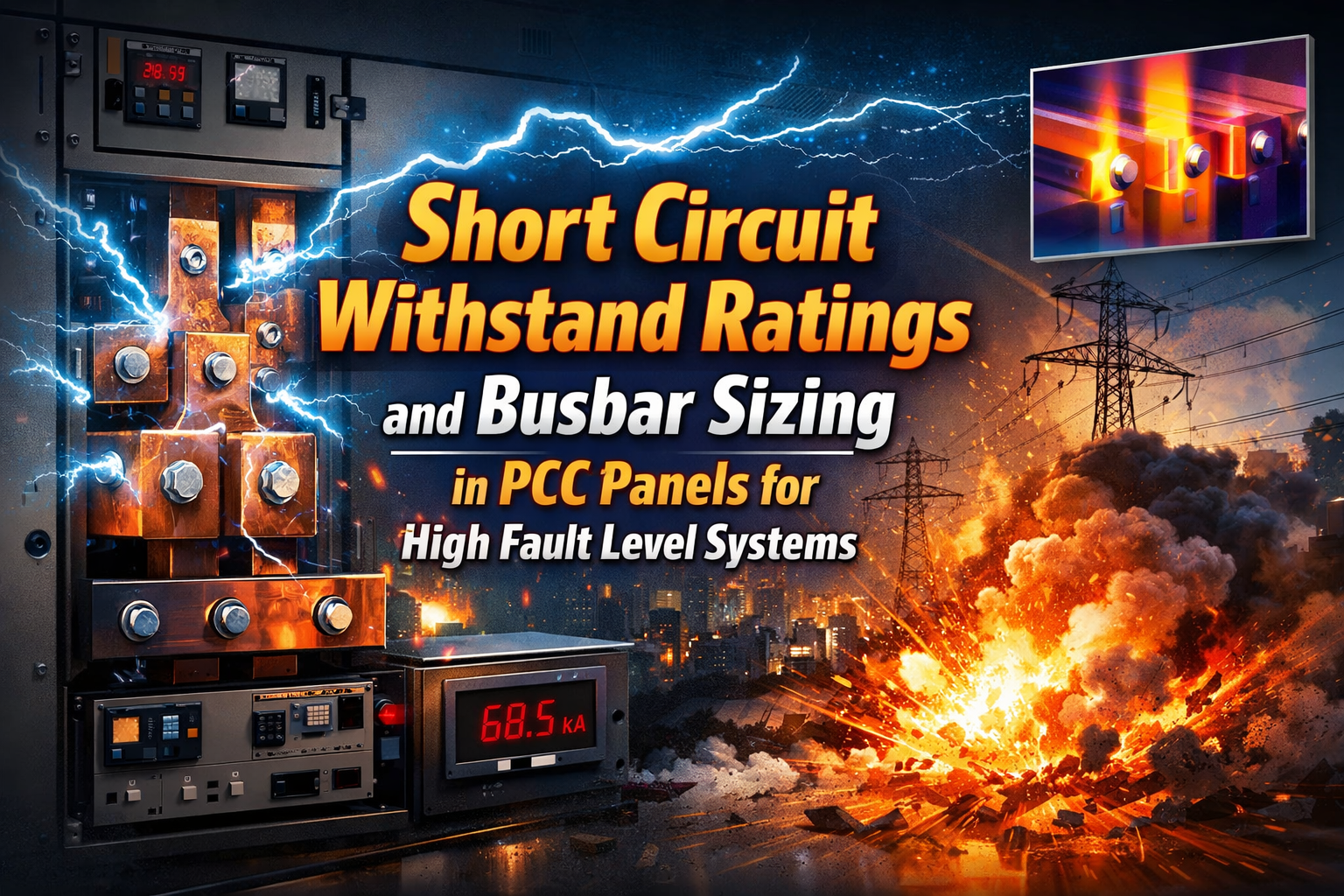
Short Circuit Withstand Ratings and Busbar Sizing in PCC Panels for High Fault Level Systems

In heavy industrial power systems, electrical faults are not hypothetical events—they are design realities that must be anticipated and engineered for. Large transformers, parallel feeders, high-capacity motors, and captive generation significantly increase prospective fault currents at the low-voltage level. In such environments, the Power Control Center (PCC) panel becomes the first line of defense against catastrophic electrical failure.

The adequacy of a PCC panel is therefore defined not just by its current rating, but by its PCC Panel Short Circuit Rating and the integrity of its busbar system under extreme fault conditions. Improper evaluation of short-circuit withstand capability or incorrect busbar sizing can lead to mechanical deformation, insulation failure, or complete panel destruction within milliseconds of a fault.

Understanding PCC Panel Short Circuit Rating in Heavy Industry

The PCC Panel Short Circuit Rating represents the panel’s ability to withstand thermal and electromechanical stresses caused by short-circuit currents for a specified duration, typically 1 second or 3 seconds. In heavy industry, fault levels at PCC incomers can easily exceed 50kA due to high transformer capacities and low system impedance.

Short-circuit rating is not limited to the breaker interrupting capacity alone. It applies to the entire current-carrying structure of the PCC panel, including busbars, supports, insulation systems, and interconnections. A breaker may successfully interrupt a fault, but if the busbar system cannot withstand the initial fault forces, severe damage occurs before protection even operates.

Electromechanical Forces During Short-Circuit Events

When a short circuit occurs, extremely high currents flow through the PCC panel busbars almost instantaneously. These currents generate strong electromagnetic forces proportional to the square of the fault current. In high fault level systems, these forces attempt to repel or attract busbars violently, stressing supports and joints.

Simultaneously, thermal energy is released due to I²R losses, rapidly increasing conductor temperature. If busbar sizing and spacing are inadequate, thermal expansion and mechanical stress combine to cause permanent deformation or insulation breakdown.
This dual stress—mechanical and thermal—is the primary reason why PCC Panel Short Circuit Rating must be evaluated holistically rather than as a nominal figure.

Busbar Sizing Philosophy for High Fault Level PCC Panels

Busbar sizing in PCC panels for heavy industry extends beyond continuous current capacity. While current rating determines steady-state operation, short-circuit performance dictates survival under fault conditions.

Correct busbar sizing considers cross-sectional area, material conductivity, phase spacing, and support arrangement. Copper busbars are commonly preferred in high fault level applications due to superior mechanical strength and thermal performance. However, material choice alone is insufficient without proper spacing and rigid support design.

Inadequate busbar sizing may pass routine current tests but fail catastrophically during a real short-circuit event, rendering the PCC panel unsafe and unusable.

PCC Panel Short Circuit Rating and Standards Compliance

Short-circuit withstand ratings are validated through design calculations and type testing in accordance with international standards such as IEC 61439. These standards specify temperature rise limits, mechanical integrity requirements, and fault duration criteria.

However, in heavy industry, reliance on minimum standard compliance is often insufficient. Fault levels may be close to or exceed standard test values, particularly in plants with parallel transformers or on-site generation. In such cases, conservative design margins and verified busbar configurations become essential.

Engineering judgment plays a critical role in translating standard requirements into real-world reliability.

Coordination Between Breakers and Busbar Withstand Capability

A common misconception is that a high-interrupting-capacity breaker alone ensures short-circuit safety. In reality, the breaker clearing time directly affects the thermal stress imposed on the busbar system. Even a fast-acting breaker allows peak fault current to flow during the first half-cycle.

Therefore, the busbar system must be capable of withstanding the peak short-circuit current as well as the thermal energy until fault clearance. This coordination between breaker characteristics and PCC Panel Short Circuit Rating is a critical aspect of protection and panel design in heavy industry.

Impact of High Fault Levels on Panel Longevity and Safety

Repeated exposure to near-fault conditions, even without full short circuits, accelerates mechanical fatigue and insulation aging in PCC panels. Poorly designed busbar systems may not fail immediately but degrade progressively, increasing the risk of arc faults and internal flashovers.

From a safety perspective, insufficient short-circuit withstand capability increases arc-flash energy levels, endangering personnel during fault events. Proper busbar sizing and robust short-circuit design reduce fault energy propagation and improve overall plant safety.

Engineering Approach of Synchro Electricals

Synchro Electricals designs PCC panels for heavy industry with short-circuit performance as a primary engineering criterion. Fault level analysis, busbar force calculations, and thermal withstand verification are integrated into the design process rather than treated as post-design checks.

Each PCC panel is engineered to meet the required PCC Panel Short Circuit Rating under actual site conditions, ensuring mechanical integrity, electrical safety, and long-term reliability in high fault level systems.

Conclusion

In heavy industrial power systems, short-circuit events define the true robustness of electrical infrastructure. A PCC panel that cannot withstand fault stresses compromises not only equipment but also plant safety and continuity.

Proper evaluation of PCC Panel Short Circuit Rating, combined with disciplined busbar sizing and structural design, ensures that PCC panels remain stable under extreme electrical stress. In high fault level environments, short-circuit withstand capability is not an optional enhancement—it is a fundamental design requirement.

FAQs

1. What does PCC Panel Short Circuit Rating actually represent?

It defines the ability of the PCC panel - including busbars, supports, and insulation—to withstand thermal and electromechanical stresses caused by a specified short-circuit current for a defined duration.

2. Is breaker interrupting capacity sufficient to ensure short-circuit safety?

No. While breakers interrupt fault current, the busbar system must withstand peak short-circuit forces before the breaker clears the fault.

3. How does busbar sizing affect short-circuit withstand capability?

Busbar cross-section, spacing, material, and support design directly influence mechanical strength and thermal performance during fault conditions.

4. Why are high fault levels common in heavy industrial plants?

Large transformers, parallel feeders, and captive generation significantly reduce system impedance, increasing prospective fault currents at the PCC level.

5. Can a PCC panel degrade over time due to repeated high-stress events?

Yes. Repeated exposure to near-fault conditions can weaken busbar supports and insulation, reducing long-term reliability if not properly designed.

DC Fault Protection and Isolation Strategies in DCDB Panels for Large Solar PV Plants

In large solar PV power plants, the DC side of the system operates under conditions that are fundamentally different from conventional AC networks. High DC voltages, continuous current flow, long cable runs, and distributed generation sources make fault behavior complex and potentially hazardous. Unlike AC systems, DC faults do not benefit from natural current zero-crossing, making fault interruption and isolation significantly more challenging.

Within this environment, the DC Distribution Board (DCDB) plays a critical role. Effective DC Fault Protection in DCDB panels determines whether a fault is contained locally or escalates into widespread power loss, equipment damage, or safety incidents. For utility-scale solar plants, DC fault protection is therefore a primary design discipline rather than an auxiliary feature.

Nature of DC Faults in Large Solar PV Plants

DC faults in solar PV systems typically arise from insulation degradation, cable damage, connector failures, or internal inverter faults. These faults may manifest as short circuits, ground faults, or series arc faults, each with distinct electrical characteristics.

In large plants, the presence of multiple parallel strings increases available fault current, while long DC cable runs raise the likelihood of insulation-related failures. Additionally, environmental exposure—UV radiation, temperature cycling, moisture, and dust—accelerates aging of DC components. These factors make DC fault detection and isolation more demanding than in compact rooftop installations.

Why DC Fault Protection in DCDB Panels Is Critical

The DCDB aggregates multiple string or array outputs before feeding inverters. As a result, it is exposed to the combined fault energy of the DC system. Without robust DC fault protection in DCDB panels, a single fault can propagate across healthy strings, leading to inverter shutdowns or irreversible damage to DC equipment.

Another critical factor is safety. DC arcs sustain longer than AC arcs and can generate extreme thermal energy. Inadequate isolation increases the risk of arc flash incidents during maintenance or fault conditions. For large solar PV plants, DCDB panels must therefore be designed to detect faults early and isolate only the affected section without disturbing the entire array.

DC Fault Protection in DCDB – Detection Philosophy

Effective DC Fault Protection in DCDB begins with accurate fault detection. Overcurrent detection alone is often insufficient because DC fault currents may be limited by string impedance and inverter characteristics.

Modern DCDB designs incorporate a combination of protection elements. DC-rated fuses or circuit breakers provide fast response to high-magnitude faults, while ground fault detection devices monitor leakage currents to earth. In advanced systems, insulation monitoring devices continuously assess the health of DC circuits, enabling early detection of insulation degradation before a hard fault develops.

This layered detection approach is essential for maintaining reliability in large-scale installations.

Isolation Strategies for DC Fault Management

Isolation is as important as detection. Once a fault is identified, the DCDB must isolate the affected circuit quickly and safely. DC isolators and disconnect switches within the DCDB provide manual and automatic means of isolation, allowing maintenance personnel to work safely without exposure to live conductors.

Selective isolation is a key design objective. In large solar PV plants, isolating an entire DC bus due to a single string fault results in unnecessary generation loss. Proper DCDB design ensures that only the faulty string or array is disconnected, preserving output from healthy sections.

Coordination between DCDB protection devices and inverter-side protection is critical to achieving this selectivity.

Challenges in Interrupting DC Fault Currents

Interrupting DC current is inherently more difficult than AC due to the absence of natural current zero. DC-rated protective devices must rely on magnetic blowout, arc chutes, or solid-state interruption techniques to extinguish arcs.

In high-voltage DC systems commonly used in large solar plants, incorrect device selection can lead to sustained arcing and contact erosion. This makes it essential that DCDB panels use protection devices specifically designed and rated for DC fault interruption at the system’s operating voltage and current levels.

Coordination with Inverter and Plant Protection Systems

DC fault protection in DCDB panels cannot be designed in isolation. Inverter protection algorithms, string-level monitoring, and plant-level SCADA systems all influence fault response.

A coordinated protection scheme ensures that DC faults are cleared at the appropriate level without conflicting actions. For example, a DCDB fuse should operate before an inverter trips on DC overcurrent, preventing unnecessary inverter shutdown. Similarly, ground fault detection thresholds must align with inverter insulation monitoring to avoid false alarms or missed faults.

Such coordination improves plant availability and reduces fault recovery time.

Engineering Approach of Synchro Electricals

Synchro Electricals designs DCDB panels with DC fault behavior as a primary engineering consideration. Fault current analysis, insulation coordination, and selective isolation logic are integrated into the DCDB design from the earliest stages.

By focusing on real operating conditions in large solar PV plants, Synchro Electricals ensures that DC Fault Protection in DCDB panels delivers reliable fault containment, enhanced safety, and long-term system stability.

Conclusion

In large solar PV plants, DC-side faults present unique risks that demand specialized protection strategies. Effective DC Fault Protection in DCDB panels ensures early fault detection, selective isolation, and safe interruption of DC fault currents—preventing minor issues from escalating into major plant outages or safety hazards.

As PV plant capacities continue to grow, DCDB fault protection must be treated as a core system design discipline. Robust DC fault protection and isolation strategies are essential for achieving reliable, safe, and sustainable solar power generation at scale.

FAQs

1. Why is DC fault protection more challenging than AC fault protection?

DC systems lack natural current zero-crossing, making arc extinction and fault interruption more difficult and increasing thermal stress during faults.

2. What types of faults are typically addressed by DC fault protection in DCDB panels?

DCDB panels manage short-circuit faults, ground faults, and insulation-related faults occurring within PV strings and array circuits.

3. Is overcurrent protection alone sufficient for DCDB fault protection?

No. Overcurrent protection must be supplemented with ground fault detection and insulation monitoring to detect low-level and developing faults.

4. How does selective isolation improve plant availability?

By isolating only the affected string or array, healthy sections remain operational, minimizing generation loss during fault conditions.

5. Why is coordination with inverter protection important?

Proper coordination prevents unnecessary inverter shutdowns and ensures faults are cleared at the correct level for faster system recovery.

PCC Panels for Plastic Manufacturing Units: Managing High Energy Loads with Ease

Plastic and polymer manufacturing units are among the most power-intensive industrial environments. From injection molding and extrusion to compounding, blow molding, and recycling, these processes rely on machines that draw heavy, continuous electrical loads. Any instability in power distribution directly impacts production quality, machine life, and operational efficiency.

In this context, PCC Panels for Plastic Industry play a central role. Power Control Center (PCC) panels are not just electrical distribution units; they are the backbone that manages high-energy loads, stabilizes power flow, and ensures uninterrupted operations in plastic manufacturing plants. Poorly designed PCC panels often result in frequent tripping, overheating, and unexpected downtime—issues that plastic manufacturers cannot afford.

Energy-Intensive Nature of Plastic Manufacturing

Plastic manufacturing equipment operates under demanding electrical conditions. Injection molding machines draw high peak loads during heating and clamping cycles. Extruders run continuously for long production shifts. Auxiliary systems such as chillers, compressors, dryers, and material handling units add further load complexity.

Because of this, PCC Panels for Plastic Industry must be designed to handle:

  • Continuous high current demand
  • Sudden load variations during machine cycles
  • Simultaneous operation of multiple heavy machines
  • Long operating hours without thermal stress

Generic power panels are rarely suitable for such environments. Plastic manufacturing requires PCC panels that are purpose-built for high-load, high-duty industrial applications.

How PCC Panels Stabilize Power in Plastic Manufacturing Units

In plastic plants, unstable power supply often leads to rejected batches, machine faults, and inconsistent product quality. PCC panels help stabilize the electrical system by managing how power is distributed across machines and process lines.

PCC Panels for Plastic Industry ensure balanced load distribution, preventing overloading of individual feeders. They also support controlled power delivery to sensitive equipment, reducing voltage fluctuations that affect heating elements and motor-driven systems. This stability directly improves process consistency and machine performance.

Managing Peak Loads and Continuous Operation

Plastic manufacturing rarely follows a fixed load pattern. Machines start and stop based on production schedules, mold changes, and material requirements. These frequent load variations place stress on the electrical distribution system.

Well-designed PCC Panels for Plastic Industry are engineered to manage both peak demand and continuous operation. They accommodate high starting currents, support parallel feeder configurations, and prevent nuisance tripping during load surges. This capability allows production teams to operate machines flexibly without worrying about electrical interruptions.

Reducing Downtime in Plastic Processing Plants

Downtime in plastic manufacturing is expensive. Restarting extrusion lines or molding machines often involves material waste, re-heating cycles, and production delays. Electrical failures at the PCC level can shut down entire sections of a plant.

By enabling structured power distribution and selective isolation, PCC Panels for Plastic Industry help contain electrical issues before they escalate. A fault in one machine feeder does not necessarily impact the entire plant, allowing other production lines to continue operating. This localized fault handling significantly improves plant uptime and operational reliability.

Supporting Auxiliary Systems in Plastic Manufacturing

Plastic plants rely heavily on auxiliary equipment—chillers for mold cooling, compressors for pneumatic systems, material dryers, and ventilation systems. These systems are critical for maintaining process quality and safety.

PCC panels act as the central coordination point for these auxiliary loads. PCC Panels for Plastic Industry ensure that both production machinery and support systems receive stable and protected power, maintaining overall plant efficiency. A failure in auxiliary systems can be just as disruptive as a machine shutdown, making reliable power distribution essential.

Scalability for Growing Plastic Manufacturing Units

Plastic and polymer plants often expand capacity by adding new machines, molds, or production lines. Electrical infrastructure must be able to support this growth without requiring a complete redesign.

PCC Panels for Plastic Industry are typically designed with future expansion in mind. Modular feeder arrangements, spare capacity, and structured layouts allow new equipment to be integrated smoothly. This scalability helps manufacturers grow operations while keeping electrical upgrades manageable and cost-effective.

Operational Safety and Compliance

High current levels and continuous operation increase electrical risks in plastic manufacturing environments. Overheating, insulation degradation, and arc faults pose safety concerns for both equipment and personnel.

By managing load distribution and fault isolation effectively, PCC Panels for Plastic Industry enhance operational safety. They support safer maintenance practices, controlled shutdowns, and compliance with industrial electrical standards. This is particularly important in plants operating around the clock with limited downtime windows.

Synchro Electricals designs PCC panels specifically for high-load industrial environments such as plastic and polymer manufacturing units. Their approach focuses on real production conditions—continuous operation, load variability, and expansion needs—ensuring PCC panels deliver reliable performance over the long term.

By aligning panel design with process demands, Synchro Electricals supports efficient energy management and stable operations in plastic manufacturing plants.

Conclusion

Plastic manufacturing units demand electrical systems that can handle high energy loads without compromising stability or safety. PCC Panels for Plastic Industry provide the control, reliability, and scalability required to support modern plastic processing operations.

By managing continuous loads, handling peak demand, and supporting both machines and auxiliary systems, PCC panels enable plastic manufacturers to operate efficiently and confidently. In an industry where power reliability directly affects productivity and quality, investing in the right PCC panels is a strategic decision, not just an electrical requirement.

FAQs

1. Why are PCC Panels for Plastic Industry essential in plastic manufacturing units?

Plastic manufacturing involves high, continuous, and fluctuating electrical loads. PCC Panels for Plastic Industry ensure stable power distribution, prevent overloads, and support uninterrupted production.

2. How do PCC panels handle high energy loads in plastic plants?

PCC panels are designed to manage continuous high current, peak load conditions, and simultaneous operation of multiple machines such as injection molding and extrusion equipment.

3. Can PCC Panels for Plastic Industry reduce production downtime?

Yes. By enabling selective isolation and structured power distribution, PCC panels limit the impact of electrical faults to specific sections instead of shutting down the entire plant.

4. Are PCC panels suitable for both machines and auxiliary systems in plastic plants?

Absolutely. PCC Panels for Plastic Industry support not only production machinery but also auxiliary systems like chillers, compressors, dryers, and ventilation units.

5. Do PCC panels support future expansion in plastic manufacturing units?

Yes. Well-designed PCC panels include spare capacity and modular feeder arrangements, allowing plastic plants to add new machines or lines without major electrical redesign.

Welcome to Synchro Electricals

We provide trusted, high-performance electrical solutions tailored for every industry.

Apply For Job