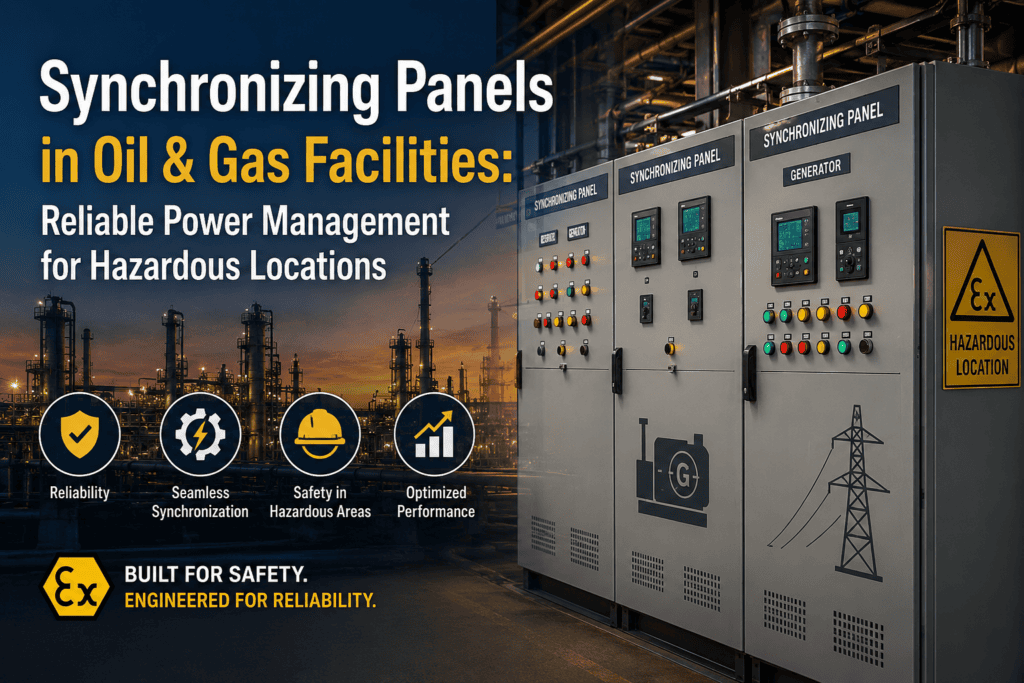
Power reliability in the oil and gas sector isn’t just an operational requirement – it’s a safety one. Offshore platforms, refineries, LNG terminals, petrochemical complexes, upstream drilling facilities – a power interruption in any of these doesn’t just disrupt processes. It hits production targets and creates serious safety concerns simultaneously.
Most oil and gas facilities run multiple power sources to keep operations continuous – diesel generators, gas generators, utility feeders, and emergency backup systems. Managing all of that efficiently requires advanced synchronizing panels for oil and gas applications.
A well-designed synchronizing panel keeps multiple generators running together safely, distributes loads effectively, and maintains uninterrupted power across critical systems. In hazardous environments where reliability isn’t negotiable, these panels form an important part of the overall power management system for oil and gas facilities.
Why Power Continuity Matters More in Oil and Gas Operations
Oil and gas plants aren’t like commercial facilities. Compressors, pumps, process control systems, emergency shutdown systems, safety instrumentation – all of it depends on stable electrical power, continuously.
Even a short interruption affects production processes and triggers significant operational losses. That’s why most facilities run multiple generators in parallel rather than betting everything on a single power source.
Connecting multiple generators to a common electrical network isn’t straightforward, though. Voltage, frequency, and phase angle all have to match before a generator can be safely connected. That coordination is exactly what the generator synchronizing panel handles.
Without proper synchronization, severe electrical and mechanical stresses hit the power distribution system fast.
Operating Multiple Generators as One Power System
The core job of a synchronizing panel for oil and gas facilities is seamless operation between multiple power sources.
When an additional generator is needed, the panel monitors generator parameters continuously and adjusts them until synchronization conditions are met. Once voltage, frequency, and phase sequence match the live busbar, the breaker closes automatically, and the generator joins the system.
Modern automatic synchronizing panels also handle load distribution between generators — a process known as load sharing. This prevents one generator from running hard while others sit underutilised.
For refineries, offshore platforms, and petrochemical plants where power demand shifts throughout the day, effective load sharing improves fuel efficiency and extends generator life.
Designing Synchronizing Panels for Hazardous Locations
Electrical equipment in oil and gas facilities has to perform reliably in some of the harshest industrial conditions that exist. Explosive atmospheres, corrosive environments, extreme temperatures, continuous vibration – all of it influences how equipment gets designed.
Synchronizing panels used in hazardous locations are engineered with that reality built in from the start.
Key design requirements typically include:
- Integration with hazardous area electrical systems
- Robust enclosure construction
- High-reliability control components
- Redundant power management architecture
- Advanced protection and monitoring systems
Depending on facility classification, synchronizing panels may also interface with explosion-proof equipment and hazardous area instrumentation. That scope makes oil and gas synchronizing panels a different animal entirely compared to standard commercial generator control panels.
SCADA Integration and Centralized Power Management
Modern oil and gas facilities run on automation and centralised monitoring. Synchronizing panels for oil and gas applications are now routinely integrated with plant-wide SCADA and distributed control systems (DCS).
That integration gives operators real-time visibility across:
- Generator loading
- Busbar status
- Breaker position
- Fuel consumption trends
- Power quality parameters
Informed decisions get made faster when the data is all in one place. Synchronizing panels with SCADA integration also support remote operation, event logging, alarm management, and predictive maintenance programs – capabilities that matter a great deal in remote or unmanned installations.
Protection Strategies for Critical Power Systems
Electrical faults in oil and gas environments need to be detected and isolated quickly. Letting a fault develop in a critical power system isn’t an option.
Modern generator synchronizing panels carry multiple protection functions built specifically for these applications – protecting generators, switchgear, and connected loads from abnormal conditions before they escalate.
Protection schemes commonly built into oil and gas synchronizing panels include overcurrent protection, reverse power protection, under-frequency protection, over-voltage protection, and busbar protection.
Combined with intelligent control algorithms, these protection systems maintain stability across the entire industrial power distribution network.
Engineering Synchronizing Panels for Demanding Applications
At Synchro Electricals, we design and manufacture synchronizing panels for industrial power management applications across demanding sectors, including oil and gas, infrastructure, utilities, and process industries.
Our engineering focus sits on reliable generator synchronization, accurate load sharing, advanced protection coordination, and seamless SCADA integration. Robust panel construction combined with intelligent control technology is what delivers dependable power management in environments where reliability is critical, and failure isn’t an acceptable outcome.
The Backbone of Reliable Power Generation
Oil and gas facilities run around the clock, often in remote and unforgiving locations where power reliability simply cannot be compromised. Synchronizing multiple generators, distributing load efficiently, and responding quickly to changing operating conditions – that’s what keeps continuous production possible.
It’s why synchronizing panels for oil and gas facilities remain a key component of modern power management systems. Safe generator operation, intelligent load sharing, centralised control – these panels deliver the reliability that hazardous industrial locations demand.