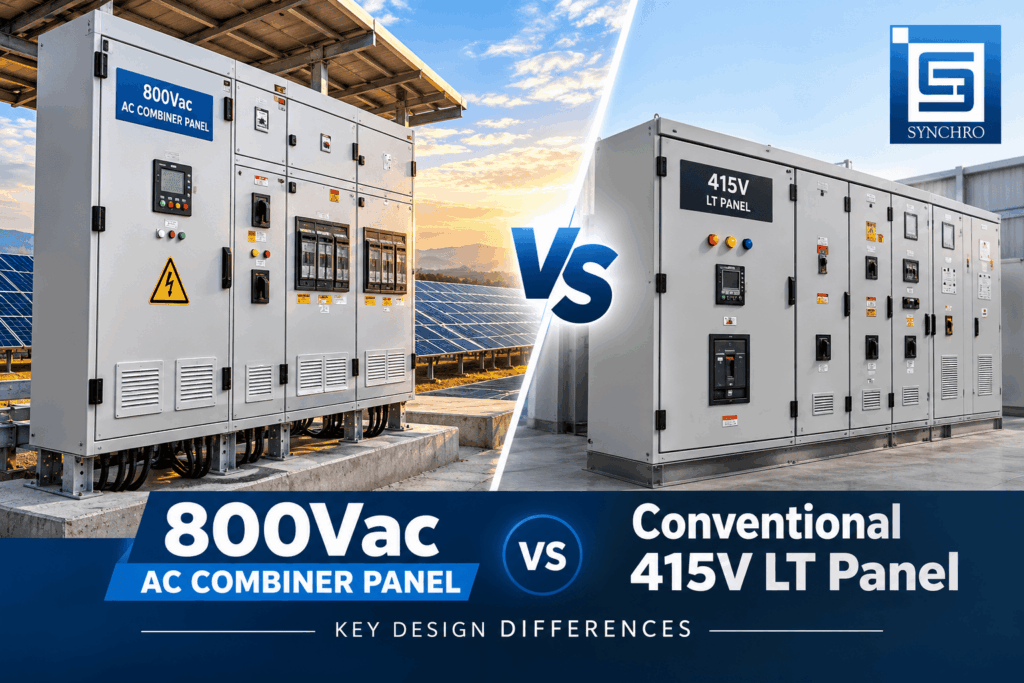
On a GA drawing, an 800Vac AC combiner panel and a 415V LT panel can look almost the same: incoming feeders, a busbar chamber, an outgoing breaker, and some meters. That similarity causes one of the costliest mistakes in solar procurement. A panel built like a 415V LT panel, with 415V or 690V devices and 415V clearances, is then asked to run at 800V next to a transformer.
This guide sets out the real design differences, so consultants and EPC teams can write a specification that gets the right panel. It is written by the engineering team at Synchro Electricals, manufacturer of the 800VAC Solar Type Tested Panel.
Table of Contents
- The Short Version
- 1. Voltage Rating of Every Device
- 2. Breaking Capacity at the Actual Voltage
- 3. Reverse Power Flow
- 4. Insulation, Clearances and Creepage
- 5. Busbar Sizing and Heat
- 6. Auxiliary Supply
- 7. Metering and Communication
- 8. Earthing System
- 9. Verification and Testing
- Specification Checklist for an 800Vac Panel
- When a 415V Panel Is Still the Right Choice
- Why Work With Synchro Electricals
- Conclusion
- FAQs
The Short Version
| Design aspect | Conventional 415V LT panel | 800Vac solar AC combiner panel |
|---|---|---|
| Typical role | Distributes grid or DG power to loads | Collects string inverter outputs and feeds a transformer |
| Power flow | Grid → loads | Inverters → transformer → grid |
| System | Three-phase, four-wire (with neutral) | Usually three-phase, three-wire |
| Rated operational voltage of devices | 415V AC | 800V AC (declared) |
| Breaking capacity | Declared at 415V | Must be declared at 800V; usually lower than the same frame at 415V |
| Insulation and clearances | Sized for 415V | Larger, sized for higher rated insulation and impulse voltages |
| Current for the same power | Higher | About half |
| Control and auxiliary supply | Taken directly from 230V/415V | Needs an auxiliary transformer or separate auxiliary source |
| Metering | Direct-connected meters common | 800V-rated meters or voltage transformers |
| Surge protection | 415V AC SPD | SPD rated for 800V systems |
| Load profile | Varies with plant loads | Near full current for hours every sunny day |
1. Voltage Rating of Every Device
In a 415V panel, almost any industrial breaker, contactor or meter will do. At 800V, the list shrinks. Many MCCB frames stop at 690V. Others are rated at 800V but with lower breaking capacity. Auxiliary contacts, shunt trips and undervoltage releases also need checking. The rule is simple: every device connected to the 800V circuit must have a declared rated operational voltage of at least 800V AC from its manufacturer. A “690V” breaker is not an 800V breaker.2. Breaking Capacity at the Actual Voltage
A breaker’s ultimate breaking capacity (Icu) and service breaking capacity (Ics) fall as voltage rises. The catalogue figure printed in large type is usually the 415V figure. For an 800Vac panel, the consultant must check the breaking capacity at 800V against the prospective fault current at the panel. That fault current comes mainly from the transformer and grid, with a smaller contribution from the inverters themselves. Our post on how fault-level calculations influence switchgear selection explains the method.3. Reverse Power Flow
In a normal LT panel, power flows from the incomer to the outgoing loads. In an 800Vac solar panel, the “incomers” are inverter feeders and power flows towards the transformer. At night or during a fault, the transformer side can also feed back. Some breakers are designed with defined line and load terminals. Before using them, confirm with the manufacturer that the device is suitable for reverse feeding. Protection settings must also be coordinated for current coming from both directions.4. Insulation, Clearances and Creepage
Higher voltage needs more insulation. Under IEC 61439, the panel’s rated insulation voltage (Ui) and rated impulse withstand voltage (Uimp) determine the minimum clearances and creepage distances. They also determine the dielectric test voltage used during verification. A busbar system that is fine at 415V may not meet the clearances needed at 800V, especially in a dusty, polluted inverter room.5. Busbar Sizing and Heat
The good news at 800V: current is roughly half that of a 415V system of the same power, so busbars can be smaller. The challenge: a solar panel runs near full current for long periods on hot days, often in a hot inverter room or outdoor enclosure. Busbar size, spacing and ventilation must be verified for temperature rise at the real site ambient, not a catalogue rating at 35°C. See our comparison of copper vs aluminium busbars for the material choice.6. Auxiliary Supply
Relays, meters, panel lights, heaters and fans in a 415V panel run from a 230V supply taken straight off the bus. That is not possible at 800V. The panel needs a properly protected auxiliary transformer, or an auxiliary feed from the plant’s LT system or UPS. Decide this early, because it changes the panel layout.7. Metering and Communication
Multifunction meters must either be rated for 800V direct connection or be fed through voltage transformers. CT ratios are chosen for the lower current. Most EPC specifications also call for Modbus RS485 or Ethernet output to the plant SCADA.8. Earthing System
A 415V distribution panel usually works in a TN system with an earthed neutral. An 800V inverter-transformer system may be designed as TN or IT, depending on the transformer LV winding and inverter requirements. The earthing system affects protection settings, the need for insulation monitoring, and SPD configuration. The panel must be designed for the system the plant actually uses.9. Verification and Testing
Both panels should follow IEC 61439. For an 800Vac panel the stakes are higher: higher voltage, high fault level near the transformer and long hours at full load. Most utility and EPC specifications therefore require full design verification, including temperature rise and short-circuit withstand, plus routine verification on every unit. Read more in our IEC 61439 verification guide and our post on type-tested 800Vac panels (activate once live).Specification Checklist for an 800Vac Panel
- Rated operational voltage 800V AC for every main-circuit device
- Breaking capacity declared at 800V, at or above the calculated fault level
- Breakers confirmed suitable for reverse feeding
- Rated insulation and impulse withstand voltages stated
- Busbar current and short-time withstand rating stated at the site ambient
- Auxiliary supply arrangement defined
- Metering voltage rating or VT arrangement defined
- SPD rated for the 800V system
- Earthing system (TN or IT) stated
- IEC 61439 design verification documents and routine test reports requested