Indian utility-scale solar has moved to 1500V DC. Along with it, a piece of equipment that used to be unusual has become standard: the 800Vac panel. If your plant uses 1500V string inverters, there is a good chance their AC output is 800V. Every one of those inverter outputs has to be collected, protected, and fed to a transformer. That is the 800Vac panel’s job.
This guide explains what an 800Vac panel is, why the voltage is 800V and not 415V, what goes inside, and what EPC teams should check when they specify one.
Currents are calculated as power ÷ (1.732 × voltage) at unity power factor.
At 800V, a 3MW block carries roughly half the current it would at 415V. That makes busbars, cables and the transformer’s LV side smaller and cheaper. Cable losses, which rise with the square of current, drop sharply. It also matches the 1500V DC side: an inverter working from a 1500V DC input naturally produces a higher AC output voltage.
One detail often missed: a breaker’s breaking capacity falls as voltage rises. A breaker frame that interrupts a high fault current at 415V will have a lower rating at 690V or 800V, and some frames are not rated at 800V at all. Every switching device must have a declared rating at the panel’s operating voltage.
Where the 800Vac Panel Sits in a 1500V Plant
A typical block in a string-inverter plant looks like this:- PV strings at up to 1500V DC feed a string inverter, either directly or through a DC combiner.
- Each string inverter converts DC to AC and outputs 800V AC (three-phase, usually without neutral).
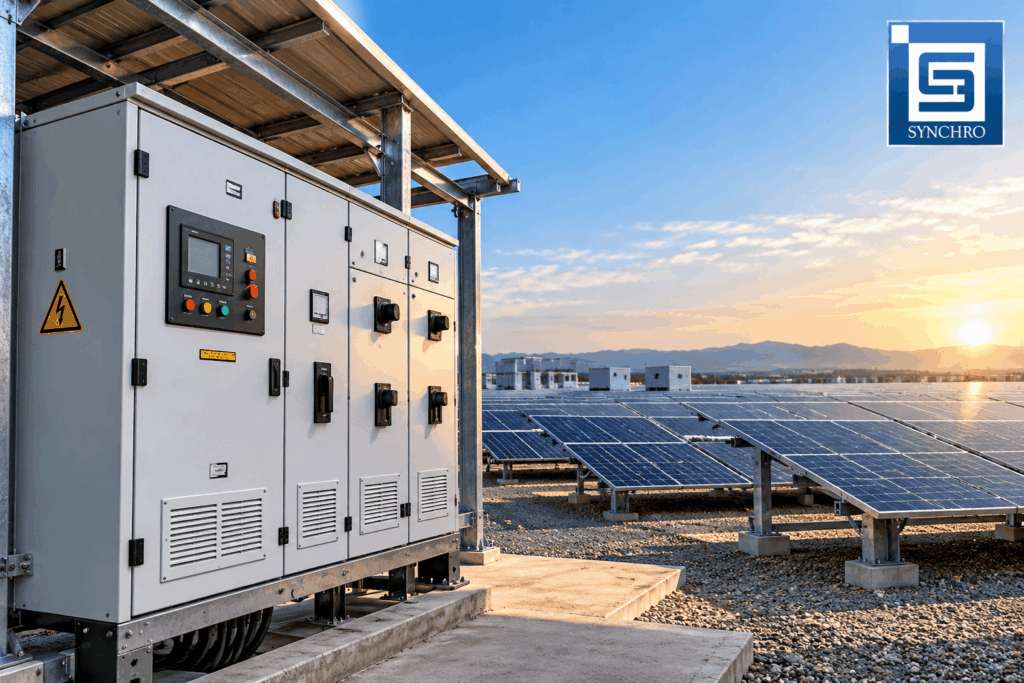
- The outputs of several inverters run to an 800Vac panel, also called an AC combiner panel or LT panel.
- The panel combines them onto a busbar, protects each incoming feeder, and feeds the low-voltage side of the inverter-duty transformer.
- The transformer steps the voltage up (for example to 11kV or 33kV) for the plant’s collection system.
Why 800V and Not 415V?
For the same power, a higher voltage means a lower current. Lower current means smaller cables, smaller busbars and lower resistive losses.| Inverter output | Current at 415V | Current at 800V |
|---|---|---|
| 100 kW | 139 A | 72 A |
| 250 kW | 348 A | 180 A |
| 300 kW | 417 A | 217 A |
| 3 MW block (combined) | about 4,170 A | about 2,165 A |
What Is Inside an 800Vac Panel
| Section | Typical components | What to check |
|---|---|---|
| Incoming feeders | One MCCB (or fused switch) per inverter | Rated operational voltage of 800V AC; breaking capacity at 800V, not at 415V |
| Busbar | Copper or aluminium main busbar | Current rating at site ambient; short-time withstand rating |
| Outgoing | ACB or MCCB to transformer LV | Rated at 800V AC; protection relay or release settings coordinated with the transformer |
| Surge protection | AC SPD rated for 800V systems | Continuous operating voltage suitable for 800V |
| Metering | Multifunction meters, CTs | Meter rated for 800V or fed through suitable PTs |
| Auxiliary supply | Auxiliary transformer for control and lighting | Most control devices are not 800V-rated, so a step-down supply is needed |
| Enclosure | Indoor or outdoor, IP rated | IP rating, ventilation and heat rise at site temperature |
Why Type Testing Matters for 800Vac Panels
An 800Vac panel combines several hundred kilowatts to several megawatts on one busbar, right next to a transformer. If a short circuit happens, the fault current is high. The panel has to carry that current for a set time without the busbars bending, supports breaking or the enclosure failing. It must also stay within temperature limits while running at full output in a hot inverter room or outdoors. That is why EPC specifications for 800Vac panels usually require design verification to IEC 61439, including temperature-rise and short-circuit withstand verification. Read our guide on type-tested 800Vac panels and IEC 61439 (activate once live) and our general IEC 61439 verification guide.800Vac Panel vs Conventional LT Panel
An 800Vac panel looks similar to a 415V LT panel, but the design is different in several ways: device ratings, insulation, clearances, the auxiliary supply, and the absence of a neutral. Our detailed comparison is in 800Vac AC combiner panel vs 415V LT panel (activate once live).What EPC Teams Should Specify
- Number of incoming inverters and each inverter’s maximum output current
- Transformer rating and LV fault level
- Busbar rating and short-time withstand current
- Required design verification (IEC 61439) and test documents
- Indoor or outdoor installation, IP rating and site ambient temperature
- Metering, communication (Modbus/RS485) and SCADA interface
- Cable entry (top or bottom) and cable sizes
- Space for future inverters, if expansion is planned