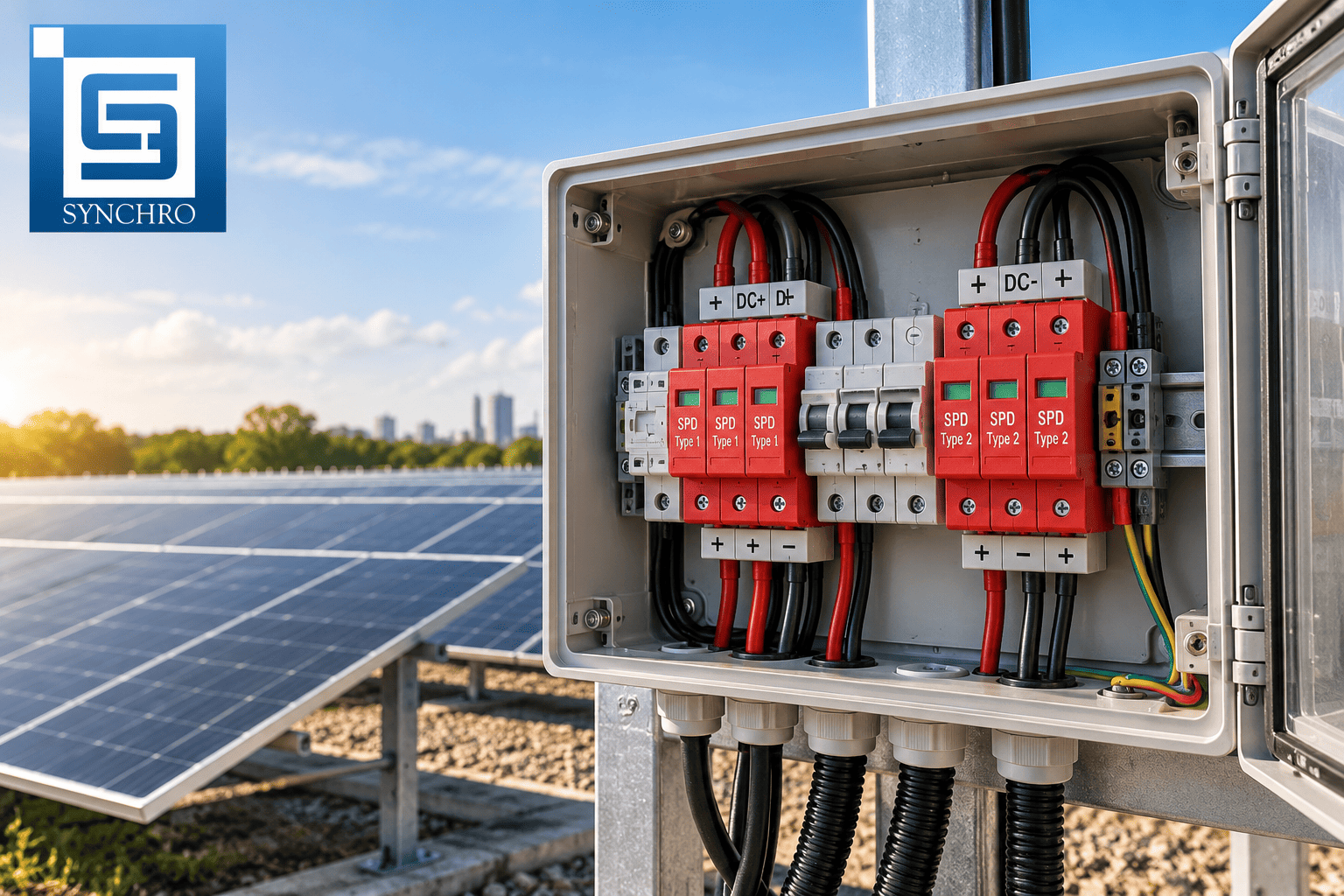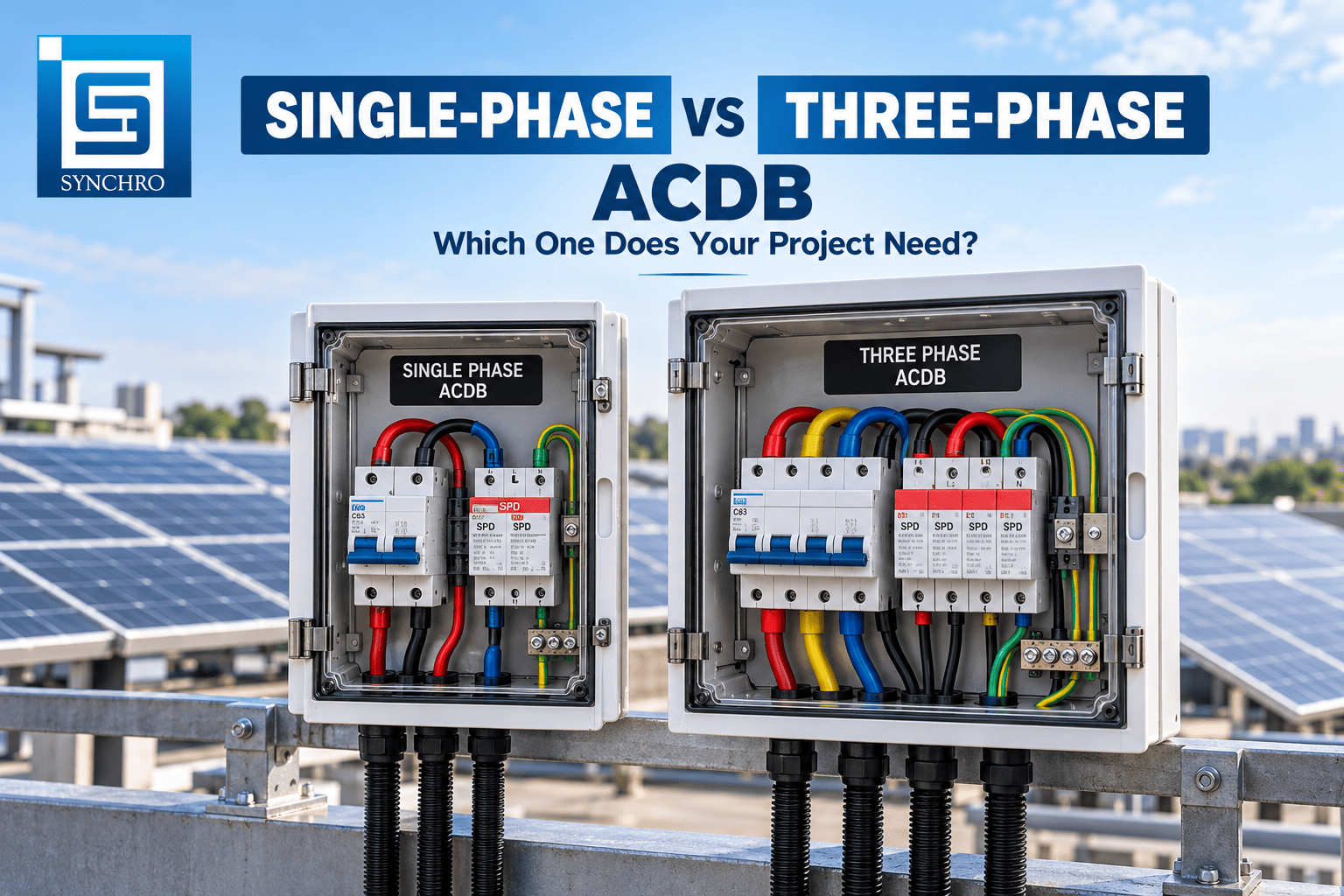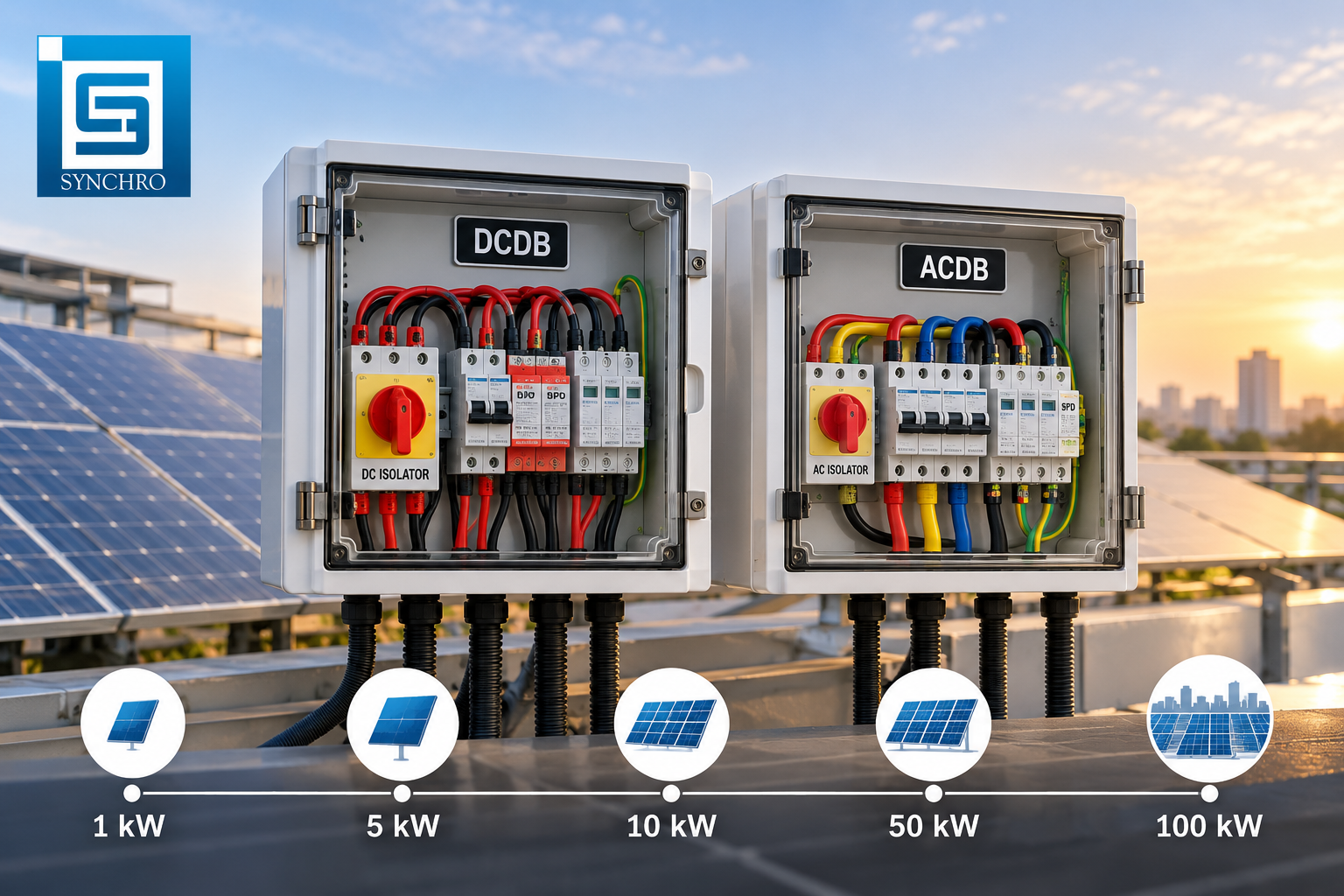
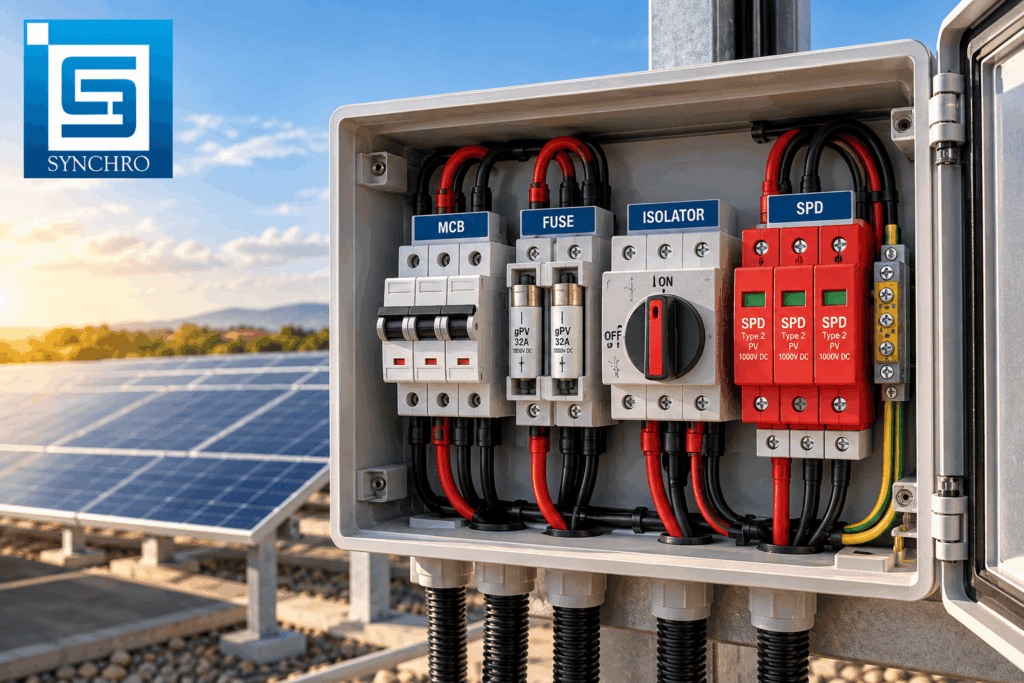
Two DCDBs can look identical from the outside and perform very differently on a roof. The difference is inside: whether the isolator is rated for DC-PV duty, whether the MCB is polarity-sensitive and wired the right way round, whether the fuse is a true gPV type, and whether the SPD is rated for the cold-morning string voltage.
This checklist covers every component in a solar DCDB, what each one does, and which ratings to verify before you approve a sample or accept a bulk delivery. It is based on the checks our engineering team at Synchro Electricals applies when we build solar ACDB DCDB boxes.
Why DC Components Need Special Attention
AC current passes through zero 100 times a second on a 50Hz system, which helps an arc extinguish when a device opens. DC current never passes through zero. An arc drawn by a DC switch or breaker that is not designed for it can keep burning, melting contacts and starting a fire.
Solar DC circuits add two more challenges. The array cannot be switched off during the day, because the modules keep generating whenever there is light. Fault current from a PV array is also limited and close to the normal operating current, so a protective device can struggle to tell a fault from normal operation. Every DC component must be chosen with these facts in mind.
The Complete DCDB Component Checklist
| # | Component | What it does | Ratings and features to check |
|---|---|---|---|
| 1 | Enclosure | Houses and protects all components | IP65 or better outdoors; UV-stabilised material; adequate size for heat; lockable door; flame-retardant |
| 2 | DC isolator (switch-disconnector) | Safely isolates the strings for maintenance | DC-PV2 utilisation category to IEC 60947-3; voltage at or above max string Voc; current at or above 1.25 × Isc; correct number of poles |
| 3 | DC MCB | Protects the cable against overcurrent and allows switching | DC-rated at system voltage; polarity marking respected; breaking capacity suitable for the array |
| 4 | gPV fuse and holder | Protects strings against reverse current when 3+ strings are paralleled | gPV class to IEC 60269-6; rating 1.5–2.4 × Isc and within the module’s maximum series fuse; holder rated for the same voltage |
| 5 | DC SPD | Limits surge voltage reaching the inverter | PV-rated to IEC 61643-31; Ucpv at or above cold-weather Voc; Up below inverter withstand; Type chosen from lightning exposure |
| 6 | Busbars and terminals | Join and distribute current | Sized for current with temperature margin; tinned copper preferred; insulated and shrouded |
| 7 | Internal wiring | Connects components | DC solar cable or suitably rated copper; red for positive, black for negative; ferrules at terminations |
| 8 | Cable glands or MC4 inlets | Bring cables in without breaking the IP rating | Matched to cable diameter; UV-resistant; IP rating equal to the enclosure |
| 9 | Earthing terminal | Connects SPD and enclosure to earth | Clearly marked; sized for SPD discharge current; short path |
| 10 | Labels and warnings | Tells site staff what is live and how to isolate | “DC voltage present during daylight” warning; polarity marks; input/output IDs; rating plate |
Component Details
DC isolator
The isolator is the device an electrician relies on before touching the strings. It must be rated for the full open-circuit voltage of the string on a cold morning, and for switching DC-PV loads. Ask the supplier for the isolator’s utilisation category. DC-PV2 is the category designed for switching PV circuits under load.
DC MCB
Many DC MCBs are polarity-sensitive: they extinguish arcs correctly only when current flows in the marked direction. A polarity-sensitive MCB wired backwards may fail to clear a fault. Either use non-polarised DC MCBs or check polarity on every unit during inspection.
gPV fuses
Standard industrial fuses are not designed for the low, steady fault currents of a PV array. gPV fuses are. They are only needed when enough strings are in parallel for reverse current to damage a module, typically three or more. On those designs, fuse both positive and negative where the earthing arrangement requires it.
DC SPD
Choose the SPD from the array’s maximum voltage and the site’s lightning exposure. Read our detailed guide on Type 1 vs Type 2 SPD in solar DCDB (activate once live).
Enclosure
Most rooftop DCDBs sit in direct sun. A polycarbonate or FRP enclosure must be UV-stabilised, or it will become brittle and crack. A metal enclosure needs a durable coating and good earthing. Size matters too: a crowded box runs hotter, and breakers and fuses derate as temperature rises.
Inspection Checklist for Samples and Bulk Deliveries
Use this when you approve a sample or inspect a delivery.
- Every component’s rating plate matches the approved drawing and BOM
- DC isolator rated for DC-PV duty at the system voltage
- DC MCB polarity matches the marking on every unit
- Fuse class is gPV and the rating matches the drawing
- SPD Ucpv is at or above the calculated maximum string voltage
- SPD earth lead is short and direct
- Positive and negative wiring colours are consistent
- All terminals are tight, with ferrules on stranded wires
- Glands fitted and sealed; unused entries blanked
- Warning labels and input/output identification in place
- Insulation resistance test results recorded
- Test report supplied for the batch
For wiring practices that apply to all panels, see our post on electrical panel wiring design best practices.
Red Flags When Comparing DCDB Quotes
| Red flag | Why it matters |
|---|---|
| Component brands or ratings not stated | You cannot verify what you will receive |
| “DC rated” with no voltage class | The device may be rated for a lower voltage than your strings |
| AC isolator listed in a DCDB | Unsafe for DC switching |
| No SPD Ucpv value | Cannot be checked against your string voltage |
| No test report offered | No proof each box was checked before dispatch |
| Very low price for a high-voltage DCDB | Usually a sign of substituted components |
Why Work With Synchro Electricals
At Synchro Electricals, a Rajkot panel manufacturer working since 2018 under an ISO 9001:2015 certified quality system, we build ACDB DCDB boxes to an approved drawing and BOM. Every component is named on the drawing before we order it. Every box gets insulation resistance, high-voltage and functional tests, and a test report is supplied with each order. For larger plants we also build string combiner boxes and the 1500VDC Solar DCDB Panel.
Conclusion
A reliable DCDB comes down to ten components, each rated for DC-PV duty at the right voltage. Check the isolator’s category, the MCB’s polarity, the fuse class, the SPD’s Ucpv and the enclosure’s UV resistance. Then insist on a test report. Those checks take minutes, and they prevent the failures that cost the most to fix on a roof.
Send us your string data and quantities for a DCDB with a fully named BOM. Get in touch.
FAQs
1. What components are inside a solar DCDB?
A typical solar DCDB contains a DC isolator, DC MCB or gPV fuses, a DC SPD, busbars and terminals, internal wiring, cable glands, an earthing terminal and warning labels, all inside a weatherproof enclosure.
2. What is the difference between a DC isolator and a DC MCB?
An isolator switches the circuit off for safe maintenance but does not trip on overcurrent. An MCB switches and also trips automatically on overcurrent.
3. Can I use an AC isolator in a DCDB?
No. AC isolators rely on the current passing through zero to extinguish the arc. DC current does not, so the arc can persist.
4. Why do DC MCBs have polarity markings?
Many DC MCBs use magnets to push the arc into the arc chute, and this only works in one current direction. Wire them according to the marking.
5. Do I need fuses in my DCDB?
Usually only when three or more strings are connected in parallel. With one or two strings per input, reverse current is limited.
6. What is a gPV fuse?
A fuse designed to IEC 60269-6 for photovoltaic circuits. It can interrupt the low, steady fault currents typical of PV arrays, which ordinary fuses may not.
7. What IP rating should a DCDB have?
For outdoor rooftop installation, IP65 or better is common. Check also that the material is UV-stabilised.
8. Is a polycarbonate or metal DCDB box better?
Both work. Polycarbonate is light and non-conductive but must be UV-stabilised. Metal is robust but needs good coating and earthing. The choice depends on site exposure and specification.
9. What cable is used inside a DCDB?
DC solar cable or suitably rated copper conductors, with red for positive and black for negative, and ferrules at each termination.
10. What is DC-PV2 on an isolator?
It is a utilisation category in IEC 60947-3 for switch-disconnectors used in PV DC circuits, covering switching under PV load conditions.
11. Why does a DCDB need warning labels?
PV strings stay live whenever there is daylight, even with the inverter off. Labels warn maintenance staff and identify inputs, outputs and polarity.
12. How do I check a DCDB before installation?
Check ratings against the drawing, polarity, fuse class, SPD Ucpv, terminal tightness and gland sealing, and review the insulation resistance test report.
13. Should the DCDB include monitoring?
Small rooftop DCDBs usually do not. On larger plants, string monitoring or an SPD status contact helps O&M teams catch faults early.
14. What causes DCDB fires?
Common causes are loose terminals, AC-rated or under-rated DC devices, polarity errors, SPDs with too low a Ucpv, and overheating in undersized enclosures.
15. Can you supply DCDBs with a fixed BOM for bulk orders?
Yes. Synchro Electricals builds every unit in a bulk order to one approved drawing and named BOM. Contact us.