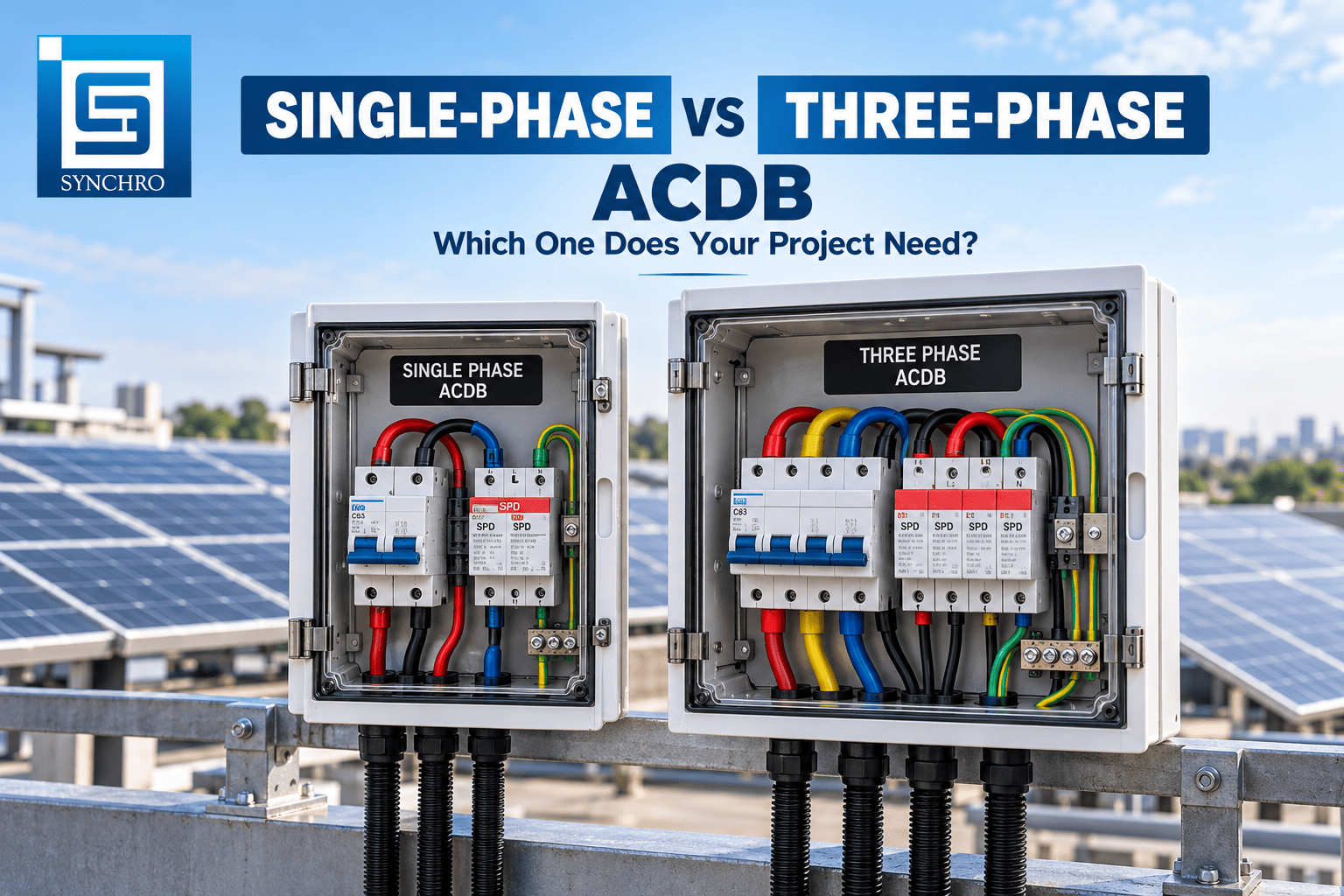
Most ACDB and DCDB problems on rooftop solar sites are not caused by bad components. They are caused by boxes that were never sized for the system they were installed on. A 32A MCB on a 10kW three-phase inverter, a 600V DC SPD on a string that reaches 640V on a cold morning, a DC isolator rated for AC duty. Each of these looks fine on the day of commissioning and fails months later.
This guide shows how to size an ACDB and DCDB correctly for systems from 1kW to 100kW. It is written by the engineering team at Synchro Electricals, a Rajkot-based manufacturer of solar ACDB DCDB boxes, and it uses the same method we follow when we design boxes for EPC contractors and rooftop installers across India.
What ACDB and DCDB Actually Do
A solar plant has two electrical sides, and each needs its own protection box.
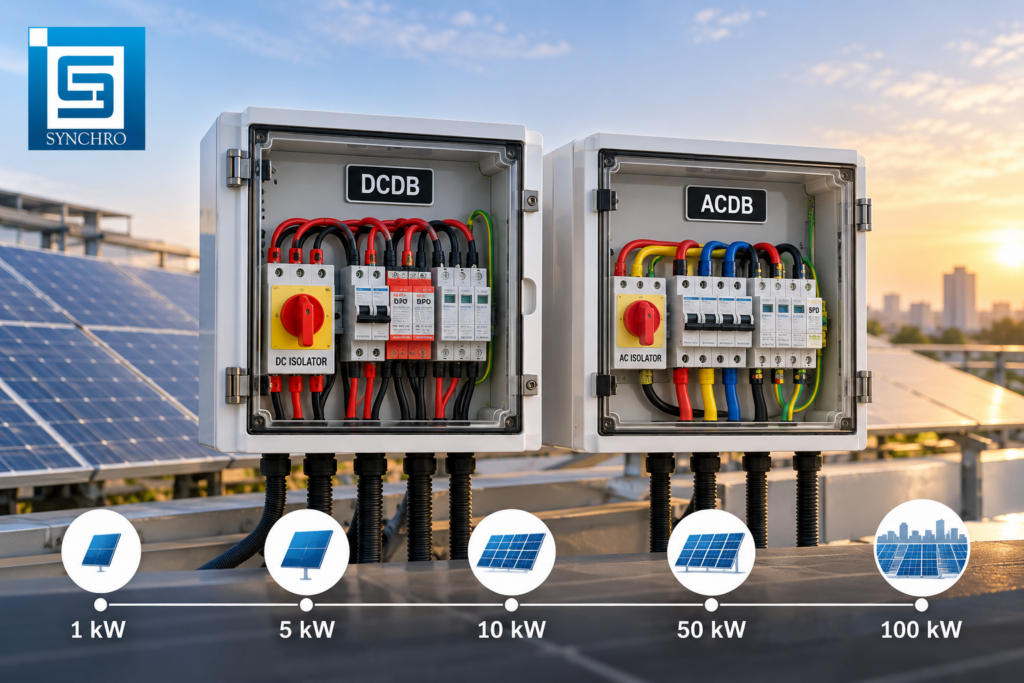
- DCDB (DC Distribution Box): sits between the PV strings and the inverter. It isolates the strings, protects the DC cables and inverter from surges, and in larger systems protects strings from reverse current.
- ACDB (AC Distribution Box): sits between the inverter and the building’s main panel or net meter. It protects the inverter output cable, isolates the inverter for maintenance, and protects against surges coming from the grid side.
Sizing each box means choosing the right voltage rating, current rating, breaking capacity, and surge protection for the system it serves. These numbers come from the inverter datasheet and the PV module datasheet, not from the system’s kW figure alone.
The Inputs You Need Before Sizing
Collect these values first. Without them, any sizing is a guess.
| Input | Where to find it | Used for |
|---|---|---|
| Inverter maximum AC output current | Inverter datasheet | ACDB MCB/MCCB rating |
| Grid connection (single-phase 230V or three-phase 415V) | DISCOM sanction, site survey | ACDB pole count, SPD type |
| Number of MPPTs and strings per MPPT | Inverter datasheet, string layout | DCDB input/output count |
| Module Voc and Isc at STC | Module datasheet | DC voltage and current ratings |
| Voc temperature coefficient | Module datasheet | Cold-morning maximum string voltage |
| Lowest site temperature | Local weather data | Maximum string voltage |
| Inverter maximum DC input voltage | Inverter datasheet | DC component voltage class |
| Fault level at the connection point | DISCOM or site data | Breaking capacity of AC devices |
How to Size the ACDB
Step 1: Find the design current
Use the inverter’s maximum AC output current from the datasheet. If you only have the kW rating, calculate it:
- Single-phase: current = power ÷ 230V
- Three-phase: current = power ÷ (1.732 × 415V)
The datasheet value is better because some inverters can push more current than the nominal figure, especially at low grid voltage.
Step 2: Apply a continuous-load margin
Solar inverters run at or near full output for hours every day. Breakers are not meant to sit at 100% of their rating for long periods. Multiply the design current by 1.25, then choose the next standard MCB or MCCB rating.
Step 3: Choose the device type
- Up to about 63A: MCB, with breaking capacity matched to the site fault level (commonly 10kA for most rooftop sites).
- Above 63A: MCCB, with adjustable thermal settings where the current is close to a step.
- Add an RCCB or RCBO where the DISCOM, the inverter manufacturer or the building wiring rules require it. Check which RCD type the inverter manufacturer recommends.
Step 4: Add AC surge protection
An AC SPD (usually Type 2) protects the inverter from grid-side surges. Its continuous operating voltage must suit the grid. Single-phase boxes use a 1P+N arrangement, three-phase boxes use 3P+N.
ACDB sizing table (indicative)
Currents below are calculated at unity power factor. Always confirm against the inverter’s maximum output current.
| System size | Grid | Approx. output current | Current × 1.25 | Suggested incomer |
|---|---|---|---|---|
| 1 kW | 1-phase 230V | 4.3 A | 5.4 A | 10 A MCB, 2P |
| 2 kW | 1-phase 230V | 8.7 A | 10.9 A | 16 A MCB, 2P |
| 3 kW | 1-phase 230V | 13.0 A | 16.3 A | 20 A MCB, 2P |
| 5 kW | 1-phase 230V | 21.7 A | 27.2 A | 32 A MCB, 2P |
| 5 kW | 3-phase 415V | 7.0 A | 8.7 A | 10–16 A MCB, 4P |
| 10 kW | 3-phase 415V | 13.9 A | 17.4 A | 20 A MCB, 4P |
| 15 kW | 3-phase 415V | 20.9 A | 26.1 A | 32 A MCB, 4P |
| 20 kW | 3-phase 415V | 27.8 A | 34.8 A | 40 A MCB, 4P |
| 25 kW | 3-phase 415V | 34.8 A | 43.5 A | 50 A MCB, 4P |
| 30 kW | 3-phase 415V | 41.7 A | 52.2 A | 63 A MCB, 4P |
| 50 kW | 3-phase 415V | 69.6 A | 87.0 A | 100 A MCCB, 4P |
| 75 kW | 3-phase 415V | 104.3 A | 130.4 A | 160 A MCCB, 4P |
| 100 kW | 3-phase 415V | 139.1 A | 173.9 A | 200 A MCCB, 4P |
The incomer is not the only consideration. Cable size, ambient temperature inside the box, and the number of inverters feeding one ACDB all change the final choice. A 100kW plant built from two 50kW inverters needs either two outgoing feeders in one ACDB or two separate ACDBs, which changes the busbar and enclosure size.
How to Size the DCDB
Step 1: Calculate the maximum string voltage
Module voltage rises as temperature falls. The highest string voltage occurs on a cold, bright morning, not at noon. Use the module’s Voc temperature coefficient:
Max string Voc = modules in series × module Voc (STC) × [1 + |coefficient| × (25 − lowest site temperature)]
Example: 10 modules with a Voc of 49.5V give 495V at STC. With a coefficient of −0.27%/°C and a lowest temperature of 10°C, the maximum is about 515V. A 600V DCDB works here. A string of 12 such modules would reach about 618V, so it needs 1000V-class components.
Step 2: Choose the voltage class
Match every DC component (isolator, MCB or fuse, SPD) to the voltage class at or above the maximum string voltage and the inverter’s maximum DC input.
| Voltage class | Typical use |
|---|---|
| 600V DC | Small single-phase rooftop systems with short strings |
| 1000V / 1100V DC | Most three-phase rooftop and C&I systems |
| 1500V DC | Utility-scale plants; see our 1500VDC Solar DCDB Panel |
Step 3: Size the current rating
DC devices are sized on the module’s short-circuit current (Isc), with a margin. A common design rule is at least 1.25 × Isc for switches and cables. Where string fuses are used, IEC 62548 places the fuse rating between 1.5 × Isc and 2.4 × Isc, and not above the module’s maximum series fuse rating.
Step 4: Decide whether string fuses are needed
With one or two strings in parallel per input, a faulty string cannot receive enough reverse current to damage itself, so fuses are usually not required. With three or more strings in parallel, the healthy strings can push current into a faulted one. That is when gPV fuses become necessary.
Step 5: Add DC surge protection
Choose a PV-rated DC SPD whose continuous operating voltage (Ucpv) is at or above the maximum string voltage. Most rooftop systems use Type 2. Read our guide on Type 1 vs Type 2 SPD in solar DCDB (activate once live) for when Type 1 is needed.
DCDB configuration table (indicative)
| System size | Typical inverter | DCDB configuration | Voltage class | Fuses? |
|---|---|---|---|---|
| 1–3 kW | 1-phase, 1 MPPT | 1 in 1 out | 600V | No |
| 3–5 kW | 1-phase, 1–2 MPPT | 1 in 1 out or 2 in 2 out | 600V or 1000V | No |
| 5–10 kW | 3-phase, 2 MPPT | 2 in 2 out | 1000V / 1100V | No |
| 10–25 kW | 3-phase, 2–3 MPPT | 2–4 inputs | 1000V / 1100V | Only if 3+ strings in parallel |
| 25–50 kW | 3-phase, 3–6 MPPT | 4–8 inputs, or per-MPPT isolation | 1000V / 1100V | Depends on string layout |
| 50–100 kW | One or more string inverters | Multi-input DCDB or string combiner box | 1000V / 1100V | Usually yes when strings are paralleled |
Common Sizing Mistakes We See
| Mistake | What happens | How to avoid it |
|---|---|---|
| Sizing the AC MCB on nominal kW instead of maximum output current | Nuisance tripping on hot afternoons | Use the datasheet maximum current × 1.25 |
| Using an AC isolator or AC MCB on the DC side | DC arcs do not self-extinguish; the device can burn | Use devices rated for DC-PV duty at the system voltage |
| Ignoring cold-morning Voc | SPD or isolator works above its rating | Calculate Voc at the lowest site temperature |
| Oversized string fuses | Fuse does not clear a reverse-current fault | Stay within 1.5–2.4 × Isc and the module’s fuse limit |
| Mixed polarity labelling on bulk orders | Wrong termination on site | Insist on standard terminal marking across every unit |
| Box too small for heat | Breakers derate and trip | Size the enclosure for heat, not just component count |
Sizing for Bulk Rollouts
If you are buying ACDB and DCDB boxes for 30, 100 or 500 rooftop installations, sizing becomes a standardisation exercise. Group your projects into a small number of system-size bands (for example 3kW, 5kW and 10kW), fix the bill of materials for each band, and get each design approved once. Every unit in that band is then built to the same drawing, wiring colour code and terminal marking.
This cuts site errors and makes spares simple. It also makes inspection faster, because your QA team checks every box against one approved design. Read more about this in our guide on how solar EPCs can source ACDB and DCDB in bulk (activate once live).
Why Work With Synchro Electricals
Synchro Electricals has manufactured electrical panels in Rajkot, Gujarat since 2018 and is ISO 9001:2015 certified. For ACDB DCDB boxes, we:
- design each box from your inverter and module datasheets, not from a generic kW chart
- submit drawings for your approval before components are ordered
- build both single-phase and three-phase configurations, from 1-in-1-out to multi-input DCDBs
- carry out insulation resistance, high-voltage and functional tests, and supply a test report with every order
- support bulk orders where every unit is built to one approved design
See our certifications or our full product range.
Conclusion
Sizing an ACDB and DCDB correctly takes four numbers: the inverter’s maximum output current, the module’s Voc and Isc, and the lowest site temperature. Get those right, apply the margins, and choose devices rated for the right duty. The box will then protect the system for its full life instead of becoming the weakest point on the roof.
Share your inverter model, module datasheet and quantity with our team, and we will send back a sized ACDB/DCDB proposal. Contact our engineering team or call +91 96019 65426.
FAQs
1. What size ACDB do I need for a 5kW solar system?
For a 5kW single-phase inverter, the output current is about 21.7A. With a 1.25 margin, a 32A 2-pole MCB is typical. For a 5kW three-phase inverter, about 7A per phase, a 10A or 16A 4-pole MCB is common. Always confirm against the inverter’s maximum output current.
2. What size DCDB is used for a 5kW system?
Most 5kW systems use a 1-in-1-out or 2-in-2-out DCDB, depending on the number of MPPTs. The voltage class (600V or 1000V) depends on the string length and cold-morning Voc.
3. Which MCB is used in the ACDB of a 10kW three-phase system?
A 10kW three-phase inverter gives about 13.9A per phase. With margin, a 20A 4-pole MCB is typical, plus a Type 2 AC SPD and an RCCB where required.
4. Is a DCDB necessary if the inverter has a built-in DC switch?
Many string inverters include a DC switch and sometimes an SPD. A separate DCDB still lets you isolate the strings away from the inverter, protects long DC cable runs, and is required by many DISCOMs and tender specifications. Check the local requirement before omitting it.
5. Can I use an AC MCB in a DCDB?
No. DC current has no zero crossing, so an arc in an AC-only device may not extinguish. Use breakers, isolators and fuses rated for DC-PV duty at the system voltage.
6. How do I calculate the DC voltage rating for a DCDB?
Multiply the number of modules in series by the module Voc, then correct for the lowest site temperature using the Voc temperature coefficient. Choose components rated at or above that figure and the inverter’s maximum DC input voltage.
7. When are fuses needed in a DCDB?
Fuses are usually needed when three or more strings are connected in parallel on one input. Below that, reverse current through a faulty string is limited.
8. What fuse rating should a solar string fuse have?
IEC 62548 places the string fuse rating between 1.5 and 2.4 times the module Isc, and not above the module’s maximum series fuse rating.
9. Should the ACDB have an RCCB?
It depends on the DISCOM rules, the building wiring requirements and the inverter manufacturer’s guidance. Some inverters require a specific RCD type. Check the inverter manual before choosing.
10. What is the difference between a 600V and 1000V DCDB?
The voltage rating of the isolator, MCB or fuse, and SPD. A 600V DCDB suits short strings on small single-phase systems. Longer strings and three-phase inverters usually need 1000V or 1100V components.
11. Do I need a separate ACDB for each inverter?
Not always. One ACDB can have multiple incoming feeders, one per inverter, with a common outgoing. The busbar, enclosure size and heat dissipation must be designed for the combined current.
12. Which SPD is used in an ACDB?
Usually a Type 2 AC SPD in a 1P+N arrangement for single-phase or 3P+N for three-phase systems, with a voltage rating that suits the grid.
13. What size ACDB is needed for a 100kW plant?
A single 100kW three-phase output is about 139A, so a 200A 4-pole MCCB incomer is typical. If the plant uses several inverters, the ACDB needs one feeder per inverter.
14. Does the ACDB size change in hot regions?
Yes. Breakers derate at high ambient temperatures. In hot rooftops, choose a larger enclosure, better ventilation or the next breaker rating, as the breaker manufacturer’s derating table recommends.
15. What is the difference between ACDB and DCDB?
The DCDB protects the DC side between the panels and the inverter. The ACDB protects the AC side between the inverter and the grid or building load.
16. Can one box serve as both ACDB and DCDB?
Combined ACDB-DCDB enclosures exist for small rooftop systems, with the AC and DC sections physically separated inside. Larger systems usually keep them as separate boxes for safety and heat reasons.
17. What information should I send a manufacturer to get an ACDB/DCDB quote?
Send the inverter model, module datasheet, string layout, grid type (single- or three-phase), quantity, and any DISCOM or tender specification. This lets the manufacturer size the box correctly the first time.
18. Can Synchro Electricals supply ACDB and DCDB boxes in bulk?
Yes. We support bulk orders built to a single approved design for each system-size band. Contact our team with your quantities and inverter models.