The monthly electricity bill tells a factory owner how much the plant paid. It does not say why. It doesn’t show which line drove the maximum demand last Tuesday, why power factor slipped after a new machine came in, or how much power the compressors use after the second shift ends. Most factories manage power with one number that arrives once a month, weeks after the decisions that caused it.
Digital energy meters close that gap. Install them at the right points in your power distribution system, specify them properly, and wire them correctly. You then get continuous data on how your plant uses electricity, not a monthly summary. This guide comes from the panel-building side, from the engineering team at Synchro Electricals. It explains what these meters measure, how they improve factory power management, where to install them, and which panel details decide whether the data can be trusted.
What Is a Digital Energy Meter?
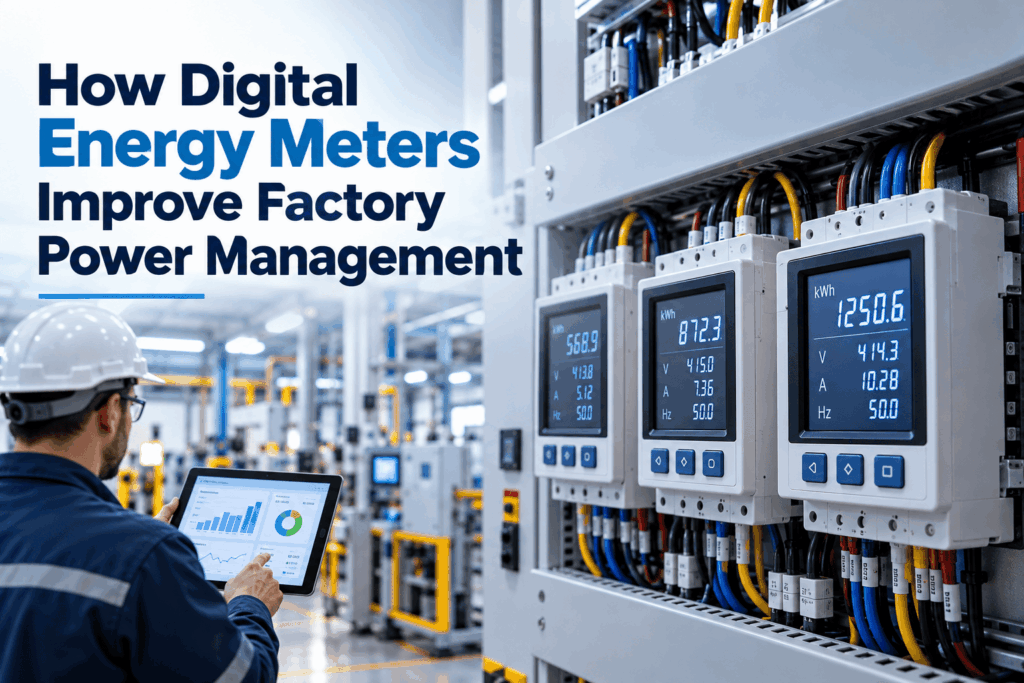
A digital (static) energy meter has no moving parts. It samples voltage and current signals, usually through current transformers (CTs) and, on HT systems, voltage transformers (PTs). It converts those signals to digital values and calculates electrical quantities with a microprocessor. A traditional electromechanical meter records one thing: energy consumed. A digital meter can calculate dozens of parameters from the same signals.
When a digital meter shows many parameters on one display, it is usually called a multifunction meter (MFM). A typical industrial MFM measures:
- Phase and line voltages, phase currents and neutral current
- Active power (kW), reactive power (kVAr) and apparent power (kVA)
- Power factor and frequency
- Energy registers: kWh, kVArh and kVAh, often in both import and export directions
- Maximum demand over a set interval
- On more advanced models, total harmonic distortion (THD) of voltage and current, plus individual harmonics
Meter Types at a Glance
| Meter type | What it measures | Typical factory use |
|---|---|---|
| Basic digital kWh meter | Energy consumption only | Simple sub-metering of small feeders or tenant loads |
| Multifunction meter (MFM) | V, I, kW, kVA, kVAr, PF, Hz, energy registers, demand | Incomers, PCC outgoings, MCC incomers, APFC, DG and solar feeders |
| Power quality meter or analyser | Everything above plus detailed harmonics, events, sags and swells | Main incomers, sensitive process lines, VFD-heavy installations |
| Utility tariff meter | Billing energy and demand, owned and sealed by the DISCOM | The legal billing point, not a substitute for your own meters |
Why Factory Power Is Hard to Manage Without Meters
Most industrial power problems are hidden. The bill shows that you paid a demand charge, not which loads stacked up to create the peak. A low power factor shows up as a penalty or a higher kVAh figure, with no indication of which feeder is responsible. Compressors, furnaces, hydraulic packs and cooling systems often keep drawing power between shifts, and nobody notices because nothing measures them separately. Harmonics from drives raise transformer and cable temperatures without any alarm.
Industrial buyers and plant engineers describe the same situation in forums: the plant knows its total consumption but cannot attribute it. Digital meters supply that attribution.
8 Ways Digital Energy Meters Improve Factory Power Management
1. Keeping Maximum Demand Under Contract Demand
For HT and many large LT industrial consumers, the demand charge depends on the highest average kVA recorded over a fixed interval, commonly 15 or 30 minutes as set by your DISCOM. One badly timed overlap can set the demand charge for the whole month, for example furnace start-up during a full production shift while compressors are loading. If recorded demand exceeds contract demand, many tariffs add excess-demand charges as well.
An MFM on the main incomer, set to the same demand interval as the utility meter, shows demand building in real time. With alarms or relay outputs, operators can stagger non-critical loads before the interval closes. Over a few months, demand logs also show whether your contract demand is set too high, too low or about right.
2. Tracking Power Factor and kVAh Costs
Power factor is the ratio of real power (kW) to apparent power (kVA). Several Indian DISCOMs now bill industrial consumers on kVAh, so the cost of poor power factor is built into every unit consumed. Others still bill kWh with a separate power factor incentive or penalty. Check the current tariff order for your category. In Gujarat, tariff orders are issued by the Gujarat Electricity Regulatory Commission (GERC).
Either way, power factor needs continuous watching, not a monthly check. A meter on the incomer shows when PF drops, during which shift, and whether it swings leading during light-load hours. That data shows how your APFC panel is actually performing. It reveals failed capacitor steps, wrong step sizing, and an APFC relay CT installed where it cannot see the full plant load. Meters with harmonic measurement also show when a detuned APFC design is needed instead of plain capacitors.
3. Sub-Metering: Knowing Which Line, Department or Machine Uses What
Sub-metering is the core of industrial energy monitoring. With meters on major feeders and loads, you can allocate energy cost to departments, product lines or shifts. You can then calculate specific energy consumption: kWh per tonne, per piece or per batch, often the most useful energy figure a manufacturing business can track.
Once a line has a baseline kWh per unit, any drift stands out quickly. Common causes are a worn pump, a leaking air system, a heater that stopped cycling properly, or a process change.
4. Exposing Idle and Off-Shift Consumption
A sub-meter shows what each feeder draws when production stops. Air compressors topping up leaking pipework, holding furnaces, hydraulic units left pressurised, chillers and lighting left on in empty bays all appear in the data. These loads are usually the cheapest savings to capture, because fixing them often needs a procedure change rather than capital spending.
5. Watching Power Quality: Voltage, Unbalance and Harmonics
Motors are sensitive to supply conditions. Voltage unbalance between phases increases motor heating. Sustained under-voltage raises current draw. Harmonic currents from VFDs, UPS systems and other electronic loads add heating to transformers, cables, neutrals and capacitors.
Meters that record per-phase voltage, current imbalance, neutral current and THD give early warning before these conditions cause nuisance tripping or insulation damage. This matters most in plants with many drives, so review your VFD panel and MCC panel design with power quality in mind. Our guide to designing MCC panels for VFD motor control systems covers this in more depth.
6. Planning Capacity Before Expansion
Before adding a new machine or production line, engineers need to know how loaded the transformer, incomer and busbars really are. Months of logged kVA data give a reliable answer and avoid guesswork. Logged data shows whether your PCC panel incomer has headroom and whether a feeder is near its rating. It also shows whether a high-current run should move from cable to an LT sandwich bus duct. Added capacity also changes the prospective fault level, so read how fault-level calculations influence switchgear selection before upgrading.
7. Monitoring DG Sets and Rooftop Solar
Factories increasingly run on three sources: grid, diesel generator and solar. Metering the DG feeder lets you work out kWh generated per litre of diesel and spot loading problems, such as generators running lightly loaded for long periods. On sites with an AMF panel or a synchronizing panel, metering each source confirms how load is actually shared.
On the solar side, bidirectional meters at the solar ACDB record generation and help reconcile it with grid import and export. Solar changes the PF picture too: when solar supplies most of the active power, the grid still supplies the reactive power, so the PF measured at the grid connection can drop. A meter makes this visible.
8. Supporting Maintenance, Energy Audits and ISO 50001
Trending a large motor’s current over weeks can reveal developing mechanical problems, such as bearing wear, misalignment or a clogged impeller. The change is gradual and shows up as rising current for the same output. Energy auditors also need logged data instead of spot readings, and organisations implementing an ISO 50001 energy management system need measured baselines to show improvement. Good metering infrastructure makes all of this easier.
Where Should Energy Meters Be Installed in a Factory?
Effective power monitoring and control uses a hierarchy of meters rather than one meter, with each level answering a different question.
Level 1: Main incomer. On HT-fed plants this is usually metering in the VCB panel through HT CTs and PTs. On the LT side it is an MFM on the main LT panel or PCC incomer. This level checks the utility bill, tracks maximum demand and power factor, and shows total power quality.
Level 2: Major feeders. These are the PCC outgoings, MCC incomers, APFC panel, lighting distribution panel, DG feeder and solar feeder. This level shows which areas or systems use the energy.
Level 3: Significant loads. These are air compressors, chillers, furnaces, large pumps and blowers, and major production machines. This level gives you specific energy consumption, idle-load detection and maintenance trends.
Most factories start with Levels 1 and 2 and add Level 3 meters to the largest consumers first. If metering for several tenants, buildings or departments needs to be grouped in one protected enclosure, a dedicated meter panel is often the cleanest solution.
How to Specify a Digital Energy Meter: A Practical Checklist
Parameters: Decide what you need. For most feeders an MFM covering V, I, kW, kVA, kVAr, PF and energy registers is enough. Add THD on incomers and drive-heavy feeders.
Accuracy class: Static energy meters are classified under standards such as IEC 62053-21 (classes 1 and 2) and IEC 62053-22 (classes 0.2S and 0.5S). In India, IS 13779 and IS 14697 cover the comparable static meter classes. The “S” classes keep their accuracy at much lower currents, which matters on feeders that run lightly loaded for long periods. Class 0.5S is a common choice for incomers and check metering. Class 1.0 is usually adequate for internal sub-metering.
CT class and ratio: A meter is only as accurate as its CTs, so match the CT accuracy class to the meter class. Size the CT ratio so normal running current sits well within the CT’s range. An oversized CT, such as 1000/5 A on a feeder that normally carries 150 A, gives poor readings at low load.
Demand settings: Set the demand interval and method to match your utility meter. Otherwise your maximum demand readings will not match the bill.
Communication: RS-485 with Modbus RTU is the most widely used industrial option. Modbus TCP over Ethernet suits larger networks. Confirm protocol, baud rate and the register map that your SCADA, BMS or energy management software needs.
Data logging and outputs: Onboard logging protects data during network outages. Relay outputs allow demand or PF alarms. Pulse outputs suit simple energy totalising.
Physical fit: Check the auxiliary supply voltage, the panel cutout size (96 × 96 mm is a common panel-mount format), or DIN-rail mounting for compact panels.
Measurement devices vs billing meters: Many panel meters are classified as measurement devices (for example under IEC 61557-12) rather than billing meters. That suits internal monitoring, but if you need meters for tenant billing, specify billing-grade accuracy classes, and confirm any regulatory requirements first.
Panel Engineering Details That Decide Whether Metering Works
A good meter in a badly built panel produces wrong data. These are the details we focus on at the panel-design stage.
CT installation and polarity. CTs must face the correct direction (P1 towards the source), and each CT must be wired to the matching voltage phase. A reversed CT or crossed phase gives negative power, wrong PF and wrong energy totals.
CT shorting terminals. A CT secondary must never be left open-circuited while the primary carries current, because dangerous voltages can develop. Shorting-type or test terminal blocks let meters be removed or replaced safely without shutting down the feeder.
Voltage circuit protection. Voltage sensing leads need appropriately rated fuses or MCBs, so a fault in the metering wiring cannot become a fault on the busbar.
Segregation and labelling. RS-485 communication cables should be routed away from power cables and drive output cables. Every meter should carry a clear label and a documented Modbus address. Our article on electrical panel wiring design best practices covers these principles.
Space for the future. Leave door space and terminal capacity for meters you may add later. Retrofitting into a crowded panel costs more than planning for it at the start.
Verification before dispatch. During factory acceptance testing, ask to see each meter powered and configured. Check CT ratios entered, phase sequence, demand settings and communication addresses. Our guide to electrical panel FAT vs SAT explains what to witness at each stage.
Documentation. A metering schedule should list every meter, its location, CT ratio, accuracy class and communication address. It saves hours at commissioning and years of confusion afterwards.
For assemblies where formal design verification matters, our guide to IEC 61439 verification explains what panel buyers should actually check, and why a type tested panel offers stronger evidence than a verbal assurance.
Why Work With Synchro Electricals
Synchro Electricals is an electrical panel manufacturer based in Rajkot, Gujarat. It has designed and built LT and HT panels for industrial, solar, infrastructure, commercial and government projects since 2018. Metering is usually built into the panels we supply, not added afterwards. That includes a dedicated meter panel and metering in PCC, MCC and APFC panels, configured to your specification.
- Design approval first: technical drawings and panel specifications go to you for written approval before manufacturing begins.
- Every panel tested: high-voltage, insulation resistance and functional tests are carried out, and a test report is supplied with each order.
- Verifiable credentials: our certifications include ISO 9001:2015, and CPRI type testing is listed among our credentials. Our 800Vac Solar Type-Tested Panel holds type-test certification to IEC 61439. For other panel types, ask us which verification route applies to your specific rating and application.
- Clear timelines: our site states 3 to 6 weeks for standard panels and 6 to 10 weeks for custom-designed panels, confirmed in writing at order.
- Support after delivery: documentation, commissioning guidance and technical support continue after the panel reaches site.
Browse our full product range, or learn more about us.
Conclusion
Digital energy meters do not cut electricity costs on their own. Decisions do. What meters provide is the information those decisions need: which loads set your maximum demand, where power factor is lost, which machines use power while producing nothing, and how much headroom your system has left. Install them in a sensible hierarchy and specify accuracy and CTs properly. Build them into panels with correct CT polarity, safe wiring and clear documentation, and they become one of the most useful tools in factory power management.
If you are planning a new LT panel, upgrading an APFC system or adding sub-metering to an existing plant, contact our engineering team with your single-line diagram, load details and metering requirements. Call +91 96019 65426 or email info@synchroelectricals.in. We will recommend a metering arrangement suited to your plant.
FAQs
1. What is a digital energy meter?
A digital energy meter is an electronic (static) meter that measures electrical energy by sampling voltage and current signals and processing them digitally. Unlike older electromechanical meters, it has no rotating disc and can calculate many parameters at once, such as kW, kVA, power factor and maximum demand.
2. How does a digital energy meter work?
The meter receives voltage signals directly or through voltage transformers, and current signals through current transformers. It samples these signals many times per cycle, converts them to digital values, and uses a processor to calculate RMS values, power, power factor and accumulated energy. The results appear on the display and can be sent to software over a communication port.
3. What is the difference between an energy meter and a multifunction meter (MFM)?
A basic energy meter mainly records energy consumption in kWh. A multifunction meter measures energy plus voltage, current, active, reactive and apparent power, power factor, frequency and demand, and sometimes harmonics, all in one instrument. Factories usually use MFMs on incomers and major feeders, and simpler kWh meters for small sub-loads.
4. What is the difference between a digital meter and a smart meter?
“Digital” describes how the meter measures: electronically. “Smart” usually means the meter also communicates data automatically, either to the utility (as with DISCOM smart meters) or to your own monitoring system. Most modern industrial MFMs are digital and communication-capable, but the utility’s smart meter remains the legal billing meter.
5. Are digital energy meters more accurate than analog meters?
Generally, yes. Digital meters have no moving parts to wear, and they hold their accuracy over a wider load range. Actual accuracy depends on the meter’s accuracy class and, just as much, on the class and sizing of the CTs feeding it.
6. Which electrical parameters should a factory monitor?
At minimum, monitor voltage, current, kW, kVA, power factor, kWh and maximum demand at the main incomer and major feeders. Plants with many VFDs, UPS systems or other electronic loads should also monitor voltage and current THD, neutral current and phase unbalance.
7. How do digital energy meters help reduce a factory’s electricity bill?
The meters do not reduce consumption themselves. They show where money is being lost: demand peaks, poor power factor, idle loads, inefficient equipment and avoidable kVAh. Savings come from acting on that data, for example rescheduling loads, repairing an APFC panel or switching off idle machines.
8. What is maximum demand, and how can a meter help control it?
Maximum demand is the highest average load, usually in kVA, recorded over a fixed interval during the billing month. The interval, commonly 15 or 30 minutes, is set by your DISCOM. A meter on the incomer set to the same interval shows demand building in real time, so operators can delay non-critical loads before a new peak is recorded.
9. What is the difference between kWh and kVAh billing?
kWh measures real energy actually used to do work. kVAh measures apparent energy, which includes the reactive component. Under kVAh billing, a poor power factor directly increases billed units, so keeping power factor close to unity reduces cost without a separate penalty calculation. Billing method varies by state and tariff category, so check your DISCOM’s current tariff order.
10. Why is my factory’s power factor still low even with an APFC panel?
Common causes are failed or degraded capacitors, contactors that no longer switch, capacitor steps sized wrongly for the load profile, and an APFC relay CT installed where it cannot see the full plant load. Harmonics that damage standard capacitors are another cause. Power factor can also swing leading at light load if too much capacitance stays connected. An incomer meter that logs PF over time helps locate the cause.
11. Which accuracy class should I choose for a factory energy meter?
Class 0.5S is a common choice for main incomers and check metering because it stays accurate at low currents. Class 1.0 is usually adequate for internal sub-metering of feeders and machines. Whatever class you choose, use CTs of matching or better accuracy, or the meter’s rating will not be achieved in practice.
12. Can a sub-meter be used for billing?
Internal panel meters are generally intended for monitoring and cost allocation, not legal billing. If you need to bill tenants or separate business units, specify billing-grade meters under the relevant energy-meter standards and confirm any applicable regulatory requirements. Billing between your factory and the DISCOM always uses the utility’s own meter.
13. Why don’t my sub-meter totals match the utility bill?
Sub-meters don’t capture transformer losses, cable losses or unmetered loads, and each meter has its own accuracy tolerance. Demand interval settings, CT ratio errors or a reversed CT can widen the gap. Some difference is normal. A large or growing gap usually points to an unmetered load or a metering fault that should be investigated.
14. How do I choose the right CT ratio for an energy meter?
Choose a CT ratio so that the feeder’s normal running current falls comfortably within the CT’s rated range. Avoid heavily oversized CTs, which reduce accuracy at normal load, and confirm the CT can handle the feeder’s maximum current and fault conditions. For feeders that run lightly loaded for long periods, “S” class CTs maintain accuracy at lower currents.
15. Why does my meter show negative kW or reverse energy?
The most common cause is a CT installed in the wrong direction or a CT wired to the wrong voltage phase. On sites with solar or a generator, negative readings can be genuine, showing power flowing back towards the grid. A CT polarity and phase check during commissioning separates the two.
16. Can digital energy meters measure harmonics?
Many multifunction meters measure voltage and current THD, and higher-end models report individual harmonic orders. For detailed power quality investigations or compliance studies, a dedicated power quality analyser is usually used alongside permanently installed meters.
17. How are energy meters connected to SCADA, BMS or energy management software?
Most industrial meters communicate over RS-485 using Modbus RTU, or over Ethernet using Modbus TCP. Meters on an RS-485 network are wired in a daisy chain, each with a unique address, and the software reads values from defined registers. Confirm the protocol and register map with your software provider before ordering.
18. How many energy meters does a factory need?
It depends on the size of the plant and the decisions you want to make. A practical starting point is one meter on each main incomer and one on every major feeder (PCC outgoings, MCC incomers, APFC, DG and solar), plus meters on the largest individual loads such as compressors and furnaces. More meters can be added as monitoring matures.
19. Can energy meters be added to existing panels?
Yes, if there is space on the door or DIN rail and a safe way to install CTs. Solid-core CTs normally need a shutdown to install. Split-core CTs can be fitted around existing cables, though they may offer lower accuracy. If an existing panel is crowded, a separate meter panel is often the cleaner option.
20. Do digital energy meters need calibration?
Meters should be checked periodically against a reference, at intervals set by the manufacturer’s guidance and your own quality or audit requirements. Utility tariff meters are tested and maintained by the DISCOM under its own regulations. For internal meters, compare readings with a calibrated portable analyser during energy audits.
21. Can an energy meter protect equipment from faults?
No. A meter measures; it does not protect. Some meters have alarm relay outputs that can warn of over-current, under-voltage or high demand, but fault protection must come from correctly rated circuit breakers, fuses and protection relays.
22. Can one system monitor grid, DG and solar power together?
Yes. Place a meter on each source (grid incomer, DG feeder and solar feeder) and bring them onto one communication network. You can then see how much each source supplies, track DG efficiency, and reconcile solar generation with grid import and export. Bidirectional meters are needed wherever power can flow both ways.
23. What is a meter panel, and when does a factory need one?
A meter panel houses and organises multiple meters, their CTs, protection devices and wiring in one protected enclosure. It suits factories with several departments, buildings or tenants to meter separately, and sites where adding meters to existing distribution panels is impractical.
24. Does Synchro Electricals supply panels with energy meters already installed?
Yes. Synchro manufactures dedicated meter panels and can integrate metering into PCC, MCC, APFC and other LT panels to your specification. Panels undergo high-voltage, insulation resistance and functional testing before dispatch and ship with a test report and technical documentation.
25. What information should I share to get a quote for a metered panel?
Share your single-line diagram, incomer and feeder ratings, connected load details and the parameters you want to monitor. Include required accuracy class, communication protocol (for example Modbus RTU or TCP) and the software you plan to connect to, plus any consultant or tender specifications. The more complete the brief, the more precise the recommendation and quote.