
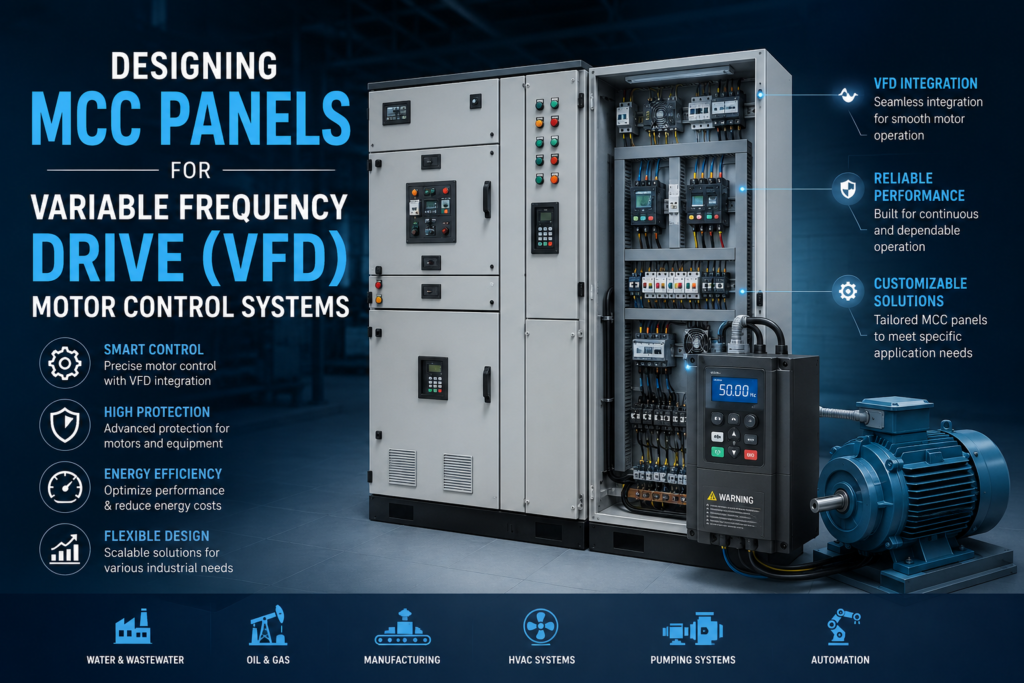
Walk through any modern manufacturing plant, and you’ll find that very few motors run at full speed all day. Production lines speed up and slow down, pumps respond to process demand, and conveyor systems adjust based on throughput requirements. This flexibility is largely made possible by Variable Frequency Drives (VFDs).
As VFD adoption keeps growing across manufacturing industries, MCC panel design has had to evolve with it. A standard motor control center that works perfectly for direct-on-line motor starters may not be suitable for VFD-based applications. Harmonics, heat dissipation, cable management, electromagnetic interference, and communication requirements all change how an MCC panel for VFD drives needs to be engineered.
For facilities investing in automation, process optimisation, and energy efficiency, the relationship between the VFD system and MCC panel design has never mattered more.
Why VFD-Driven Motors Change Panel Design Requirements
Traditional motor control is relatively clean. Power enters the MCC, passes through protection devices, and reaches the motor starter. Done.
A Variable Frequency Drive motor control system puts additional layers of electronics between the power source and the motor. The VFD continuously converts incoming AC power into DC, then reconstructs it into a variable-frequency output to control motor speed.
The benefits are real – reduced energy consumption, smoother motor operation, better process control. But so are the electrical characteristics that come with it. Thermal management, harmonic distortion, panel layout, and protection coordination all need closer attention the moment a VFD enters the picture.
Heat Is Often the First Design Challenge
Heat generation is one of the most overlooked aspects of MCC panels for VFD drives – until it becomes a problem.
Unlike conventional starters, VFDs contain semiconductor devices that generate heat continuously during operation. In large manufacturing facilities where multiple drives sit within the same enclosure, internal panel temperatures climb quickly without adequate cooling.
Proper panel design starts with calculating total heat dissipation from all installed drives and confirming the enclosure can handle it.
Depending on the application, engineers may incorporate:
- Forced ventilation systems
- Filtered cooling arrangements
- Air-conditioned electrical enclosures
- Segregated drive compartments
Getting thermal management right doesn’t just protect the drives. It extends the operational life of every component inside the MCC panel.
Harmonics Cannot Be Ignored
Every VFD introduces harmonic currents into the electrical network. As plants stack up more drives, harmonic distortion quietly becomes a serious power quality concern.
Left unmanaged, harmonics cause transformer overheating, nuisance tripping, capacitor bank stress, and reduced equipment efficiency across the facility – often in ways that are hard to trace back to the source.
Modern MCC panels for VFD motor control systems address this at the design stage rather than after problems appear. Depending on system requirements, engineers integrate:
- Line reactors
- DC link chokes
- Harmonic filters
- Active harmonic mitigation systems
Dealing with harmonics at the panel design level improves overall power system performance and keeps the installation on the right side of power quality standards.
Panel Layout Has a Direct Impact on Reliability
Fitting components into an enclosure is the easy part. How those components are arranged is what actually determines long-term reliability and how straightforward maintenance turns out to be.
VFDs generate both heat and electromagnetic interference. Sensitive control wiring sitting next to power cables creates communication issues and control system disturbances that are frustrating to diagnose and fix.
Experienced panel designers separate power cables, control wiring, communication networks, and drive power sections deliberately – not as a preference, but because the consequences of not doing so show up eventually.
In large industrial facilities, a well-considered panel layout contributes as much to reliability as the quality of the electrical components themselves.
Communication Is Now Part of Motor Control
Modern manufacturing plants run on automated control systems, and MCC panels with VFD drives are now routinely integrated into broader plant automation architectures.
Drives don’t operate in isolation anymore. They communicate continuously with PLCs, SCADA systems, and industrial networks. Protocols like Modbus, Profinet, Ethernet/IP, and CAN communication are now standard inclusions in industrial MCC panels.
That connectivity gives operators real-time visibility into motor performance, energy consumption, fault conditions, and operational status. The result is faster troubleshooting, better process control, and production efficiency that reactive systems simply can’t match.
Building MCC Panels Around Application Requirements
No two manufacturing facilities operate the same way. A food processing plant has different motor control requirements than a cement factory or an automotive production line — and the MCC panel design should reflect that.
At Synchro Electricals, designing MCC panels for VFD motor control systems starts with understanding how the application actually runs. Motor ratings, drive quantity, harmonic levels, communication requirements, and environmental conditions all shape the final design.
Working through those parameters carefully is what produces MCC panels for VFD drives that support efficient motor control, better energy performance, and reliable operation across diverse industrial sectors.
The Future of Motor Control Is Intelligent and Efficient
Variable Frequency Drives have genuinely transformed how industrial motors operate – better process control, lower energy consumption, improved equipment performance.
But none of those benefits land properly without the right MCC panel behind them. Heat, harmonics, communication requirements, and maintenance considerations all have to be engineered into the panel, not worked around after installation.
As manufacturing facilities keep moving toward automation and smart production technologies, properly designed MCC panels for VFD motor control systems will stay at the centre of reliable, efficient, and scalable motor control.