Water treatment plants rarely get attention for their electrical infrastructure, yet every stage of water processing depends on it. Raw water intake stations, pumping systems, filtration units, aeration systems, chemical dosing equipment, treated water distribution networks – reliable electrical power is what keeps the entire operation running.
Unlike most industrial facilities, water utilities operate continuously. A power interruption doesn’t just cause inconvenience – it affects water supply, treatment quality, and regulatory compliance. That’s one of the core reasons VCB panels for water treatment plants have become a preferred solution for medium voltage (MV) power distribution systems.
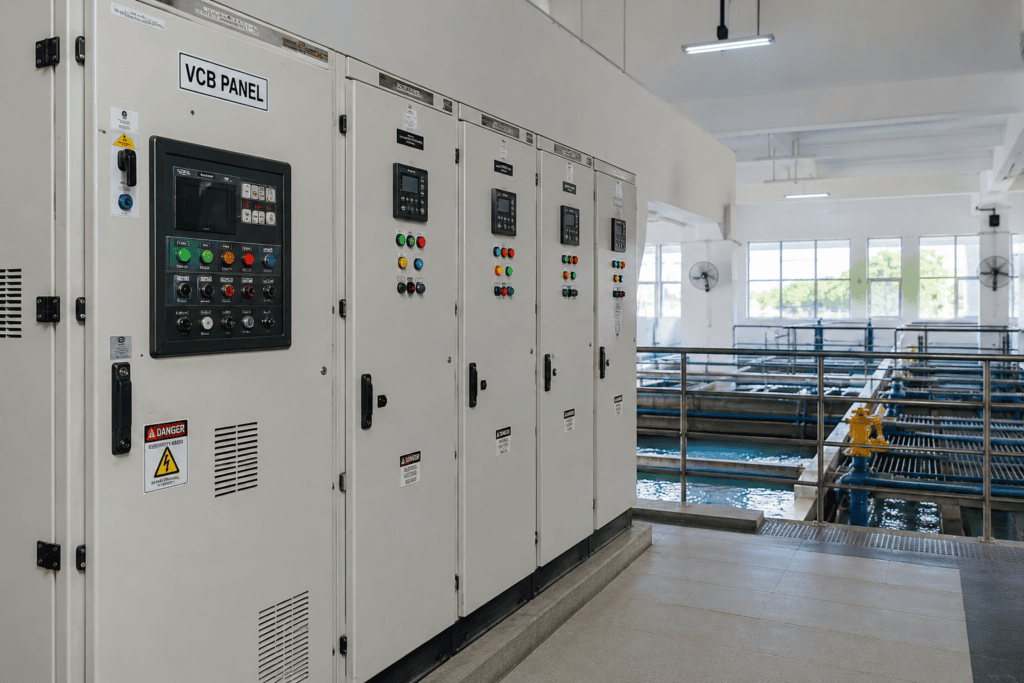
Built to handle medium-voltage networks safely and efficiently, VCB panels provide the switching, protection, and operational reliability that modern water utility infrastructure demands.
Every Pump Starts With a Reliable Medium Voltage Network
A typical water treatment facility runs dozens of motors simultaneously. High-capacity raw water pumps, booster pumps, sludge handling systems, treatment equipment – the electrical demand on the network is substantial and constant.
These loads are commonly supplied through medium voltage power distribution systems, particularly in large municipal water treatment plants and regional water utility projects.
Supplying power is only part of the challenge. The network also has to manage motor starting currents, load fluctuations, and fault conditions without disrupting critical operations.
Medium voltage VCB panels sit between incoming utility supply or transformers and downstream equipment, acting as the control point for distributing and protecting electrical power across the facility.
Why Vacuum Circuit Breakers Have Become the Industry Standard
Oil circuit breakers were once standard in water utility facilities. Vacuum circuit breaker panels have largely replaced them – and the reason comes down to how the vacuum interrupter actually works.
When a fault occurs, and breaker contacts separate, an electrical arc forms. Inside a vacuum interrupter, the arc extinguishes extremely quickly because there are very few gas molecules available to sustain ionisation.
The practical results are:
- Faster fault interruption
- Reduced contact wear
- Longer service life
- Minimal maintenance requirements
For operators of water treatment and power distribution systems, that means better reliability and lower lifecycle costs over the panel’s entire service life.
Protecting Critical Equipment From Electrical Faults
Pumps, blowers, control systems, and automation equipment in water treatment facilities can’t absorb frequent electrical disturbances. Stable power quality and reliable protection aren’t optional – they’re what keeps treatment processes running correctly.
A modern VCB panel for water utilities incorporates protection relays that monitor electrical conditions across the network continuously. These systems detect short circuits, overcurrent conditions, earth faults, undervoltage events, and feeder abnormalities.
When a fault hits, the vacuum circuit breaker isolates the affected section quickly while healthy sections of the plant keep operating. That selective fault isolation matters enormously in large treatment facilities — a complete plant shutdown carries significant operational consequences that extend well beyond the electrical system.
The Challenge of Moisture and Harsh Operating Conditions
Electrical equipment in water treatment plants doesn’t operate in a clean, controlled environment. High humidity, chemical exposure, temperature variations, and occasionally corrosive conditions create challenges that standard industrial switchgear isn’t always built to handle.
VCB panels used in water treatment plants are engineered with durable enclosures, effective insulation systems, and corrosion-resistant construction specifically because of this. Ventilation requirements and internal temperature management also have to be factored into the panel design to maintain reliable operation over extended periods.
The ability of a medium voltage VCB panel to hold up consistently under these conditions is a significant reason it remains the preferred solution in the water utility sector.
Automation Is Changing the Way Water Utilities Operate
Modern water treatment plants are moving steadily toward greater automation and centralised control. SCADA systems now monitor equipment status, energy consumption, and plant performance across entire facilities from a single interface.
VCB panels for water treatment plants are increasingly integrated with digital monitoring and communication systems to support this shift.
That integration gives plant personnel remote visibility over breaker status, electrical load conditions, fault events, power quality parameters, and maintenance alerts – all in real time. Combining medium voltage switchgear with SCADA integration improves operational visibility and cuts response times when abnormal conditions develop.
Engineering Power Distribution for Utility Reliability
At Synchro Electricals, water treatment facilities need electrical infrastructure that runs reliably every day without interruption – and designing VCB panels for medium voltage power distribution starts from that understanding.
Feeder configurations, fault levels, switching requirements, environmental conditions, and future expansion needs all feed into how each panel gets engineered. That scope is what produces VCB panels for water treatment plants that deliver dependable performance, efficient protection, and long-term reliability rather than just meeting minimum specifications.
Reliable Water Starts With Reliable Power
Water treatment facilities depend on electrical systems as much as they depend on pumps and filtration equipment. Without dependable medium voltage power distribution, even the most advanced treatment process can’t operate effectively.
Fast fault interruption, strong protection capabilities, and low-maintenance operation are what make VCB panels a critical part of modern water treatment plants and water utility infrastructure.
As municipalities and utility operators expand water networks, reliable medium voltage VCB panels will stay essential for delivering safe, uninterrupted water services to communities and industries that can’t afford anything less.