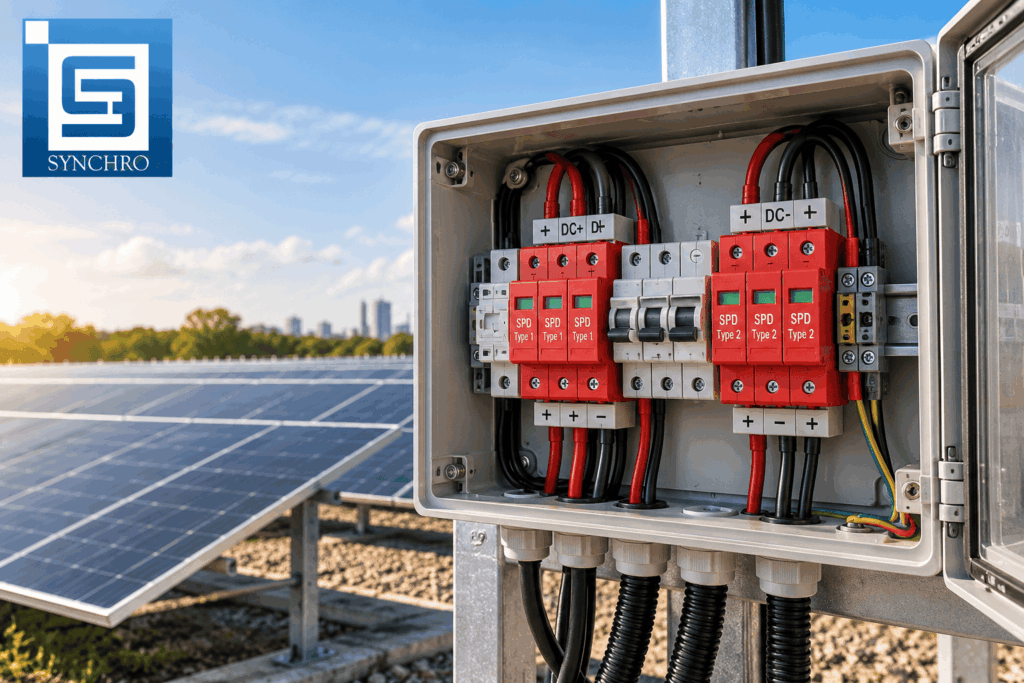
A solar array is a large metal structure spread across an open roof or field, connected to sensitive electronics by long cables. That makes it very good at collecting surges, from direct lightning strikes, from strikes nearby, and from switching on the grid. The surge protective device (SPD) in the DCDB is what stands between those surges and the inverter.
The most common question we get from EPC teams is whether a DCDB needs a Type 1 or a Type 2 SPD. The short answer: Type is not a quality grade. It describes what kind of surge current the device is designed to carry, and that depends on how the site is exposed to lightning. This guide explains how to choose.
The 10/350 μs waveform carries far more energy than the 8/20 μs waveform at the same peak current. So a 20kA Type 2 rating and a 12.5kA Type 1 rating are not comparable numbers. Compare ratings only under the same waveform.
The separation distance is set by the lightning protection design under IEC 62305. If the PV structure is directly bonded to the air-termination system, part of a lightning strike can flow through the PV conductors, and that is Type 1 duty.
Always specify a PV-rated DC SPD tested to IEC 61643-31. An AC SPD or a general DC SPD is not designed for the way PV current behaves under fault.
Table of Contents
- What an SPD Does in a DCDB
- Type 1, Type 2 and Type 1+2 Explained
- When Is a Type 1 SPD Needed?
- The Ratings That Actually Matter
- Relevant Standards
- Where to Place SPDs in a Solar System
- Installation Details That Decide Performance
- Common SPD Mistakes in Solar DCDBs
- Why Work With Synchro Electricals
- Conclusion
- FAQs
What an SPD Does in a DCDB
An SPD is normally non-conducting. When a surge raises the voltage across it above a threshold, it conducts, diverting the surge current to earth and limiting the voltage the inverter sees. When the surge passes, it returns to its non-conducting state. An SPD does not replace a fuse, breaker, isolator, earthing system or external lightning protection system. It is one part of a coordinated protection scheme.Type 1, Type 2 and Type 1+2 Explained
| Feature | Type 1 | Type 2 | Type 1+2 |
|---|---|---|---|
| Designed for | Partial direct lightning current | Induced and switching surges | Both, in one device |
| Test waveform | 10/350 μs | 8/20 μs | Both |
| Key rating | Iimp (impulse current) | In (nominal) and Imax (maximum) discharge current | Iimp and In |
| Typical location | Where lightning current can enter the system | Inverter input, combiner, DCDB | Exposed sites needing both duties |
| Energy handling | Very high | Moderate | High |
When Is a Type 1 SPD Needed?
The deciding question is whether partial lightning current can flow into the DC system.| Site situation | Typical SPD choice |
|---|---|
| Rooftop PV, no external lightning protection system (LPS) | Type 2 |
| Rooftop PV, external LPS present, separation distance maintained | Type 2 |
| Rooftop PV, external LPS present, separation distance cannot be maintained (array bonded to the LPS) | Type 1 or Type 1+2 at the relevant entry points |
| Ground-mount or utility-scale plant in an exposed open area | Project-specific study; often Type 1+2 at combiner or entry points, Type 2 at the inverter |
| Long DC cables between array and inverter | SPDs at both ends may be needed |
The Ratings That Actually Matter
Ucpv: the maximum continuous PV voltage
This is the most important rating, and the one most often chosen wrongly. Ucpv must be at or above the maximum string open-circuit voltage, calculated at the lowest site temperature. Module voltage rises on cold mornings. A string that is 900V at standard conditions can exceed 990V when cold. A 1,000V label is not an automatic match.Up: the voltage protection level
Up is the voltage the SPD lets through during a surge. It must be lower than the impulse withstand voltage of the equipment it protects, usually the inverter’s DC input. Long connecting leads add voltage, so the installed protection level is higher than the marked Up.In, Imax and Iimp
In is the current the SPD can discharge repeatedly. Imax is the maximum it can survive once. Iimp is the Type 1 lightning current rating. Choose these from the risk assessment, not from the biggest number on a catalogue page.ISCPV: short-circuit current rating
A PV SPD must be able to handle the PV array’s short-circuit current if it fails, without catching fire. Its declared PV short-circuit rating must be at or above the array’s maximum short-circuit current at that point.Relevant Standards
| Standard | What it covers |
|---|---|
| IEC 61643-31 | Requirements and tests for SPDs on the DC side of PV installations, up to 1,500V DC |
| IEC 61643-32 | Selection and application principles for SPDs in PV installations |
| IEC 62305 | Lightning protection, including risk assessment and separation distance |
| IEC 60364-7-712 | Electrical installation requirements for PV systems |
Where to Place SPDs in a Solar System
- At the inverter DC input: almost always. If the inverter has a built-in SPD, check its rating and type.
- At the DCDB or string combiner box: when the DC cable to the inverter is long. Many design guides use roughly 10m as a trigger to consider protection at both ends. Treat it as a design checkpoint, not a fixed rule.
- On the AC side: an AC SPD in the ACDB protects against grid-side surges.
- On data lines: RS485 or Ethernet monitoring lines also need protection on exposed sites.
Installation Details That Decide Performance
- Keep leads short. Every extra length of conductor adds inductive voltage during a surge. Many guides recommend keeping the total lead length to the SPD under about 0.5m.
- Use proper earthing. The SPD earth must connect to the equipotential bonding system with a low-impedance path.
- Use the backup protection the SPD manufacturer specifies. Do not upsize it because a previous device operated.
- Choose replaceable cartridges with a visual indicator. O&M teams can then replace a failed module without rewiring.
- Use a remote signalling contact on larger plants. SPD failure then shows up on SCADA or a string monitoring box, not only during a site walk.
Common SPD Mistakes in Solar DCDBs
| Mistake | Risk |
|---|---|
| Ucpv chosen from nominal string voltage, not cold-weather Voc | SPD conducts continuously and fails or catches fire |
| AC SPD used on the DC side | No safe DC fault interruption |
| Type 2 used where lightning current can enter the system | SPD destroyed by first nearby strike |
| Long, looped earth lead | Inverter sees much higher voltage than the marked Up |
| No status monitoring | Failed SPD goes unnoticed for months |