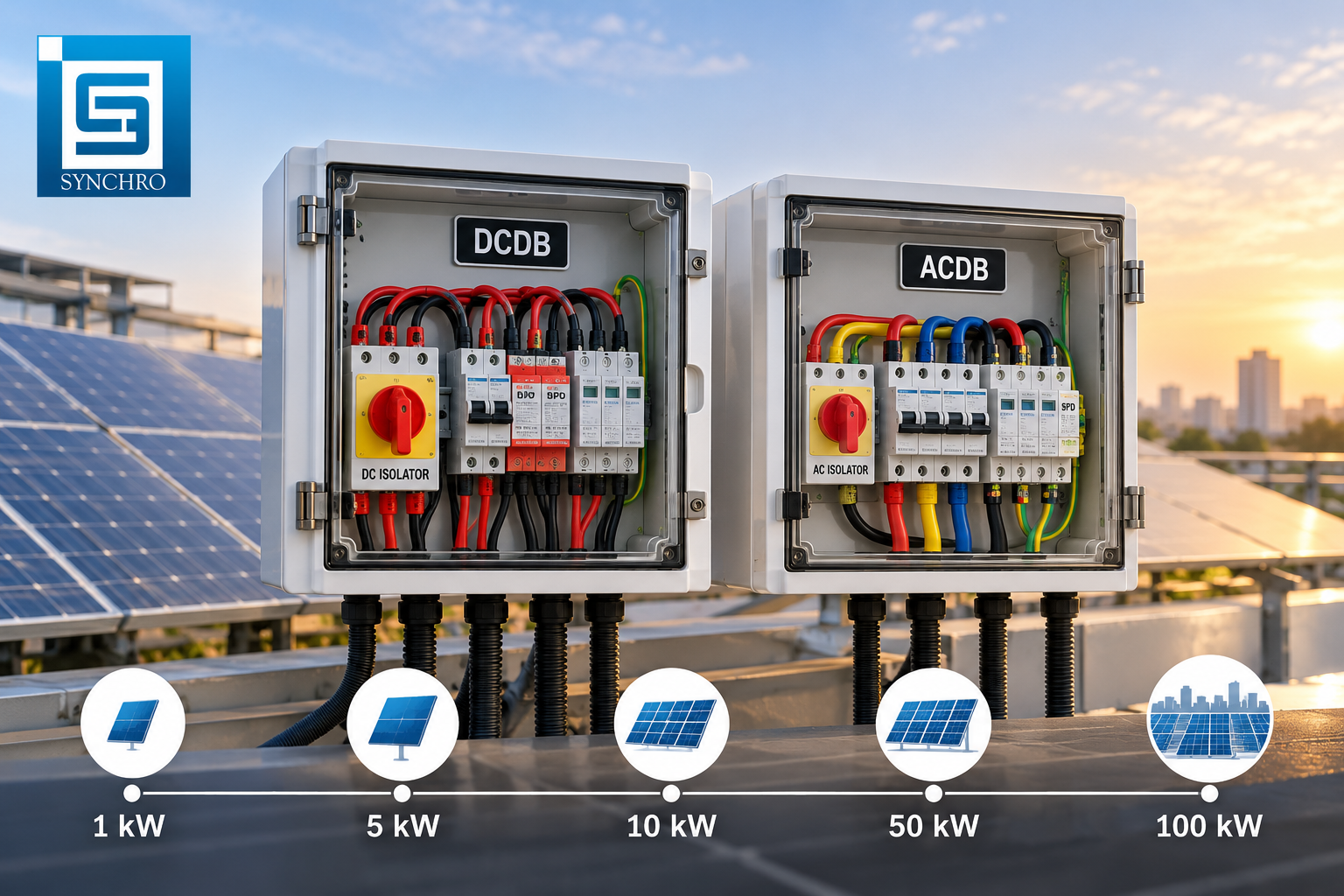
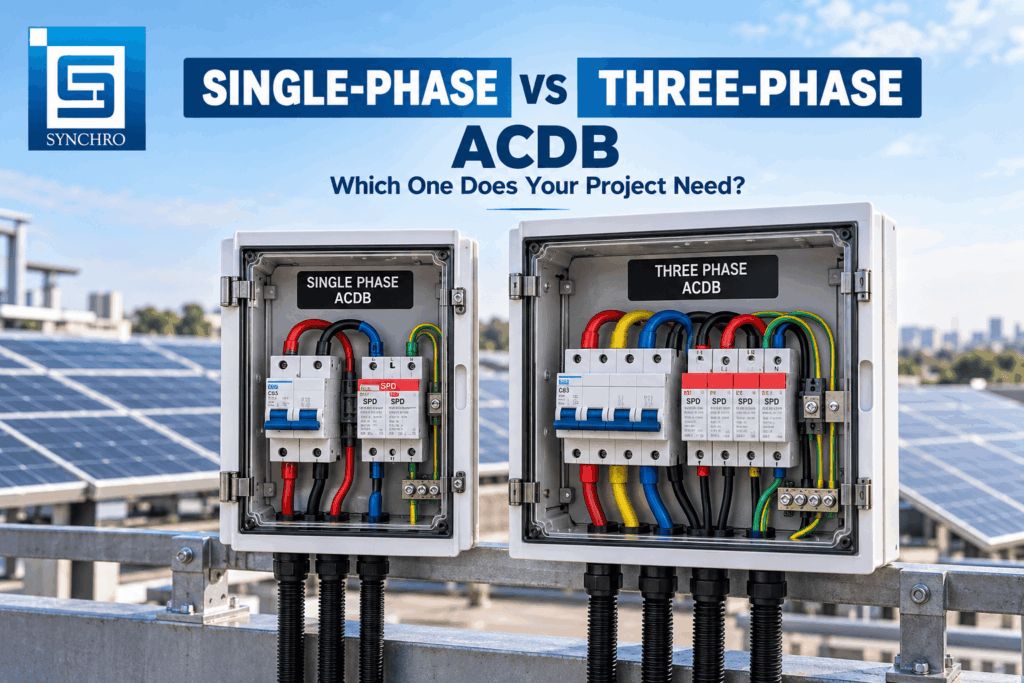
The choice between a single-phase and a three-phase ACDB is rarely made at the ACDB. It is made earlier, when the inverter is selected and the grid connection is confirmed. The ACDB simply has to match both. Problems start when a box is ordered from a generic kW list without checking either.
This guide explains how to decide, what changes inside the box, and the mistakes we see most often when installers order solar ACDB/DCDB boxes in volume.
What an ACDB Does in a Solar System
The ACDB sits between the inverter output and the building’s distribution board or net meter. It does three jobs:
- protects the inverter’s AC cable against overload and short circuit
- isolates the inverter safely for maintenance
- protects the inverter from surges arriving from the grid
A single-phase ACDB does this for a 230V single-phase inverter. A three-phase ACDB does it for a 415V three-phase inverter, with protection on all three phases and the neutral.
What Decides Single-Phase or Three-Phase
1. The grid connection at the site
If the consumer has a single-phase service connection, the system will almost always be single-phase. If the site has a three-phase connection, either type may be possible for small systems, depending on local rules.
2. The inverter
The ACDB must match the inverter’s output. A single-phase inverter needs a single-phase ACDB, even if the building has a three-phase supply. A three-phase inverter needs a three-phase ACDB.
3. System size
Small residential systems, roughly 1kW to 5kW, are commonly single-phase. Larger systems are usually three-phase, because pushing high power through one phase raises current, increases voltage rise on that phase, and can unbalance the building’s supply.
4. DISCOM and regulator rules
Connection rules differ by state and DISCOM, and they change over time. Some set capacity limits for single-phase connections; others leave the choice to the consumer below a certain size. In Tamil Nadu, for example, the regulator clarified in December 2020 that systems up to 4kW could connect at either a 240V single-phase or 415V three-phase service, at the consumer’s option. Always check the current net-metering regulations of the relevant DISCOM before finalising the design.
What Changes Inside the Box
| Component | Single-phase ACDB | Three-phase ACDB |
|---|---|---|
| Incomer / outgoing MCB | 2-pole (phase + neutral) | 4-pole (three phases + neutral), or 3-pole with separate neutral link as specified |
| RCCB / RCBO (where required) | 2-pole | 4-pole |
| AC surge protection | 1P+N SPD | 3P+N SPD |
| Busbar/terminals | L and N | L1, L2, L3 and N |
| Metering (optional) | Single voltmeter and ammeter | Voltmeter with selector switch, ammeters or multifunction meter |
| Enclosure size | Smaller | Larger, more heat to dissipate |
| Typical system size | About 1–5kW | About 5kW upwards |
Single-Phase vs Three-Phase: Pros and Cons
| Factor | Single-phase system | Three-phase system |
|---|---|---|
| Cost of ACDB | Lower | Higher (more poles, larger SPD) |
| Current per conductor | Higher for the same kW | About one-third, spread across phases |
| Voltage rise at the inverter | More likely on weak grids | Lower, because current is shared |
| Effect on building balance | Can unbalance a three-phase building | Balanced output |
| Inverter choice | Wide range in small sizes | Wide range from about 5kW |
| Suitable for | Homes with single-phase supply, small systems | Larger homes, shops, factories, C&I rooftops |
When to Choose a Single-Phase ACDB
- The site has a single-phase service connection.
- The inverter is single-phase, usually in the 1kW to 5kW range.
- The DISCOM permits the system size on a single-phase connection.
See our single-phase ACDB/DCDB range.
When to Choose a Three-Phase ACDB
- The site has a three-phase supply and the system is above the single-phase limit.
- The inverter is three-phase.
- The building has three-phase loads such as pumps, lifts, or machines, where balanced export is better.
- The system is for a commercial or industrial rooftop.
See our three-phase ACDB/DCDB range.
Mistakes We See on Site
| Mistake | Result | Fix |
|---|---|---|
| Three-phase ACDB installed with a single-phase inverter | Two phases unused, confused terminations, wasted cost | Match the ACDB to the inverter output |
| Single-phase inverter connected to the most loaded phase of a three-phase building | Voltage rise and inverter tripping on that phase | Connect to the least loaded phase, after measuring |
| Neutral not protected or poorly sized | Overheating, nuisance tripping | Follow the inverter manual and wiring rules for neutral switching |
| 3P+N inverter with a 3P SPD and no neutral protection | Neutral-earth surges not covered | Use the correct SPD configuration |
| Wrong RCD type for the inverter | RCD trips or fails to detect DC leakage | Use the type stated in the inverter manual |
| Mixed single- and three-phase boxes in one bulk shipment, poorly labelled | Wrong box installed on site | Label every box clearly by phase and kW band |
Ordering ACDBs for Mixed Fleets
Installers and EPCs who run rooftop programmes usually need both types. Typical bulk orders combine a 3kW single-phase band, a 5kW single-phase band and a 10kW three-phase band.
The practical approach is to fix one approved design per band and per phase type, and label every enclosure with the phase, rating and system band. This prevents the most common site error, which is the wrong box reaching the wrong roof. Read our ACDB and DCDB sizing guide (activate once live) for the sizing method behind each band.
Why Work With Synchro Electricals
Synchro Electricals, based in Rajkot and manufacturing since 2018, builds ACDB DCDB boxes in both single-phase and three-phase configurations. We:
- design the box from your inverter model and grid type
- share drawings for approval before we order components
- test every box for insulation resistance, high voltage, and function, and supply a test report with each order
- label boxes clearly by phase and rating for bulk rollouts
- work under an ISO 9001:2015 certified quality system (see certificates)
Conclusion
Choosing between a single-phase and three-phase ACDB starts with three checks: the grid connection, the inverter output, and the local DISCOM rule. Once those are fixed, the ACDB follows: 2-pole and 1P+N for single-phase, 4-pole and 3P+N for three-phase, each sized to the inverter’s maximum current.
Need both types for a rooftop programme? Send us your inverter list and quantities, and we will propose standard designs for each band.
FAQs
1. What is the difference between a single-phase and three-phase ACDB?
A single-phase ACDB protects one phase and neutral, using 2-pole devices and a 1P+N SPD. A three-phase ACDB protects three phases and neutral, using 4-pole devices and a 3P+N SPD.
2. Can I use a three-phase ACDB with a single-phase inverter?
It is not recommended. Two phases would be unused, terminations can be confused on site, and the cost is higher. Use an ACDB that matches the inverter output.
3. Which is better for home solar, single-phase or three-phase?
For small systems on a single-phase connection, single-phase is simpler and cheaper. For larger homes with a three-phase supply, a three-phase system shares current across phases and reduces voltage rise.
4. Up to what kW can I install a single-phase solar system?
It depends on your DISCOM’s current rules and your sanctioned load. Limits vary by state. Check the net-metering regulations before finalising.
5. Can I install a single-phase inverter on a three-phase connection?
Often yes for small systems, if the DISCOM permits it. Connect it to the least loaded phase and check voltage rise.
6. Is a three-phase inverter more efficient than single-phase?
Efficiency figures are similar. The main advantages of three-phase are lower current per conductor, balanced output and lower voltage rise.
7. What MCB is used in a single-phase ACDB?
A 2-pole MCB sized at about 1.25 times the inverter’s maximum output current. For a 3kW single-phase inverter, that is usually a 20A 2-pole MCB.
8. What MCB is used in a three-phase ACDB?
A 4-pole MCB or MCCB sized at about 1.25 times the maximum output current per phase. For a 10kW three-phase inverter, that is usually a 20A 4-pole MCB.
9. Does a three-phase ACDB need a neutral?
Most three-phase grid-tied inverters use a neutral connection, so the ACDB carries and usually switches the neutral. Follow the inverter manual.
10. Which SPD is used in a three-phase ACDB?
Usually a Type 2 AC SPD in a 3P+N arrangement, rated for the grid’s continuous operating voltage.
11. Is an RCCB required in the ACDB?
It depends on DISCOM rules, building wiring requirements, and the inverter manufacturer. Some inverters specify a particular RCD type.
12. Why does my single-phase inverter trip on high voltage?
Common causes are a weak grid, a long or undersized AC cable, or connection to a heavily loaded phase. A three-phase inverter or a better-chosen phase can help.
13. Can one ACDB serve two single-phase inverters?
Yes, with separate incoming feeders. On a three-phase building, spreading them across different phases improves balance.
14. Is a three-phase ACDB larger than a single-phase ACDB?
Yes. It holds more poles, a larger SPD, and more terminals, and dissipates more heat, so the enclosure is bigger.
15. Do you supply both single-phase and three-phase ACDB boxes?
Yes. Synchro Electricals supplies both, in standard and custom configurations, including bulk orders. Contact us with your requirements.