Most panel disputes we have seen over the years did not start with a technical failure. They started with a misunderstanding about testing.
A buyer signs off a panel at the factory, the panel reaches site, and three weeks later a feeder trips during commissioning. Now there is an argument. Was the panel faulty? Was it damaged in transit? Was it installed correctly? Was the relay setting wrong? Nobody can answer clearly, because nobody agreed upfront on what was going to be tested, where, and by whom.
FAT and SAT exist to prevent exactly this situation. They are not paperwork. They are the two checkpoints that decide whether an electrical panel does its job for the next fifteen years or becomes a recurring problem on your plant floor.
This article explains what each test actually covers, why passing one does not make the other optional, and what an industrial buyer, EPC contractor, or consultant should be checking at each stage.
What is a Factory Acceptance Test (FAT)?
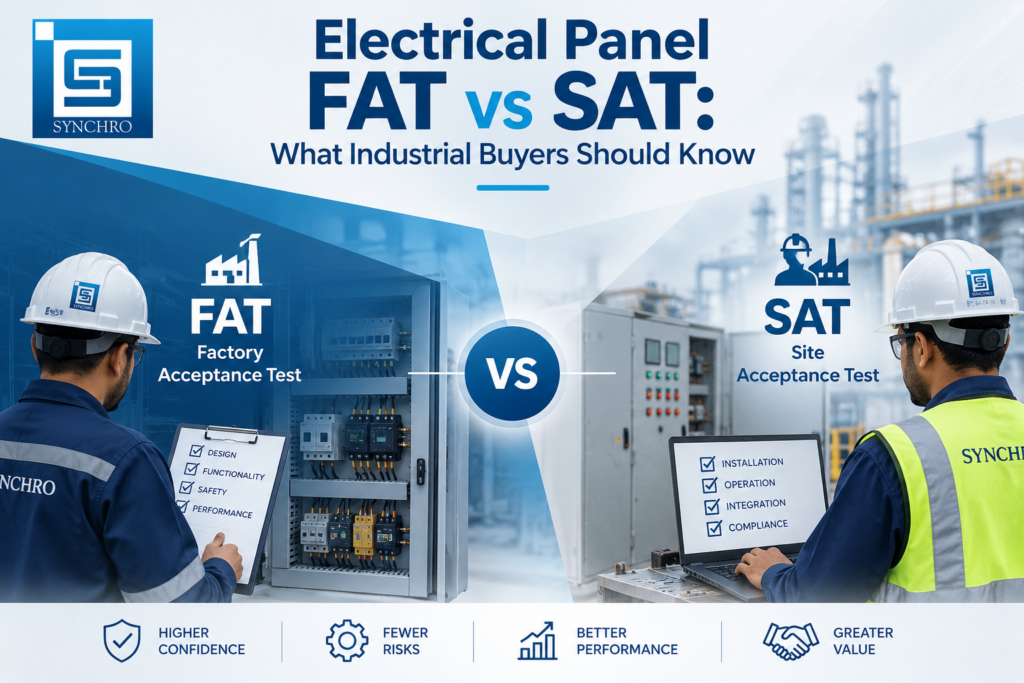
A Factory Acceptance Test is carried out at the manufacturer’s works, after the panel is fully built and before it is dispatched. The customer or their representative attends, and the panel is tested against the approved drawings and the purchase order specification.
The purpose is straightforward: confirm that what was designed and approved is what has actually been built, and catch problems while the panel is still standing next to the people and tools that can fix it.
A properly run FAT on an LT electrical control panel typically covers:
Construction and physical verification
- Dimensional check against the approved general arrangement (GA) drawing
- Enclosure construction, sheet thickness, powder coating shade and dry film thickness
- Ingress protection (IP rating) verification through gasket inspection, door alignment and gland plate arrangement
- Busbar sizing, support spacing, phase identification and torque records on all joints
- Earthing continuity across doors, gland plates and the main earth bus
- Component makes and ratings checked line by line against the approved bill of materials
- Cable entry arrangement, terminal blocks, and space available for site termination
Electrical and functional verification
- Insulation resistance (megger) testing between phases, and phases to earth
- High-voltage withstand test (typically 2.5 kV for one minute on LT assemblies rated up to 690 V)
- Wiring continuity and point-to-point checks against the schematic
- Control logic simulation: interlocks, trip circuits, indications, annunciation, auto/manual selection
- CT ratio, polarity and burden checks; metering and instrument functionality
- Protection relay setting verification and secondary injection testing
- Mechanical operation of circuit breakers, switch-fuse units, draw-out mechanisms and safety shutters
The tests above broadly align with the routine verification requirements of IEC 61439-1. On a PCC panel, the emphasis falls on incomer changeover logic and busbar integrity. On an MCC panel, it falls on feeder-wise motor starter operation and overload settings. On an APFC panel, capacitor stage switching, discharge time and contactor sequencing become the focus. Each panel type needs its own checklist, not a generic one.
What is a Site Acceptance Test (SAT)?
A Site Acceptance Test happens after the panel reaches site, is installed on its foundation or base frame, and is connected to the actual incoming supply, outgoing cables and plant earthing system.
SAT answers a different question. FAT asks “is this panel built correctly?” SAT asks “does this panel work correctly in this installation, with these cables, this earthing, this load, and these ambient conditions?”
A typical SAT includes:
- Visual inspection for transit damage: dents, cracked insulators, loosened busbar joints, displaced components
- Re-verification of busbar and terminal torque after road transport
- Insulation resistance testing repeated after installation and cable termination
- Verification of cable terminations, lug sizes, gland fitment and cable support
- Earthing connection to the plant earth grid, and measured earth resistance
- Phase sequence and phase rotation confirmation at incomer and outgoing feeders
- Control supply and battery charger functioning, DC healthiness
- Live functional testing: interlocks with upstream and downstream equipment, actual motor starting, changeover operation under real conditions
- Protection coordination verification against the site fault level, including primary injection where applicable
- Communication checks with SCADA, BMS or the plant energy monitoring system
- Thermography under load after the system has been running for a few hours
- Punch list preparation and closure, followed by handover documentation
For a VCB panel or any HT assembly, SAT also includes contact resistance measurement, breaker timing tests, vacuum interrupter integrity checks and relay coordination against the utility’s protection settings. These cannot be meaningfully simulated in a factory environment.
FAT vs SAT: A Side-by-Side Comparison
| Parameter | Factory Acceptance Test (FAT) | Site Acceptance Test (SAT) |
| Location | Manufacturer’s works | Project site, after installation |
| Timing | Before dispatch | After erection and cable termination |
| Core question | Is it built as approved? | Does it work in this installation? |
| Load condition | Simulated control supply; no real load | Actual load, actual supply, actual fault level |
| Who attends | Buyer, consultant, third-party inspector, QA team | Buyer, commissioning team, contractor, manufacturer’s engineer |
| Cost of correction | Low. Workshop, tools and spares on hand | High. Site constraints, mobilisation, schedule pressure |
| Typical commercial link | Dispatch clearance, payment milestone | Commissioning sign-off, warranty start, retention release |
| What it cannot verify | Transit effects, site earthing, real load behaviour, ambient conditions | Internal construction and workmanship already enclosed and energised |
Why Passing FAT Does Not Make SAT Optional
This is the most common misunderstanding we encounter, usually from buyers under schedule pressure. The panel cleared FAT, the test report is signed, so why test again?
Because several things change between the factory floor and the plant.
Transport. A fully built power distribution panel travelling 800 km on Indian highways experiences sustained vibration. Busbar joints loosen. Control wiring ferrules shift. Relay modules work their way out of their bases. A torque re-check after transit is not paranoia; it is basic practice.
Site conditions. A panel tested in a clean, temperature-controlled workshop may be installed in a humid coastal plant, a dusty cement facility, or an outdoor solar yard at 48°C. Ventilation, ambient temperature and airborne contamination all affect performance, and none of it exists during FAT.
The rest of the electrical system. At FAT, the panel stands alone. At SAT, it is one element of a larger system. Cable lengths affect voltage drop. The plant earthing grid affects fault current paths. The actual fault level rating available at your incomer may differ from the design assumption. Upstream and downstream protection devices have to coordinate, and that can only be verified in the real system.
Installation workmanship. Even a perfect panel can be undermined by an undersized lug, a poorly made termination, an unsupported cable pulling on a terminal, or a missing earth connection. SAT is where these get caught.
We have had cases where a panel passed FAT without a single observation, and SAT revealed that the site cable schedule had changed after the panel design was frozen. Better to find that at commissioning than during the first monsoon.
Type Test, Routine Test, FAT: Clearing Up the Confusion
Buyers often use these terms interchangeably, and vendors sometimes allow the confusion to continue. They are three different things.
Type test (design verification) is performed once on a representative sample assembly, usually at an independent laboratory such as CPRI. It proves the design can withstand specified conditions: temperature rise limits, short circuit withstand capacity, dielectric properties, degree of protection, and mechanical operation. It certifies the design, not each individual panel. A type tested panel gives you documented proof that the construction, busbar arrangement and clearances have been validated against IEC 61439. Our 800 Vac Solar Type Tested Panel carries this certification, which is why it is specified on projects where inspection scrutiny is high.
Routine test is performed by the manufacturer on every single panel produced, covering construction checks, dielectric properties and functional operation. It is an internal quality gate, and the test report should travel with the panel.
FAT is a customer-witnessed verification, usually built on top of the routine test, that also checks conformity to your specification: your approved drawings, your specified component makes, your relay settings, your labelling and your documentation requirements.
A vendor showing you a type test certificate has told you something useful about the design. They have not told you that your specific panel was built correctly. Ask for all three: type test reference, routine test report, and a witnessed FAT.
Mistakes We See Industrial Buyers Make
Not agreeing the FAT protocol at the order stage. The test procedure, checklist, acceptance criteria and attendance requirements should be frozen along with the drawing approval, not negotiated a week before dispatch.
Arriving at FAT without the approved drawings. If your team turns up without the approved GA, single line diagram and schematic, the FAT becomes a demonstration rather than a verification. Bring the documents and check against them.
Accepting a video FAT for critical panels. Remote inspection has its place for repeat, standard panels. For a custom MCC panel, a synchronising panel, or an HT assembly, someone technical should physically attend. Torque, gasket compression and internal workmanship do not photograph well.
Treating SAT as a formality once the schedule slips. This is where the compromise usually happens, and where the cost surfaces later.
Not defining who pays for re-testing. If a panel fails FAT and a second visit is needed, the commercial responsibility should be written into the purchase order.
Ignoring documentation handover. A panel is not fully delivered until you have the wiring diagrams, component datasheets, test reports, relay setting sheet, torque records, IP declaration, spares list and O&M manual. Chasing these six months later is far harder.
What Buyers Should Ask an Electrical Panel Manufacturer Before Ordering
If you are evaluating electrical control panel manufacturers for an upcoming project, these questions tell you more than a product catalogue will:
- Will you submit GA drawings, SLD and schematics for written approval before procurement starts?
- What routine tests are performed on every panel, and will I receive the report?
- Do you have a type tested panel design relevant to my application, and can I see the certificate?
- What does your standard FAT checklist include, and can it be customised to my specification?
- How much notice will I get for FAT readiness?
- What is your declared short circuit withstand capacity, current rating, voltage rating and ingress protection IP rating, and how are they substantiated?
- Will you depute an engineer for SAT and commissioning support?
- What documentation is handed over at dispatch, and what is handed over at commissioning?
A manufacturer that answers these clearly is one that has done it before. Vague answers at the enquiry stage tend to become vague answers during commissioning.
How Synchro Electricals Approaches FAT and SAT
At our Rajkot facility, no panel leaves the floor without high-voltage testing, insulation resistance testing and full functional testing, with the report compiled and issued along with the panel. That is the routine test, and it is not optional or chargeable.
Beyond that, we encourage customers to witness FAT. It is a genuinely useful hour for both sides. Observations get recorded, corrected and re-verified while the panel is still accessible, and the commissioning team arrives at site already familiar with the panel.
For SAT and commissioning, our technical team stays reachable. Whether it is relay setting confirmation on a PCC panel, changeover timing on an AMF and ATS panel, string polarity checks on a solar ACDB and DCDB installation, or troubleshooting an interlock on an MCC, support after delivery is part of the supply, not a separate negotiation.
We build to IS standards and IEC compatibility across our range, hold ISO 9001:2015 certification, and our 800 Vac Solar Type Tested Panel carries type test approval. Those certificates exist so that your inspection and compliance process is straightforward rather than adversarial.
Closing Thought
FAT and SAT are not two versions of the same inspection. One protects you from manufacturing and specification errors. The other protects you from transport, installation and system integration errors. Skip either, and you are relying on luck at a point in the project where luck is expensive.
If you are specifying panels for an upcoming industrial, solar or infrastructure project and want the test plan discussed before the order rather than after, our engineering team is available to review your requirement.
Synchro Electricals Pvt. Ltd. Plot No. 35–40, Pushti Parishar Industrial Area, Ravki, Taluka Lodhika, Rajkot, Gujarat 360004 Phone: +91 96019 65426 | Email: info@synchroelectricals.in
FAQS:-
Is FAT mandatory for every electrical panel? Not contractually, unless your purchase order specifies it. Practically, it is worth insisting on for custom-engineered panels, HT assemblies, and any panel serving a critical or continuous process. For small, standard distribution boards, a routine test report is usually sufficient.
How long does a FAT take? For a single LT panel, two to four hours. For a multi-section PCC and MCC lineup, a full working day or more. Plan for it properly rather than squeezing it around a flight schedule.
Who should attend from the buyer’s side? Someone who can read the schematic and make a decision. Ideally the project electrical engineer plus the commissioning lead, and a third-party inspector where the contract requires one.
Can SAT be waived if FAT was clear? It should not be. Even a brief SAT covering torque re-check, insulation resistance, earthing verification, phase sequence and functional operation protects you from the most common post-installation failures.
When does the warranty period start? Define this in the purchase order. Typically it runs from commissioning or from a fixed period after dispatch, whichever is earlier. Ambiguity here causes disputes later.