Most new utility-scale solar plants in India are designed at 1500V DC. The move from 1000V was driven by cost: longer strings mean fewer strings, fewer combiner boxes, less cable and fewer terminations per megawatt. But a 1500V combiner box is not a 1000V box with a new label. Nearly every component inside it changes, and so do the insulation distances and the consequences of a mistake.
This guide explains what changes and what EPC teams should check when they buy string combiner boxes for a 1500V plant.
Module counts above are indicative. Always calculate string length from the module datasheet and the lowest site temperature.
Why the Industry Moved to 1500V
The maximum system voltage limits how many modules can be connected in series. At the lowest site temperature, a typical modern module’s open-circuit voltage is around 52–54V.| Item | 1000V system | 1500V system |
|---|---|---|
| Approximate modules per string | About 18 | About 27–28 |
| Strings per MW (same modules) | More | About one-third fewer |
| Combiner boxes per MW | More | Fewer |
| DC cable and terminations | More | Fewer |
| Current for the same power | Higher | Lower |
| Inverter options | Older central and string inverters | Modern central and high-power string inverters |
What Changes Inside the Combiner Box
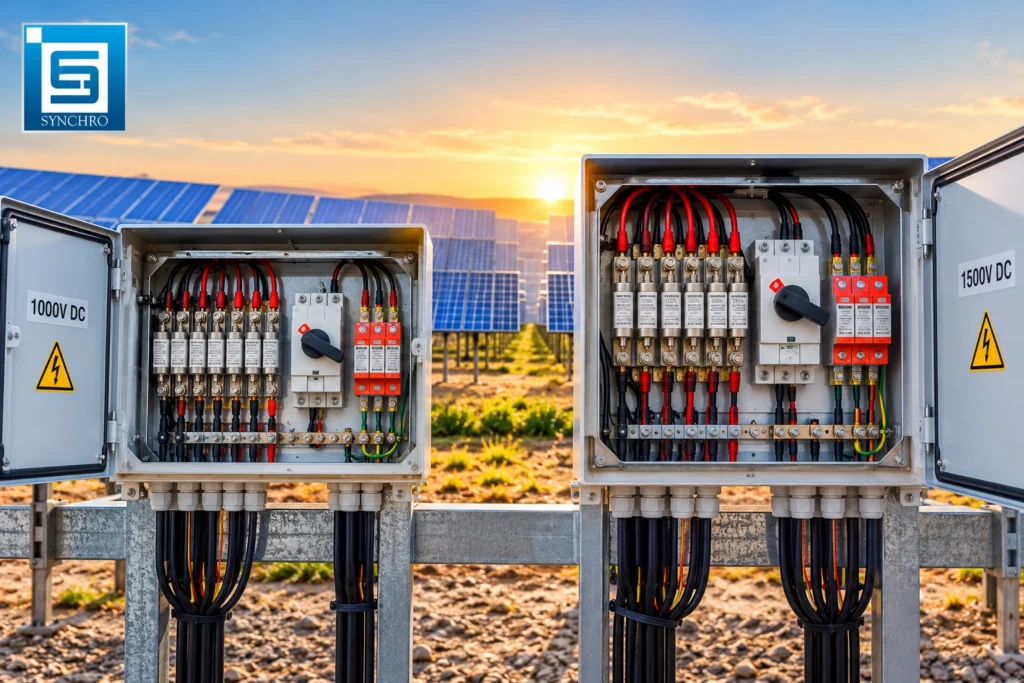
| Component | 1000V combiner box | 1500V combiner box |
|---|---|---|
| String fuses | 1000V gPV | 1500V gPV (IEC 60269-6), physically larger |
| Fuse holders | 1000V | 1500V-rated holders or bases |
| Main isolator | 1000V DC-PV2 | 1500V DC-PV2 (IEC 60947-3), usually larger frame |
| SPD | Ucpv suited to 1000V | Ucpv suited to 1500V systems (IEC 61643-31 covers up to 1500V DC) |
| Busbars and terminals | 1000V insulation | Higher insulation rating, more spacing |
| Clearances and creepage | Smaller | Larger, especially in dusty environments |
| Enclosure | Standard | Larger, with insulation rated for 1500V |
| Cable glands and connectors | 1000V-rated | 1500V-rated (cables and connectors marked for 1500V DC) |
| Monitoring (if included) | Hall-effect sensors, RS485 | Same, with sensors and power supply rated for the higher voltage |
The Design Points That Matter Most
1. Voltage class of every component
All components in the DC path must be rated for 1500V DC. One 1000V fuse holder in a 1500V box can fail. The approved BOM should state the voltage rating of every item, and incoming inspection should check the rating plates.2. Arc behaviour
A DC arc at 1500V carries more energy and is harder to extinguish than at 1000V. Isolators and fuses must be rated to break DC-PV current at 1500V, and internal layout should keep positive and negative conductors well separated.3. Clearances, creepage and pollution
Solar sites in Rajasthan, Gujarat and the Gulf are dusty. Dust plus morning dew forms conductive paths. At 1500V, creepage distances must be designed for the pollution level, not just for a clean laboratory.4. Heat
Combiner boxes sit outdoors in direct sun. Fuses and isolators lose capacity as temperature rises. A 1500V box usually carries fewer, longer strings, but the fuses and busbars must still be derated for the internal temperature on a summer afternoon.5. Input count
1500V combiner boxes are commonly built in 16, 24 or 32-input configurations, depending on inverter size and plant layout. Synchro Electricals builds combiner and monitoring boxes in configurations starting from 8 inputs. See our guide on choosing 8, 16 or 24 inputs (activate once live).Do 1500V String-Inverter Plants Still Need Combiner Boxes?
It depends on the architecture.- Central inverter plants: yes. Strings are combined in DC combiner boxes before the inverter.
- String inverter plants: strings usually connect directly to the inverter’s own DC inputs, so the combiner box may not be needed. The combining moves to the AC side, into an 800Vac panel.
- Hybrid layouts: some designs use DC distribution boxes such as the 1500VDC Solar DCDB Panel between array and inverter for isolation and protection.
Monitoring at 1500V
With fewer, longer strings, each string carries a larger share of the plant’s output. A single blown fuse or a broken connector costs more energy than it would in a 1000V plant. That is why many EPCs specify string monitoring boxes with current sensing per string and RS485 communication to SCADA. For how monitoring data helps catch faults early, see our post on real-time electrical data and equipment failures.Procurement Checklist for 1500V Combiner Boxes
- Every DC component rated for 1500V DC on the BOM and on the rating plate
- gPV fuses to IEC 60269-6, rated 1.5–2.4 × module Isc and within the module’s series fuse rating
- Isolator DC-PV2 category at 1500V
- SPD to IEC 61643-31 with Ucpv covering the maximum string voltage
- Enclosure IP rating, UV resistance and ventilation stated
- Creepage designed for the site’s pollution level
- Monitoring, if required, with communication protocol stated
- Insulation resistance and dielectric test results supplied