Government infrastructure work runs on a different clock than private industry. Tenders have fixed submission windows, technical specifications are rigid, and a panel that fails type testing or arrives without the right documentation can delay an entire project phase, not just one contractor’s schedule. Electrical panels for government infrastructure projects carry a weight of compliance that commercial buyers rarely deal with, and getting the specification and sourcing right the first time matters more here than almost anywhere else.
This guide walks through what makes government and public-sector panel procurement different, the standards that actually get checked at approval stage, and what to look for in a manufacturer before you commit to a tender response or a purchase order.
Why Government Projects Demand a Different Approach to Panels
A private factory buyer can often adjust a panel spec after delivery if something doesn’t quite fit. A government buyer usually cannot. Public works, whether under CPWD, state PWDs, railways, metro corporations, state electricity boards, or municipal bodies, follow approved drawings, empanelled vendor lists, and fixed technical specifications that were finalised months before the panel ships. Any deviation needs formal approval, which costs time nobody has once a project is underway.
This is why these projects are specified down to the last detail: busbar material and rating, breaker make and type, enclosure IP rating, paint specification, and even nameplate format. The panel has to match the tender document, not just perform well.
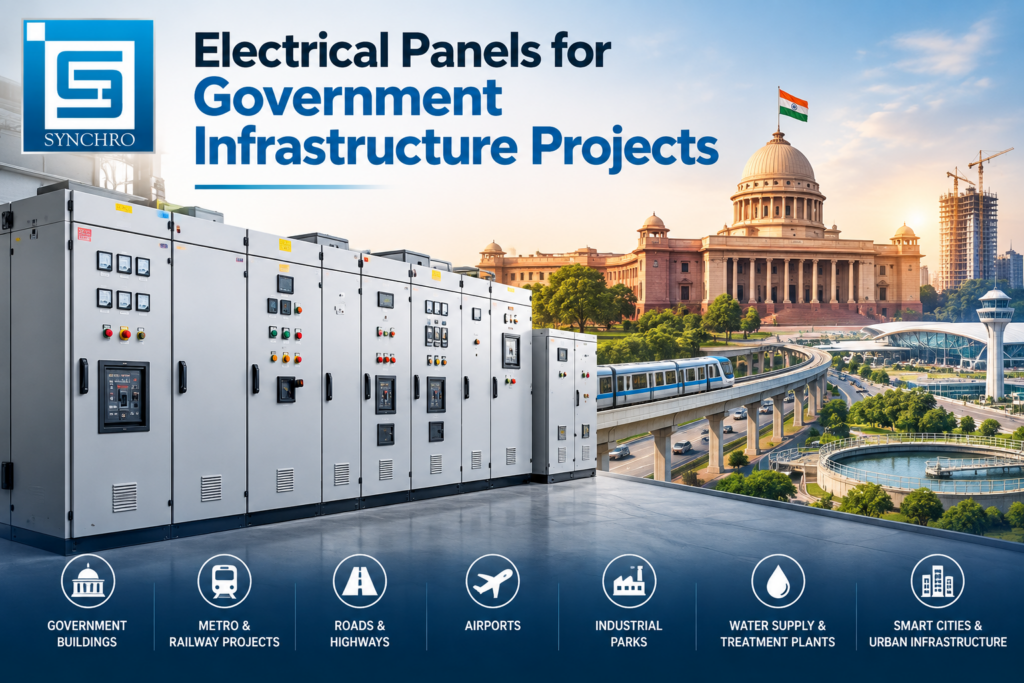
Common Government and Public Infrastructure Applications
Electrical panels show up across almost every kind of public infrastructure:
- Government buildings and administrative complexes main distribution, lighting and HVAC control panels.
- Water treatment and pumping stations motor control and automation panels for pump sets.
- Railways and metro projects power distribution and backup panels for stations, depots and signalling loads.
- Hospitals and public healthcare facilities standby power systems where continuity is a safety requirement, not a convenience.
- Solar and renewable energy installations under government schemes ACDB and distribution panels for public solar capacity.
- Smart city and street lighting projects automation and lighting control panels distributed across a municipal area.
- Substations and power distribution infrastructure switchgear and protection panels for state utilities.
Each of these comes with its own load profile, environment and compliance checklist, which is why a panel built for one government application rarely transfers directly to another without re-engineering.
Common Question Asked:-
Can panels be customised to match a specific tender specification?
Yes. Busbar material, breaker make, enclosure finish, IP rating and documentation format can all be built to match the exact tender requirement.
Standards and Compliance: What Actually Gets Checked
Government technical committees and consultants verify compliance against specific documents, not general claims of quality. The ones that come up most often include:
- IEC 61439 for low-voltage switchgear and controlgear assemblies, covering temperature rise, short-circuit withstand and verification by testing.
- UL 508A, where a project specification calls for it, particularly on panels linked to equipment with US-origin standards.
- IS standards issued by the Bureau of Indian Standards, which many government tenders reference directly for enclosures, busbars and protective devices.
- Type tested panel certification, meaning the panel design has been independently verified to survive its rated fault level, not just calculated on paper.
- Fault level rating and short circuit withstand capacity, confirmed against the specific substation or supply point feeding the installation.
- Ingress protection (IP) rating, matched to the installation environment, whether that’s an air-conditioned control room or an outdoor pump house.
A manufacturer that cannot produce test certificates and type-test reports on request is a risk on a government tender, regardless of how competitive the price looks. Synchro Electricals issues a documented test report with every panel, including high-voltage, insulation and functional test results, which is exactly the paperwork a government inspection or third-party agency will ask to see.
Turnkey Execution: Why SITC Matters on Public Projects
Many government tenders are structured as turnkey project or SITC (Supply, Installation, Testing and Commissioning) contracts rather than supply-only orders. This shifts responsibility for electrical system installation and electrical project management onto the panel vendor, not just the panel itself.
For electrical panels for government infrastructure projects, working with expert electrical contractors who handle the full scope, from electrical power installation through site testing and commissioning, reduces the coordination burden on the government department or its consultant. It also means installing electrical panels on site is backed by the same team that built them, which shortens the path to resolving any site-fit or interface issue.
Specification Details That Government Buyers Should Not Skip
A handful of details repeatedly cause disputes or rework on public-sector panel orders:
- Current rating and voltage rating: confirmed against the actual supply authority connection, not an assumed standard value.
- Busbar sizing: copper or aluminium, sized for both running current and short-circuit withstand, not just nameplate load.
- Breaker selection: circuit breaker type and make often need to match an approved vendor list maintained by the department.
- Enclosure and finish: IP rating, paint shade and material grade are frequently specified exactly in government tenders and checked at inspection.
- Documentation package: general arrangement drawings, single line diagrams, test certificates and compliance certificates, usually required before final payment is released.
- Empanelment and vendor approval: some departments require the manufacturer to be pre-approved or empanelled before a bid is even considered.
Panel Types Commonly Required on Government Projects
Public infrastructure projects typically call for a mix of panel types rather than a single standard product:
- PCC panels for main power control and distribution in substations and utility building
- MCC panels for pumping stations, water treatment plants and HVAC systems where motor control** is central.
- VFD panels for variable-speed pump and fan applications in public utility infrastructur
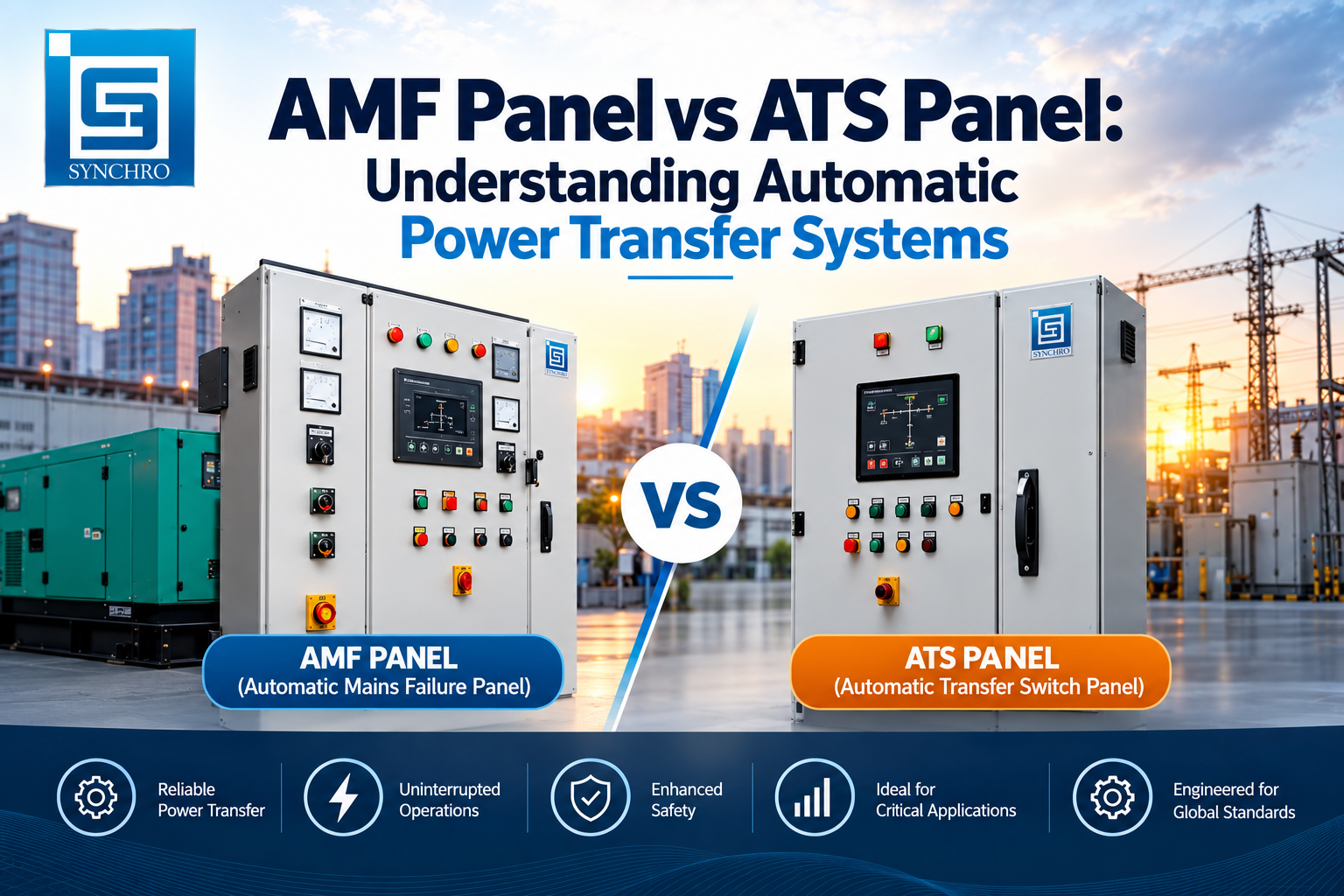
- AMF panels for standby power in hospitals, data centres and critical government facilities, providing backup power solutions and uninterrupted power supply** when the grid fails.
- Synchronizing panels where multiple generators or sources need to parallel for larger public facilitie
Government hospitals, in particular, have strict requirements for standby power continuity. Our detailed guide on ATS panels for hospitals and emergency power transfer covers what public healthcare facilities typically need to specify.
Testing and Documentation: Where Government Projects Differ Most
On a commercial project, a factory acceptance test is good practice. On a government project, it is often contractual. Site acceptance testing follows, witnessed by the department’s representative or appointed consultant, before the panel is accepted into service. Our guide to electrical panel FAT vs SAT explains what gets witnessed at each stage and what documentation should accompany it. Fault-level verification is just as important here as the physical test; see our explanation of how fault-level calculations influence switchgear selection for how this is typically calculated and checked.
Why Wiring Quality Matters More on Long-Life Public Assets
Government infrastructure is built to last decades, often with maintenance budgets that are tighter than the original capital budget. Panels with neat, labelled, well-documented control wiring are dramatically easier for a public works maintenance team to service years down the line, when the original installing contractor may no longer be involved. Our notes on electrical panel wiring design best practices are written with exactly this kind of long-service-life maintainability in mind.
Why Work With Synchro Electricals
As an electrical panel manufacturer based in Rajkot, Gujarat, Synchro Electricals has supplied LT and HT panels for industrial, solar and public infrastructure projects since 2018. Our approach is built around the documentation and compliance departments actually require:
- Design approval first: drawings go to the consultant or department for approval before manufacturing begins, matching tender specifications exactly.
- Every panel tested: high-voltage, insulation and functional tests are performed, with a signed test report issued for project records.
- Verifiable quality: we hold ISO 9001:2015 and other certifications that government technical committees commonly request.
- Turnkey capability: supply, installation, testing and commissioning handled under one point of accountability, reducing coordination overhead for the department.
Browse our wider product range or contact our engineering team with your tender specification, and we will confirm compliance and turnaround before you submit your bid.
Conclusion
Electrical panels for government infrastructure projects are judged on documentation and compliance as much as on the panel itself. A manufacturer who understands IEC and IS standards, delivers verifiable type-test evidence, and can execute turnkey SITC scope reduces risk at every stage, from tender submission through final commissioning. Whether you’re sourcing panels for a water treatment plant, a government hospital, or a substation upgrade, get the specification, testing and paperwork right before the order is placed. Share your tender requirements with Synchro Electricals and our engineers will help you specify it correctly.
Frequently Asked Questions (FAQs)
- What makes government infrastructure panel procurement different from commercial orders?
Government projects follow fixed tender specifications, approved vendor lists, and strict documentation requirements, leaving little room for post-delivery adjustment compared to commercial orders.
- Which standards are most commonly referenced in government panel tenders?
IEC 61439 for switchgear assemblies, relevant IS standards from the Bureau of Indian Standards, and UL 508A when the project specification calls for it.
- What is a type tested panel, and why do government buyers ask for it?
It is a panel design independently verified to survive its rated fault level through physical testing, not just calculation. Departments ask for it because calculated designs alone don’t guarantee real-world performance.
- What does SITC mean in a government tender?
Supply, Installation, Testing and Commissioning. It means the vendor is responsible for the full scope, not just manufacturing and delivering the panel.
- Do government projects require vendor empanelment?
Many departments maintain approved or empanelled vendor lists, and some tenders require empanelment before a bid is even considered. Requirements vary by department and project.
- What documentation is typically required with the panel delivery?
General arrangement drawings, single line diagrams, test certificates, compliance certificates, and often a signed factory acceptance test report.
- What is the difference between FAT and SAT on a government project?
Factory Acceptance Testing happens before dispatch, usually witnessed by the consultant. Site Acceptance Testing repeats key checks on site with the actual installed system before final handover.
- Which panel types are most common on public infrastructure projects?
PCC panels for main distribution, MCC panels for pumping and motor loads, VFD panels for variable-speed applications, and AMF panels for standby power in critical facilities.
- How important is backup power for government hospitals?
Critical. Standby power continuity is treated as a safety requirement in healthcare facilities, typically specified with AMF panels and often paired with a UPS for sensitive equipment.
- What is fault level rating and why does it matter for public infrastructure?
It defines the maximum short-circuit current a panel must safely withstand at its installation point. Public infrastructure often sits on larger supply networks with higher available fault current, making this a critical check.