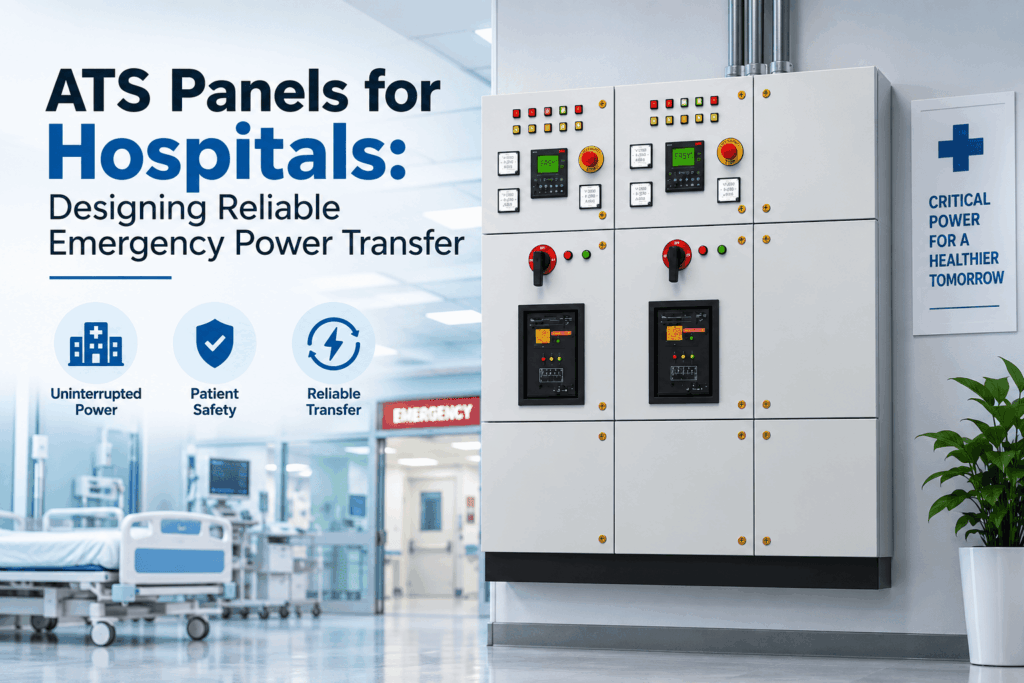
In a factory, a power cut costs you production. In a hospital, a power cut is a clinical event.
That single difference changes almost everything about how an ATS panel for hospitals should be designed. The switching device may look similar to the one going into a packaging plant. The engineering behind it is not.
Over the years our team has built changeover and AMF panels for manufacturing plants, municipal water works, commercial complexes and healthcare facilities. Hospitals are consistently the most demanding of them, and the reason is rarely the panel rating. It is that a hospital does not have one backup requirement. It has three or four different ones running at the same time, in the same building, on the same incomer.
This article explains how we approach that problem: how to classify hospital loads, what transfer times actually mean in practice, which switching class to specify, and what an accreditation auditor will ask you to produce afterwards. If you are an EPC contractor, hospital project consultant, biomedical head or facility engineer writing a specification, this is the design conversation we would have with you before quoting.
What Is an ATS Panel in a Hospital?
An ATS panel, or automatic transfer switch panel, is the assembly that automatically moves a hospital’s electrical load from its normal supply to an alternate supply when the normal supply fails, and moves it back when the normal supply is confirmed healthy again.
In standards language, the switching device inside is called Automatic Transfer Switching Equipment (ATSE) and is covered by IEC 60947-6-1. The enclosure, busbar system, internal separation and verification are covered by the IS/IEC 61439 series, the same standards that govern any PCC panel or distribution board we build.
In a hospital, the “alternate supply” is usually a diesel generator, but increasingly it is more than that:
- A second utility feeder from a different substation or transformer
- One or more DG sets
- A central UPS system serving critical clinical areas
- Local isolated power supplies inside operating theatres
- In newer projects, a solar plus battery hybrid supporting daytime essential load
The ATS panel is the point where these sources meet the load. Get the logic wrong here and every downstream investment in generators and UPS capacity is compromised.
Quick clarification most people search for: the ATS panel is not the same as the AMF panel, though they usually sit in the same enclosure. We cover the distinction in detail below and in our companion article, How AMF Panels Work with Industrial DG Sets.
Why Hospital Power Transfer Is a Different Engineering Problem
Three things make a hospital emergency power supply system genuinely harder than an industrial one.
- The acceptable interruption is not a single number. An operating theatre light and a laundry machine cannot tolerate the same outage. A design that satisfies one will over-engineer or under-serve the other. Hospital design therefore starts with load classification, not equipment selection.
- You cannot shut it down to fix it. An industrial plant schedules a maintenance shutdown. A hospital does not. This means every hospital ATS panel needs a serviceable architecture: manual bypass, safe isolation, and access to the switching mechanism without de-energising the essential bus.
- The design has to survive an audit. NABH, JCI, and state health authority inspections all ask for evidence: single line diagrams, test reports, transfer time records, maintenance logs. A panel that works but has no documentation behind it becomes a finding.
We have seen all three of these show up as retrofit problems on hospitals that were originally specified with a generic changeover panel. Retrofitting an essential load segregation scheme into a live hospital is expensive and disruptive. Designing it correctly at tender stage costs almost nothing extra.
AMF and ATS Panel Difference: Getting the Terminology Right
This confuses procurement teams constantly, and it leads to mismatched quotes.
AMF — Automatic Mains Failure. This is the control intelligence. It monitors the incoming utility supply, decides when a failure is real (rather than a momentary dip), sends the start command to the DG set, verifies the generator has reached healthy voltage and frequency, and manages the cooldown and shutdown after the mains returns.
ATS — Automatic Transfer Switch. This is the switching action. It physically disconnects the load from one source and connects it to another, with mechanical and electrical interlocking so the two sources cannot be inadvertently paralleled.
A useful shorthand:
AMF = detection and logic. ATS = source transfer.
In practice, a hospital standby system with a single DG set almost always needs both functions, and we build them into one coordinated assembly. But the words matter when you write a specification. Asking for “an ATS panel” when you actually need generator start logic, or asking for “an AMF panel” when you have two utility feeders and no generator, produces the wrong quotation and the wrong panel.
Where a hospital runs multiple DG sets in parallel to serve a large essential load, an AMF/ATS arrangement alone is not sufficient. That application requires a synchronizing panel with load sharing, because the generators must match voltage, frequency and phase before they can share a common bus.
The Transfer Time Classes That Drive Hospital Design
This is the section that decides the architecture of the whole system.
IEC 60364-7-710, the international standard for electrical installations in medical locations, classifies safety services by how quickly the supply must be restored. Broadly, three classes matter:
| Class | Restoration requirement | Typical hospital loads |
| Class 0.5 | Supply restored in 0.5 seconds or less | Surgical luminaires, life-support equipment, equipment in Group 2 medical locations |
| Class 15 | Supply restored in 15 seconds or less | Firefighting lifts, smoke extraction, fire detection and alarm, medical gas plant electrics, selected lighting, essential clinical equipment |
| Class > 15 | Supply restored in more than 15 seconds | Sterilisation, kitchen, laundry, general HVAC, non-critical lighting and power |
The design implication is direct and unavoidable:
A diesel generator cannot meet a 0.5 second requirement. No matter how good the DG set or how fast the ATS panel, engine cranking, run-up and voltage stabilisation take several seconds at minimum. Class 0.5 loads must be supported by a static source — a UPS, or an isolated power supply system with battery backup inside the operating theatre itself.
The ATS panel’s job for those loads is not to carry the transfer. It is to restore the UPS input quickly enough that the batteries are not deeply discharged before the DG picks up.
The 15 second class is where the ATS panel and DG set genuinely deliver. This is the number that governs your generator start sequence, mains failure confirmation delay and transfer logic, and it is the number your commissioning report needs to demonstrate.
How this maps to Indian projects
Indian hospital projects are typically governed by the National Building Code of India 2016 (Part 8, Section 2 for electrical and allied installations, with Part 4 covering fire and life safety loads), the CEA (Measures relating to Safety and Electric Supply) Regulations, and state fire and health authority requirements. NBC requires standby power arrangements for fire and life safety systems in high-rise and institutional buildings, with automatic changeover.
IEC 60364-7-710 is not automatically mandatory on every Indian hospital project, but in our experience it is the most useful engineering framework available, and consultants on larger and accredited hospitals frequently specify to it. For hospitals seeking JCI accreditation or built for export markets, NFPA 99 and NFPA 110 apply instead, with their own essential electrical system branch structure (life safety, critical, equipment) and a Type 10 requirement to restore power within 10 seconds.
Always confirm the applicable edition and the local authority having jurisdiction before finalising a design. We ask for this in writing at the enquiry stage, because it changes the panel.
Hospital Load Segregation: The Table That Should Exist Before the Panel Is Designed
Before anyone selects a switch rating, the hospital’s loads need to be sorted. This is the single most valuable hour of engineering on the project.
| Hospital area/load | Medical location group | Required transfer class | Recommended source |
| Operating theatre — surgical luminaires | Group 2 | ≤ 0.5 s | UPS / IT system with battery, DG behind it |
| OT — anaesthesia, perfusion, endoscopy stack | Group 2 | ≤ 0.5 s | UPS on isolated power supply |
| ICU / CCU / NICU bedside outlets and monitors | Group 2 | ≤ 0.5 s | UPS, DG-backed |
| Cath lab, hybrid OT | Group 2 | ≤ 0.5 s | UPS + DG |
| Dialysis, day-care procedure rooms | Group 1 | ≤ 15 s | DG via ATS |
| Blood bank, lab refrigeration, pharmacy cold chain | Group 1 / 0 | ≤ 15 s | DG via ATS |
| Fire pump, sprinkler, firefighting lift | — | ≤ 15 s | DG via dedicated ATS |
| Smoke extraction and pressurisation fans | — | ≤ 15 s | DG via ATS |
| Medical gas plant, vacuum, compressed air | — | ≤ 15 s | DG via ATS |
| Server room / HIS / PACS | — | ≤ 0.5 s | UPS, DG-backed |
| CT, MRI, cath lab imaging power | Group 1 | ≤ 15 s (verify OEM) | DG via ATS, OEM-specified |
| Passenger lifts (non-firefighting) | — | > 15 s or 15 s | Project decision |
| General ward lighting and power | Group 0 / 1 | ≤ 15 s partial | Split: essential + non-essential |
| HVAC chillers, AHUs | — | > 15 s, staged | DG with step loading |
| Kitchen, laundry, CSSD, admin | — | > 15 s or none | Non-essential |
Two notes from experience.
Imaging equipment is a trap. CT and MRI systems have OEM-specific supply quality requirements, and some manufacturers will not honour warranty on generator supply without defined voltage and frequency tolerances. Get the OEM power specification in writing before you size the DG or set your transfer logic. We have had projects where this single document changed the generator rating.
Splitting ward circuits is worth the effort. Putting an entire ward on essential supply inflates the DG size. Splitting each ward into an essential sub-circuit (a proportion of lighting, nurse call, critical socket outlets) and a non-essential one is more work at design stage and considerably cheaper over the life of the building. This split usually lives in the lighting and power distribution boards, not in the ATS panel itself.
Class PC or Class CB? Choosing the Right ATSE
IEC 60947-6-1 recognises two classes of transfer switching equipment, and hospital specifications should say which one is required.
Class PC — equipment capable of making and withstanding short-circuit currents, but not designed to break them. Protection is provided by separate upstream devices. Class PC devices are typically compact, fast-acting and mechanically simple, with a high number of operating cycles. They suit dedicated transfer duty where upstream protection is already coordinated.
Class CB — equipment fitted with integral overcurrent releases, essentially two interlocked circuit breakers with a transfer controller. This gives protection and transfer in one device, with adjustable trip settings that support selective coordination.
For most hospital essential-supply applications we recommend Class CB where the ATS is also the protective device for the essential bus, and Class PC where dedicated upstream protection already exists and transfer speed, endurance and mechanical simplicity are the priorities.
Whichever class is chosen, the fault withstand rating must be verified against the actual prospective short-circuit current at the panel location, taking both sources into account. Undersizing here is one of the more dangerous mistakes we encounter in tender documents. Our article on how fault-level calculations influence switchgear selection covers the calculation approach.
Open, Delayed or Closed Transition: Which Belongs in a Hospital
The transition method determines what happens in the instant between sources.
Open transition (break-before-make). The load is disconnected from the first source before being connected to the second. There is a genuine, brief interruption. This is the standard, and correct, arrangement for a conventional hospital standby system with a single DG set. It is simple, safe, and cannot parallel the sources.
Delayed transition (programmed neutral position). The switch pauses in a neutral, off-load position for a set interval before closing onto the new source. This deliberate delay allows residual voltage on large motor loads to decay so that reconnection does not produce a damaging out-of-phase torque transient. If the hospital has significant motor load on the essential bus — chillers, large AHUs, lifts, medical vacuum pumps — this matters. The alternative approach is an in-phase monitor that only permits transfer when the two sources are acceptably close in phase.
Closed transition (make-before-break). Both sources are briefly paralleled so the load never sees an interruption. This eliminates the transfer blink for planned transfers, which is genuinely useful in a hospital during monthly generator testing. It also introduces real complexity: synchronising control, protection against sustained paralleling, and in most cases a formal agreement with the utility, since you are momentarily back-feeding onto their network.
Our practical position: specify open transition with an in-phase monitor or delayed transition for the essential bus, and consider closed transition only where planned no-break testing is a stated operational requirement and the utility permits it. Do not add closed transition because it sounds better. Add it because someone has a defined need for it and has cleared it with the distribution licensee.
Twelve Design Decisions We Walk Hospital Clients Through
These are the questions our design team asks before drawings are issued for approval. If your specification answers all twelve, you will get comparable quotes from every vendor.
- Four-pole or three-pole switching. For hospitals on a TN-S system with earth-fault protection and RCDs downstream, four-pole switching with an overlapping neutral is generally the safer choice. It prevents parallel neutral paths between sources that can cause circulating currents and nuisance earth-fault tripping. The overlapping (make-before-break) neutral contact ensures the neutral reference is never lost during the transfer itself. This should be an explicit line in the specification.
- Continuous current rating and duty. Hospital essential buses run for long periods on generator during monsoon outages. Rate the switch for continuous duty at the design ambient inside the panel room, not the nominal catalogue figure.
- Fault withstand coordination. Icw for Class PC, Icu/Ics for Class CB, verified against calculated prospective fault current from both sources.
- Control supply redundancy. The transfer controller must be fed from both sources, ideally with a battery-backed DC supply. A controller that loses power during a deep voltage dip cannot execute the transfer it was installed for. This is a small cost and a large reliability gain.
- Manual bypass and isolation. Can the switching mechanism be maintained or replaced without shutting down the essential bus? In a hospital, the answer must be yes. Bypass isolation arrangements should be specified deliberately.
- Mechanical plus electrical interlocking. Both, not either. Mechanical interlocking is the last line of defence against inadvertent paralleling.
- Form of separation and IP rating. Form 3b or Form 4b for hospital LT and essential panels, allowing safe work on one section while others remain live. IP54 is typical for indoor panel rooms; higher where the plant room environment demands it.
- Enclosure, busbar and workmanship. Electrolytic-grade copper busbars sized for temperature rise per IEC 61439, properly torqued joints, segregated power and control wiring, ferruled and numbered terminations. Our panel wiring design guide covers the standards we build to.
- Metering, indication and event logging. Source-available indicators, load-on-source indication, per-phase metering, and a controller that logs transfer events with timestamps. That log is what you hand an auditor.
- BMS and monitoring integration. Modbus RTU or TCP to the hospital BMS as standard. Hospital engineering teams need to see source status and generator status from the control room, not from a walk to the panel room.
- Generator step loading. A DG set cannot accept 100% of its rating as a single block. Where the essential load is large, the transfer sequence should stage the load in steps so the generator’s voltage and frequency recover between blocks. Coordinate this with the generator supplier’s load acceptance data.
- Spare capacity and future expansion. Hospitals expand. Specify spare feeder ways and headroom in the essential bus rating. Retrofitting a new wing into a fully loaded essential panel is not a small job.
Failure Modes We Have Actually Seen in the Field
These are not textbook cautions. These are the reasons hospitals call us.
The generator started but the load never transferred. The DG ran perfectly during the monthly no-load test for two years. During a real outage, the transfer failed because the transfer controller’s control supply was derived only from the mains side and had collapsed. No-load DG testing does not test the transfer.
Nuisance earth-fault tripping after commissioning. A three-pole switch with a solidly linked neutral between two sources created a parallel neutral path. Circulating current through the neutral produced residual current readings that tripped downstream RCDs at apparently random times. The fix was a four-pole switch with an overlapping neutral, which should have been specified originally.
Lift and chiller damage after transfer. Open transition with no in-phase monitor and a fast transfer time. The motors were still spinning with residual voltage when they were reconnected out of phase. Mechanical damage followed. A delayed transition setting would have prevented it.
Essential load crept up until the DG could not carry it. The essential bus was designed at commissioning and then loaded with additional equipment over five years without anyone recalculating. The first long outage revealed the problem. Essential load registers need to be maintained, not just created.
No transfer time record for the audit. The system worked. Nobody had ever measured and recorded the actual transfer time. The auditor asked for evidence and there was none. Measuring it during commissioning takes an hour.
Testing, Commissioning and the Documentation an Audit Will Ask For
A hospital changeover panel is only as good as its evidence trail.
Factory testing before dispatch
Every panel we build for a healthcare project goes through routine verification aligned with IS/IEC 61439:
- Visual inspection and dimensional verification against approved drawings
- Power-frequency dielectric withstand test per the relevant IEC 61439-1 requirement
- Insulation resistance measurement at 500 V DC
- Continuity of the protective circuit
- Functional testing of the complete transfer sequence, simulating source failure and restoration
- Verification of interlocking, both mechanical and electrical
- Controller settings recorded and documented
We issue the test report with the panel, along with wiring diagrams, component datasheets, GA drawings and the operation manual. Our IEC 61439 verification guide explains what buyers should check on any panel, not just ours.
Site commissioning tests
- Measured transfer time, mains to generator and generator back to mains, recorded with instrumentation and compared against design intent
- Full-load transfer test under realistic load, not just no-load
- Load bank testing of the DG where the essential load cannot be safely used
- Verification that each classified load actually recovers within its assigned time class
- Confirmation of BMS alarm points
Records to maintain for NABH and other accreditation
NABH’s Facility Management and Safety expectations centre on documented alternate power arrangements and evidence of periodic testing. Practically, keep:
- Single line diagram showing sources, ATS panels and essential load segregation
- Essential load register, reviewed and updated whenever load changes
- Commissioning test reports including measured transfer times
- Monthly and quarterly test logs with observed transfer times and any faults
- Preventive maintenance records with dates and technician names
- Controller configuration backup and setting sheet
- Fuel stock and battery replacement records for the DG
Confirm current requirements against the applicable accreditation edition, since these standards are periodically revised.
Maintenance Schedule for a Hospital ATS Panel
| Interval | Activity |
| Monthly | DG test run; verify source indications; check controller status and alarm history |
| Quarterly | On-load transfer test with measured transfer time logged; verify DG picks up essential load |
| Half-yearly | Thermographic scan of busbars, terminations and switching contacts under load |
| Annually | Torque check on busbar and cable terminations; contact resistance measurement; controller settings verified against setting sheet; cleaning and inspection of the switching mechanism |
| Annually | Insulation resistance test; protective device settings verified; interlock function test |
| As required | Control supply battery replacement; firmware and settings backup after any change |
Thermography deserves special mention. Loose terminations at a transfer switch are a leading cause of hospital panel failures, and thermal imaging under load finds them before they become an outage.
Specification Checklist You Can Copy Into Your Tender
When you send us an enquiry for an ATS panel for hospitals, this is the information that lets us quote accurately in one round rather than three.
- Number and type of sources (utility feeders, DG sets, UPS)
- System voltage, frequency, phases, earthing system (TN-S, TN-C-S, TT)
- Essential load in kW/kVA, with load list and classification by transfer class
- Motor load on the essential bus (largest motor rating and total)
- Prospective short-circuit current at the panel location
- Required ATSE class: PC or CB
- Transition type: open, delayed or closed; in-phase monitor required or not
- Poles: three-pole or four-pole with overlapping neutral
- Bypass isolation requirement
- Form of separation and IP rating
- Metering, indication and communication protocol for BMS
- Step-loading requirement and generator load acceptance data
- Governing standards and the authority having jurisdiction
- Panel room dimensions, cable entry direction, ambient conditions
- Spare feeder ways and future expansion allowance
- Documentation and testing deliverables required
Common Mistakes in Hospital ATS Tenders
Specifying the DG size before classifying the loads. The generator rating is an output of the load classification exercise, not an input to it.
Assuming the ATS solves the operating theatre requirement. It does not. Class 0.5 loads need a static source. The ATS supports the source that supports them.
Copying an industrial specification. Industrial changeover specifications rarely address neutral switching, bypass isolation, transfer classes or accreditation documentation, all of which matter in a hospital.
Buying on price without design verification. A panel that has not been verified to IS/IEC 61439 and cannot produce test reports will cost more at inspection stage than it saved at purchase.
Treating the panel as a one-time purchase. The essential load register, the quarterly transfer test and the thermography scan are what keep the system working in year eight.
How Synchro Electricals Approaches Hospital Panel Projects
We are an electrical panel manufacturer based in Rajkot, Gujarat, building custom LT and HT panels since 2018 across industrial, solar, government and infrastructure projects, including power distribution for commercial and healthcare facilities.
For healthcare work, our process is deliberately front-loaded:
- Understand — we ask for the load list, classification, earthing system, fault level, governing standards and the AHJ before we quote. If that information does not exist yet, we help build it.
- Design — GA drawings, single line diagram and schematics are submitted for your written approval before a single component is ordered. Nothing is built on assumption.
- Build and test — ISO 9001:2015 process fabrication, followed by full routine testing. Every panel is functionally tested through its complete transfer sequence before dispatch.
- Deliver and support — complete documentation pack, commissioning guidance on site, and a technical team that stays reachable afterwards.
Our panels are built to IS standards and are IEC compatible, and our quality and type-testing credentials are published on our certificates page rather than merely claimed.
If you are specifying a hospital emergency power system, send us the load list, and we will come back with a design recommendation, not a generic quotation. Call our engineering team on +91 96019 65426, email info@synchroelectricals.in, or get in touch here.
Frequently Asked Questions
What is an ATS panel in a hospital?
An ATS panel is an automatic transfer switch assembly that moves the hospital’s electrical load from the normal utility supply to an alternate source, usually a diesel generator, when the normal supply fails, and returns the load when the utility supply is confirmed stable. In a hospital, it typically serves a segregated essential bus rather than the whole building.
How fast should a hospital transfer to generator power?
It depends on the load. IEC 60364-7-710 classifies safety services into those requiring restoration within 0.5 seconds, those within 15 seconds, and those beyond 15 seconds. A generator and ATS realistically serve the 15 second class. Loads requiring 0.5 seconds, such as surgical luminaires and life-support equipment, need a UPS or isolated power supply with battery backup.
What is the difference between AMF and ATS panels?
AMF (Automatic Mains Failure) is the control logic that detects a confirmed mains failure, starts the generator, verifies it is healthy and manages shutdown after mains return. ATS (Automatic Transfer Switch) is the switching mechanism that physically transfers the load between sources. A standby system with a DG set generally needs both, usually built into one coordinated assembly.
Do hospitals need both a UPS and an ATS panel?
Yes, in almost every case. They solve different problems. The UPS provides a no-break supply to critical clinical and IT loads that cannot tolerate any interruption. The ATS panel restores the wider essential supply from the generator, including the UPS input, within the permitted time. Neither replaces the other.
Which hospital loads must be on emergency power?
Typically operating theatres, ICUs and critical care areas, medical gas and vacuum plant, fire pumps and firefighting lifts, smoke extraction, fire detection and alarm, blood bank and lab refrigeration, server and HIS infrastructure, and a defined proportion of ward lighting and power. The exact list should be agreed with the hospital, the consultant and the authority having jurisdiction.
Is a four-pole ATS required in hospitals?
It is not universally mandated, but for hospitals on a TN-S system with downstream earth-fault protection, four-pole switching with an overlapping neutral is generally recommended. It avoids parallel neutral paths between sources and the nuisance earth-fault tripping that can result, while ensuring the neutral reference is not lost during the transfer.
What is the difference between open, delayed, and closed transition?
Open transition disconnects from one source before connecting to the next, producing a brief interruption. Delayed transition adds a deliberate pause in a neutral position so residual motor voltage can decay before reconnection. Closed transition briefly parallels both sources so the load sees no interruption, which requires synchronising control and usually the distribution licensee’s permission.
How do I select the ATS panel rating for a hospital?
Start with the classified essential load, not the total connected load. Then account for the largest motor starting on the essential bus, the generator load acceptance capability, the prospective short-circuit current at the panel location, the required ATSE class, ambient conditions in the panel room, and spare capacity for future expansion.
Can one ATS panel serve an entire hospital?
It can, but on larger hospitals it is often better practice to use multiple ATS panels serving different load groups, for example one dedicated to fire and life safety loads and another to clinical essential loads. This limits the impact of any single failure and simplifies selective coordination and maintenance.
What standards apply to hospital ATS panels in India?
The switching equipment is covered by IEC 60947-6-1 and the assembly by the IS/IEC 61439 series. Installation requirements are typically governed by the National Building Code of India 2016 and the CEA safety regulations, along with state fire and health authority requirements. IEC 60364-7-710 provides the medical-location framework widely used by consultants. JCI-accredited and export projects generally follow NFPA 99 and NFPA 110. Always confirm the current edition and the authority having jurisdiction.
How often should a hospital ATS panel be tested?
A practical regime is a monthly generator test run with source and controller verification, a quarterly on-load transfer test with the transfer time measured and logged, half-yearly thermographic inspection under load, and an annual programme covering torque checks, contact resistance, insulation resistance and interlock verification. Every test should be recorded.
What documentation should we keep for a NABH audit?
Single line diagram, essential load register, commissioning test reports with measured transfer times, monthly and quarterly test logs, preventive maintenance records, controller setting sheet and configuration backup, and DG fuel and battery records. Verify specifics against the applicable accreditation edition.
Can a hospital ATS panel be maintained without a shutdown?
Only if it was designed for it. Bypass isolation arrangements allow the switching mechanism to be isolated and serviced while the essential bus stays energised. This should be specified at tender stage, because retrofitting it into a live hospital is difficult and expensive.
Do we need a synchronizing panel instead of an ATS panel?
If the hospital runs a single standby generator, an AMF and ATS arrangement is appropriate. If multiple generators must operate in parallel to carry the essential load, a synchronizing and load-sharing system is required, because the sets must match voltage, frequency and phase before connecting to a common bus.
About the Author
This article was prepared by the engineering team at Synchro Electricals Pvt. Ltd., an ISO 9001:2015 certified electrical panel manufacturer in Rajkot, Gujarat, operating since 2018. The team designs and builds custom LT and HT panels including PCC, MCC, APFC, VFD, AMF/ATS, synchronizing and solar distribution panels for industrial, infrastructure, government and healthcare projects across India, with more than 500 projects delivered and panel solutions supporting over 8 GW of solar capacity.
The guidance here reflects design practice on real projects. It is general engineering information, not a substitute for a project-specific design by a qualified electrical consultant, and standards referenced should be verified against their current editions and the requirements of the authority having jurisdiction.