Procurement Definition: Sourcing electrical panels is not simply purchasing switchgear – it is the process of selecting an engineering partner capable of designing, manufacturing, testing, documenting, and commissioning IEC-compliant electrical distribution systems for industrial and infrastructure projects.
Global EPC projects are becoming larger, more complex, and increasingly dependent on reliable electrical infrastructure. Whether it’s a manufacturing plant, metro rail project, commercial high-rise, solar park, or utility substation, the electrical panel forms the heart of the power distribution system.
Over the last decade, India has emerged as one of the world’s preferred destinations for electrical panel manufacturing. International contractors now shortlist an electrical panel manufacturer in India for the same reasons they once looked exclusively to Europe: engineering depth, IEC 61439 compliance, and export-ready production – with a materially better landed cost.
However, selecting the right EPC electrical panel supplier requires more than comparing quotations. A low-cost panel without proper short-circuit verification, documentation, or Factory Acceptance Testing (FAT) can create expensive delays during commissioning.
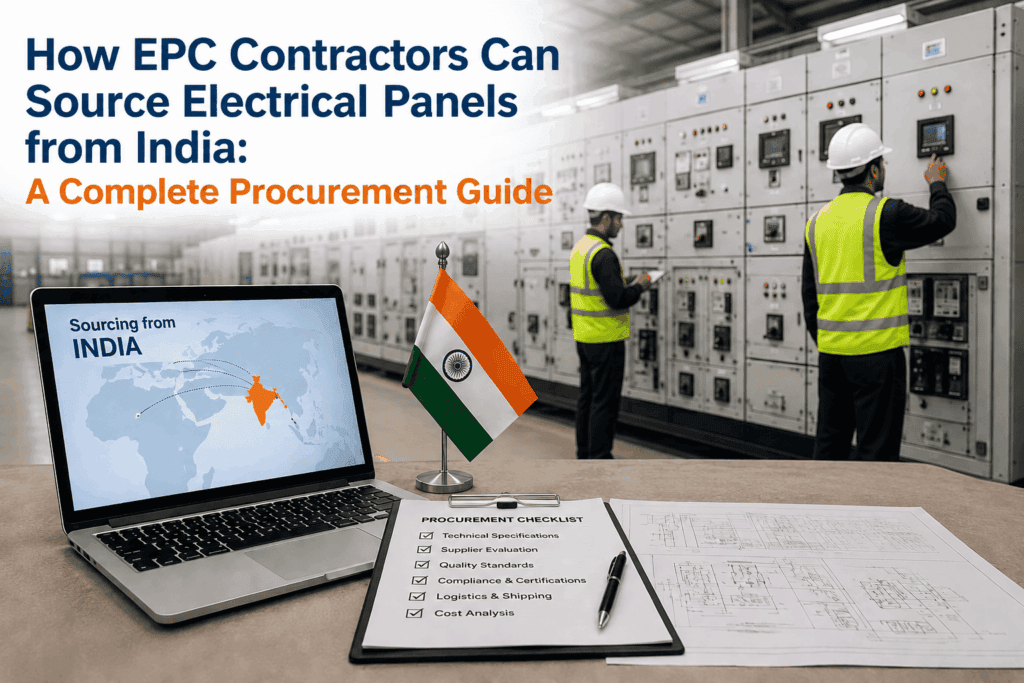
This guide explains the complete procurement journey – from RFQ preparation to commissioning – so EPC contractors can confidently source electrical panels from India.
Why Global EPC Contractors Source Electrical Panels from India
The short answer
India offers a unique combination of technical capability, manufacturing scale, skilled electrical engineering, and internationally compliant production, making it one of the strongest sourcing hubs for LT and HT electrical panels.
Why procurement teams are shifting to India
| Procurement Factor | India | Many Other Regions |
| Engineering customization | Excellent | Moderate |
| IEC 61439 manufacturing | Widely available | Varies |
| Cost competitiveness | High | Medium–Low |
| Skilled electrical workforce | Strong | Varies |
| Export infrastructure | Mature | Region dependent |
| Technical documentation | Comprehensive | Depends on supplier |
| Solar project experience | Extensive | Limited in many markets |
India is no longer competing only on manufacturing cost. Today, the country’s competitive advantage comes from engineering-led manufacturing. A modern LT panel manufacturer in India provides complete CAD drawings, busbar calculations, BOQ verification, protection coordination, FAT reports, and commissioning support alongside the physical product.
Five reasons EPC contractors benefit
- Custom engineering: Panels are designed around project load calculations, SLDs, and client specifications rather than fixed catalogue models.
- International compliance: A reputable industrial electrical panel supplier in India builds to IS and IEC 61439 standards with documented design verification and testing procedures.
- Solar EPC capability: India has significant experience as a solar ACDB DCDB manufacturer, covering string combiner boxes, synchronization panels, and utility-scale distribution equipment for renewable energy projects.
- Export-ready logistics: Manufacturers commonly handle electrical panel export from India end to end — fumigated wooden packing, container loading support, packing lists, certificates of origin, and complete test documentation.
- Lower lifecycle cost: Properly engineered panels reduce downtime, simplify maintenance, and improve future expansion compared with poorly specified alternatives.
Key Takeaways
- India combines engineering quality with competitive manufacturing.
- Compliance with IEC 61439 should matter more than the lowest quotation.
- Export documentation and FAT support are essential for international EPC projects.
Electrical Panels Commonly Used in EPC Projects
Every EPC project uses different panel configurations depending on voltage level, load profile, automation requirements, and redundancy strategy. Before shortlisting an industrial electrical panel supplier in India, procurement teams should be clear on which of the following assemblies the project scope actually requires.
PCC (Power Control Centre) Panel
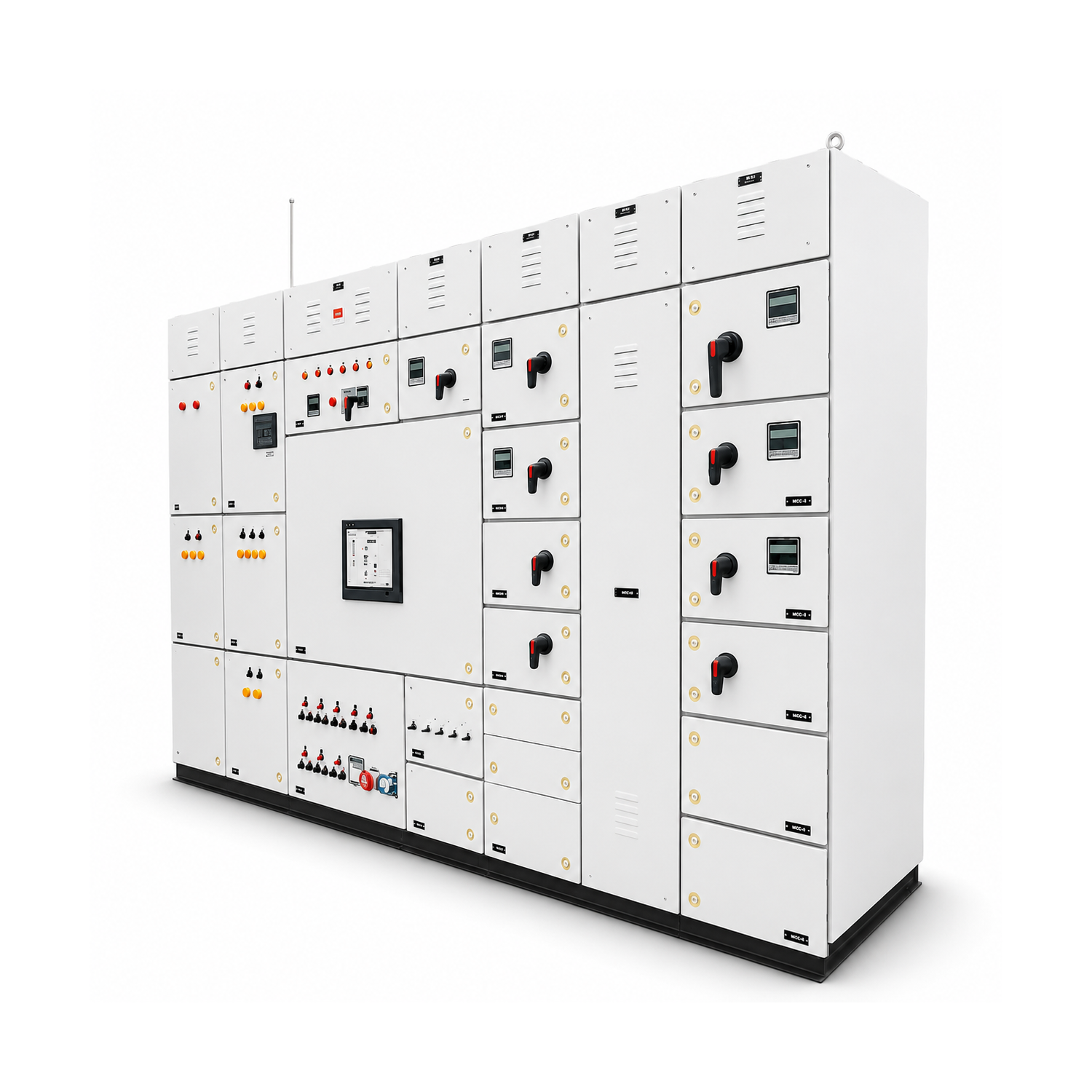
PCC (Power Control Centre) Panel
Purpose: Main power distribution and incoming electrical supply management.
PCC panels receive power from transformers or DG sets and distribute electricity across the facility. They generally contain ACBs, MCCBs, metering systems, protection relays, and copper or aluminium busbars. When evaluating an MCC PCC panel manufacturer, ask to see busbar sizing calculations for the exact fault level specified in your BOQ.
Typical applications
- Manufacturing plants
- Cement industries
- Data centres
- Hospitals
- Infrastructure projects
Selection considerations
- Current rating
- Busbar capacity
- Short-circuit withstand
- Form of segregation
- Future outgoing feeders
MCC (Motor Control Centre) Panel
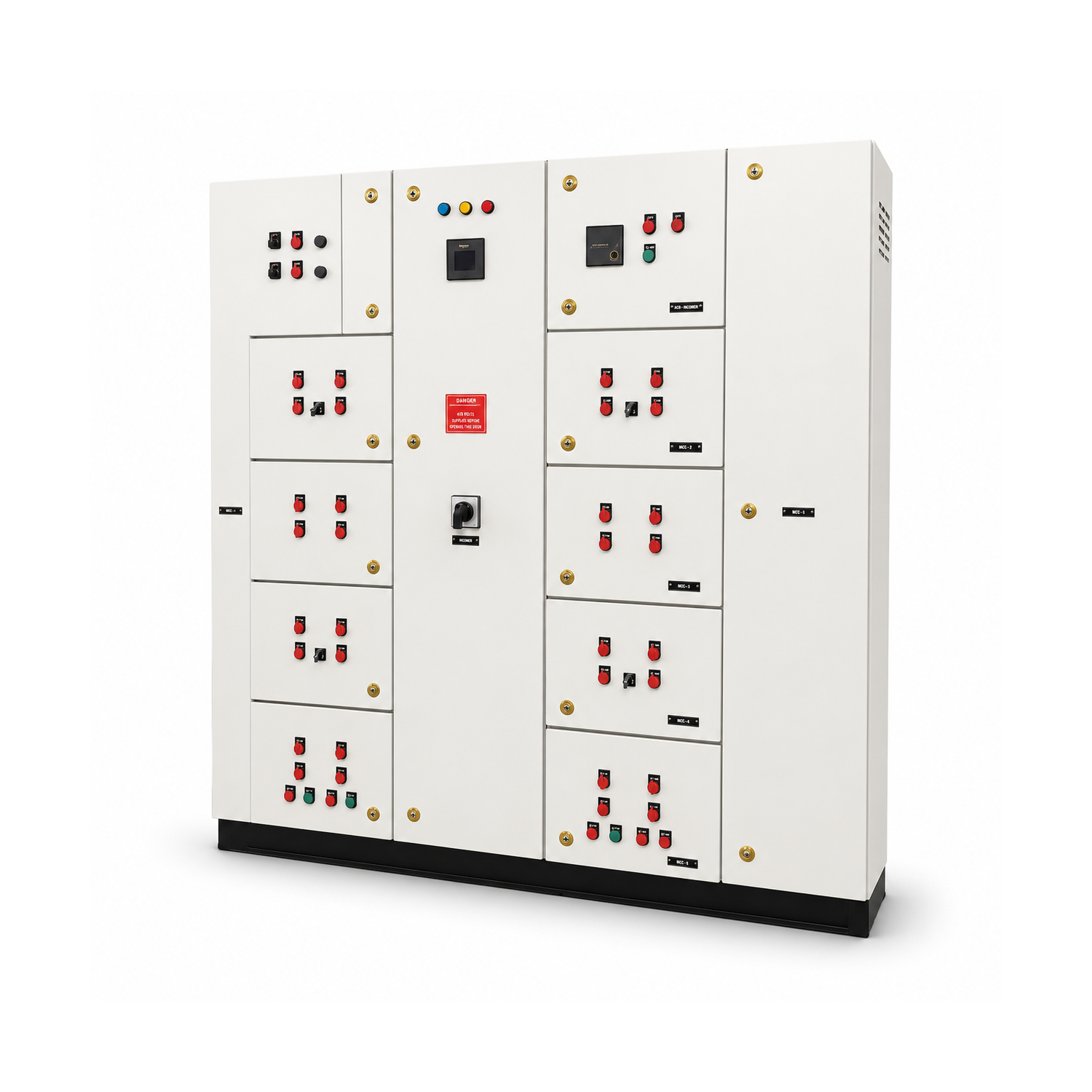
MCC (Motor Control Centre) Panel
Purpose: Centralized control and protection of multiple motors.
MCC panels improve operational reliability by grouping motor starters, overload protection, VFD feeders, and PLC interfaces within a single enclosure. Most projects source both assemblies together, which is why a single MCC PCC panel manufacturer usually delivers better protection coordination than two separate vendors.
Industries
- Water treatment
- HVAC
- Food processing
- Pharmaceutical
- Textile
Key specifications
- DOL / Star-Delta starters
- Soft starters
- VFD integration
- PLC compatibility
- Motor protection relays
APFC (Automatic Power Factor Correction) Panel
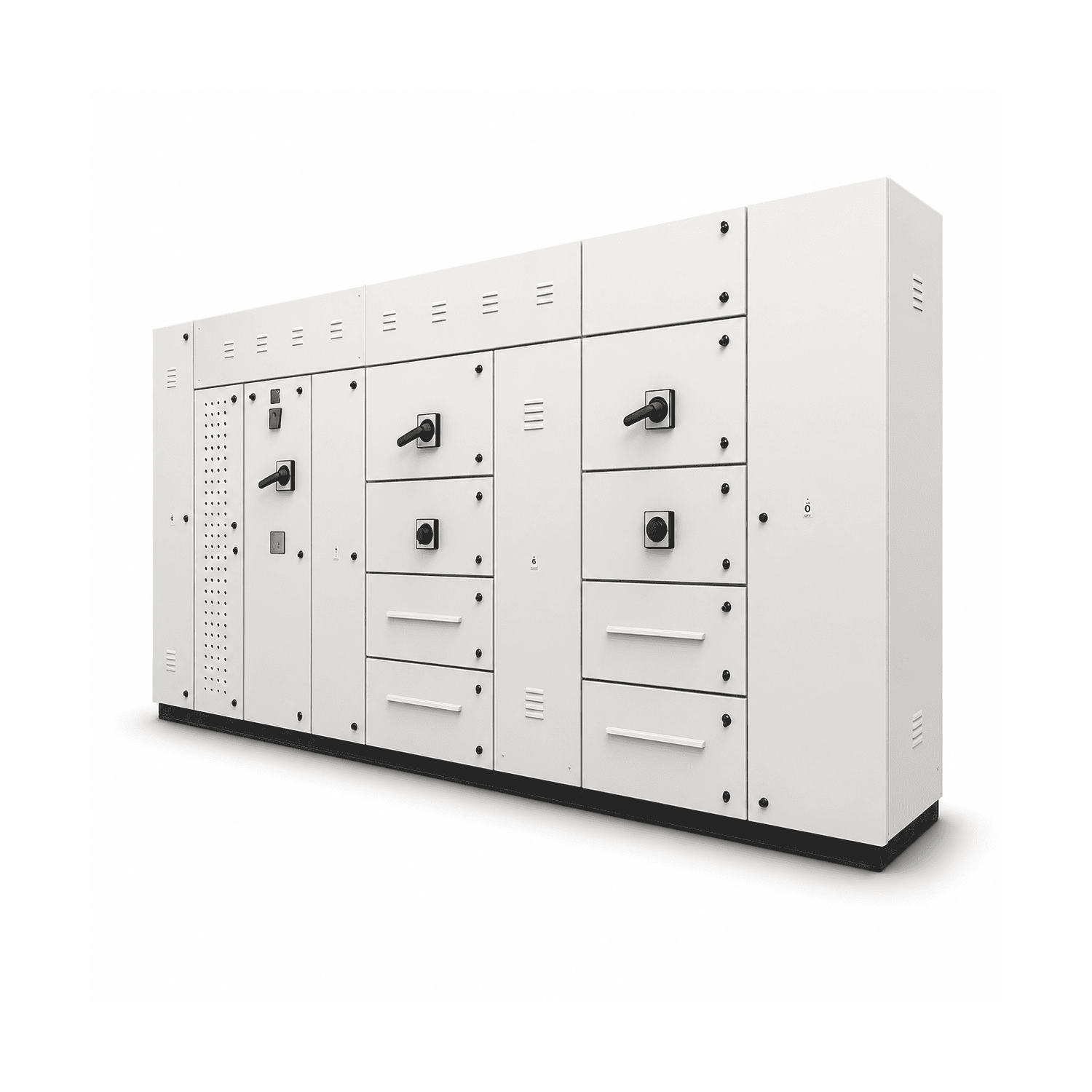
APFC (Automatic Power Factor Correction) Panel
Purpose: Improve power factor and reduce utility penalties.
These panels automatically switch capacitor banks according to reactive power demand, improving energy efficiency and stabilizing electrical systems.
Ideal for
- Industrial facilities
- Commercial buildings
- Heavy motor loads
Synchronization Panel
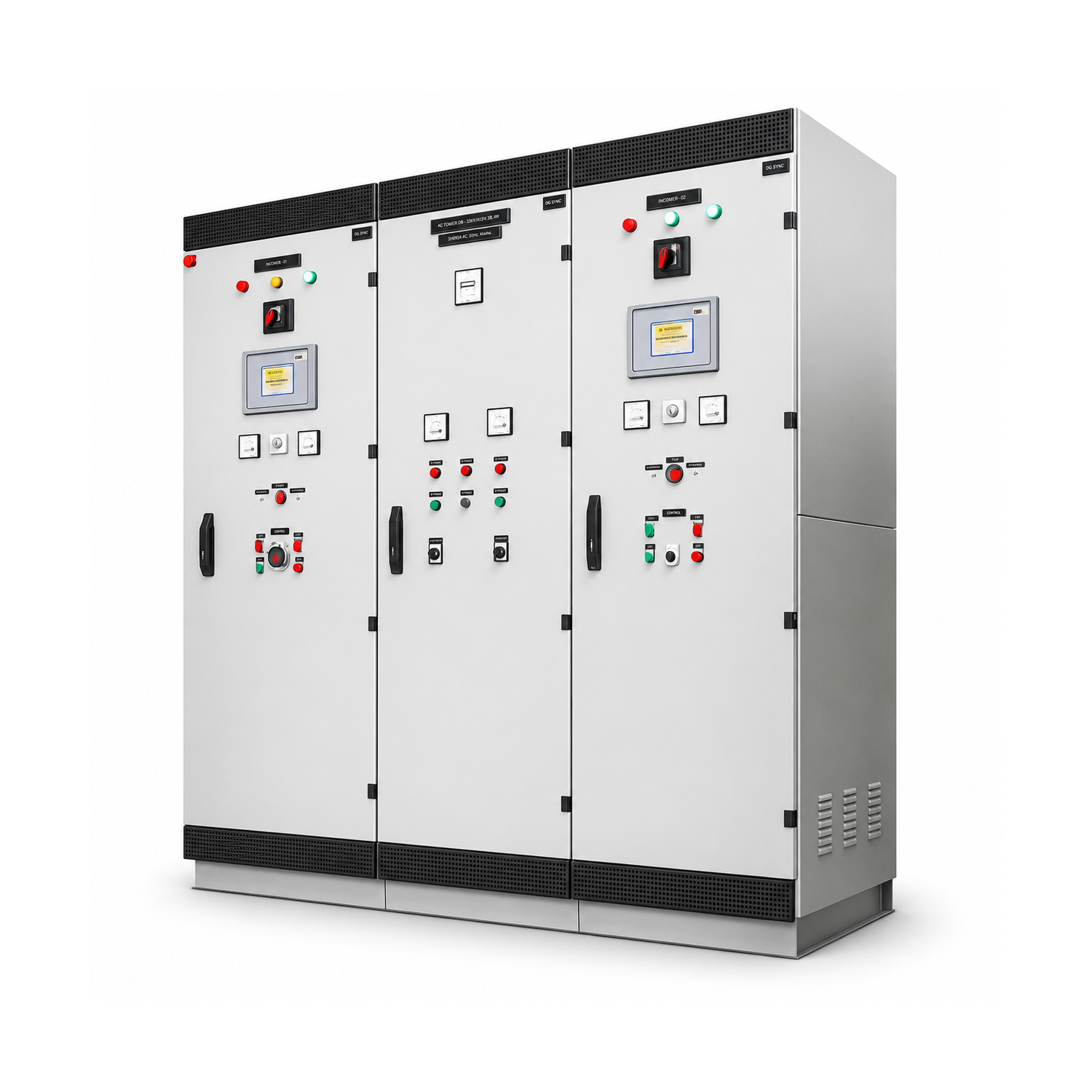
SYNCHRONIZING PANEL
Purpose: Synchronize multiple generators or generator-to-grid operation.
These panels match voltage, frequency, and phase angle before connecting power sources safely.
Common applications
- Hospitals
- Airports
- Data centres
- Utility backup systems
VFD Panel
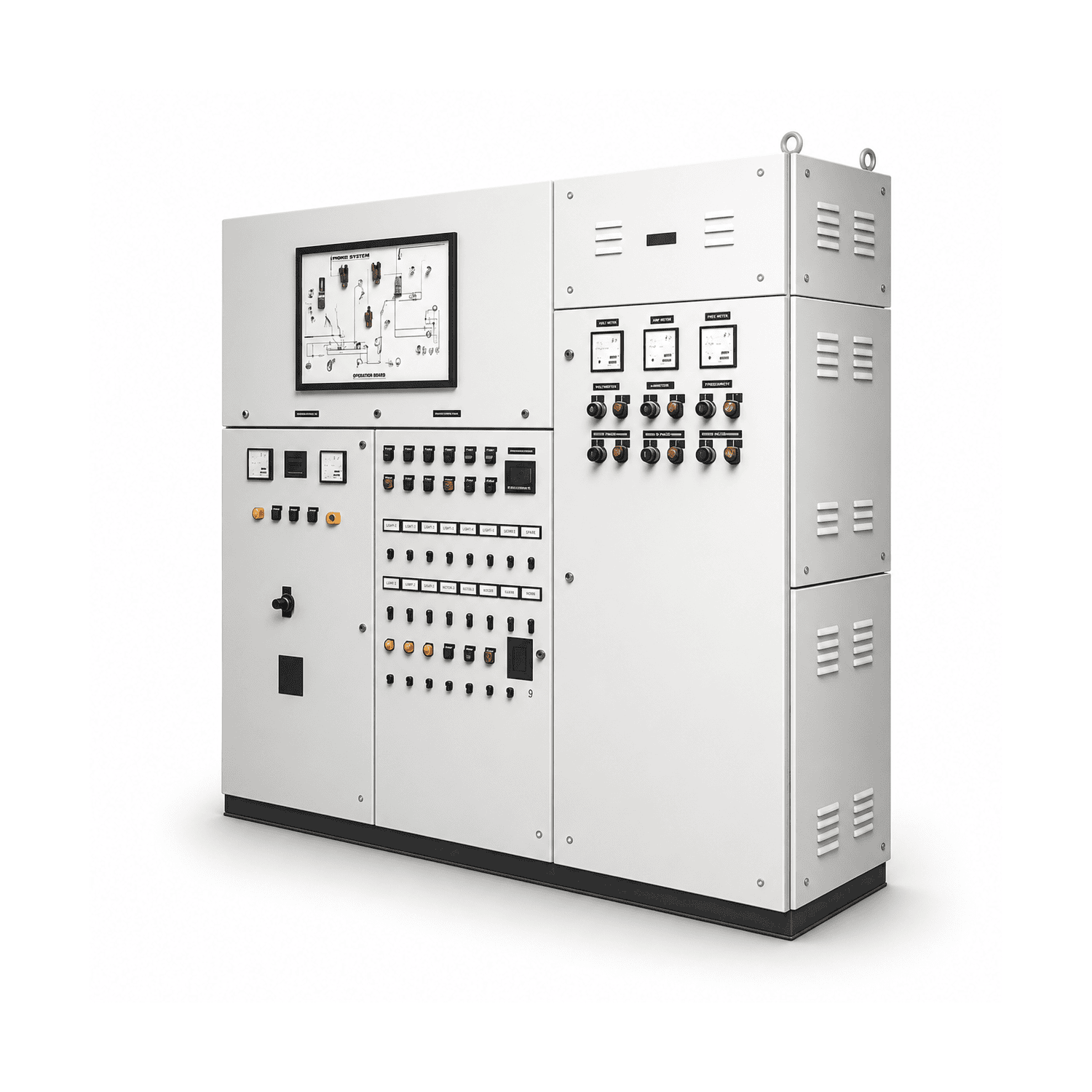
VFD Panel
Purpose: Control motor speed while improving energy efficiency.
VFD panels reduce mechanical stress and optimize motor performance for pumps, conveyors, compressors, and process equipment.
AMF / ATS Panel
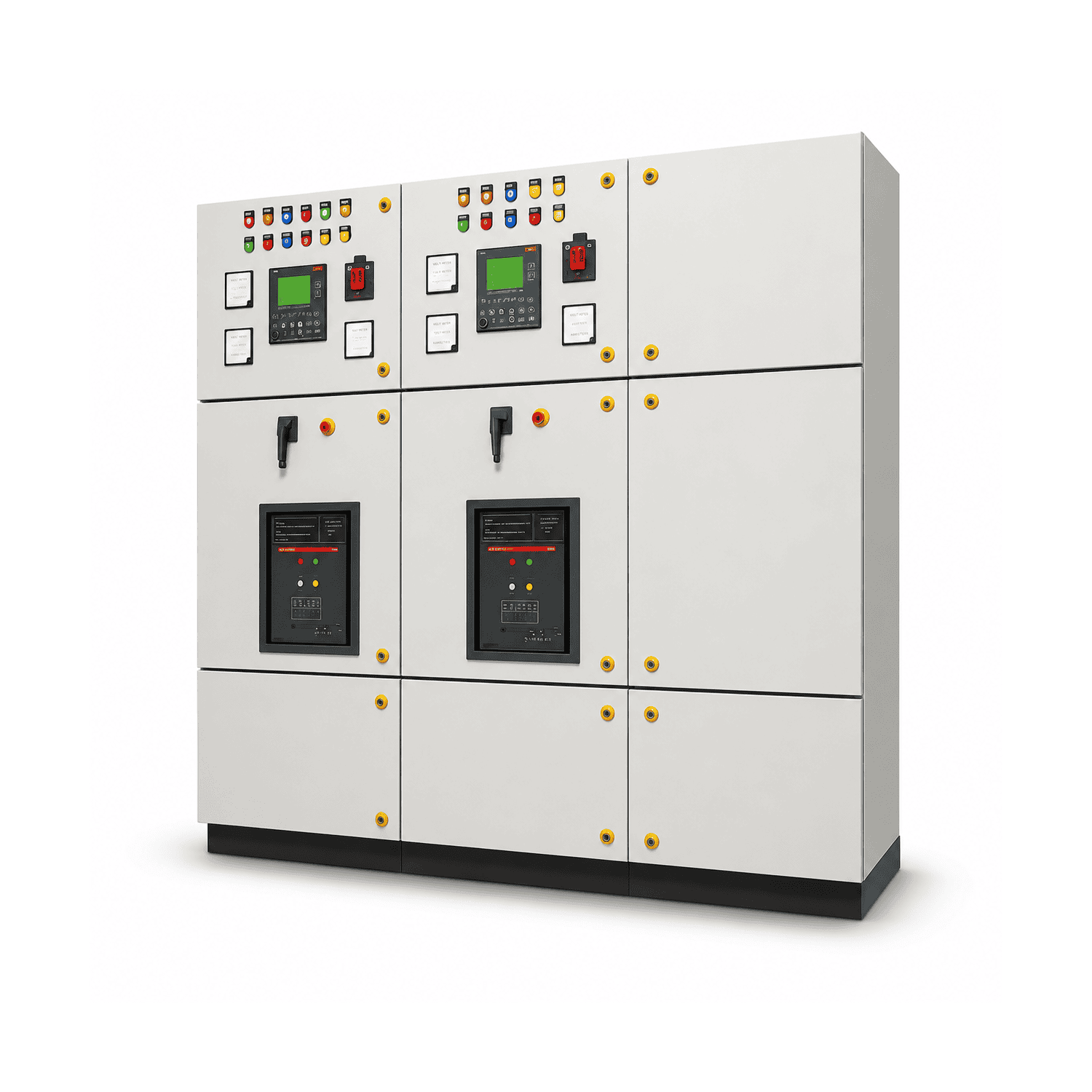
AMF / ATS Panel
Purpose: Automatic power transfer between utility supply and diesel generators.
Critical facilities depend on AMF panels to restore power without manual intervention.
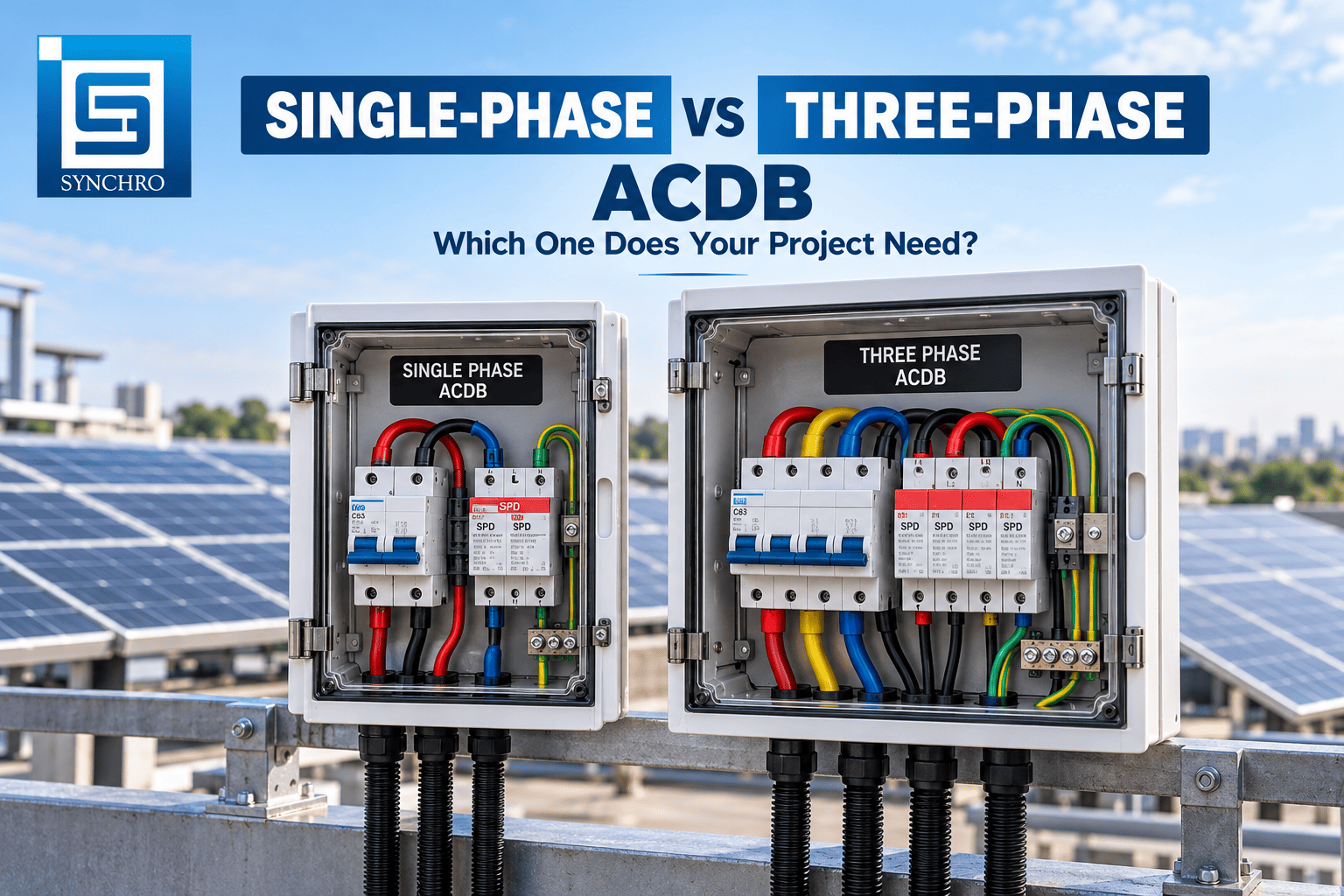
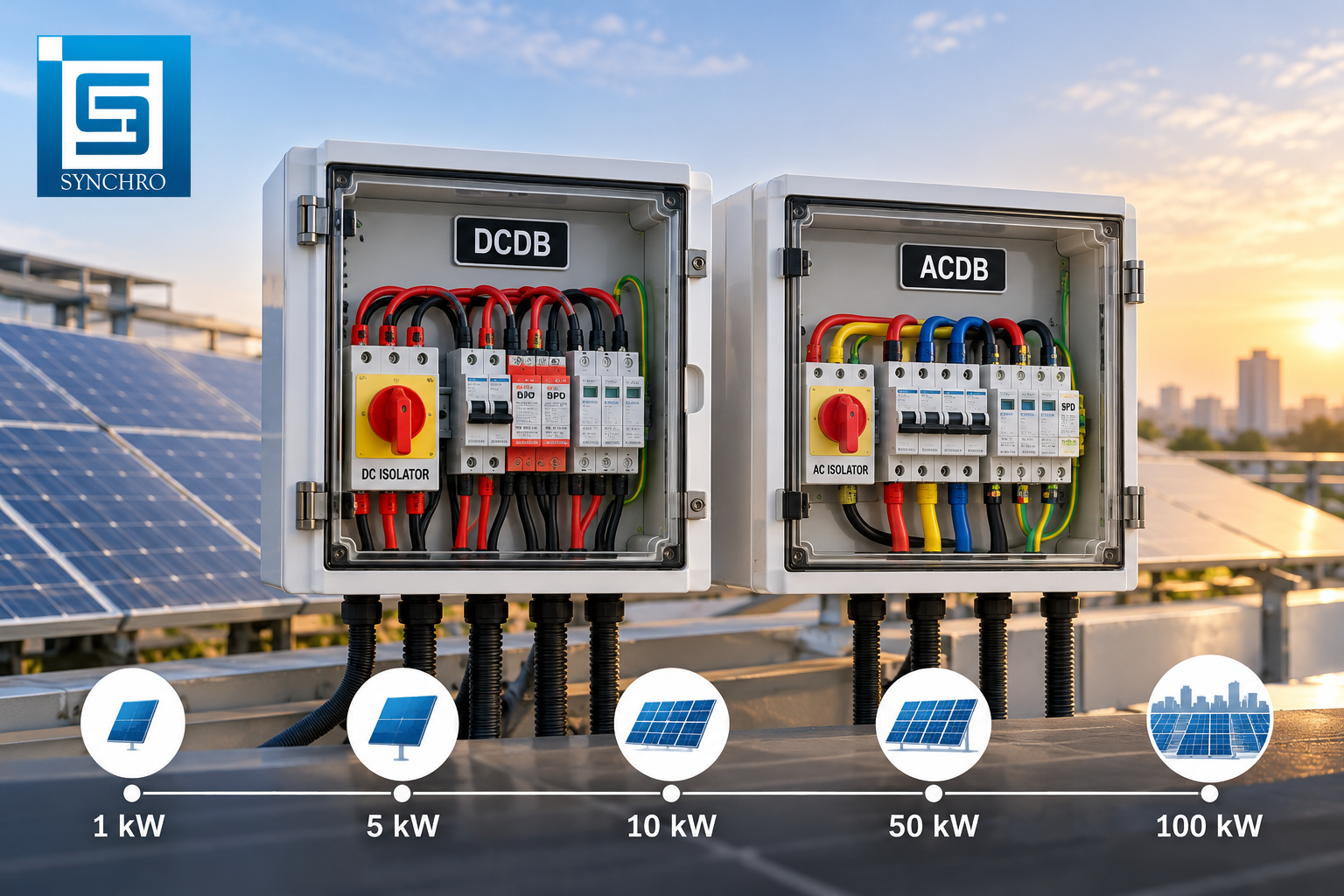
Solar ACDB / DCDB Panel
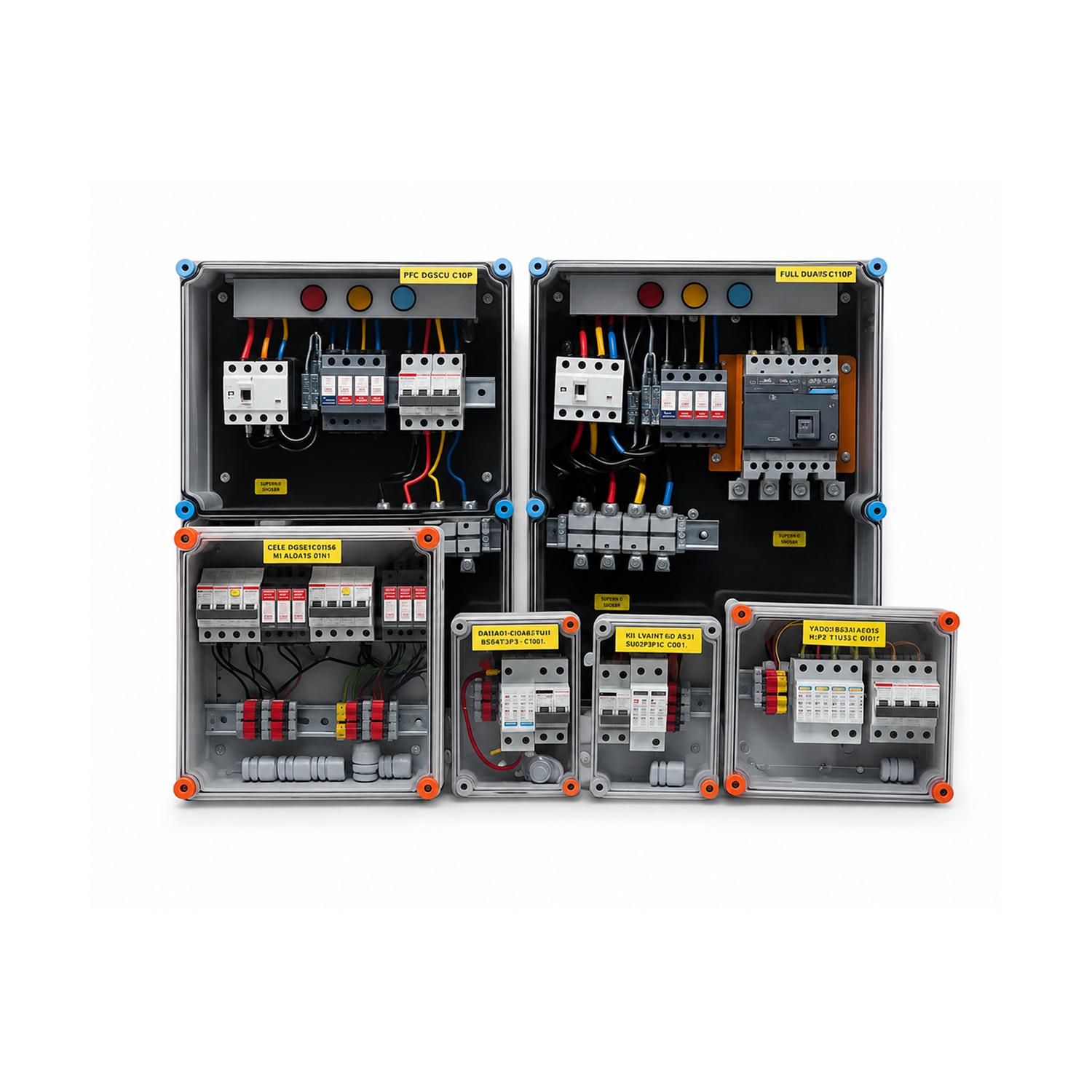
Solar ACDB DCDB Box
These panels protect strings, inverters, and AC distribution networks using surge protection devices, isolators, MCCBs, and monitoring components. India’s renewable ecosystem has made the solar ACDB DCDB manufacturer in India a major export category — many panel builders now ship combiner and distribution assemblies for multi-megawatt plants across the Middle East, Africa, and Southeast Asia.
Sandwich Bus Duct System
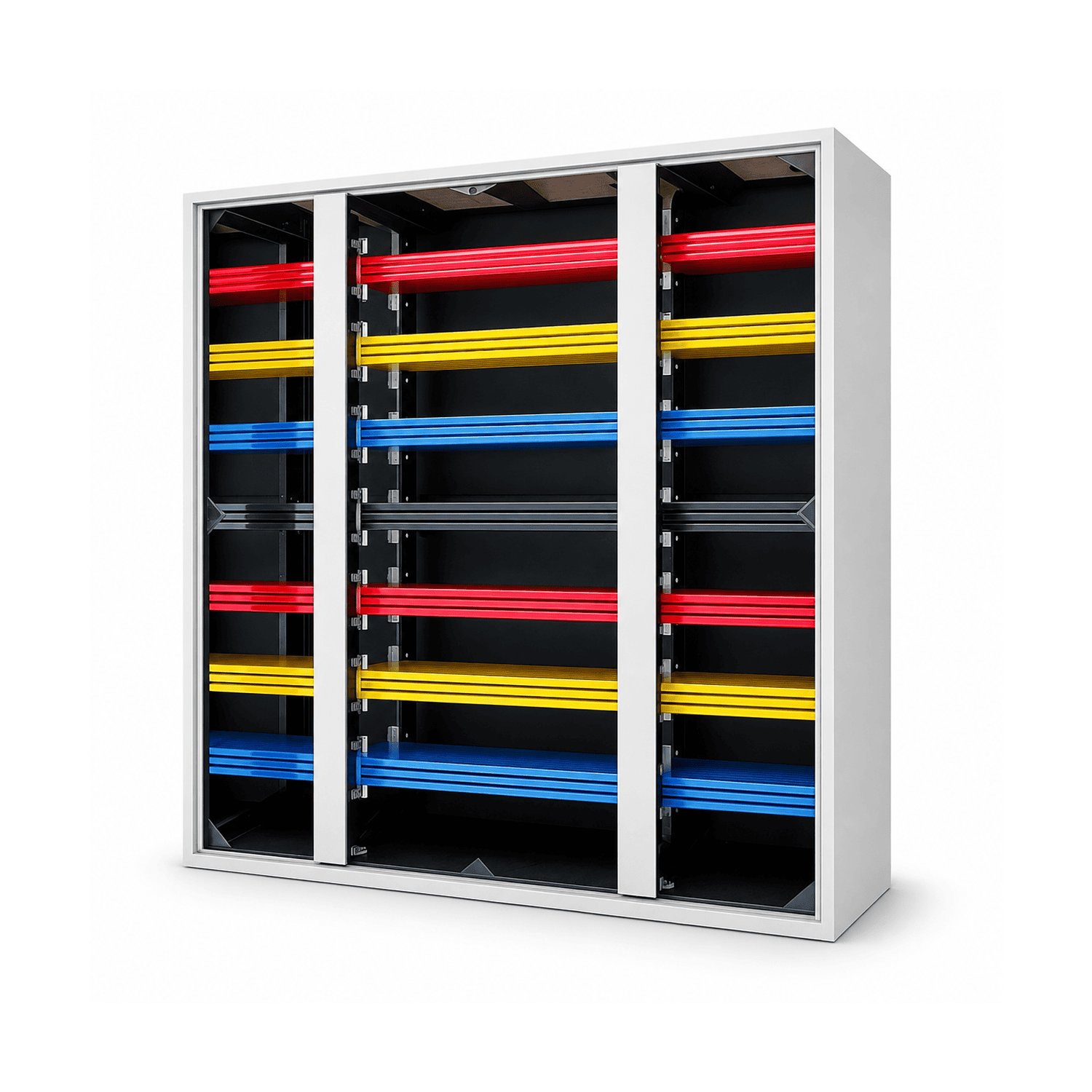
L.T. BUS DUCT / SANDWICH BUS DUCT
Purpose: High-current power distribution replacing conventional cable systems.
Bus ducts provide better thermal performance, easier maintenance, lower voltage drop, and simplified expansion in high-rise buildings and industrial facilities.
Panel Selection Matrix
| Panel Type | Primary Function | Typical Voltage |
| PCC | Main distribution | 415V |
| MCC | Motor control | 415V |
| APFC | Power factor correction | 415V |
| VFD | Variable motor speed | 415V |
| AMF | Generator changeover | LT |
| Synchronization | Multiple DG / Grid | LT |
| ACDB / DCDB | Solar distribution | AC/DC |
| Bus Duct | High-current distribution | LT/HT |
Complete EPC Procurement Workflow (RFQ to Commissioning)
A successful electrical panel project follows a structured engineering workflow rather than a purchasing workflow.
Designer note: Create this as a horizontal infographic using engineering blue (#0057B8), grey, and white with icons for RFQ, CAD, manufacturing, testing, shipping, and commissioning. Suggested alt text: “EPC procurement workflow for sourcing electrical panels from India, from RFQ to commissioning”
Step 1: BOQ Review: Verify load calculations, feeder ratings, cable schedules, transformer capacity, and future expansion requirements.
Step 2: RFQ Preparation: A complete RFQ should include:
- Single Line Diagram
- BOQ
- GA requirements
- IP rating
- Busbar material
- Applicable IEC standards
Step 3: Technical Bid Evaluation. Compare each EPC electrical panel supplier on engineering compliance — not price alone. Two quotations for the same feeder schedule can differ by 30% simply because one has assumed a lower fault level or a thinner busbar.
Step 4: Drawing Approval: Review GA drawings, SLDs, busbar layouts, cable entry, and panel dimensions before production.
Steps 5–8: Manufacturing → FAT → Export logistics → Site installation complete the engineering lifecycle.
Technical Checklist Before Selecting an Electrical Panel Manufacturer in India
Use this procurement checklist before issuing a purchase order.
- IEC 61439 compliance confirmed
- CPRI type test reports available
- ISO 9001 certified manufacturer
- Short-circuit rating verified
- Busbar sizing calculation approved
- IP rating matches site conditions
- GA drawing approved
- Single Line Diagram approved
- Routine testing included
- FAT documentation provided
- Warranty and commissioning support defined
How to Verify IEC 61439 and CPRI Compliance
What is IEC 61439?
IEC 61439 is the international standard governing low-voltage switchgear and controlgear assemblies. It defines requirements for design verification, temperature rise, dielectric performance, short-circuit withstand, and overall assembly safety. IEC 61439 electrical panels carry documented design verification for each of these parameters — a claim of “IEC compliant” without supporting reports should be treated as unverified.
Type Testing vs Routine Testing
| Type Testing | Routine Testing |
| Validates the design | Validates each manufactured panel |
| Conducted on a representative assembly | Conducted before dispatch |
| Includes short-circuit and temperature rise | Includes IR, HV and functional tests |
| Third-party / accredited | Manufacturer quality control |
Both are important. Type testing proves the design is safe; routine testing confirms the delivered panel is manufactured correctly.
What is CPRI?
The Central Power Research Institute (CPRI) is India’s premier testing authority for electrical equipment. A CPRI-certified electrical panel design carries independent verification of performance parameters, including short-circuit withstand, IP protection, dielectric strength, and temperature rise — which is often the fastest way for an overseas consultant to accept an Indian-built assembly without re-testing.
Documents Every EPC Buyer Should Request
| Document | Purpose |
| GA Drawing | Mechanical approval |
| Single Line Diagram | Electrical approval |
| Type Test Report | Design verification |
| Routine Test Report | Manufacturing verification |
| CPRI Certificate | Independent compliance |
| Bill of Materials | Procurement traceability |
| FAT Report | Acceptance documentation |
| Warranty Certificate | After-sales support |
Custom Panels vs Standard Panels
| Criteria | Standard Panel | Custom Engineered Panel |
| Project flexibility | Limited | Excellent |
| Expansion capability | Low | High |
| Safety coordination | Generic | Project-specific |
| Maintenance | Moderate | Easier |
| Downtime risk | Higher | Lower |
| Lifecycle cost | Medium | Lower over time |
For EPC projects, custom engineering usually delivers better long-term value because protection settings, feeder arrangements, and future expansion are designed around the actual application rather than standardized assumptions. This is also where an experienced LT panel manufacturer in India differs from a general fabrication shop — the difference shows up in the drawings, not the enclosure.
Factory Acceptance Testing (FAT)
Factory Acceptance Testing is the final verification before dispatch. It ensures the manufactured panel matches approved drawings and performs safely under test conditions.
FAT Checklist
- Visual inspection of enclosure and labelling
- Busbar torque verification
- Insulation resistance test
- High-voltage dielectric test
- Functional operation of breakers
- Protection relay testing
- Meter calibration
- PLC / VFD functional verification
- Documentation review
Key takeaway: Never dispatch a critical EPC panel without FAT approval and signed test records.
Electrical Panel Export from India: Logistics and Delivery
International delivery requires both mechanical protection and documentation compliance. Manufacturers experienced in electrical panel export from India treat packing and paperwork as part of the engineering scope, not an afterthought handed to a freight forwarder.
Export Packaging Standards
- Fumigated wooden crates
- Moisture barrier wrapping
- Shock-resistant internal supports
- Panel lifting markings
- Container load planning
Typical Documentation
- Packing List
- Commercial Invoice
- Certificate of Origin
- Routine Test Report
- FAT Report
- Warranty Documents
Indicative Project Timeline
| Stage | Typical Duration |
| Engineering review | 3–7 days |
| GA approval | 5–10 days |
| Manufacturing | 3–6 weeks |
| FAT | 1–2 days |
| Export packing | 2–3 days |
| Sea freight | Depends on destination |
10 Common Procurement Mistakes EPC Contractors Make
| Mistake | Consequence | Prevention |
| Choosing lowest price only | Poor reliability | Compare technical compliance |
| Ignoring IEC verification | Inspection failures | Request IEC 61439 documents |
| Skipping FAT | Site rework | Conduct witnessed FAT |
| Incomplete BOQ | Variation orders | Verify quantities early |
| Wrong IP rating | Moisture damage | Match environment |
| Undersized busbar | Overheating | Perform calculations |
| Missing spare strategy | Longer downtime | Include critical spares |
| Poor documentation | Commissioning delays | Demand complete manuals |
| No future expansion | Costly modifications | Reserve spare feeders |
| No commissioning support | Startup issues | Choose an engineering partner |
Most of these failures trace back to the same root cause: treating the purchase as a commodity transaction instead of qualifying the electrical panel manufacturer in India on engineering evidence.
Why Synchro Electricals Is a Reliable EPC Manufacturing Partner
An EPC contractor typically benefits most from manufacturers that combine engineering, documentation, testing, and project support under one roof.
According to its published capabilities, Synchro Electricals Pvt. Ltd. manufactures custom LT and HT electrical panels for industrial, infrastructure, and renewable energy applications from its Rajkot, Gujarat facility. The company highlights IEC 61439-compliant manufacturing, CPRI-tested panel designs, in-house engineering, CAD-based design, FAT support, and export-ready documentation. It also reports experience across 500+ completed projects and 30+ customized panel solutions, including solar applications supporting multi-gigawatt installations.
Rather than evaluating an EPC electrical panel supplier solely on price, procurement teams should assess:
- Engineering capability
- Technical documentation
- Manufacturing quality systems
- Testing infrastructure
- Delivery reliability
- After-sales commissioning support
These factors have a much greater impact on project success than initial equipment cost.
Conclusion
Sourcing from an established electrical panel manufacturer in India has become a strategic advantage for EPC contractors seeking reliable, standards-compliant, and cost-effective power distribution solutions. The most successful procurement decisions are based on engineering quality — not the lowest quotation.
Before awarding any project, verify IEC 61439 compliance, review CPRI test reports, approve GA drawings, witness Factory Acceptance Testing, and ensure complete documentation is included. A manufacturer that provides engineering support throughout the project lifecycle will reduce commissioning risk and improve long-term operational reliability.
FAQs
-
How do I choose an electrical panel manufacturer in India?
Evaluate manufacturers on IEC 61439 compliance, CPRI type test reports, engineering capability, FAT procedures, documentation quality, and project experience rather than price alone.
-
What is IEC 61439?
IEC 61439 is the international standard for low-voltage switchgear and controlgear assemblies, covering safety, design verification, temperature rise, dielectric strength, and short-circuit performance.
-
Is CPRI certification mandatory?
CPRI certification is not legally mandatory for every assembly, but a CPRI-certified electrical panel design provides strong independent validation of safety and performance for EPC procurement.
-
What is the difference between PCC and MCC panels?
PCC panels distribute incoming electrical power, while MCC panels control and protect multiple electric motors through starters, VFDs, and protection devices. Most projects source both from a single MCC PCC panel manufacturer to keep protection coordination consistent.
-
What documents should EPC buyers request?
Request GA drawings, SLDs, BOQ, CPRI reports, routine test reports, FAT records, warranty certificates, and operation manuals.
-
What is Factory Acceptance Testing?
FAT is a pre-dispatch inspection where the completed panel undergoes visual, functional, insulation, dielectric, and protection testing before shipment.
-
How long does electrical panel manufacturing take?
Custom industrial panels generally require 3–6 weeks after drawing approval, depending on project complexity and component availability.
-
Can Indian manufacturers export electrical panels globally?
Yes. Electrical panel export from India is well established — manufacturers routinely provide export packaging, IEC documentation, FAT reports, fumigated crates, and international shipping support.
-
What is the difference between type testing and routine testing?
Type testing validates the panel design, while routine testing verifies every manufactured panel before delivery.
-
Are custom panels better than standard panels?
For EPC projects, custom panels usually provide better safety, easier expansion, improved maintenance, and lower lifecycle cost.
-
What IP rating should industrial electrical panels have?
The required IP rating depends on the environment. Indoor industrial applications commonly use IP42–IP54, while dusty or outdoor locations may require IP55 or higher. Confirm this with your industrial electrical panel supplier in India before drawing approval.
-
How are solar ACDB and DCDB panels selected?
Selection depends on inverter capacity, string configuration, DC voltage, surge protection, short-circuit rating, and site environmental conditions – all of which a specialist solar ACDB DCDB manufacturer in India should size against your array layout.
-
Which certifications indicate quality?
Compliance with IEC 61439, ISO 9001 quality management, and CPRI type test reports are among the strongest quality indicators.
-
What affects electrical panel pricing?
Current rating, fault level, enclosure size, busbar material, protection devices, IP rating, automation components, and customization all influence pricing.
-
Why do EPC contractors prefer Indian manufacturers?
Indian manufacturers combine engineering expertise, competitive costs, international standards, customization, and strong export capabilities in one sourcing destination.