
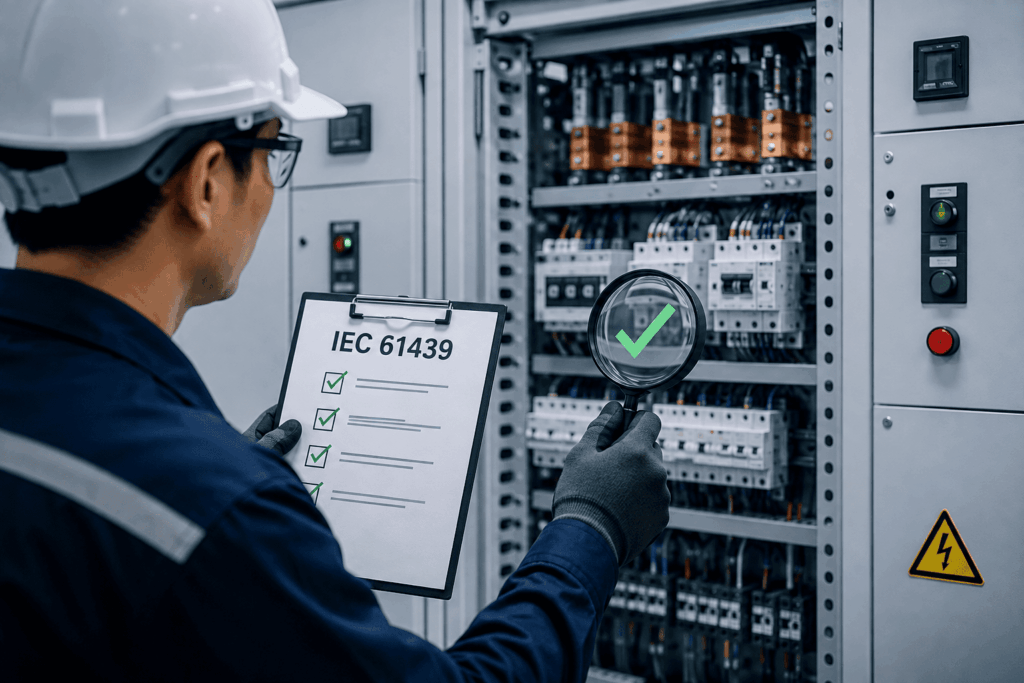
Choosing a low-voltage electrical panel is no longer just about comparing prices or selecting the lowest bidder. Whether you’re an EPC contractor, consultant, industrial facility manager, or project owner, the reliability of your electrical distribution system depends heavily on one critical factor: IEC 61439 verification.
Many manufacturers advertise IEC 61439 compliant panels or CPRI type tested panels, but those claims don’t always mean the same thing. A genuine IEC 61439 compliant panel is backed by verified design calculations, laboratory testing, routine inspections, traceable documentation, and quality-controlled manufacturing processes. Without these, a panel may meet basic functional requirements while still exposing your project to overheating, short circuits, arc faults, premature failures, and costly downtime.
This comprehensive buyer’s guide explains exactly what IEC 61439 requires, how design verification differs from routine verification, what CPRI testing proves, and the documents every buyer should request before approving an electrical panel manufacturer.
IEC 61439 verification is the internationally recognised process that proves a low-voltage electrical panel has been designed, tested, and manufactured to operate safely under real electrical conditions. Buyers should verify design test reports, routine verification records, CPRI documentation, and component traceability before approving any industrial electrical panel.
Why IEC 61439 matters more than ever
Industrial facilities today operate with higher electrical loads, smarter automation systems, and stricter safety regulations than ever before. A failure inside a PCC, MCC, APFC, or Synchronisation Panel can stop production, damage equipment worth millions, and create serious safety risks.
IEC 61439 was developed by the International Electrotechnical Commission to standardise how low-voltage switchgear and controlgear assemblies are designed and verified. Rather than simply specifying component quality, the standard evaluates the entire assembled panel as one integrated system.
That distinction is important.
A premium circuit breaker installed inside a poorly designed enclosure does not automatically create an IEC 61439 compliant panel. The complete assembly—including busbars, temperature rise, insulation distances, mechanical strength, and short-circuit performance—must be verified together.
Industries where IEC 61439 is essential
- Manufacturing plants
- Pharmaceutical facilities
- Data centres
- Commercial buildings
- Oil & gas installations
- Water treatment plants
- Renewable energy projects
- Infrastructure and EPC projects
For consultants and project owners, specifying IEC 61439 verification reduces technical risk during procurement and improves long-term system reliability.
What is IEC 61439?
IEC 61439 is an international standard governing the design and verification of low-voltage switchgear assemblies up to 1000V AC and 1500V DC.
It replaced the older IEC 60439 standard and introduced stricter requirements for design verification and manufacturer responsibility.
What the standard covers
| Area | Purpose |
| Electrical safety | Protection against electric shock |
| Temperature rise | Prevent overheating during operation |
| Short-circuit strength | Withstand fault current safely |
| Mechanical strength | Maintain structural integrity |
| Insulation | Ensure dielectric performance |
| Internal clearances | Reduce risk of flashover |
Instead of relying solely on component manufacturers, IEC 61439 places responsibility on the panel manufacturer to demonstrate that the final assembly performs safely under specified operating conditions.
Design Verification vs Routine Verification
This is the most misunderstood part of IEC 61439.
Many buyers receive a factory inspection report and assume the panel has been fully type tested. In reality, design verification and routine verification serve completely different purposes.
Design Verification
Design verification proves that the panel design itself has been validated through testing, calculation, or assessment before production.
It answers questions like:
- Can the busbar withstand 50kA fault current?
- Will the enclosure overheat at full load?
- Are insulation distances adequate?
- Is IP protection maintained after assembly?
This verification is usually completed once for each validated design.
Routine Verification
Routine verification is performed on every manufactured panel before dispatch.
It confirms that the delivered panel matches the verified design and has been assembled correctly.
Quick comparison
| Design Verification | Routine Verification |
| Validates the design | Validates each manufactured panel |
| Performed once per design | Performed on every panel |
| Includes thermal & short-circuit assessment | Includes wiring and functional inspection |
| Uses laboratory testing/calculation | Factory quality inspection |
| Required by IEC 61439 | Also mandatory |
A reputable manufacturer should provide evidence of both, not one or the other.
The 13 IEC 61439 Design Verification Tests Explained
IEC 61439 identifies thirteen critical design verification requirements. These ensure that the panel performs safely under electrical, thermal, and mechanical stress.
1. Strength of materials and parts
The enclosure must resist corrosion, UV exposure (where applicable), mechanical impact, and environmental deterioration.
Example: Powder-coated CRCA steel enclosures should demonstrate coating durability through recognised testing procedures.
2. Degree of protection (IP Rating)
This verifies protection against dust and water ingress.
Common industrial ratings include:
- IP42 – Indoor commercial installations
- IP54 – Industrial environments
- IP55 – Dust and water protection
- IP65 – Outdoor installations
3. Clearance and creepage distances
Proper spacing between live conductors prevents flashover and insulation failure.
Higher system voltages require larger minimum distances.
4. Protection against electric shock
The design must ensure safe access, protective earthing, and prevention of accidental contact with live parts.
5. Incorporation of switching devices
Circuit breakers, MCCBs, ACBs, contactors, and relays must be installed according to manufacturer specifications while maintaining electrical performance.
6. Internal electrical circuits
Wiring layouts, conductor sizing, identification, and routing are evaluated for reliability and maintenance safety.
7. Terminals for external conductors
Incoming and outgoing cable terminals must accommodate specified conductor sizes without overheating or mechanical failure.
8. Dielectric properties
High-voltage insulation tests confirm that insulation withstands temporary overvoltage conditions without breakdown.
9. Temperature Rise Verification
One of the most important tests.
This evaluates whether busbars, conductors, and devices remain within acceptable temperature limits at rated current.
A poorly designed busbar arrangement may pass visual inspection yet fail under continuous operation due to excessive heat generation.
10. Short-Circuit Withstand Strength
Perhaps the most valuable verification for industrial buyers.
The assembly is subjected to extremely high fault current to verify structural integrity.
Typical ratings include:
- 25kA
- 36kA
- 50kA
- 65kA
The verified rating must match the project’s fault level.
11. Electromagnetic Compatibility (EMC)
Ensures the panel operates correctly without causing or suffering unacceptable electromagnetic interference.
Critical for automation and PLC systems.
12. Mechanical Operation
Doors, hinges, interlocks, withdrawable mechanisms, and operating handles undergo repeated operation to verify durability.
13. Functional Performance
The completed assembly must perform exactly as intended under operational conditions.
This includes:
- Control circuits
- Indications
- Metering
- Protection logic
- Interlocks
What CPRI Type Testing Actually Proves
One of the most common marketing phrases in the industry is “CPRI Type Tested Panel.”
But what does it actually mean?
CPRI (Central Power Research Institute) is an accredited independent testing organisation that evaluates electrical equipment against recognised standards, including IEC 61439.
A successful CPRI test demonstrates that a specific panel design has undergone rigorous laboratory evaluation under controlled conditions.
Typical CPRI laboratory tests
These tests typically include:
- Temperature rise
- Short-circuit withstand
- Dielectric withstand
- IP verification
- Mechanical operation
- Protection continuity
Important buyer insight
A CPRI report does not automatically certify every future panel.
The manufactured panel must:
- Match the tested design.
- Use equivalent authorised components.
- Maintain identical busbar configuration.
- Follow documented manufacturing procedures.
If major design changes occur, the original report may no longer represent the delivered product.
Documents Every Buyer Should Request Before Approval
A professional procurement process should never rely solely on a catalogue or quotation.
Request the following documents before issuing technical approval.
Essential documentation checklist
| Document | Why it matters |
| IEC 61439 Design Verification Report | Confirms validated design |
| CPRI Type Test Report | Independent laboratory evidence |
| Routine Verification Record | Factory inspection of delivered panel |
| Single Line Diagram | Confirms electrical configuration |
| GA Drawing | Mechanical layout verification |
| Busbar Calculation | Current carrying capability |
| BOM with authorised components | Traceability |
| IP Test Evidence | Environmental suitability |
| Quality Inspection Report | Manufacturing consistency |
| Nameplate Details | Ratings and identification |
At Synchro Electricals, certification and verification documents are maintained as part of a documented quality process, allowing consultants and EPC clients to review technical compliance before project approval.
Internal Link Opportunity: Certificate Page
Practical Example: Two Similar Panels, Different Outcomes
Imagine an EPC contractor receives quotations from two manufacturers.
Manufacturer A
- Lowest price
- IEC 61439 mentioned on brochure
- No test report
- No routine verification record
- Mixed component brands
Manufacturer B
- Verified IEC 61439 documentation
- CPRI test report available
- Schneider/Siemens/L&T authorised components
- Busbar calculations provided
- Routine verification for every panel
Although both quotations appear similar, Manufacturer B significantly reduces technical and contractual risk.
The lowest purchase price often becomes the highest lifecycle cost when failures, downtime, or warranty disputes occur.
Red Flags When Evaluating Panel Manufacturers
Before approving any supplier, watch for these warning signs.
- No IEC 61439 test report
No evidence of verified design. - “Type tested” without documentation
Marketing claims should always be supported by reports. - Unauthorised component substitutions
Changing breakers or busbars can invalidate verification. - Missing traceability
No serial numbers, inspection records, or manufacturing history. - Generic certificates
Certificates that don’t reference the tested assembly or ratings. - No routine verification records
Every dispatched panel should have inspection documentation.
A reliable manufacturer welcomes technical audits rather than avoiding documentation requests.
10-Point Electrical Panel Buyer Checklist
Use this checklist during technical evaluation.
- IEC 61439 design verification available
Request the complete verification report. - CPRI or equivalent accredited laboratory report
Verify the issuing laboratory and tested ratings. - Short-circuit rating matches project requirement
Example: 50kA for 1 second. - Temperature rise verification completed
Critical for continuous industrial loading. - Authorised branded components specified
Avoid undocumented substitutions. - Routine verification record included
Must relate to the supplied panel. - Busbar sizing and calculation provided
Confirms current carrying capacity. - IP rating suitable for installation environment
Indoor vs outdoor applications differ. - Complete drawings and GA approved
Prevents installation conflicts. - Manufacturer offers technical support after commissioning
Long-term reliability depends on service as well as hardware.
Consultants often include a similar checklist within factory acceptance test (FAT) procedures to standardise supplier evaluation.
Why Certification Alone Is Not Enough
A certificate is valuable – but only when supported by traceability and controlled manufacturing.
The three pillars of genuine compliance
1. Traceability
Every panel should have:
- Unique serial number
- Manufacturing date
- Inspection history
- Material batch traceability
This simplifies maintenance and warranty support.
2. Documentation Control
Drawings, revisions, and bills of materials must match the delivered assembly.
A mismatch between approved drawings and manufactured panels is a common cause of project disputes.
3. Authorised Components
Replacing one breaker brand with another may affect:
- Thermal performance
- Short-circuit withstand
- Mounting arrangement
- Busbar connections
Equivalent ratings do not always mean equivalent performance.
This is why professional manufacturers maintain approved component lists and documented engineering change procedures.
How Consultants Can Verify Compliance During FAT
During Factory Acceptance Testing (FAT), don’t limit inspection to visual appearance.
Verify these technical points:
| FAT Check | Verify |
| Nameplate | Voltage, current, fault rating |
| Busbars | Size and support spacing |
| Torque records | Critical electrical joints |
| Insulation test | Recorded values |
| Functional testing | Interlocks and controls |
| Protection devices | Settings and coordination |
| Documentation | Latest revision only |
A structured FAT reduces commissioning issues and improves project acceptance.
Why Leading EPC Contractors Prioritise Verified Manufacturers
Large infrastructure projects increasingly specify:
- IEC 61439 compliant assemblies
- Accredited laboratory verification
- Routine verification documentation
- Branded authorised components
- Factory acceptance testing
- Complete quality dossiers
Manufacturers with documented engineering processes provide greater confidence during consultant review, client audits, and regulatory inspections.
For organisations procuring PCC, MCC, APFC, or Synchronisation Panels, technical documentation is often as important as manufacturing capability itself.
Frequently Asked Questions
1. What is IEC 61439 verification?
IEC 61439 verification is the process of proving that a low-voltage electrical panel design satisfies international safety and performance requirements through design verification and routine verification.
2. Is IEC 61439 the same as CPRI certification?
No. IEC 61439 is the international standard, while CPRI is an accredited testing organisation that performs laboratory testing against that standard.
3. What is the difference between type testing and routine testing?
Type testing validates the panel design under laboratory conditions, whereas routine testing inspects every manufactured panel before dispatch.
4. Can any manufacturer claim IEC 61439 compliance?
A manufacturer may claim compliance only if they can provide evidence of design verification and manufacture panels according to the verified design.
5. Why is temperature rise testing important?
Excessive heat shortens component life, reduces reliability, and may cause insulation failure. Temperature rise verification ensures safe continuous operation.
6. Does changing component brands affect compliance?
Yes. Unauthorised substitutions can invalidate the verified design if thermal or mechanical characteristics differ.
7. Which documents should consultants request?
Request design verification reports, CPRI reports, routine verification records, GA drawings, SLDs, BOMs, and inspection reports.
8. What IP rating is suitable for industrial panels?
It depends on the environment. Indoor applications commonly use IP42 or IP54, while outdoor installations may require IP55 or IP65.
9. Is a CPRI report enough to approve a panel?
No. Buyers should also verify that the supplied panel matches the tested design and includes routine verification documentation.
10. Why choose a manufacturer with documented verification?
Documented verification reduces technical risk, improves safety, simplifies consultant approval, and provides stronger long-term reliability.
Conclusion
An electrical panel is a long-term infrastructure investment, not a commodity product. The real value lies in engineering integrity, verified performance, and documented compliance rather than the lowest quotation.
Before approving any manufacturer, verify the IEC 61439 design verification, review accredited laboratory evidence, request routine verification records, and confirm complete traceability of components and drawings.
For consultants, EPC contractors, and industrial buyers, these checks significantly reduce project risk while ensuring safer and more reliable electrical distribution systems.
Call to Action: Download Synchro Electricals’ IEC 61439 certification documents and technical verification records to evaluate compliance before your next project.