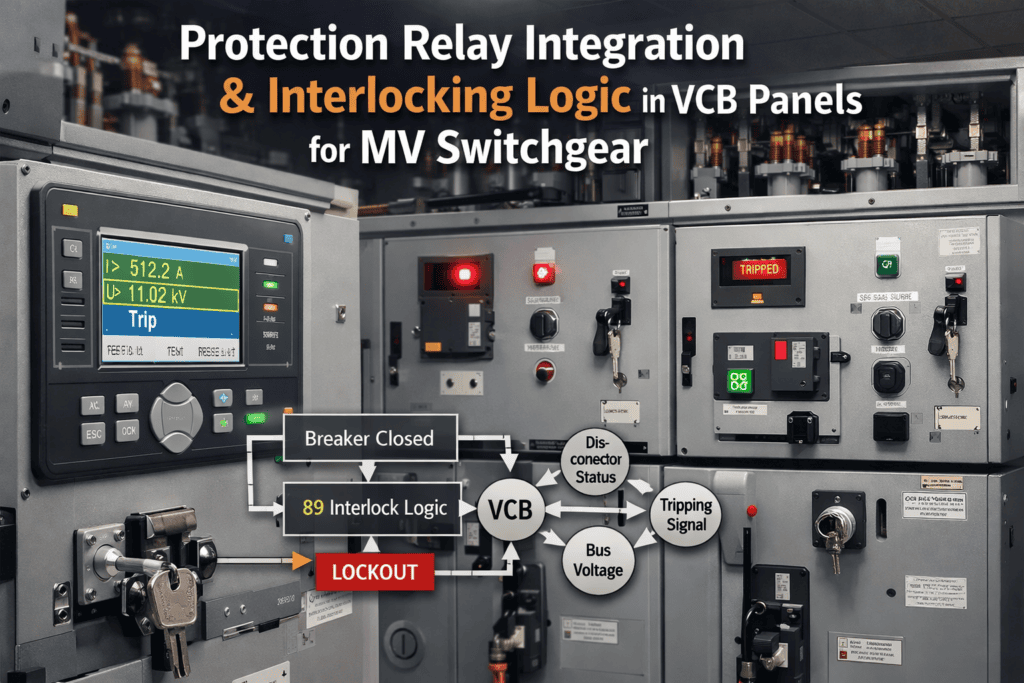
In utility and substation environments, medium-voltage (MV) switchgear is expected to operate under high fault levels, dynamic grid conditions, and strict reliability requirements. At the center of this infrastructure, VCB panels serve as both the switching and protection interface between the grid and downstream networks. However, the true effectiveness of a VCB panel is determined not by the breaker alone, but by the robustness of its VCB Panel Protection Relay Scheme.
Modern substations rely on numerical protection relays, intelligent control logic, and fail-safe interlocking philosophies to ensure that faults are detected, isolated, and cleared without compromising system stability or personnel safety. Protection relay integration and interlocking logic, therefore form the backbone of MV switchgear design.
Role of Protection Relay Integration in VCB Panels
Protection relay integration in VCB panels involves coordinating multiple protection functions—overcurrent, earth fault, feeder protection, breaker failure protection, and inter-tripping—within a unified control and protection architecture. In utility-grade MV switchgear, this integration must align with overall substation protection philosophy and grid code requirements.
Numerical protection relays for VCB panels continuously monitor current, voltage, and status inputs, converting raw electrical quantities into protection decisions. These relays must interface seamlessly with trip circuits, breaker mechanisms, and control relays, ensuring deterministic operation during fault conditions. Poor relay integration can result in delayed tripping, unwanted breaker operation, or complete failure to clear faults.
VCB Panel Protection Relay Scheme Architecture
A typical VCB panel protection relay scheme is structured around functional separation. Protection relays handle fault detection and tripping logic, while control circuits manage breaker operation, indication, and SCADA interfacing. This separation ensures that protection functions remain operational even if control or communication systems fail.
In 11kV and 33kV applications, feeder protection relay schemes are commonly implemented using numerical relays with configurable settings and communication capability. These relays coordinate with upstream and downstream devices to maintain selectivity, while also supporting redundancy where required by utility standards.
Integration increasingly includes IEC 61850 communication, allowing protection relays to exchange signals through GOOSE messaging rather than hardwired interconnections. While this improves speed and flexibility, it also places higher demands on interlocking logic design.
Interlocking Logic Design in VCB Panels
Interlocking logic is the mechanism that prevents unsafe operations within MV switchgear. In VCB panels, interlocking exists at multiple levels—mechanical, electrical, and logical.
Electrical and logical interlocking ensure that breaker closing is permitted only when predefined conditions are satisfied. These conditions may include correct isolator position, absence of earth switch engagement, healthy trip circuit supervision, and valid protection relay status. Logical interlocking implemented within numerical relays or control relays adds an additional layer of safety by enforcing operational sequences.
In substation environments, interlocking logic design must consider normal operation, maintenance conditions, and abnormal scenarios such as breaker failure or protection malfunctions. A poorly defined interlock can be as dangerous as no interlock at all.
Protection Relay Coordination and Interlocking Interaction
Protection relay coordination and interlocking logic are closely linked. For example, breaker failure protection relies on both relay logic and interlocking to initiate upstream tripping when a breaker fails to clear a fault. Similarly, inter-trip and blocking schemes require precise coordination between relays across multiple VCB panels.
In MV switchgear protection design, the interlocking philosophy must support fast fault clearance without allowing incorrect or premature breaker operation. This is particularly important in busbar and feeder interlocking logic, where incorrect coordination can lead to bus outages or equipment damage.
Fail-Safe Philosophy in Utility-Grade MV Switchgear
Utility and substation applications demand a fail-safe approach to protection and control. The VCB panel protection and control philosophy must ensure that any failure—loss of auxiliary supply, relay malfunction, communication failure—results in a safe system state.
This is achieved through redundancy in protection relay schemes, supervised trip circuits, and permissive logic that defaults to blocking unsafe operations. Control relay vs protection relay coordination is critical here; protection must always take precedence over control commands.
SCADA and Communication Integration
Modern substations require seamless SCADA integration with protection relays for monitoring, event analysis, and remote operation. However, SCADA must remain supervisory in nature. Protection decisions within the VCB panel protection relay scheme must remain local and autonomous to avoid dependency on external systems.
IEC 61850-based architectures enhance visibility and coordination but must be implemented with strict cybersecurity and reliability considerations, especially in grid-connected MV protection systems.
Engineering Perspective of Synchro Electricals
Synchro Electricals designs VCB panels with a protection-first philosophy. Relay integration, interlocking logic, and fail-safe design are treated as core engineering disciplines rather than wiring exercises. Each VCB panel protection relay scheme is developed in alignment with utility protection standards, substation operating practices, and real-world fault behavior.
Conclusion
In utilities and substations, MV switchgear reliability is defined by the quality of its protection and interlocking design. A well-engineered VCB Panel Protection Relay Scheme ensures that faults are cleared selectively, unsafe operations are prevented, and system stability is preserved under all operating conditions.
Protection relay integration and interlocking logic are not independent elements—they function as a unified system. When designed correctly, they transform VCB panels into intelligent, fail-safe components of modern power transmission infrastructure.
Frequently Asked Questions
1. What is a protection relay in a VCB panel?
A protection relay monitors electrical parameters and detects abnormal conditions such as overcurrent, short circuit, earth fault, under-voltage, or other configured faults. When a fault is detected, the relay sends a trip command to the VCB to disconnect the affected circuit.
2. Why is protection relay integration important in MV switchgear?
Protection relay integration enables accurate fault detection and coordinated circuit protection. Properly configured protection schemes can help isolate faults quickly while maintaining the continuity of healthy sections of the medium-voltage electrical system.
3. What is interlocking logic in a VCB panel?
Interlocking logic is a safety mechanism that prevents specific switching operations when predefined conditions are not satisfied. Electrical and mechanical interlocks can help prevent unsafe operations, such as closing a breaker when required permissive conditions are absent or operating an isolator under prohibited conditions.
4. How does interlocking improve safety in MV switchgear systems?
Interlocking helps ensure that switching operations follow the intended safe sequence. It can reduce the possibility of incorrect breaker or isolator operation, helping protect personnel and equipment from electrical and mechanical hazards.
5. What types of protection relays are commonly used in MV switchgear?
Common protection functions include overcurrent, earth-fault, under-voltage, over-voltage, differential, and other application-specific protection schemes. Modern numerical protection relays can combine multiple protection functions within a single device.
6. What is the difference between an overcurrent relay and an earth-fault relay?
An overcurrent protection function responds when current exceeds a configured threshold, while earth-fault protection detects current associated with a fault to earth. The exact detection method and settings depend on the protection scheme and system configuration.
7. Can numerical protection relays communicate with SCADA systems?
Yes. Many modern numerical protection relays support communication interfaces and protocols that allow integration with SCADA, PLC, HMI, or other automation systems. This can provide remote monitoring of electrical measurements, alarms, breaker status, and protection events.
8. Why is protection coordination important in MV switchgear?
Protection coordination helps ensure that the protective device closest to a fault operates appropriately while upstream devices remain available when possible. Proper coordination can help limit the affected portion of the electrical system and improve overall system reliability.
9. What happens when a protection relay detects a fault in a VCB panel?
When the relay identifies a fault that meets its configured protection criteria, it issues a trip command to the VCB. The breaker opens to isolate the affected circuit, while the relay may record fault information and generate an alarm for further investigation.
10. Can protection relays and interlocking systems be customized for different VCB applications?
Yes. Protection and interlocking schemes can be designed according to the system voltage, fault level, transformer or feeder configuration, operating sequence, protection philosophy, and project requirements. The final settings and logic should be determined through appropriate electrical studies and engineering.