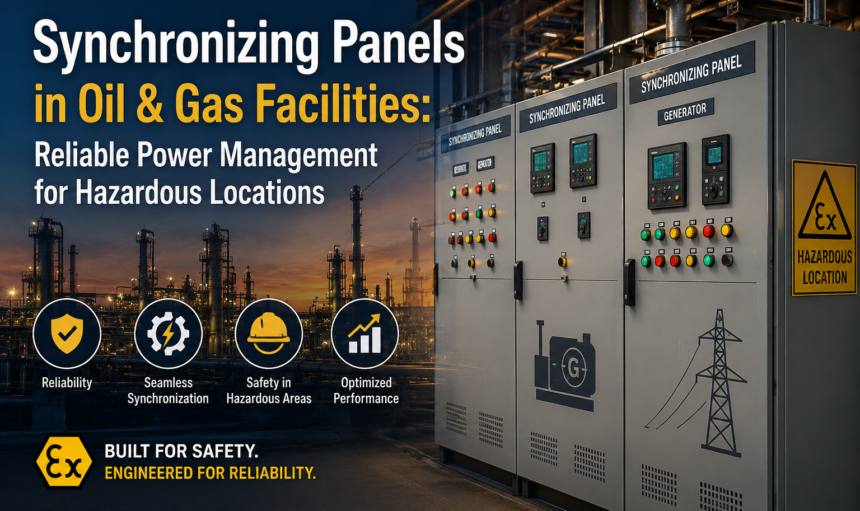
Synchronizing Panels in Oil & Gas Facilities: Reliable Power Management for Hazardous Locations

Power reliability in the oil and gas sector isn’t just an operational requirement – it’s a safety one. Offshore platforms, refineries, LNG terminals, petrochemical complexes, upstream drilling facilities – a power interruption in any of these doesn’t just disrupt processes. It hits production targets and creates serious safety concerns simultaneously.

Most oil and gas facilities run multiple power sources to keep operations continuous – diesel generators, gas generators, utility feeders, and emergency backup systems. Managing all of that efficiently requires advanced synchronizing panels for oil and gas applications.

A well-designed synchronizing panel keeps multiple generators running together safely, distributes loads effectively, and maintains uninterrupted power across critical systems. In hazardous environments where reliability isn’t negotiable, these panels form an important part of the overall power management system for oil and gas facilities.

Why Power Continuity Matters More in Oil and Gas Operations

Oil and gas plants aren’t like commercial facilities. Compressors, pumps, process control systems, emergency shutdown systems, safety instrumentation – all of it depends on stable electrical power, continuously.

Even a short interruption affects production processes and triggers significant operational losses. That’s why most facilities run multiple generators in parallel rather than betting everything on a single power source.

Connecting multiple generators to a common electrical network isn’t straightforward, though. Voltage, frequency, and phase angle all have to match before a generator can be safely connected. That coordination is exactly what the generator synchronizing panel handles.

Without proper synchronization, severe electrical and mechanical stresses hit the power distribution system fast.

Operating Multiple Generators as One Power System

The core job of a synchronizing panel for oil and gas facilities is seamless operation between multiple power sources.

When an additional generator is needed, the panel monitors generator parameters continuously and adjusts them until synchronization conditions are met. Once voltage, frequency, and phase sequence match the live busbar, the breaker closes automatically, and the generator joins the system.

Modern automatic synchronizing panels also handle load distribution between generators — a process known as load sharing. This prevents one generator from running hard while others sit underutilised.

For refineries, offshore platforms, and petrochemical plants where power demand shifts throughout the day, effective load sharing improves fuel efficiency and extends generator life.

Designing Synchronizing Panels for Hazardous Locations

Electrical equipment in oil and gas facilities has to perform reliably in some of the harshest industrial conditions that exist. Explosive atmospheres, corrosive environments, extreme temperatures, continuous vibration – all of it influences how equipment gets designed.

Synchronizing panels used in hazardous locations are engineered with that reality built in from the start.

Key design requirements typically include:

  • Integration with hazardous area electrical systems
  • Robust enclosure construction
  • High-reliability control components
  • Redundant power management architecture
  • Advanced protection and monitoring systems

Depending on facility classification, synchronizing panels may also interface with explosion-proof equipment and hazardous area instrumentation. That scope makes oil and gas synchronizing panels a different animal entirely compared to standard commercial generator control panels.

SCADA Integration and Centralized Power Management

Modern oil and gas facilities run on automation and centralised monitoring. Synchronizing panels for oil and gas applications are now routinely integrated with plant-wide SCADA and distributed control systems (DCS).

That integration gives operators real-time visibility across:

  • Generator loading
  • Busbar status
  • Breaker position
  • Fuel consumption trends
  • Power quality parameters

Informed decisions get made faster when the data is all in one place. Synchronizing panels with SCADA integration also support remote operation, event logging, alarm management, and predictive maintenance programs – capabilities that matter a great deal in remote or unmanned installations.

Protection Strategies for Critical Power Systems

Electrical faults in oil and gas environments need to be detected and isolated quickly. Letting a fault develop in a critical power system isn’t an option.

Modern generator synchronizing panels carry multiple protection functions built specifically for these applications – protecting generators, switchgear, and connected loads from abnormal conditions before they escalate.

Protection schemes commonly built into oil and gas synchronizing panels include overcurrent protection, reverse power protection, under-frequency protection, over-voltage protection, and busbar protection.

Combined with intelligent control algorithms, these protection systems maintain stability across the entire industrial power distribution network.

Engineering Synchronizing Panels for Demanding Applications

At Synchro Electricals, we design and manufacture synchronizing panels for industrial power management applications across demanding sectors, including oil and gas, infrastructure, utilities, and process industries.

Our engineering focus sits on reliable generator synchronization, accurate load sharing, advanced protection coordination, and seamless SCADA integration. Robust panel construction combined with intelligent control technology is what delivers dependable power management in environments where reliability is critical, and failure isn’t an acceptable outcome.

The Backbone of Reliable Power Generation

Oil and gas facilities run around the clock, often in remote and unforgiving locations where power reliability simply cannot be compromised. Synchronizing multiple generators, distributing load efficiently, and responding quickly to changing operating conditions – that’s what keeps continuous production possible.

It’s why synchronizing panels for oil and gas facilities remain a key component of modern power management systems. Safe generator operation, intelligent load sharing, centralised control – these panels deliver the reliability that hazardous industrial locations demand.

FAQs

  1. 1. What is the purpose of a synchronizing panel in an oil and gas facility? 

    It safely connects multiple generators to a common busbar and manages load sharing between power sources – keeping the facility’s electrical system stable and continuous.

  2. 2. Why are synchronizing panels important in hazardous locations? 

    Because power failures in these environments don’t just cost money – they affect safety. These panels keep critical equipment running without interruption in conditions where that matters most.

  3. 3. Can synchronizing panels support automatic load sharing?

    Yes. Modern automatic synchronizing panels continuously balance electrical loads across multiple generators without manual intervention.

  4. 4. Are synchronizing panels integrated with SCADA systems?

    Most modern synchronizing panels support full SCADA and DCS integration for centralised monitoring, remote operation, and alarm management.

  5. 5. Where are synchronizing panels commonly used in the oil and gas sector? 

    Refineries, offshore platforms, LNG terminals, petrochemical plants, drilling facilities, and pipeline infrastructure – anywhere multiple power sources need to be managed reliably.

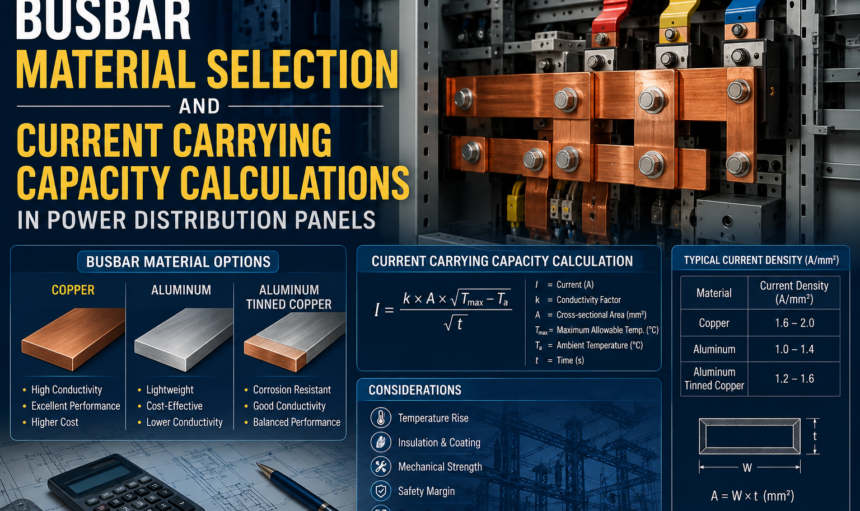
Busbar Material Selection and Current Carrying Capacity Calculations in Power Distribution Panels

In modern power systems engineering, the performance and safety of power distribution panels depend heavily on the design of the busbar system. Busbars act as the primary electrical conductors inside switchboards and distribution panels, carrying large currents from incoming feeders to outgoing circuits.

Selecting the correct busbar material and performing accurate busbar current-carrying capacity calculations are critical design tasks in industrial electrical engineering. Poor busbar design can lead to overheating, voltage drop, mechanical deformation, and even catastrophic panel failures.

For engineers designing industrial power distribution panels, understanding the electrical, thermal, and mechanical characteristics of busbars is essential for ensuring reliable power delivery in high-load environments.

The Electrical Backbone of Power Distribution Panels

Inside every industrial power distribution panel, busbars function as the central pathway through which electrical energy flows. Unlike cables, busbars provide a rigid conductor structure that supports high current capacity with lower impedance and improved thermal performance.

Busbars distribute power between key components such as:

  • Incoming circuit breakers
  • Outgoing feeder breakers
  • protection relays
  • switchgear assemblies

Because these conductors carry large currents continuously, their design must ensure both efficient current transfer and thermal stability. This makes busbar material selection and current-carrying capacity calculations fundamental aspects of power distribution panel engineering.

Copper vs Aluminum: Engineering Considerations in Busbar Material Selection

One of the first design decisions in busbar system design for power distribution panels involves choosing the appropriate conductor material. The two most commonly used materials are copper busbars and aluminum busbars.

Copper Busbars

Copper is widely used in high-performance power distribution panels because of its excellent electrical conductivity and mechanical strength.

Key technical characteristics include:

  • High electrical conductivity (~58 MS/m)
  • Superior thermal conductivity
  • High short circuit withstand capability
  • Compact busbar dimensions for the same current rating

Because of these advantages, copper busbars are commonly used in high-current industrial distribution panels and critical electrical infrastructure.

Aluminum Busbars

Aluminum busbars are sometimes selected where cost and weight reduction are priorities.

Important characteristics include:

  • Lower density compared to copper
  • Reduced material cost
  • Larger cross-sectional area required for the same current capacity

Although aluminum is less conductive than copper, properly designed aluminum busbar systems can still provide reliable performance in many power distribution applications.

Current Carrying Capacity Calculations in Busbar Design

The busbar current-carrying capacity, often referred to as ampacity, determines how much current the busbar can safely conduct without exceeding permissible temperature limits.

Busbar sizing calculations consider multiple thermal and electrical parameters to ensure safe operation.

Key parameters used in busbar current calculations include:

  • Rated current of the power distribution system
  • Ambient temperature within the electrical panel
  • Permissible temperature rise of the conductor
  • Busbar material resistivity
  • Installation configuration and spacing

As current flows through the busbar, electrical resistance generates heat according to I²R losses. If the busbar cross-sectional area is insufficient, excessive heating can occur, which may damage insulation and reduce system reliability.

Therefore, accurate busbar current capacity calculations ensure that power distribution panels operate within safe thermal limits.

Thermal Performance and Heat Dissipation in Busbar Systems

Thermal management is a critical aspect of busbar design in power distribution panels. High current flow results in resistive heating, and if heat is not dissipated effectively, busbar temperatures may exceed safe operating limits.

Engineers, therefore evaluate the thermal equilibrium of busbars by considering:

  • convection cooling inside the panel enclosure
  • Radiation heat transfer between conductors
  • airflow within the switchgear cabinet

In many industrial power distribution panels, busbars are spaced strategically to allow sufficient airflow and reduce heat accumulation.

Proper busbar layout design therefore, contributes significantly to maintaining safe operating temperatures under full load conditions.

Mechanical Strength and Short Circuit Withstand Capability

Busbars inside power distribution panels must also withstand the mechanical forces generated during short circuit conditions.

When fault currents flow through conductors, powerful electromagnetic forces are generated between busbars. These forces can cause bending, vibration, or displacement if the busbars are not properly supported.

Therefore, busbar design for industrial distribution panels includes structural considerations such as:

  • rigid busbar supports
  • adequate spacing between phases
  • insulation barriers
  • high mechanical strength materials

These design features ensure that the busbar system can withstand both thermal stress and mechanical stress during fault events.

Voltage Drop and Efficiency Considerations

Another important factor in busbar current calculations is voltage drop. Excessive voltage drop across busbars can reduce the efficiency of the power distribution panel and affect downstream equipment performance.

Busbar resistance depends on:

  • conductor material
  • cross-sectional area
  • length of the conductor

By increasing the busbar cross-sectional area or selecting materials with higher conductivity, engineers can reduce voltage losses and improve overall system efficiency.

Efficient busbar system design in power distribution panels therefore supports stable voltage delivery across the electrical network.

Synchro Electricals: Precision-Engineered Power Distribution Panels

Synchro Electricals specializes in designing and manufacturing high-quality power distribution panels with optimized busbar systems. The company focuses on engineering panels that support reliable current flow, efficient heat dissipation, and strong short circuit withstand capability.

Each power distribution panel from Synchro Electricals is developed with carefully calculated busbar current-carrying capacity and material selection, ensuring dependable performance in demanding industrial environments.

With expertise in power systems engineering and industrial electrical panel manufacturing, Synchro Electricals provides robust electrical solutions that support safe and efficient power distribution across multiple industries.

Reliable Busbar Design as the Foundation of Electrical Panel Performance

The reliability of any power distribution panel ultimately depends on the quality of its busbar system. Proper busbar material selection and current-carrying capacity calculations ensure that electrical panels can safely handle high load currents without overheating or mechanical instability.

By carefully balancing electrical conductivity, thermal performance, and structural strength, engineers can design busbar systems that support long-term reliability in industrial power distribution networks.

For modern power systems, accurate busbar current calculations and optimized busbar design remain essential for building safe, efficient, and durable electrical infrastructure.

FAQs

  1. 1. What is a busbar in a power distribution panel?

    A busbar is a conductive metal strip used in power distribution panels to carry and distribute large electrical currents between incoming and outgoing circuits.

  2. 2. Which material is commonly used for busbars in electrical panels?

    Copper and aluminum are the most commonly used busbar materials, with copper offering higher conductivity and mechanical strength.

  3. 3. How is busbar current carrying capacity calculated?

    Busbar current capacity is calculated based on conductor cross-sectional area, material conductivity, permissible temperature rise, and ambient operating conditions.

  4. 4. Why is busbar sizing important in power distribution panels?

    Proper busbar sizing prevents overheating, reduces voltage drop, and ensures safe operation of the electrical distribution system.

  5. 5. What factors influence busbar performance in electrical panels?

    Material selection, cross-sectional area, thermal conditions, mechanical strength, and short circuit withstand capability all influence busbar performance.

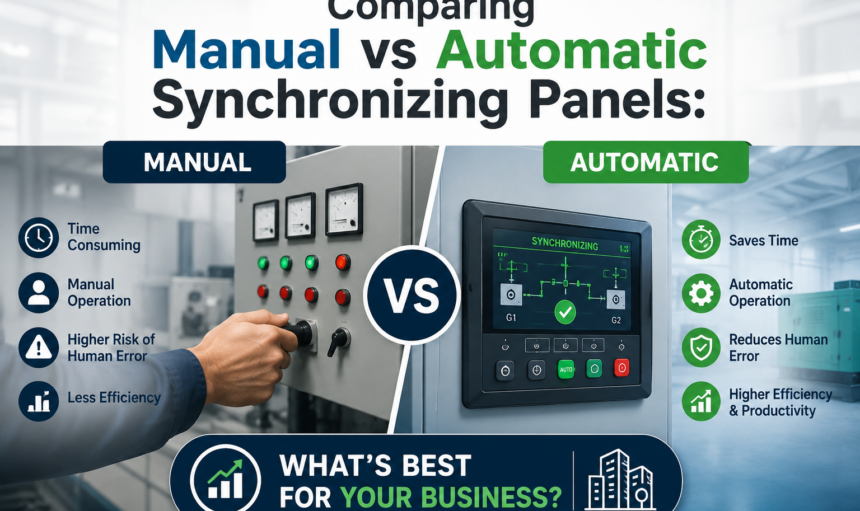
Comparing Manual vs Automatic Synchronizing Panels: What’s Best for Your Business?

In commercial power systems where multiple generators operate together, synchronizing panels play a critical role in ensuring stable and safe power distribution. These panels synchronize generator parameters such as voltage, frequency, and phase angle before connecting them to a common busbar. For facilities that rely on generator-based backup or continuous power supply, selecting the right synchronizing panel becomes an important operational decision.

Businesses typically choose between manual synchronizing panels and automatic synchronizing panels depending on their power requirements, operational complexity, and automation needs. Understanding the differences between manual vs automatic synchronizing panels helps organizations select the most suitable solution for their electrical infrastructure.

Manual Synchronizing Panels in Power Systems

A manual synchronizing panel requires an operator to monitor generator parameters and perform synchronization manually. The operator observes instruments such as voltmeters, frequency meters, and synchroscopes to ensure that the incoming generator matches the busbar conditions before closing the breaker.

Manual systems are often used in small commercial power systems where synchronization operations occur infrequently, and skilled operators are available to manage the process.

Because synchronization depends on human intervention, the process can take longer and requires careful monitoring. However, manual panels are generally simpler in design and involve lower initial investment compared to automated systems.

Automatic Synchronizing Panels for Modern Power Infrastructure

An automatic synchronizing panel uses advanced controllers and protection systems to perform generator synchronization automatically. These panels continuously monitor generator parameters and automatically adjust voltage, frequency, and load sharing before connecting generators to the electrical network.

In commercial facilities with multiple generators or critical power loads, automatic synchronization significantly improves operational efficiency. The system responds quickly to changing load conditions and can automatically start, synchronize, and share load among multiple generators.

Automation also reduces dependency on manual intervention and minimizes the risk of synchronization errors. This makes automatic synchronizing panels particularly valuable for data centers, hospitals, manufacturing facilities, and large commercial complexes where power continuity is essential.

Key Differences Between Manual and Automatic Synchronizing Panels

FeatureManual Synchronizing PanelAutomatic Synchronizing Panel
Operation MethodRequires operator to synchronize generators manuallySynchronization is handled automatically by control systems
Response TimeSlower due to manual monitoring and interventionFast synchronization with real-time controller adjustments
System ComplexitySimple design with basic instrumentsAdvanced controllers, PLCs, and protection relays
Human DependencyHigh dependency on trained operatorsMinimal human intervention required
Application SizeSuitable for small commercial power systemsIdeal for large commercial or industrial power systems
Load SharingOften manual or limitedAutomatic load sharing between generators

Choosing the Right Synchronizing Panel for Your Business

Selecting between a manual synchronizing panel and an automatic synchronizing panel depends largely on the scale and operational requirements of the power system.

Businesses operating smaller generator installations may find manual panels sufficient, particularly where synchronization operations occur rarely. However, as the complexity of the electrical network increases, automation becomes increasingly beneficial.

Modern commercial facilities often prefer automatic synchronizing panels because they provide faster generator response, improved load sharing control, and better integration with monitoring systems such as SCADA.

Manufacturers involved in electrical panel engineering, including Synchro Electricals, design synchronizing panels tailored to different power system requirements. Whether for manual or automated operations, well-designed panels help ensure safe generator synchronization and reliable power distribution.

FAQs

  1. 1. What is a synchronizing panel used for?

    A synchronizing panel ensures that multiple generators match voltage, frequency, and phase before connecting to a common electrical bus.

  2. 2. What is the main advantage of automatic synchronizing panels?

    Automatic panels synchronize generators faster and reduce the need for manual operator intervention.

  3. 3. Are manual synchronizing panels still used today?

    Yes, they are still used in smaller power systems where generator synchronization is performed occasionally.

  4. 4. Which industries use automatic synchronizing panels?

    Industries such as healthcare, data centers, manufacturing, and commercial complexes commonly use automatic synchronization systems.

  5. 5. Can synchronizing panels manage load sharing between generators?

    Yes, advanced automatic synchronizing panels can automatically balance electrical load between multiple generators.

Load Sharing in Synchronizing Panels: Intelligent Power Balancing for Multi-DG Power Plants

Industrial facilities that rely on multi-DG power plants face a critical operational challenge – how to distribute electrical load efficiently across multiple generators. When several diesel generators operate together without proper coordination, the result can be unstable frequency, inefficient fuel usage, and uneven mechanical stress.

This is where automatic synchronizing panels play a vital role. Modern synchronizing panels integrate intelligent load sharing algorithms that automatically balance electrical demand among generators operating on the same busbar.

In large-scale power generation systems, proper load sharing in synchronizing panels ensures that each DG set contributes proportionally to the total power demand, improving efficiency and protecting expensive generator equipment.

Understanding the Load Sharing Challenge in Multi-DG Power Plants

Running a single diesel generator is relatively simple. However, when multiple generators operate simultaneously in industrial power plants, maintaining equilibrium becomes significantly more complex.

Each generator must match system parameters such as frequency, voltage, and phase angle before connecting to the power bus. Once connected, the generators must continuously adjust their output so that the electrical load is evenly distributed.

Without an effective load sharing mechanism in synchronizing panels, several operational problems can arise:

  • One DG set may become overloaded
  • Other generators may run underutilized
  • Fuel efficiency may drop significantly
  • Generator engines may experience premature wear

Advanced synchronizing panels used in power generation plants prevent these issues by implementing intelligent load distribution logic.

How Automatic Synchronizing Panels Manage Generator Coordination

A synchronizing panel acts as the control center of a multi-generator power system. It monitors electrical parameters from each generator and ensures that generators connect to the system safely.

Once synchronization is achieved, the panel’s control system manages generator output using specialized load sharing algorithms.

The panel continuously monitors parameters such as:

  • Generator real power output (kW)
  • System frequency and voltage
  • Generator engine speed
  • Power factor

Based on these readings, the automatic synchronizing panel dynamically adjusts generator performance to maintain balanced load distribution across all running DG sets.

Key Load Sharing Strategies Used in Modern Synchronizing Panels

Modern industrial synchronizing panels rely on several control methods to maintain stable generator operation. Each method is designed to ensure reliable load sharing in multi-DG power plants.

1. Droop-Based Load Sharing

The droop method is one of the most widely implemented techniques in automatic synchronizing panels. In this system, a generator’s frequency slightly decreases as its load increases.

Because every generator follows this behavior, the load naturally distributes across all DG sets connected to the bus. This method is commonly used in industrial power plants and manufacturing facilities due to its simplicity and reliability.

2. Isochronous Control for Precision Power Distribution

In facilities that demand extremely stable power – such as data centers or healthcare infrastructure – more precise control is required.

Isochronous control allows one generator to maintain system frequency while other generators share load proportionally. This approach ensures tight load regulation while maintaining stable electrical parameters across the entire system.

3. Digital Load Sharing Controllers

Modern synchronizing panels for power generation plants increasingly use microprocessor-based controllers that perform real-time load management.

These controllers communicate between generators and continuously adjust fuel injection and engine speed, ensuring optimal load balancing. Digital control systems improve both efficiency and system stability in large multi-generator installations.

Operational Advantages of Intelligent Load Sharing

Well-designed load sharing systems in synchronizing panels significantly improve generator plant performance. For industrial power facilities, these benefits directly translate into lower operating costs and improved system reliability.

Key operational advantages include:

Balanced Generator Utilization
All DG sets share electrical demand evenly, preventing overload conditions.

Improved Fuel Efficiency
Generators running at optimal load levels consume less fuel per unit of power generated.

Enhanced System Stability
Stable voltage and frequency are maintained even during sudden load changes.

Reduced Equipment Wear
Balanced load distribution minimizes mechanical stress on generator engines and alternators.

These advantages make automatic synchronizing panels with advanced load sharing algorithms essential for modern power generation systems.

Engineering Considerations for Synchronizing Panel Design

Designing synchronizing panels for multi-DG power plants requires advanced electrical engineering expertise. Panel design must ensure accurate measurement, reliable control, and strong protection mechanisms.

Critical components of a high-performance industrial synchronizing panel include:

  • Precision voltage and frequency sensors
  • Intelligent load sharing controllers
  • Programmable logic controllers (PLC)
  • Protection relays for reverse power and overload conditions
  • High-quality busbar systems

Together, these components enable reliable load sharing in synchronizing panels, ensuring smooth generator coordination in demanding industrial environments.

Synchro Electricals: Advanced Synchronizing Panel Solutions

Synchro Electricals is a trusted manufacturer of industrial synchronizing panels and generator control systems designed for reliable multi-DG power plant operations.

The company’s automatic synchronizing panels incorporate advanced control technologies and intelligent load sharing algorithms, ensuring stable generator coordination and efficient power distribution.

With deep expertise in industrial electrical panel manufacturing, Synchro Electricals delivers solutions that support power plants, infrastructure projects, manufacturing facilities, and critical power installations.

By combining engineering precision with robust panel design, Synchro Electricals helps industries maintain reliable and efficient generator synchronization and load management systems.

Final Thoughts

Operating multiple generators efficiently requires more than just connecting them to the same power bus. Proper coordination through synchronizing panels with advanced load sharing algorithms is essential for maintaining system stability and optimizing generator performance.

From droop-based control to digital load sharing systems, modern automatic synchronizing panels provide the intelligence needed to manage complex multi-DG power plants.

For industrial facilities that rely on dependable power generation, investing in high-quality synchronizing panels engineered for efficient load sharing ensures long-term operational reliability and energy efficiency.

FAQs

  1. 1. What is load – sharing in synchronizing panels?

    Load sharing in synchronizing panels ensures that multiple generators in a multi-DG power plant distribute electrical load evenly, preventing overload and improving overall power system efficiency.

  2. 2. Why are synchronizing panels important for multi-DG power plants?

    Synchronizing panels match voltage, frequency, and phase before connecting generators to the busbar, ensuring safe generator operation and stable power distribution.

  3. 3. Which load sharing method is commonly used in synchronizing panels?

    The droop control method is widely used in industrial synchronizing panels because it allows generators to naturally balance load without complex communication systems.

  4. 4. What industries use automatic synchronizing panels?

    Automatic synchronizing panels are commonly used in manufacturing plants, hospitals, data centers, power plants, and large infrastructure facilities where multiple generators operate together.

  5. 5. How do load-sharing algorithms improve generator performance?

    Advanced load-sharing algorithms optimize generator utilization, reduce fuel consumption, and maintain stable voltage and frequency in multi-generator power systems.

Role of Synchronizing Panels in Telecom and Remote Infrastructure Power Systems

Telecom networks operate in environments where uninterrupted power is not just desirable—it is mandatory. Telecom towers, remote telecom stations, and telecom data transmission hubs depend on reliable electrical infrastructure to maintain network connectivity 24/7. From rural telecom towers and mobile base stations to remote communication sites and fiber network hubs, power reliability directly determines service availability.

In these critical telecom environments, Synchronizing Panels for Telecom play a vital role in managing multiple power sources such as utility supply, diesel generators, and backup energy systems. Telecom power systems often operate in remote locations where grid supply may be unstable or unavailable. Synchronizing panels ensures that telecom infrastructure power systems can switch or operate between multiple sources without disruption.

Telecom Infrastructure Depends on Multi-Source Power Systems

Telecom networks rarely rely on a single power source. Most telecom towers and remote telecom infrastructure sites operate with a combination of grid power, diesel generator backup, and sometimes renewable energy systems such as solar hybrid telecom power solutions.

Managing these multiple sources requires careful coordination. Synchronizing Panels for Telecom enables telecom power systems to operate multiple generators in parallel, coordinate generator start-up, and maintain stable power for telecom equipment. Without proper synchronization, switching between power sources can cause voltage disturbances that may affect sensitive telecom electronics and communication hardware.

For telecom network operators, reliable synchronization is essential for ensuring uninterrupted connectivity.

Power Challenges in Remote Telecom Infrastructure

Remote telecom towers face unique electrical challenges. Many telecom sites are located in rural or hard-to-access areas where grid power reliability is limited. Frequent voltage fluctuations, unexpected outages, and inconsistent grid supply make backup power systems a necessity.

In these conditions, Synchronizing Panels for Telecom help telecom operators maintain stable operations by coordinating generator systems and managing load sharing between power sources. Telecom base stations often run critical equipment such as transmission radios, network routers, and cooling systems that cannot tolerate sudden power interruptions.

By enabling seamless transitions between generators and grid supply, synchronizing panels helps telecom infrastructure maintain operational continuity even during unstable power conditions.

How Synchronizing Panels Support Telecom Power Reliability

Telecom power systems must support continuous operation without manual intervention. When grid power fails, backup generators must start automatically and synchronize before taking over the telecom load.

Synchronizing Panels for Telecom manage this process by ensuring voltage, frequency, and phase alignment before connecting generators to the telecom power bus. This prevents electrical disturbances and protects sensitive telecom equipment.

In telecom tower infrastructure, synchronizing panels also enable multiple generators to operate in parallel. This allows telecom operators to distribute load efficiently across generator units, reducing fuel consumption and improving generator lifespan.

Reliable synchronization helps telecom operators maintain stable communication networks even in challenging operating environments.

Supporting Continuous Operation of Telecom Networks

Telecom infrastructure operates continuously, often without onsite operators. Automated power management, therefore, becomes essential. Synchronizing panels help telecom facilities run unattended by managing generator operation automatically.

With Synchronizing Panels for Telecom, telecom operators can maintain power continuity across:

  • Remote telecom towers
  • Cellular base stations
  • Telecom switching facilities
  • Fiber network hubs
  • Rural communication sites

These systems ensure telecom equipment receives stable power even when the grid supply is unavailable.

Ensuring Efficient Power Management in Telecom Sites

Energy efficiency is also a major concern for telecom operators. Running multiple generators inefficiently increases operational costs and maintenance requirements.

Synchronizing Panels for telecom improves efficiency by balancing loads across generators and preventing unnecessary generator operation. By optimizing generator usage, telecom infrastructure operators can reduce fuel consumption and extend equipment life.

Efficient power synchronization also supports hybrid telecom energy systems that combine solar power, battery storage, and diesel generators.

Scalability for Expanding Telecom Networks

Telecom networks continue to expand as demand for mobile connectivity, broadband services, and rural communication infrastructure increases. Power systems must be capable of supporting additional equipment and expanded network loads.

Synchronizing Panels for Telecom allows telecom operators to scale power infrastructure by integrating additional generators or energy sources without disrupting existing operations. This scalability is especially valuable for telecom providers expanding coverage in rural and remote regions.

Power Infrastructure Solutions for Telecom Environments

Synchro Electricals develops Synchronizing Panels for Telecom designed specifically for remote telecom infrastructure, telecom towers, and communication network facilities. Their synchronizing solutions support reliable power coordination, stable generator operation, and uninterrupted telecom network performance.

Conclusion

Telecom networks depend on reliable power infrastructure to maintain continuous communication services. In remote telecom sites and distributed telecom networks, managing multiple power sources effectively is essential.

Synchronizing Panels for telecom ensures seamless coordination between grid supply, generators, and backup systems, enabling telecom operators to maintain uninterrupted service even in challenging power environments. As telecom infrastructure continues to expand, synchronizing panels remains a key component of reliable telecom power systems.

FAQs

1. Why are Synchronizing Panels for Telecom important in telecom towers?

They coordinate multiple power sources, such as generators and grid supply, to ensure continuous power for telecom equipment.

2. How do Synchronizing Panels for Telecom improve telecom network reliability?

They allow seamless switching and parallel operation of generators, preventing power interruptions in telecom infrastructure.

3. Can synchronizing panels support remote telecom sites without operators?

Yes. Synchronizing Panels for Telecom enable automated power management in unattended telecom stations.

4. Do telecom power systems require multiple generators?

Many telecom towers and communication sites use multiple generators for redundancy, which are managed through synchronizing panels.

5. Can Synchronizing Panels for Telecom support hybrid energy systems?

Yes. They can coordinate generators with renewable energy sources such as solar systems used in telecom infrastructure.

PLC-Based Synchronizing Panels: Control Logic Design for Generator Paralleling Systems

In industrial power systems, generator paralleling is no longer a niche requirement limited to large power plants. Manufacturing facilities, process industries, data centers, and critical infrastructure increasingly rely on multiple generators operating in parallel with each other and with the utility grid. In these environments, the reliability of synchronization is defined not by hardware alone, but by the intelligence of the control system behind it.

This is where a PLC – Based Synchronizing Panel becomes central. Unlike conventional relay-based systems, PLC-driven synchronizing panels offer deterministic logic execution, advanced sequencing capability, and full adaptability to complex operating scenarios. For engineers, the real value lies in how the control logic is designed, validated, and coordinated with generator dynamics.

Why PLC-Based Synchronizing Panels Are Preferred in Industrial Power Systems

Traditional synchronizing relays are effective for basic voltage, frequency, and phase matching, but they are inherently limited in flexibility. Industrial power systems often require conditional logic, multi-mode operation, and interaction with auxiliary systems such as fuel management, load shedding, and process interlocks.

A PLC Based Synchronizing Panel allows synchronization to be treated as a control problem rather than a discrete event. The PLC continuously evaluates system states, generator availability, breaker status, and grid conditions before executing synchronization decisions. This capability is essential when paralleling multiple generators with varying ratings, response characteristics, and operating priorities.

Control Architecture of a PLC-Based Synchronizing Panel

At the core of a PLC-based system is a real-time control loop that monitors electrical parameters and system status. Voltage, frequency, and phase angle are acquired through transducers or digital meters, while breaker status, generator readiness, and fault signals are processed as discrete inputs.

The PLC executes synchronization logic cyclically, ensuring that decisions are based on current system conditions rather than static thresholds. This architecture enables coordinated control across generators, grid incomers, and bus couplers within a single control platform.

Crucially, the PLC does not replace protective relays; instead, it coordinates with them. Protection remains autonomous and fast, while the PLC manages sequencing, permissive logic, and operational control.

Synchronization Logic Design Using PLC

PLC-Based Synchronizing Panel – Pre-Synchronization Logic

Before synchronization, the PLC verifies that the generator is electrically and mechanically ready. This includes confirmation of rated voltage buildup, stable frequency, correct phase rotation, and acceptable governor and AVR response.

Speed and voltage ramping are controlled gradually to avoid overshoot. Unlike relay-based systems that wait passively for alignment, PLC logic actively drives the generator toward synchronism using feedback control. This reduces synchronization time while minimizing transient stress.

PLC-Based Synchronizing Panel – Breaker Closing and Validation Logic

Once synchronization criteria are met within defined tolerances, the PLC issues a breaker close command. However, advanced PLC logic also validates post-closure conditions. It checks for successful breaker operation, confirms that slip frequency collapses as expected, and ensures that no abnormal current or power flow is detected.

If post-synchronization conditions deviate from expected behavior, the PLC can initiate corrective action or controlled disconnection, preventing unstable operation from propagating into the system.

Load Sharing and Post-Synchronization Control

Synchronization is only the first step. In generator paralleling systems, stability depends heavily on how load is shared after connection. PLC-based panels integrate load-sharing algorithms that coordinate governor and AVR references to distribute active and reactive power proportionally.

The PLC continuously monitors real power, reactive power, and frequency deviation to damp oscillations and prevent hunting between generators. This is particularly important in industrial systems with fluctuating loads or large motor starts, where poor load sharing can lead to instability or nuisance tripping.

Handling Multiple Operating Modes

One of the strongest advantages of a PLC Based Synchronizing Panel is its ability to manage multiple operating modes within the same logic framework. These may include island mode operation, grid-parallel operation, generator-only mode, or black-start scenarios.

Each mode requires different synchronization permissives, sequencing rules, and protection coordination. PLC logic enables these modes to coexist without hardware modification, allowing operators to transition between configurations safely and predictably.

Failure Handling and Logic Robustness

In real-world systems, synchronization does not always succeed on the first attempt. Voltage instability, governor lag, or grid disturbances can interrupt the process. PLC-based logic handles these scenarios deterministically by aborting synchronization sequences, resetting conditions, and retrying only when stability is restored.

This approach avoids repeated mechanical stress and uncontrolled breaker operations, which are common failure modes in poorly designed systems.

Engineering Approach of Synchro Electricals

Synchro Electricals designs PLC-based synchronizing panels with a control-engineering-first philosophy. Synchronization logic is developed as a structured sequence with clearly defined states, transitions, and failure responses. Generator dynamics, grid behavior, and operational requirements are modeled into the PLC logic rather than handled as afterthoughts.

This approach ensures that the PLC-based synchronizing panel performs reliably under complex industrial conditions, including multi-generator operation, weak grids, and variable load profiles.

Conclusion

In modern industrial power systems, synchronization is no longer a single moment of alignment but a continuous control function. A PLC-based synchronizing panel provides the intelligence, flexibility, and determinism required to manage generator paralleling safely and efficiently.

By focusing on robust control logic design—covering pre-synchronization, breaker control, load sharing, and failure handling—engineers can build systems that remain stable under real operating stress. PLC-based synchronization is not simply an upgrade in technology; it is a fundamental shift toward system-level power control.

FAQs

1. What differentiates a PLC Based Synchronizing Panel from relay-based systems?

A PLC Based Synchronizing Panel uses deterministic control logic to manage synchronization, sequencing, and load sharing, whereas relay-based systems are limited to threshold-based matching of voltage, frequency, and phase.

2. Can a PLC Based Synchronizing Panel handle multiple generators with different ratings?

Yes. PLC logic can be customized to account for generator capacity, response characteristics, and priority, enabling stable paralleling of unequal machines.

3. How does PLC logic improve synchronization reliability?

PLC logic actively controls speed and voltage ramping, validates post-breaker conditions, and aborts unsafe sequences, reducing transient stress and synchronization failures.

4. Is PLC-based synchronization dependent on protection relays?

Protection relays operate independently for fault clearing. The PLC coordinates operational logic but does not replace protection functions.

5. Can PLC Based Synchronizing Panels support island and grid-parallel operation?

Yes. Multiple operating modes can be implemented within the same PLC program, allowing seamless transitions between islanded and grid-connected states.

Smart Synchronizing Panels for Airports: Managing Multi-Source Power with Precision

Airports are among the most power-sensitive infrastructure facilities in the world. From runway lighting and navigation systems to terminal operations, baggage handling, security, and air traffic control, every function depends on uninterrupted and precisely managed electrical power. Even a brief disturbance can impact passenger safety, flight schedules, and regulatory compliance.

To meet these demands, modern airports rely on multiple power sources operating together—utility grid supply, standby diesel generators, and increasingly, renewable or hybrid systems. Managing this complexity requires intelligent control at the heart of the power system. This is where Synchronizing Panels for Airports play a critical role, ensuring smooth coordination between power sources without disruption.

Synchro Electricals designs smart synchronizing panels specifically for infrastructure environments where reliability, automation, and precision are essential.

Why Power Management Is Different in Airports

Unlike conventional commercial buildings, airports operate continuously and cannot tolerate manual intervention during power transitions. Power changeovers must be seamless, fast, and fully automated. Systems such as runway approach lighting, radar installations, terminal HVAC, and emergency communication networks require stable voltage and frequency at all times.

Airports also face unique operational challenges:

  • Large, distributed electrical loads across terminals and airside areas
  • Strict aviation safety and compliance requirements
  • High public visibility and zero-tolerance for outages
  • Need for rapid response during grid failures or maintenance

These challenges make traditional changeover systems insufficient. Airports require synchronizing solutions that actively manage multiple sources in real time.

Role of Synchronizing Panels for Airports in Multi-Source Power Systems

Synchronizing Panels for Airports act as the central intelligence that allows grid supply, DG sets, and other power sources to operate together safely. Instead of simply switching between sources, these panels synchronize voltage, frequency, and phase angle before connection, ensuring smooth power transfer without electrical shock or interruption.

In airport infrastructure, synchronizing panels enable:

  • Seamless grid-to-DG and DG-to-grid transitions
  • Parallel operation of multiple generators for load sharing
  • Stable power delivery during peak operational hours
  • Automated response during grid disturbances

This level of control is essential in environments where power quality directly impacts operational safety.

Managing Multiple Power Sources with Precision

Airports typically operate multiple DG sets configured for redundancy and scalability. During peak loads or grid outages, these generators must operate in parallel, sharing load evenly to avoid overloading individual units.

Smart synchronizing panels coordinate this process by continuously monitoring electrical parameters and adjusting generator operation accordingly. Load sharing is managed dynamically, ensuring efficient fuel usage and reducing mechanical stress on generators.

For airports integrating renewable energy or hybrid power systems, synchronizing panels also ensure that non-conventional sources interact safely with conventional generation, maintaining overall system stability.

Operational Advantages of Smart Synchronizing Panels in Airports

The value of Synchronizing Panels for Airports goes beyond power continuity. They directly support operational efficiency and long-term infrastructure reliability.

Automated synchronization eliminates reliance on manual switching, reducing human error during critical events. Power transitions occur without flicker or interruption, protecting sensitive airport systems. Centralized monitoring allows facility teams to track power performance and respond proactively to potential issues.

In emergency scenarios, synchronizing panels ensure that backup power is available instantly, supporting safety-critical systems such as runway lighting, control towers, and emergency response facilities.

Applications Across Airport Infrastructure

Synchronizing panels are used across multiple airport zones, each with different power priorities. Terminal buildings rely on them for uninterrupted passenger services and security systems. Airside infrastructure uses them to support runway lighting, navigation aids, and ground handling equipment. Support facilities such as data centers, maintenance hangars, and fuel systems also depend on synchronized power for safe operation.

In all these applications, the synchronizing panel ensures consistent power delivery regardless of source availability or load variation.

Why Airports Choose Advanced Synchronizing Panels

Airport authorities and infrastructure planners prioritize systems that offer long-term reliability, automation, and compliance. Smart synchronizing panels meet these expectations by combining robust hardware with intelligent control logic.

They support future expansion as airports grow, accommodate additional generators or new power sources, and integrate with centralized monitoring systems. This adaptability makes synchronizing panels a strategic investment rather than a short-term solution.

Synchro Electricals’ Approach to Airport Power Synchronization

Synchro Electricals designs synchronizing panels with a deep understanding of infrastructure-scale power systems. Each solution is engineered to meet the operational realities of airports, including redundancy requirements, continuous operation, and compliance with safety standards.

By focusing on automation, precision control, and system reliability, Synchro Electricals delivers Synchronizing Panels for Airports that support uninterrupted operations in one of the most demanding infrastructure environments.

Conclusion

Reliable power is the backbone of airport operations. As airports grow larger and more complex, managing multiple power sources with precision becomes essential. Synchronizing Panels for Airports provide the intelligence needed to coordinate grid supply, generators, and backup systems seamlessly—ensuring safety, continuity, and operational confidence.

In aviation infrastructure, where every second matters, smart synchronizing panels are not just electrical components—they are critical enablers of safe and efficient airport operations.

FAQs

1. Why are synchronizing panels essential for airport power systems?

Airports rely on multiple power sources operating together. Synchronizing panels ensure smooth coordination between grid supply and backup generators without power interruption.

2. How do synchronizing panels improve safety in airport operations?

They prevent voltage and frequency disturbances during power transitions, protecting critical systems like runway lighting, navigation aids, and control centers.

3. Can synchronizing panels support multiple generators at airports?

Yes. Synchronizing panels manage parallel operation and load sharing of multiple generators to maintain stable power during peak demand or outages.

4. Are synchronizing panels suitable for future airport expansion?

Absolutely. They are designed to scale with additional generators or new power sources as airport infrastructure grows.

5. Do synchronizing panels integrate with airport monitoring systems?

Yes. Modern synchronizing panels can integrate with centralized monitoring and control systems for real-time visibility and automated operation.

Transient Stability Analysis of Generator Synchronizing Panels in Grid-Connected Operations

In utility-scale power systems, generator synchronization is no longer a simple act of matching voltage and frequency before closing a breaker. Modern grids are dynamic, heavily loaded, and often stressed by fluctuating demand, renewable integration, and network disturbances. In this environment, the ability of a generator to remain stable immediately after synchronization — known as transient stability — becomes a defining factor in reliable power generation.

At the heart of this challenge lies the synchronizing panel. Far beyond a basic control interface, the synchronizing panel directly influences generator synchronizing stability during the most critical moments of grid interaction. When poorly designed or inadequately configured, it can become the weak link that leads to generator tripping, mechanical stress, or even widespread grid disturbances.

Transient Stability in Practical Power System Terms

Transient stability refers to a generator’s ability to maintain synchronism with the grid following a sudden disturbance. These disturbances occur frequently in real operating conditions: a short circuit on the transmission network, sudden load changes, switching operations, or the parallel connection of large generators.

During such events, the balance between mechanical input torque and electrical output torque is momentarily disrupted. The generator rotor accelerates or decelerates rapidly, and if corrective control is not applied within a very short time window, the rotor angle may drift beyond stable limits. Unlike steady-state instability, which develops gradually, transient instability unfolds within fractions of a second — making fast, intelligent control absolutely essential.

Why Synchronizing Panels Matter Beyond Breaker Closing

In many installations, synchronizing panels are still treated as devices that simply permit safe breaker closure. This narrow view overlooks their influence on generator behavior during and immediately after synchronization.

The moment a generator is connected to the grid is one of the most electrically stressful events in its operating life. If phase angle alignment is inaccurate or frequency convergence is poorly controlled, the generator experiences severe transient currents and torque shocks. Even if the breaker closes successfully, instability may develop moments later as the generator struggles to settle into synchronous operation.

A properly engineered synchronizing panel manages this transition carefully, ensuring the generator enters the grid smoothly and remains stable as electrical and mechanical forces equalize.

Transient Events That Threaten Generator Synchronizing Stability

In grid-connected operations, transient instability does not arise from a single cause but from a combination of fast-changing system conditions. Grid faults reduce terminal voltage abruptly, weakening electrical torque and allowing rotor acceleration. Sudden load rejection causes the opposite effect, forcing rapid deceleration. Weak grids exacerbate both scenarios by delaying voltage and frequency recovery.

In multi-generator environments, poor load sharing after synchronization can introduce power oscillations, commonly referred to as hunting. These oscillations place repetitive mechanical stress on shafts and couplings while simultaneously disturbing grid frequency stability.

In all these cases, the synchronizing panel’s control logic determines whether the generator stabilizes quickly or loses synchronism entirely.

How Synchronizing Panels Influence Transient Behavior

Advanced synchronizing panels actively shape generator response during transient conditions rather than reacting passively. Before synchronization, the panel ensures tight control over speed ramping, excitation coordination, and phase alignment. This minimizes the initial disturbance at breaker closure.

Immediately after synchronization, the panel’s load-sharing logic becomes critical. Controlled load pickup prevents sudden torque imbalances, allowing the generator to settle smoothly into steady operation. During grid disturbances, coordination between the synchronizing panel and protection relays determines whether corrective action is attempted or an orderly disconnection is initiated.

This combination of precision control and intelligent decision-making is what sustains generator synchronizing stability under real-world operating stress.

Control Logic That Separates Stable Systems from Unstable Ones

In utility and power plant applications, the quality of control logic embedded within the synchronizing panel is often more important than the hardware itself. High-speed digital controllers allow synchronization decisions to be made in milliseconds, which is essential during transient events.

Modern panels track phase angle movement continuously rather than relying on static thresholds. They adapt synchronization windows based on grid conditions and generator behavior. Integration with the governor and automatic voltage regulator ensures that mechanical and electrical responses remain coordinated throughout transient events.

Without this level of control sophistication, even well-designed generators can become vulnerable during grid disturbances.

Digital Synchronizing Panels and Transient Stability Analysis

Digital synchronizing panels have transformed how utilities approach transient stability. They provide detailed event records that allow engineers to analyze synchronization behavior after disturbances. Oscillation trends, frequency response, and breaker timing can all be studied to refine settings and improve future performance.

This analytical capability is particularly valuable in modern grids with high renewable penetration, where system inertia is lower and transient events propagate faster than in conventional networks.

Why Utilities Cannot Ignore Transient Stability

From a utility perspective, generator instability is never an isolated incident. A single loss of synchronism can trigger protection cascades, reduce available generation, and compromise grid reliability. Regulatory frameworks increasingly emphasize stability, performance and fault ride-through capability, making advanced synchronization control a compliance requirement rather than a design option.

Synchronizing panels designed with transient stability in mind help utilities protect assets, maintain grid integrity, and meet evolving grid code requirements.

Engineering Approach of Synchro Electricals

Synchro Electricals approach synchronizing panels as dynamic control systems rather than static switching devices. Their designs focus on precise synchronization tolerances, fast response logic, and robust coordination with protection systems. This engineering philosophy ensures stable generator behavior during transient events across a wide range of grid conditions, including weak grids and multi-generator configurations.

Conclusion

Transient stability is one of the most critical yet misunderstood aspects of grid-connected generator operation. While mechanical design and protection systems play their roles, it is the synchronizing panel that governs the generator’s behavior during the most vulnerable moments of operation.

By applying rigorous transient stability principles and deploying synchronizing panels engineered for dynamic grid behavior, utilities and power plant operators can significantly enhance generator synchronizing stability, reduce operational risk, and ensure long-term reliability in an increasingly complex power system.

FAQs

What makes transient stability different from steady-state stability?

Transient stability concerns short-duration disturbances and requires extremely fast control response, whereas steady-state stability deals with slow, gradual changes.

Can poor synchronization damage generator equipment?

Yes. Improper synchronization can cause severe torque shock, mechanical stress, and accelerated component wear

Are digital synchronizing panels essential for modern grids?

In most utility applications, yes. Their speed, adaptability, and diagnostic capability are critical for transient stability management.

Is transient stability more critical in weak grids?

Absolutely. Weak grids recover slowly, increasing the risk of loss of synchronism without advanced control logic.

Do synchronizing panels work with protection systems during faults?

Yes. Proper coordination ensures corrective action is attempted before safe disconnection when stability cannot be maintained.

Hybrid Power Synchronizing Panels: Integrating Solar, Grid, and DG Sets for Maximum Reliability

Modern power infrastructure is no longer built around a single energy source. Across industrial plants, commercial campuses, telecom sites, and critical facilities, hybrid power systems combining solar, grid, and DG sets have become the new standard. While this multi-source approach improves availability and efficiency, it also introduces complexity. Reliability now depends not just on the sources themselves, but on how intelligently they are coordinated.

This is where Hybrid Synchronizing Panels become essential. They act as the control layer that allows different power sources to operate together safely, smoothly, and predictably. Without proper synchronization, even the most advanced hybrid system can become unstable.

Synchro Electricals designs hybrid synchronizing panels specifically for environments where uninterrupted power is critical and source conditions change continuously.

Inside a Hybrid Power Ecosystem

A hybrid power system typically includes solar inverters supplying variable generation, a utility grid that may be unstable or unavailable, and DG sets that provide backup during outages or peak demand. Each source behaves differently.

Solar output fluctuates with irradiance. Grid supply can experience voltage or frequency variations. DG sets require controlled loading to operate efficiently and avoid mechanical stress. In real-world conditions, these sources must start, stop, and operate in parallel—often multiple times a day.

Without a central control mechanism, transitions between these sources can cause voltage dips, frequency mismatches, or momentary outages. Over time, these disturbances affect equipment health, operational continuity, and fuel efficiency.

Where Hybrid Systems Fail Without Synchronization

Many hybrid installations struggle not because of poor generation capacity, but due to inadequate coordination between sources. Common failure scenarios include:

  • Power interruptions during grid-to-DG or solar-to-DG transitions

  • DG sets running inefficiently due to poor load sharing

  • Solar inverters tripping during sudden grid or DG changes

  • Manual changeovers introducing human error and delays

  • Electrical stress on sensitive equipment during unsynchronized switching

These issues may not always cause immediate shutdowns, but they gradually reduce system reliability and increase operating costs. In mission-critical environments, even brief instability can have serious consequences.

Hybrid Synchronizing Panels as the Control Layer

A Hybrid Synchronizing Panel functions as the intelligence layer between power sources and loads. Instead of allowing each source to operate independently, the panel continuously monitors voltage, frequency, phase angle, and load demand to make real-time decisions.

Before connecting any source in parallel, the panel ensures electrical parameters are aligned. This prevents transient disturbances and allows smooth load transfer. During normal operation, the panel manages how much load each source carries, ensuring stable performance and efficient energy use.

In essence, the synchronizing panel transforms multiple independent power sources into a single, coordinated power system.

Making Hybrid Power Predictable and Stable

One of the biggest advantages of hybrid synchronization is predictability. When synchronization is handled correctly, system behavior becomes consistent and controllable.

Power transitions occur without interruption. DG sets start only when required and operate within optimal load ranges. Solar generation is utilized effectively without destabilizing the system. Grid interaction remains smooth even during frequent changes.

For operators and engineers, this predictability simplifies planning, reduces troubleshooting, and improves confidence in the power infrastructure. Hybrid Synchronizing Panels turn a complex energy mix into a reliable, manageable system.

Engineering Highlights That Matter

Rather than focusing on exhaustive feature lists, effective hybrid synchronizing panels emphasize a few critical engineering capabilities.

Microprocessor-based synchronizing controllers ensure precise matching of voltage, frequency, and phase before connection. Integrated load-sharing logic distributes power proportionally across available sources. Protection functions guard against reverse power, overloads, and abnormal electrical conditions.

Compatibility with PLC and SCADA systems allows real-time monitoring, data logging, and remote control—essential for modern facilities managing multiple sites or operating with limited on-site personnel. Robust enclosure design ensures reliable operation even in harsh industrial or outdoor environments.

Where Hybrid Synchronization Has the Greatest Impact

Hybrid synchronizing panels deliver the most value in environments where power continuity and efficiency are non-negotiable.

Industrial facilities rely on them to prevent production losses during grid outages. Hospitals and healthcare centers depend on seamless transitions to protect life-critical equipment. Telecom and data infrastructure require stable power to avoid service disruptions. Commercial campuses use synchronization to reduce fuel consumption while maximizing solar utilization.

In each case, the panel’s role is the same: ensuring power remains stable regardless of how sources change.

Why Synchro Electricals Fits Hybrid Power Projects

Hybrid power systems demand more than standard control panels. They require engineering expertise that understands both electrical behavior and real-world operating conditions.

Synchro Electricals approaches hybrid synchronizing panels as system solutions rather than isolated components. Each panel is designed based on load profiles, source characteristics, and operational priorities. This system-level thinking ensures reliable performance, simplified commissioning, and long-term operational stability.

With experience across industrial, renewable, and infrastructure projects, Synchro Electricals delivers solutions that integrate seamlessly into complex hybrid environments.

Conclusion

Hybrid power systems achieve their full potential only when intelligence sits between their energy sources. Solar, grid, and DG sets alone cannot guarantee reliability without precise coordination.

Hybrid Synchronizing Panels provide that coordination—ensuring smooth transitions, stable operation, and predictable performance. By deploying well-engineered synchronizing panels, operators can reduce downtime, optimize energy usage, and build power systems that remain reliable under all conditions.

FAQs

1. What is the main role of a hybrid synchronizing panel?

It synchronizes and controls multiple power sources to ensure stable, uninterrupted power delivery.

2. Can hybrid synchronizing panels prioritize solar energy?

Yes. They can be configured to maximize solar usage while supporting grid and DG sources when required.

3. Are these panels suitable for multiple DG sets?

Yes. They support parallel operation and load sharing of multiple generators.

4. Do synchronizing panels reduce DG fuel consumption?

By optimizing DG runtime and load distribution, fuel consumption and mechanical stress are reduced.

5. Can the system be monitored remotely?

Yes. Integration with PLC and SCADA systems enables real-time monitoring and remote control.

Synchronizing Panels for Industrial Warehouses: Reducing Downtime

In the logistics and warehousing industry, uninterrupted power is not a convenience—it’s a critical operational necessity. From conveyor systems and automated storage units to climate-controlled inventory zones, every process relies on consistent electrical supply. Even brief power fluctuations can lead to costly downtime, disrupted operations, and potential product loss.
To counter these challenges, synchronizing panels for warehouses have become essential in maintaining seamless power continuity. Designed to manage and balance multiple power sources, these panels ensure that industrial facilities operate smoothly, efficiently, and without interruption.

Synchro Electricals, a trusted manufacturer of industrial electrical control and distribution solutions, delivers advanced synchronizing panel systems engineered for modern warehouses. Built with precision, reliability, and adaptability, these panels safeguard against unplanned outages and help facilities achieve superior energy resilience.

What Are Synchronizing Panels?

A synchronizing panel is an intelligent control system that allows two or more generators—or a generator and the utility grid—to operate in parallel. It ensures voltage, frequency, and phase alignment between the power sources before synchronization takes place. Once synchronized, power is evenly distributed according to the load demand, providing a stable and continuous supply.

For industrial warehouses, where operations often run around the clock, synchronizing panels prevent sudden shutdowns by enabling automatic power transfer between sources. They form the backbone of power management systems, especially in facilities with high-energy demands or mission-critical applications.

Why Synchronization Matters in Warehouses

Warehouses and distribution centers are dynamic environments powered by automation and technology. Equipment like automated guided vehicles (AGVs), high-speed conveyors, and temperature-regulated storage systems require consistent power. Synchronizing panels help ensure this reliability through:

  • Seamless Load Sharing: By operating multiple generators in sync, load is distributed efficiently, preventing overload on a single unit.

  • Continuous Operation: Automatic synchronization ensures power continuity during maintenance, grid failure, or generator transitions.

  • Improved Energy Utilization: Smart control logic optimizes power distribution, enhancing energy efficiency across the facility.

  • Enhanced System Reliability: Synchronization mitigates risks of power instability, protecting sensitive electrical infrastructure.

In an industry where every minute of downtime translates into financial loss and operational delays, synchronizing panels act as a vital safeguard.

How Synchronizing Panels Reduce Downtime in Industrial Environments

Power interruptions can cause cascading effects—halted conveyor lines, frozen system interfaces, and downtime in critical loading or dispatch zones. A synchronizing panel for warehouses minimizes these risks through advanced automation and control features:

  • Automatic Generator Start & Stop: In the event of a power outage, standby generators start automatically, synchronize with the main supply, and resume operations within seconds.

  • Real-Time Load Balancing: Dynamic load sharing between generators ensures smooth operation even under fluctuating power demands.

  • Redundancy & Backup: Multiple synchronized generators provide fail-safe backup, preventing single-point failures.

  • Fast Transfer Logic: Automatic transfer switches (ATS) integrated with the panel enable instant switching between grid and generator supply.

  • Smart Monitoring: Remote monitoring and data logging allow maintenance teams to analyze power behavior and prevent failures proactively.

Together, these capabilities help industrial facilities achieve near-zero downtime and maintain productivity even in adverse power conditions.

Key Features of Synchro Electricals’ Synchronizing Panels

Synchro Electricals’ synchronizing panels are built to meet the diverse requirements of logistics hubs, cold storage facilities, and industrial warehouses. Every panel is designed for efficiency, reliability, and long-term performance.

Key features include:

  • Microprocessor-Based Synchronizing Relays: Ensures precise phase, voltage, and frequency matching.

  • Auto/Manual Synchronization Modes: Provides flexibility for both automated and manual control during maintenance.

  • PLC Integration & SCADA Compatibility: Enables advanced automation, real-time data monitoring, and remote fault diagnosis.

  • Modular Design: Simplifies installation, scaling, and system upgrades.

  • Protective Relays & Circuit Breakers: Offers protection against overload, reverse power, and short-circuit faults.

  • User-Friendly Interface: Intuitive control panel for easy monitoring and configuration.

  • Robust Construction: Designed for industrial-grade durability with corrosion-resistant enclosures and IP-rated safety compliance.

Every system undergoes rigorous testing to ensure maximum reliability under demanding industrial conditions.

Applications in Logistics & Warehousing

Synchronizing panels are integral to various power-critical operations within warehousing and logistics environments. Typical applications include:

  • Cold Storage Facilities: Maintain uninterrupted refrigeration and climate control during power transitions.

  • Distribution Centers: Ensure operational continuity of sorting and packaging lines.

  • Automated Warehouses: Support uninterrupted operation of robotics, lifts, and conveyors.

  • Large-Scale Industrial Parks: Enable load sharing between multiple backup generators for site-wide reliability.

  • Integrated Logistics Parks: Manage hybrid power sources (grid + DG sets) for optimized energy management.

With the growing adoption of automation and renewable power integration, synchronizing panels are now a key component of modern warehouse electrical infrastructure.

Why Choose Synchro Electricals

Synchro Electricals brings extensive expertise in designing and manufacturing high-performance synchronizing panels for warehouses that deliver precision, safety, and dependability.

Here’s why leading logistics and industrial clients trust Synchro:

  • Tailored Solutions: Panels designed to match specific load profiles and backup configurations.

  • Tested for Performance: Each panel is factory-tested for synchronization accuracy and protection performance.

  • Expert Engineering Support: From design consultation to commissioning, Synchro’s technical team ensures seamless integration.

  • Long-Term Reliability: Built using high-quality switchgear, relays, and automation controllers for long service life.

Synchro Electricals continues to set benchmarks in industrial power management, helping warehouses achieve operational efficiency and energy reliability.

Conclusion

As logistics and warehousing operations evolve toward automation and 24/7 efficiency, maintaining continuous power becomes mission-critical. Synchronizing panels for warehouses offer the control, flexibility, and redundancy needed to keep essential operations running smoothly.

With Synchro Electricals’ advanced synchronization systems, industrial facilities can reduce downtime, protect assets, and ensure uninterrupted power—making every second of operation count.

FAQs

What is the role of a synchronizing panel in an industrial warehouse?

A synchronizing panel enables multiple generators or power sources to operate in parallel, ensuring seamless power transfer and continuous supply during outages or maintenance.

How do synchronizing panels help reduce downtime?

They automatically synchronize standby generators with the main supply during a power failure, restoring operations in seconds without manual intervention.

Are Synchro Electricals’ panels compatible with SCADA systems?

Yes, Synchro’s panels are fully compatible with SCADA and PLC systems, enabling real-time monitoring, data logging, and fault diagnostics.

Can synchronizing panels be customized for different load capacities?

Absolutely. Synchro Electricals designs panels tailored to specific load requirements and generator capacities for warehouses of all sizes.

What safety features are included in these panels?

Each panel is equipped with protective relays, circuit breakers, and synchronization interlocks to ensure safe and reliable operation at all times.

Welcome to Synchro Electricals

We provide trusted, high-performance electrical solutions tailored for every industry.

Apply For Job