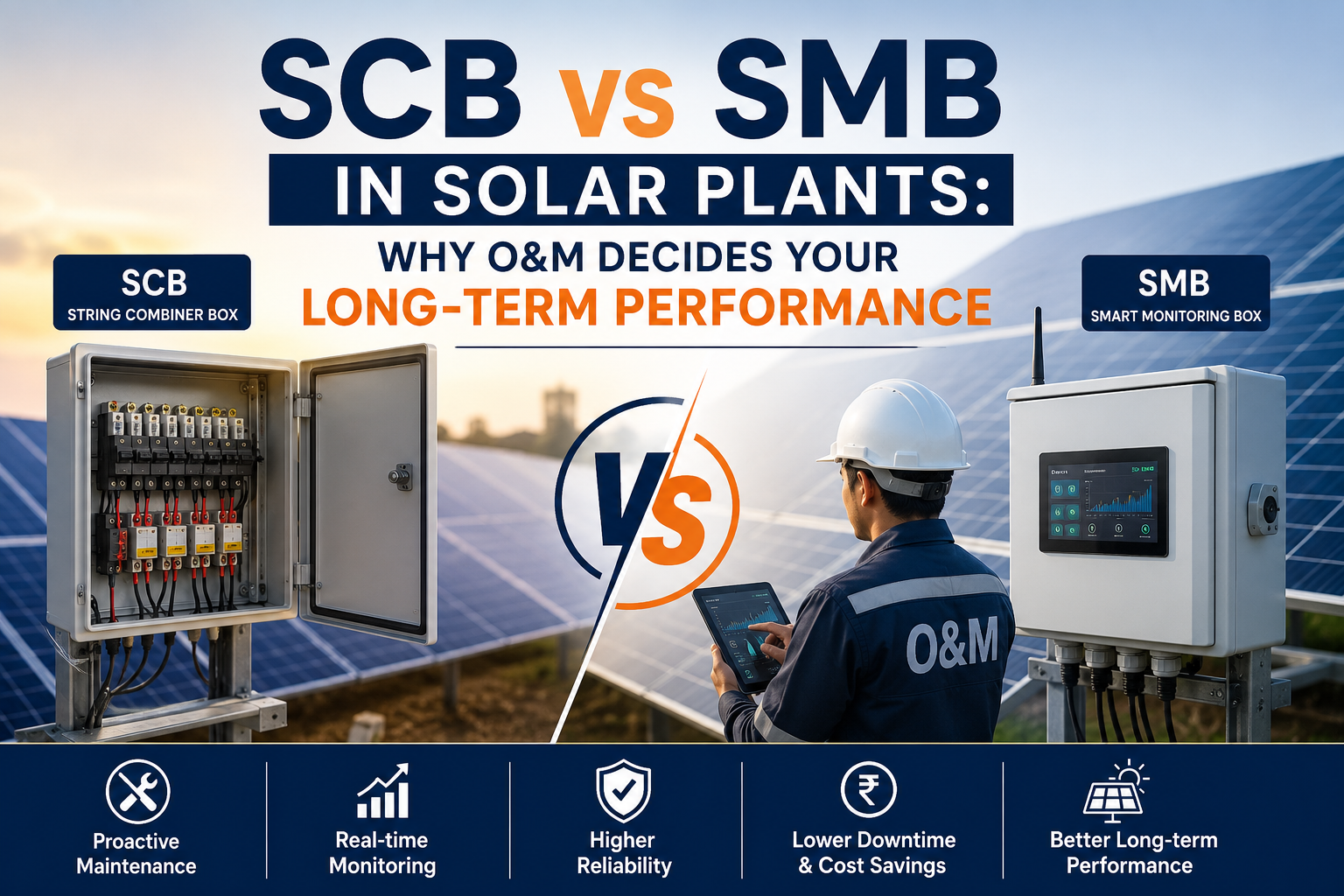
Building a solar power plant is a milestone – but commissioning day is the starting line, not the finish. Here’s how two often-overlooked components, the String Combiner Box and the String Monitoring Box, quietly determine how much energy your plant actually delivers over its lifetime, and why Operations & Maintenance is the factor that separates a good installation from a great investment.
Installing a solar plant is the visible, exciting part. Panels go up, cables get pulled, boxes get mounted, the inverter hums to life, and the meter starts spinning backwards. It feels finished.
It isn’t.
A solar asset is a 25-year investment, and the day it’s energized is the day the real work begins. Two components sitting between your panels and your inverter – the String Combiner Box (SCB) and the String Monitoring Box (SMB) – do a lot of quiet, unglamorous work to protect that investment. And whether they keep doing that work depends almost entirely on something even less glamorous: Operations & Maintenance (O&M).
Let’s break down what these boxes actually do, and why proactive maintenance is what protects your yield, your equipment, and your returns.
What a String Combiner Box (SCB) actually does
In any utility-scale or large commercial solar plant, you don’t wire every panel string directly to the inverter – that would mean a chaotic tangle of cables and no practical way to protect or isolate anything. Instead, multiple strings are routed into a String Combiner Box, where they’re combined into a single, higher-current DC output that feeds the inverter.
But an SCB is far more than a junction box. Inside a well-built one, you’ll typically find:
- String fuses — overcurrent protection for each individual string, so a fault in one string can’t damage the others or the box.
- DC Surge Protection Devices (SPDs) — the plant’s defense against lightning-induced and switching voltage surges, which are one of the most common causes of DC-side damage.
- A DC isolator / disconnect switch — lets technicians safely de-energize and isolate the box for maintenance without shutting down the whole array.
- Busbars, terminals, and cable glands — the physical backbone that combines the strings while keeping the enclosure sealed against dust and moisture.
In short: the SCB combines strings, protects against overcurrent and overvoltage, and lets you safely isolate part of the plant. It is a safety and reliability device first, and a wiring convenience second.
What a String Monitoring Box (SMB) adds – and how it differs from an SCB
An SMB does everything an SCB does, then adds the one thing an SCB can’t: visibility.
Alongside the combining and protection functions, an SMB includes current sensors on each string (shunts or Hall-effect sensors) plus a communication interface – usually RS-485/Modbus feeding into the plant’s SCADA or monitoring platform. That means you’re not just combining strings; you’re measuring each one individually and reporting it in real time.
Here’s why that matters. With a plain combiner box, if one string quietly fails – a blown fuse, a loose connection, a disconnected cable, heavy soiling, or a degrading module – you often won’t notice until you see the whole plant underperforming, if you notice at all. With string-level monitoring, that failing string shows up immediately as an outlier, and your team can pinpoint the exact box and string to inspect.
SCB vs SMB, in one line:
| String Combiner Box (SCB) | String Monitoring Box (SMB) | |
|---|---|---|
| Combines strings | ✅ | ✅ |
| Overcurrent & surge protection | ✅ | ✅ |
| Safe DC isolation | ✅ | ✅ |
| String-level current measurement | ❌ | ✅ |
| Remote monitoring/fault detection | ❌ | ✅ |
The SMB doesn’t replace the SCB’s role – it extends it. Combining and protection keep the plant safe; monitoring keeps it accountable.
The point most solar buyers miss: installation ≠ reliability
Here’s the core idea, and it’s the whole reason this article exists:
A combiner or monitoring box that’s installed perfectly on day one is not the same as one that keeps performing on day 2,000.
These boxes live outdoors, often in harsh conditions — baking heat, monsoon humidity, dust, salt air near coastlines, and the occasional curious rodent or insect. Every component inside them ages, and several of them fail silently. Left unattended, the very devices meant to protect your plant slowly become the things that drag it down.
Consider what actually goes wrong when SCBs and SMBs are ignored after commissioning:
- SPDs degrade. Surge protection devices wear out over time and after every surge event they absorb. A “dead” SPD looks identical to a working one from the outside — but your plant is now unprotected against the next lightning strike.
- Connections loosen and heat up. Thermal cycling loosens terminals. Loose terminals mean higher resistance, which means heat, which means power loss — and, in the worst case, an arc or fire. This is one of the leading causes of DC-side fires.
- Fuses blow unnoticed. A single blown string fuse takes a whole string offline. On a plain SCB with no monitoring, that lost generation can go undetected for months.
- Enclosure integrity fails. Cracked seals, failed glands, or corroded hinges let in water, dust, and pests, quietly destroying the IP rating the box relied on.
- Corrosion sets in. Busbars and terminals corrode, raising resistance and losses, especially in humid or coastal environments.
- Monitoring drifts. Even the sensors in an SMB can drift out of calibration, so the data you’re trusting stops telling the truth.
Each of these is invisible from a distance. Each of them costs you energy, money, or safety. And every one of them is preventable with routine O&M.
What good O&M for SCBs and SMBs looks like
Proactive maintenance isn’t a vague promise to “check on things.” For combiner and monitoring boxes specifically, it’s a concrete, repeatable set of activities:
- Thermographic (infrared) scanning to catch hotspots from loose or corroded connections before they become failures.
- Torque verification on terminals and busbar connections to keep resistance — and heat — low.
- SPD status checks (many have visual indicators) and timely replacement of degraded units.
- Fuse continuity testing to find silently blown fuses and the underlying string faults.
- Visual inspection of enclosures, seals, and glands for cracks, water ingress, corrosion, and pest damage.
- Cleaning of the enclosure and, where relevant, the surrounding area to maintain ventilation and IP integrity.
- Monitoring-data review and sensor validation on SMBs, so string-level data stays trustworthy, and outliers are investigated.
- String-level I-V curve tracing as a diagnostic when monitoring flags an underperformer.
The best O&M programs combine remote monitoring (catching anomalies in real time via the SMB) with scheduled on-site inspection (catching the physical problems a sensor can’t see). Neither alone is enough.
The business case: what O&M actually returns
It’s easy to treat O&M as a cost line. It’s more accurate to treat it as the thing that protects every other number in your project:
- Higher availability and yield. Fewer offline strings and faster fault resolution mean a better performance ratio – you sell the energy you were always supposed to generate.
- Extended equipment life. Boxes, SPDs, fuses, and connections that are maintained simply last longer, deferring expensive replacements.
- Reduced downtime. Proactive detection turns “the plant was down for three weeks, and we didn’t know why” into “we replaced a fuse on Tuesday.”
- Safety and fire prevention. IR scanning and torque checks directly address the loose-connection and SPD-failure modes that cause DC-side fires.
- Protected ROI. A solar plant’s returns are modeled over decades. Silent degradation quietly erodes that model; O&M keeps the asset performing to plan.
Put simply: manufacturing and installing a reliable solar plant is only half the job. Keeping it reliable is the other half – and that half is O&M.
Watch: SCB & SMB — The Importance of O&M for Solar Plants :
Conclusion
The String Combiner Box and String Monitoring Box are small parts of a large plant, but they sit at a critical junction between your panels and your power. The SCB keeps the DC side safe; the SMB makes its performance visible. Both, however, are only as reliable as the maintenance behind them.
If you’re planning a new solar project – or want to get more out of one you already own – the smartest question isn’t just “who built it?” It’s “who’s keeping it running?” Reliable solar infrastructure goes beyond manufacturing and installation. It’s earned, year after year, through dedicated Operations & Maintenance.
[“Talk to our team about O&M support for your solar plant,” with your contact details.]
Frequently Asked Questions (FAQs)
1. What is the difference between an SCB and an SMB?
Both combine multiple PV strings into a single DC output and provide protection (string fuses, surge protection, DC isolation). The difference is monitoring: a String Monitoring Box (SMB) adds per-string current sensors and a communication link to your SCADA/monitoring system, so you can see each string’s performance in real time. A String Combiner Box (SCB) does the combining and protection but has no built-in monitoring.
2. Do I really need an SMB if I already have an SCB?
Not strictly – an SCB is fully functional for combining and protection. But without string-level monitoring, faults like a blown fuse or a failing string can go undetected for a long time, silently costing you generation. An SMB pays for itself by catching those losses early, especially on larger plants where a single technician can’t inspect everything by eye.
3. How often should SCBs and SMBs be inspected?
It depends on plant size, environment, and warranty/contract terms, but a common approach is continuous remote monitoring (on SMBs) combined with scheduled physical inspections – often quarterly or semi-annually – plus periodic infrared thermographic scanning. Harsh environments (coastal, dusty, high-humidity) usually warrant more frequent checks. Follow your equipment manufacturer’s and O&M provider’s recommendations.
4. What are the most common faults in combiner and monitoring boxes?
The frequent ones are: degraded or dead surge protection devices (SPDs), blown string fuses, loose or corroded terminal connections (which cause hotspots and losses), water or dust ingress from failed seals/glands, pest damage, and – on SMBs – sensor drift or communication failures. Most of these are silent, which is exactly why routine O&M matters.
5. Can string-level monitoring actually improve my energy yield?
Yes – indirectly but meaningfully. Monitoring doesn’t generate power, but it lets you find and fix underperforming or offline strings quickly, restoring generation you’d otherwise lose. Over a plant’s life, faster fault detection translates into higher availability and a better performance ratio.
6. What’s typically included in an O&M program for these boxes?
A solid program usually covers: infrared/thermographic scanning for hotspots, torque checks on connections, SPD status checks and replacement, fuse continuity testing, enclosure and seal inspection, cleaning, monitoring-data review, and diagnostic I-V curve tracing when anomalies appear. The best programs pair remote monitoring with on-site inspection.
7. What happens if a string fuse or SPD fails and no one notices?
A silently blown fuse takes a string offline, so you lose that string’s generation until it’s found and replaced. A failed SPD is more serious for safety: the box looks fine, but your DC side is no longer protected against surges, leaving expensive equipment exposed to the next lightning or switching event. Both are avoidable with routine checks.
8. Is O&M worth the cost for a smaller rooftop plant?
Even at smaller scale, the same failure modes apply – loose connections that heat up, aging SPDs, and undetected string faults all erode returns and, in the case of thermal faults, create real safety risk. The scope can be scaled to the plant size, but skipping maintenance entirely tends to cost more in lost generation and shortened equipment life than the maintenance itself.
Have questions about SCBs, SMBs, or O&M for your specific solar plant? Get in touch — we’re happy to help you plan a new project or optimize an existing one.