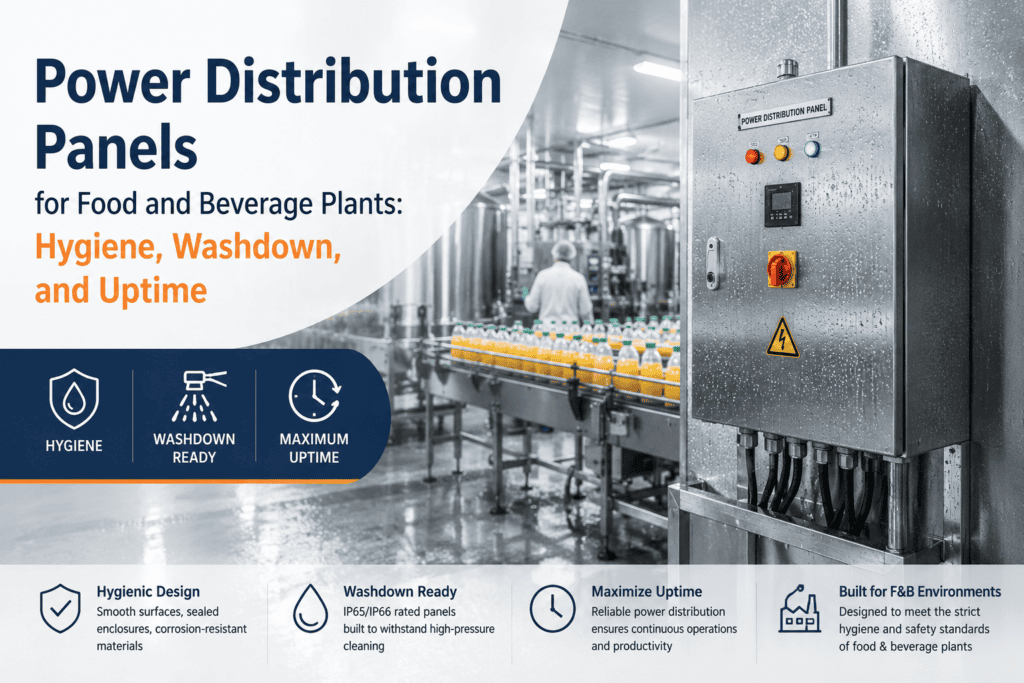
In most factories, the electrical panel’s worst enemy is the process. In a food plant, it is the cleaning crew.
Every night, someone walks down your production hall with a hose delivering water at 80–100 bar and 80°C, carrying caustic soda or peracetic acid, and directs it at everything within reach. They are doing their job correctly. They are also, over a few years, going to destroy any enclosure that was not designed for them.
That is the central fact about power distribution panels for food and beverage plants, and it is why a panel specification that works perfectly in a textile mill or a cement plant fails here. This guide covers what actually changes: enclosure ratings (including a standards error that appears in almost every Indian food-plant tender), material selection, hygienic design, the thermal trap that sealed panels create, and how to design around the sanitation window instead of fighting it.
If you are a plant engineer, a maintenance head, or a food safety manager, this is the argument you need to get the right enclosure approved — and the places you can safely spend less.
The IP69K Mistake in Almost Every Food Plant Specification
Let’s start here, because it is on your tender document right now and it is wrong.
Open any food plant electrical specification in India, and you will find a line reading “enclosure shall be IP69K rated.” It is copied from vendor catalogues, which copied it from each other. Almost nobody who writes it knows where the rating comes from.
Where IP69K actually comes from
The “K” is not an IEC designation. It never was.
IP69K originated in DIN 40050-9 (1999), a German standard for road vehicles. When DIN 40050-9 was withdrawn in 2012, the rating moved into ISO 20653 — full title: “Road vehicles — Degrees of protection (IP code) — Protection of electrical equipment against foreign objects, water and access.”
ISO 20653 uses the notation IP6K9K, and the standard explicitly states that the K codes describe requirements for road vehicles that are not covered by IEC 60529. The K is a marker of automotive lineage — it exists to signal that the test includes vehicle-specific stressors like road dust and vibration.
What your panel’s own standard actually says
Your electrical control panel is not a road vehicle. It is a low-voltage assembly, governed by IEC 61439-1/-2, which references IEC 60529 for ingress protection.
In 2013, the IEC recognised the gap and published Amendment 2 to IEC 60529, formally introducing the high-pressure, high-temperature water test into the general electrical standard. But the IEC rejected the K suffix. Consistent with its 0–9 numbering, it simply added the numeral 9.
So under the standard that actually governs your panel, the correct designation is IP69 — not IP69K.
Does this matter, or is it pedantry?
It matters in two concrete ways.
First, at tender evaluation. If your spec says IP69K, you are citing a road-vehicle standard. A vendor who tests to IEC 60529 and offers you a correctly certified IP69 panel is technically non-compliant with your written spec, and a procurement officer following the document literally may disqualify the right product. That has happened.
Second, at certification. Ask a vendor claiming “IP69K” which standard they tested to and which lab issued it. Many will not be able to answer, because the claim was never tested at all — it was marketing copy. The test itself is specific and expensive: water at 80°C ±5°C, 80–100 bar, nozzle held at 100–150 mm, sprayed from four angles (0°, 30°, 60°, 90°) for 30 seconds each while the enclosure rotates on a turntable at 5 rpm. Nobody passes that by accident.
The correct way to write the line: “Enclosure shall be certified IP69 per IEC 60529 (Amendment 2:2013), test report from an accredited laboratory to be submitted at DQ.” If you also want the automotive variant for some reason, name it separately as IP6K9K per ISO 20653 and say why.
This single sentence will tell you more about a vendor than the rest of their proposal.
Why Most of Your Panels Should Not Be IP69 At All
Now the part that costs us money to say.
An IP69-certified stainless steel enclosure is expensive — often 3–5× a standard powder-coated electrical panel box of the same size. And in a well-designed food plant, most of your panels do not need one, because they should not be in the washdown zone in the first place.
The right architecture in almost every case:
| Location | What goes there | Rating |
| Dedicated MCC room (dry, outside the process hall) | MCC panel, PCC panel, VFD panels, APFC panel | IP42–IP54, mild steel acceptable |
| Process hall, splash zone | Local control stations, isolators, junction boxes | IP66 SS304/316L, hygienic design |
| Direct washdown line-of-fire | Only what genuinely cannot be moved | IP69 SS316L, certified |
Put your power distribution panels in a dry MCC room and run cables out to hygienic local stations. You get better thermal performance, easier maintenance, cheaper panels and a longer life — all at once.
Specify IP69 for the small population of enclosures that genuinely sit in the line of fire. Specifying it for the whole plant is not conservatism. It is an unnecessary capital cost and, as you will see below, it creates a thermal problem you then have to spend more money solving.
If a panel vendor encourages you to blanket-specify IP69 across a plant without asking where each panel sits, they are selling enclosures, not engineering.
Material Selection: Where SS304 Fails
The chloride problem
Stainless steel is not one material, and the difference will cost you.
SS304 is fine for general splash. SS316L contains molybdenum, and molybdenum is what resists chlorides.
Chlorides are everywhere in food production: brine, seafood, cheese, pickling, chlorinated sanitisers, and coastal ambient air. Under chloride attack, SS304 suffers pitting corrosion — small, deep, localised penetrations that go through the wall while the surrounding surface still looks perfectly bright. Add heat and tensile stress, and you can get chloride stress corrosion cracking, which propagates without visible warning.
The rule: any chloride exposure — process, sanitiser or coastal — means SS316L. Not SS304 with better paint. Not SS304 “because the sanitiser is diluted.” The cost delta is 20–30% on the enclosure. Replacing a pitted panel in year four, plus the production stop to do it, is not 20–30%.
For inland dry-goods plants — flour, biscuits, snacks — SS304 is genuinely adequate. Say so in the spec and save the money there.
Why powder-coated mild steel is a food safety hazard, not just a durability problem
Powder-coated mild steel in a washdown zone fails in a specific and dangerous sequence:
- High-pressure water finds an edge or a fastener and lifts the coating
- Moisture reaches the mild steel underneath
- Corrosion advances under the coating, invisibly
- The coating blisters and flakes
- A flake of paint lands on the line
Step 5 is a foreign body contamination event. It is not an electrical failure — it is a food safety failure, and it will be traced back to your panel by a QA team looking at a customer complaint.
This is the argument that gets a stainless steel enclosure approved when the maintenance budget says no. It is not a maintenance issue. It is a HACCP issue.
Surface finish — and a specification error worth avoiding
You will see Ra ≤ 0.8 µm quoted for food equipment surfaces. It is a real requirement — for product contact surfaces.
Your panel is not a product contact surface. Applying Ra 0.8 to an electrical enclosure is a common copy-paste error that adds cost for no food safety benefit. What panels actually need is to be cleanable and drainable.
Useful zoning language for your spec:
- Zone 1 — product contact: Ra ≤ 0.8 µm, 3-A / EHEDG territory. Your panel is never here.
- Zone 2 — non-contact, close proximity: can splash onto Zone 1. Local control stations may sit here. Smooth, cleanable, drainable, no harbourage.
- Zone 3 — non-contact, in the processing room: most in-hall enclosures. Cleanable and corrosion-resistant.
- Zone 4 — outside processing areas: the MCC room. Standard industrial construction.
Write your panel spec against the zone it actually occupies. One note on finish that does matter: a brushed finish has directional grain that traps soil along the grain. Bead-blasted is more uniform and cleans better. Cheap and worth specifying.
Hygienic Enclosure Design: The EHEDG Principles That Apply to Panels
The EHEDG (European Hygienic Engineering & Design Group) publishes the reference guidance on hygienic equipment design. It is voluntary — not law anywhere — but it is where the engineering consensus lives, and applying it to an enclosure is straightforward:
Sloped top, minimum 30°. A flat panel top is a shelf. It holds water, soil and condensate, and it is the first thing an auditor puts a gloved finger on. A sloped top sheds. This is the single highest-value hygienic feature on a food plant panel, and it costs almost nothing.
Standoff mounting, 25–50 mm from the wall. If the crew cannot get a hose and a hand behind the panel, they cannot clean behind it, and behind it is where the problem grows.
Legs, not plinths. A hollow plinth is a sealed void that will eventually not be sealed. Legs lift the enclosure clear and let the floor drain and dry underneath. If you must use a plinth, it must be fully welded and continuously sealed — no gaps, no drain holes into the void.
Continuous welds, ground and polished. Spot welds and stitch welds leave crevices. A crevice is a bacterial harbourage site that cannot be cleaned, only sterilised — and you cannot sterilise an electrical panel.
Radiused internal corners. Sharp internal corners hold residue and defeat wiping.
One-piece moulded gaskets — never cut-and-glued. A glued gasket joint separates. Once it separates, it wicks water into the enclosure and holds it against the seal face. Specify moulded-in-place or one-piece.
Sealed, sloped gland plates. Leave a gap at the bottom, and you have not built an enclosure; you have built a funnel — water, soil and vermin all take the same route in. Slope the plate so anything landing on it runs off instead of pooling.
No upward-facing threads or bolt heads. They collect. Use domed or recessed hardware, or orient fasteners so nothing points up.
Blue polymer components — gaskets, cable ties, glands. No natural food is blue. A blue fragment on a line is immediately visible to an operator and to a camera-based inspection system. Where the plant runs metal detection, specify metal-detectable blue polymer. This is standard practice in F&B and almost unheard of in Indian panel building.
The Listeria Problem Nobody Designs Out
This is the one that ends careers, and it is worth being blunt about.
Listeria monocytogenes does not need to grow in your food. It needs to survive somewhere wet, cold and undisturbed in your plant, and then get transferred. It grows at refrigeration temperatures. It forms biofilms. And it lives in harbourage sites — niches that are wet, protected, and never properly cleaned because nobody can reach them.
Read that description again and then look at a typical Indian food-plant electrical installation:
- Hollow panel legs with an open bottom
- The unsealed gap between a plinth and the floor
- The 10 mm gap behind a wall-mounted panel
- An unsealed gland plate with cable entries
- A condensate drip tray under a panel cooler that nobody has looked in since commissioning
- The underside of a flat panel top
Every one of those is a textbook harbourage site. In a ready-to-eat plant, environmental monitoring swabs will eventually find them — and when a positive turns up in Zone 2, the investigation traces back to the nearest harbourage, and your panel is standing right there.
This is the argument to bring to your food safety manager. Not “the panel will last longer.” Instead: “Every hollow void, unsealed gap and standing-water point on this enclosure is a potential Listeria harbourage site inside a Zone 2 area, and I want them designed out at the drawing stage rather than swabbed out later.”
That conversation gets a budget approved. “Better enclosure” does not.
The Thermal Trap: Sealed Panels and VFD Heat
Here is the chain that catches most projects, and it is a genuinely non-obvious one.
You correctly specify a sealed IP69 enclosure. Sealed means no ventilation. No louvres, no filter fans — every one of those is a hole, and a hole is not IP69.
Inside that sealed box you have put VFD panels driving conveyors, pumps and homogenisers. A VFD dissipates roughly 3% of its rated power as heat. A 200 kW drive line-up is throwing 6 kW into a box you have deliberately sealed shut.
So you add cooling. Your options, and what each one does to you:
| Method | Trade-off |
| Filter fans | Breaks the IP rating. Not available to you. |
| Air-to-air heat exchanger | Maintains IP. Limited capacity. Only works if ambient is meaningfully cooler than the panel. |
| Panel air conditioner | High capacity, maintains IP — but produces condensate |
| Vortex cooler | No moving parts, maintains IP — but needs clean dry compressed air and is expensive to run continuously |
The condensate is the problem. A panel A/C generates litres of water per day. That water has to go somewhere. In nine plants out of ten, “somewhere” is a length of tube pointed at the floor.
You have now installed a device that continuously deposits water on the floor of a food processing hall, next to an electrical panel, in a Zone 2 area. You have engineered a Listeria harbourage site and given it a permanent water supply.
Do this instead: pipe condensate to a proper drain with an air gap. Or, better, avoid the whole chain — put the VFDs in the dry MCC room where they belong, and run motor cable out to the machines. The thermal problem, the condensate problem and the cost problem all disappear together.
This is the strongest practical argument for panel-room architecture, and it is the one nobody makes at design stage.
Washdown Chemistry vs Your Gaskets
CIP and open-plant cleaning chemistry is aggressive by design:
- Caustic soda (NaOH), 1–3% — fats and proteins
- Nitric or phosphoric acid, 0.5–2% — mineral scale
- Peracetic acid / chlorinated alkaline — sanitising
- Hot water, 60–85°C — throughout
Gasket compatibility is not a detail. It decides whether your IP rating survives contact with reality:
| Elastomer | Good with | Fails with |
| EPDM | Caustic, hot water, steam, acids | Oils and fats — swells and degrades |
| Nitrile (NBR) | Oils and fats | Caustic and hot water |
| Silicone (food grade) | Wide temperature range | Poor abrasion resistance; verify food-grade certification |
| PTFE | Almost everything | Poor elastic recovery — a compression set means a lost seal |
The trap: a dairy or edible-oil plant has both fat and caustic. EPDM handles the caustic and fails on the fat. Nitrile handles the fat and fails on the caustic. There is no single default — the answer depends on your actual chemistry and your actual duty cycle.
Ask your panel vendor for the gasket material and the chemical compatibility data. If the answer is “standard gasket,” you have learned everything you need to know about that vendor.
Uptime: Designing Around the Sanitation Window
Food plants have a structural problem that other industries do not.
Production runs 16–20 hours. Sanitation takes the remaining 4–6. Electrical maintenance has to fit inside the same window as the cleaning crew — and cannot be done while the crew is hosing the hall down.
What that means for panel design:
Form 4b separation. Without it, touching a single starter means dropping the whole board — and dropping the board during a sanitation window takes your refrigeration down with it. Form 4b buys you the ability to work on one outgoing unit in isolation.
Front access only. A panel you can only service from the rear needs clearance you do not have and a shutdown you cannot get.
Draw-out or plug-in starters on critical duties. Swap a module in minutes, diagnose it later, off the critical path.
Diagnostics that survive the night. A trip at 02:00 during washdown, with an event log that shows what happened, is a 20-minute fix. The same trip with a mechanical flag and no log is a 3-hour hunt in a wet hall, and the line does not start on time.
Segregate refrigeration. Ammonia compressors and cold-room plant should never be on the same board as production drives. Cold chain does not stop for a starter fault on a conveyor.
The economics are stark. A mid-size bottling line runs 30,000–60,000 units/hour. A pasteuriser trip is not a restart — it is product diversion, a full CIP cycle and a two-hour recovery. Panel decisions that look like ₹2–3 lakh of over-specification are settled by one avoided event.
What the Regulations Actually Require — Stated Honestly
Here is where most vendor content overclaims, so let’s be accurate.
No food safety regulation in India specifically regulates electrical panels. There is no clause anywhere that says “MCC enclosures shall be SS316L.” Anyone telling you otherwise is selling something.
What actually applies, and how:
| Framework | Status | How it reaches your panel |
| FSSAI Schedule 4 (FSS Licensing & Registration Regs, 2011) | Mandatory. Every licensed FBO needs a documented FSMS built on GMP + GHP. Penalties ₹25,000–₹10 lakh, plus licence suspension. Enforcement has tightened sharply since 2023. | Requires surfaces in food areas to be smooth, impermeable and easily cleanable, and premises to be free of contamination harbourage. A panel in a food area is a surface in a food area. That is the whole link — indirect, but real. |
| HACCP / FSSC 22000 / ISO 22000 / BRCGS | Voluntary, but contractually mandatory for most exporters and modern-trade suppliers | Your customer’s audit, not the government’s, is what will actually find the panel |
| EHEDG guidelines | Voluntary | The engineering consensus on hygienic design. Not law. Cite it as best practice, never as a legal requirement |
| 3-A Sanitary Standards / NSF | Voluntary; effectively required for US dairy | Relevant only if you export |
| IEC 61439-1/-2 | The panel design standard | Ratings, type tests, routine tests, form of separation |
| IEC 60529 (Am2:2013) | IP ratings, including IP69 | The correct reference for a food plant enclosure |
| ISO 20653 | IP6K9K — road vehicles | Cite only if you specifically want the automotive test |
Also note: FSSAI published a draft amendment to the Licensing and Registration Regulations in the Gazette on 23 January 2026, proposing FIFO/FEFO inventory requirements for licensed manufacturers. It was open for public consultation at the time of writing and does not affect panel specification — but if you are planning a facility upgrade, check its current status rather than assuming.
The practical position: your panel obligation is driven by your customer’s audit, not by a government clause. A BRCGS or FSSC audit will find a flaking panel, a hollow leg or a condensate puddle. Schedule 4 gives the inspector the language to write it up. Design for the audit and the regulation takes care of itself.
What Goes Wrong, and Where It Was Decided
- “IP69K” copied into the spec from a catalogue. Cites a road vehicle standard. Nobody can produce a test report because nobody tested.
- IP69 blanket-specified across the plant. Three to five times the enclosure cost, plus a thermal problem you then pay again to solve.
- SS304 in a chloride environment. Looks perfect at handover. Pitted through by year four.
- Panel A/C condensate piped to the floor. A permanent water supply to a Listeria harbourage site, installed deliberately, signed off by everyone.
- Gasket chosen without checking the CIP chemistry. EPDM in an edible oil plant. Seal gone in 18 months, IP rating gone with it.
- Rear-access panel in a food hall. Needs clearance nobody has and a shutdown nobody will authorise. Never properly maintained again.
Notice what these have in common: not one of them is an electrical fault. Four are food safety findings, one is a corrosion failure, one is an access problem. Your panel will fail its audit long before it fails its duty — which is why the enclosure decision belongs to your QA team as much as your electrical team.
Specification Checklist
The short version, for your drawing review meeting. Take your QA lead with you — half of this list is their decision, not yours.
- Panel-by-panel zone assessment (Zone 2/3/4) driving the rating — not one blanket rating
- IP rating certified to IEC 60529, with a test report from an accredited lab
- Material grade justified against your actual chloride exposure (SS304 vs SS316L)
- Gasket material with chemical compatibility data against your actual CIP chemistry
- Hygienic features drawn, not described: sloped top ≥30°, standoffs, legs, continuous welds, sealed gland plates
- Blue food-grade / metal-detectable polymer for gaskets, glands and cable ties
- Thermal calculation for every sealed enclosure, with a condensate management plan
- Form of separation and access strategy matched to your sanitation window
- Type test certification per IEC 61439-1/-2
- Prior food and beverage references — with contactable names
If a vendor answers “IP69K, stainless steel” and stops there, they have not read your plant.
Three Questions That Tell You Everything About a Panel Vendor
You do not need a technical audit to separate food-plant panel builders from the rest. You need three questions, and you can ask them on a phone call.
“Where does each panel sit?”
A vendor who quotes you a rating before asking this is selling enclosures out of a catalogue. The right answer starts with a question back: which panels are in the MCC room, which are in the hall, which are genuinely in the line of fire. Zone 4 gets a Zone 4 panel. You should not be paying IP69 prices to protect a dry electrical room from a hose that will never reach it.
“What do you clean it with?”
This one decides the gasket and the steel grade. A vendor who does not ask cannot have chosen either on purpose. If they answer “standard gasket, SS304” without knowing whether you run caustic, peracetic acid or a chloride sanitiser, they have guessed — and the guess surfaces as a lost seal in month eighteen or a pitted enclosure in year four.
“Where does the condensate go?”
The question almost nobody asks. Seal a panel, fill it with drives, and you have to cool it — and cooling makes water. A vendor who has never thought past the enclosure will have no answer. A vendor who has actually built for a food plant will already be telling you to move the drives to the MCC room instead of selling you a cooler.
Our answers, in order. We ask before we quote. We ask for your CIP chemistry and match the elastomer and the steel grade to it. And we will usually tell you to move the panel rather than sell you a more expensive box to leave it where it is.
Beyond that: MCC Panel, PCC Panel, VFD Panels and APFC panels built as one package with one thermal model and one point of accountability, type test certification per IEC 61439, and thermal calculations issued before dispatch rather than after a summer of nuisance trips.
Send us your plant layout and load list. You will get back a panel-by-panel zone assessment with a rating and a material grade against each one — and an honest note wherever we think you are about to over-specify.
📞 +91 9601965426 · ✉️ info@synchroelectricals.com · Request a technical review →
Frequently Asked Questions
The Panel Is Part of the Food Safety System Now
There is nothing exotic in a food plant panel. Same breakers, same busbars, same standards.
What changes is that the panel has become part of the food safety system. Its top is a surface an auditor will touch. Its legs are a harbourage site an environmental swab will find. Its coating is a foreign body waiting for a hose. Its cooling system is a water source on a floor that is supposed to stay dry.
None of that is on the electrical drawing. All of it is decided there.
The panel builder who asks where each enclosure sits, what you clean it with, and where the condensate goes — before quoting — is the one who has built for a food plant before. The one who answers “IP69K, stainless steel” has built for a catalogue.