Vacuum Interrupter Contact Erosion and Maintenance Cycles in VCB Panels

In medium voltage power distribution systems, vacuum circuit breakers play a critical role in protecting electrical infrastructure from overloads and fault currents. Installed inside VCB panels, these breakers interrupt fault currents rapidly while maintaining high reliability and minimal maintenance requirements.

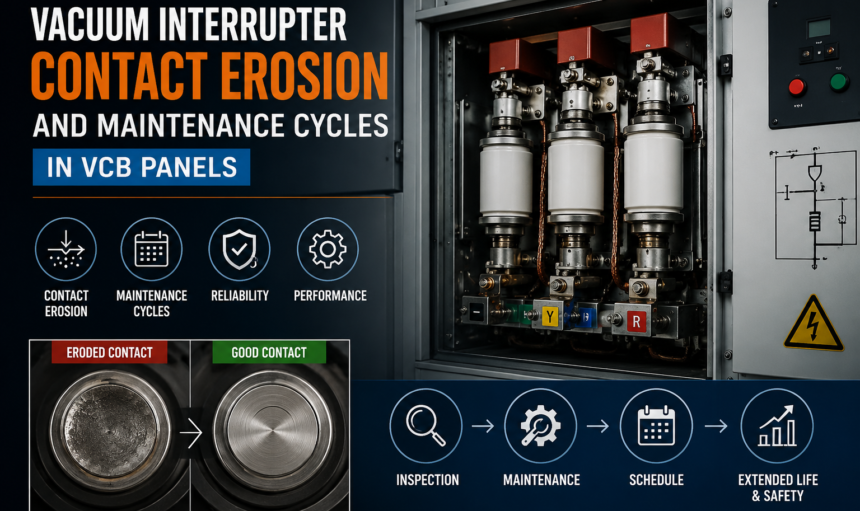
At the heart of every vacuum circuit breaker (VCB) lies the vacuum interrupter, a sealed switching device designed to extinguish electrical arcs during current interruption. While vacuum technology offers superior arc quenching characteristics, repeated switching operations gradually cause contact erosion inside the vacuum interrupter.

For electrical engineers responsible for medium voltage switchgear maintenance, understanding vacuum interrupter contact erosion and maintenance cycles in VCB panels is essential for ensuring long-term reliability and safe operation of industrial power distribution systems.

What Happens Inside the Vacuum Interrupter During Switching

When a vacuum circuit breaker interrupts current, the breaker contacts separate inside a high-vacuum environment. Despite the vacuum conditions, an electrical arc still forms due to the vaporization of metal from the contact surfaces.

This arc consists of metal vapor plasma generated from the contact material. As the alternating current approaches its natural zero crossing, the arc collapses rapidly because the vacuum environment does not support sustained ionization.

Although the arc duration is extremely short, each interruption causes a small amount of contact material erosion. Over time, repeated switching operations gradually reduce the thickness of the contacts inside the vacuum interrupter used in VCB panels.

This process is known as vacuum interrupter contact erosion.

Contact Material Engineering in Vacuum Circuit Breakers

The performance and lifespan of vacuum interrupters in medium voltage VCB panels depend heavily on the design and composition of the breaker contacts.

Most modern vacuum circuit breakers use copper-chromium (CuCr) contact materials, which provide an optimal balance between electrical conductivity, arc resistance, and mechanical durability.

Copper ensures efficient current conduction, while chromium enhances resistance to arc erosion. During switching events, the arc moves across the contact surface rather than remaining concentrated in one location.

This arc movement distributes thermal energy more evenly, reducing localized damage and extending the operational life of the vacuum interrupter contacts.

Advanced contact geometries and magnetic field control techniques further improve the arc distribution behavior inside vacuum circuit breakers.

Key Factors That Influence Contact Erosion in VCB Panels

Although vacuum circuit breakers are known for their long mechanical life, several operational factors influence the rate of contact erosion inside vacuum interrupters.

Switching Frequency

Frequent switching operations increase the number of arc events experienced by the contacts. Industrial environments with frequent load switching may experience faster contact wear.

Interrupting High Fault Currents

Interrupting high short circuit currents generates stronger arcs and greater thermal stress on contact surfaces. Repeated fault interruptions accelerate contact erosion in VCB panels.

System Voltage and Load Conditions

Medium voltage distribution systems operating at higher voltages generate stronger arc energy during interruption events, which may contribute to increased contact wear.

Contact Material and Breaker Design

Modern vacuum circuit breaker designs incorporate optimized contact structures and magnetic arc control to minimize erosion and improve switching endurance.

Understanding these factors helps engineers predict maintenance cycles for vacuum circuit breakers in medium voltage switchgear panels.

Monitoring Contact Wear in Vacuum Circuit Breakers

Unlike oil circuit breakers, vacuum interrupters are sealed units that cannot be visually inspected internally. Instead, engineers rely on several diagnostic methods to assess contact wear in VCB panels.

Common monitoring techniques include:

  • mechanical travel measurement of breaker contacts
  • contact resistance testing
  • vacuum integrity testing of the interrupter chamber
  • breaker timing analysis during switching operations

By tracking these parameters, maintenance engineers can determine whether vacuum interrupter contacts are approaching their wear limits.

Modern medium voltage VCB panels often incorporate monitoring systems that record breaker operations and switching cycles to assist in predictive maintenance.

Maintenance Cycles for Vacuum Circuit Breakers in Medium Voltage Panels

One of the major advantages of vacuum circuit breaker technology is its relatively low maintenance requirement compared to older breaker technologies.

However, periodic maintenance remains essential to ensure safe operation of VCB panels in medium voltage power distribution systems.

Typical maintenance practices include:

  • inspection of mechanical operating mechanisms
  • lubrication of breaker operating parts
  • verification of contact travel and contact pressure
  • electrical testing of insulation and contact resistance

Maintenance intervals are typically based on number of switching operations, fault interruptions, and operating environment conditions.

For many industrial VCB panels, vacuum interrupters can withstand 10,000 to 30,000 switching operations before replacement may be required.

Reliability Benefits of Vacuum Interrupter Technology

The adoption of vacuum interrupters in medium voltage switchgear has significantly improved the reliability of modern power distribution systems.

Compared to oil circuit breakers or air circuit breakers, VCB panels provide several advantages:

  • extremely fast arc quenching
  • minimal contact wear during normal operation
  • sealed interrupter chambers that prevent contamination
  • long electrical and mechanical service life

Because of these benefits, vacuum circuit breakers have become the preferred switching technology for medium voltage power distribution panels in industrial facilities, utilities, and infrastructure projects.

Synchro Electricals: Reliable VCB Panels for Medium Voltage Systems

Synchro Electricals manufactures advanced VCB panels designed for medium voltage power distribution networks. These panels integrate high-performance vacuum circuit breakers engineered for efficient arc interruption and long operational life.

Each VCB panel produced by Synchro Electricals is designed with durable switchgear components and robust panel construction to ensure reliable performance in demanding industrial environments.

With strong expertise in industrial electrical panels and medium voltage switchgear systems, Synchro Electricals provides dependable solutions for power distribution in manufacturing facilities, utilities, and infrastructure installations.

Sustaining Performance Through Proper VCB Maintenance

Although vacuum circuit breakers are known for their durability, monitoring vacuum interrupter contact erosion and maintenance cycles remains essential for maintaining system reliability.

By implementing regular testing, monitoring breaker operations, and following recommended maintenance schedules, industrial facilities can ensure the long-term performance of VCB panels in medium voltage power distribution systems.

Effective maintenance strategies not only extend equipment lifespan but also enhance the overall stability and safety of industrial electrical networks.

FAQs

  1. 1. What causes contact erosion in vacuum circuit breakers?

    Contact erosion occurs due to the metal vapor arc formed during current interruption inside the vacuum interrupter.

  2. 2. How long do vacuum interrupter contacts typically last?

    In most medium voltage applications, vacuum interrupters can withstand 10,000–30,000 switching operations depending on load and fault conditions.

  3. 3. How is contact wear monitored in VCB panels?

    Engineers monitor contact wear through contact resistance testing, breaker timing analysis, and measurement of contact travel.

  4. 4. Why are vacuum circuit breakers preferred in medium voltage systems?

    VCBs provide fast arc quenching, long operational life, minimal maintenance, and reliable fault interruption in medium voltage power distribution networks.

  5. 5. When should vacuum interrupters be replaced in VCB panels?

    Replacement is recommended when contact wear exceeds manufacturer limits or when diagnostic tests indicate reduced interrupter performance.

Selecting the Right VCB Panel for High-Voltage Power Distribution Projects

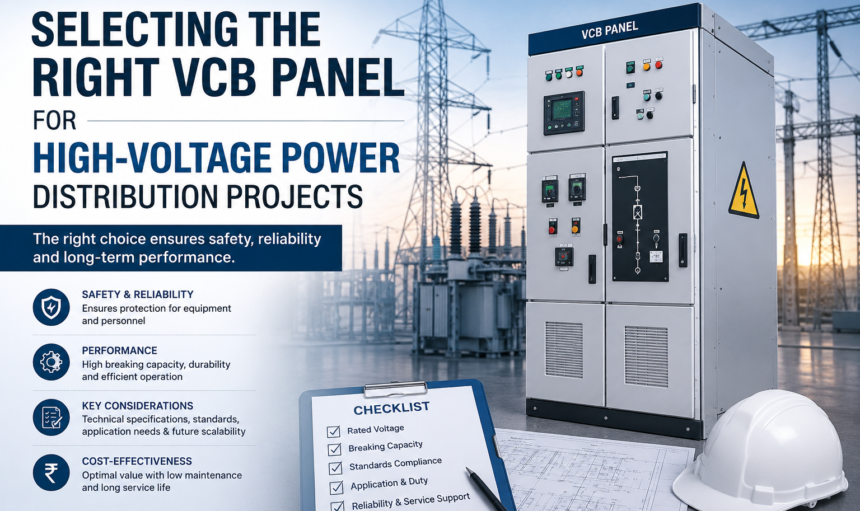
High-voltage power distribution networks used in industrial facilities, infrastructure developments, and large EPC projects require switching equipment that can safely handle high electrical loads and fault conditions. One of the most reliable technologies used in modern medium and high-voltage switchgear systems is the VCB panel (Vacuum Circuit Breaker panel).

In power transmission and EPC power distribution projects, VCB panels are responsible for switching operations, feeder protection, and isolating electrical faults within the network. Because these panels operate in demanding environments and handle voltage levels ranging from 3.3kV to 36kV, selecting the right high-voltage VCB panel is essential for ensuring safe and stable electrical infrastructure.

A properly designed VCB panel for high-voltage power distribution improves fault protection, reduces downtime, and supports the long-term reliability of power systems.

Why Vacuum Circuit Breaker Panels Are Preferred in High-Voltage Systems

Vacuum circuit breaker technology has become the industry standard for medium and high-voltage power distribution panels. Unlike oil or air circuit breakers, a vacuum circuit breaker (VCB) extinguishes electrical arcs inside a sealed vacuum interrupter.

When the breaker contacts separate during switching or fault interruption, an electrical arc forms due to the ionization of metal vapor from the contact surfaces. In a vacuum environment, however, the lack of gas molecules prevents the arc from sustaining itself. As the current reaches its natural zero crossing, the arc collapses rapidly and the vacuum regains its insulation strength.

This fast arc quenching capability of vacuum circuit breakers offers several advantages in high voltage power distribution projects, including faster fault interruption, minimal contact erosion, and longer operational life. These characteristics make VCB panels highly suitable for industrial power systems and utility distribution networks.

Matching the VCB Panel to System Voltage and Fault Levels

Selecting a high voltage VCB panel begins with evaluating the electrical characteristics of the power system. The panel must be compatible with the system voltage level and capable of handling the maximum fault current expected in the network.

Typical voltage ratings used in VCB panels for power distribution systems include 6.6kV, 11kV, 22kV, and 33kV. In addition to voltage compatibility, engineers must evaluate the short-circuit interrupting capacity of the vacuum circuit breaker.

Industrial facilities with large transformers or multiple power sources can produce high prospective fault currents. If the VCB panel short circuit rating is insufficient, the breaker may not be able to interrupt the fault safely. For this reason, proper coordination between system fault levels and breaker interrupting capacity is critical in high voltage switchgear design.

Operational Reliability and Switching Performance

Power distribution systems require frequent switching operations for load control, maintenance isolation, and fault management. The operational endurance of the vacuum circuit breaker therefore, plays an important role when selecting a VCB panel.

Modern high voltage VCB panels are designed to support thousands of switching operations while maintaining stable performance. Vacuum interrupter contacts experience minimal wear during normal switching, which contributes to the long service life of the breaker.

Two key parameters often evaluated during VCB panel selection for EPC power projects are mechanical endurance and electrical endurance. Mechanical endurance refers to the number of open–close operations the breaker mechanism can perform, while electrical endurance represents the breaker’s ability to interrupt load and fault currents repeatedly without degradation.

Reliable switching performance ensures that the VCB panel maintains consistent protection capability throughout its lifecycle.

Protection Systems Integrated in VCB Panels

Protection and control functions are essential elements of high voltage VCB panels used in power distribution networks. Modern switchgear panels incorporate advanced protection relays that continuously monitor electrical parameters.

These relays detect abnormal conditions such as overcurrent or earth faults and initiate breaker tripping to isolate the faulty section of the system. Protection functions typically integrated within VCB panels for industrial power distribution include:

  • Overcurrent and short circuit protection
  • Earth fault protection
  • Feeder protection for outgoing distribution circuits
  • Protection coordination with upstream and downstream switchgear

These protective mechanisms ensure that electrical faults are cleared quickly, preventing damage to equipment and maintaining stability within the high-voltage power distribution network.

Engineering Design and Panel Construction

Apart from electrical ratings, the mechanical construction of the VCB panel also plays a significant role in system reliability. High-voltage switchgear panels are typically designed with compartmentalized structures separating busbars, circuit breakers, and cable sections.

This arrangement improves operational safety and helps contain electrical faults within specific compartments. Proper insulation coordination, busbar spacing, and cable termination design are also critical factors considered during VCB panel engineering for power transmission projects.

Manufacturers specializing in industrial electrical panels and medium voltage switchgear, such as Synchro Electricals, focus on designing VCB panels that meet the reliability and safety requirements of high-voltage power distribution systems used in industrial plants and EPC infrastructure projects.

Ensuring Reliable Power Distribution with the Right VCB Panel

Selecting the appropriate VCB panel for high-voltage power distribution projects requires careful evaluation of system voltage, fault current levels, switching endurance, and protection coordination. Each of these factors contributes to the safe operation of the electrical network.

As industrial facilities and infrastructure projects continue to expand, high voltage VCB panels remain a fundamental component of modern power distribution systems. By choosing properly engineered vacuum circuit breaker panels, power system designers can ensure reliable switching performance, enhanced electrical protection, and long-term operational stability.

FAQs

  1. 1. What is a VCB panel used for in power distribution systems?

    A VCB panel houses vacuum circuit breakers used to control and protect medium and high-voltage power distribution networks.

  2. 2. What voltage levels are commonly used in VCB panels?

    VCB panels are commonly designed for 6.6kV, 11kV, 22kV, and 33kV power distribution systems.

  3. 3. Why are vacuum circuit breakers preferred over other breaker types?

    They provide fast arc interruption, longer service life, minimal maintenance, and reliable fault protection.

  4. 4. What protection systems are included in VCB panels?

    Typical protection systems include overcurrent protection, earth fault protection, and feeder protection relays.

  5. 5. Where are high voltage VCB panels commonly installed?

    They are widely used in power plants, substations, industrial manufacturing facilities, and large infrastructure power distribution projects.

Arc Quenching Characteristics of Vacuum Circuit Breakers in Medium Voltage Panels

Medium voltage power distribution systems demand switching devices that can interrupt fault currents quickly and reliably. In modern electrical infrastructure, vacuum circuit breakers (VCBs) installed in medium voltage panels have become the preferred solution for safe and efficient fault interruption. Their superior arc quenching technology allows them to extinguish electrical arcs rapidly while maintaining long operational life.

In industrial power networks, the ability to interrupt fault currents safely is critical. During switching or fault conditions, an electrical arc forms between separating contacts inside the breaker. If this arc is not extinguished immediately, it can cause severe equipment damage and compromise system stability. This is where VCB arc quenching technology offers significant advantages compared to traditional air or oil circuit breakers.

Why Arc Interruption Matters in Medium Voltage Power Distribution

In medium voltage panels, circuit breakers perform the essential task of protecting electrical systems from overloads and short circuits. When a fault occurs, the breaker contacts open to interrupt current flow. However, because current continues momentarily through ionized particles, an arc is formed between the separating contacts.

The ability to control and extinguish this arc determines the effectiveness of the circuit breaker. Poor arc control can lead to contact erosion, excessive heat generation, and even equipment failure.

Vacuum circuit breakers in VCB panels are specifically designed to handle these conditions. Their arc-quenching mechanism ensures that the arc is extinguished almost immediately, making them highly reliable for industrial power distribution systems.

The Physics Behind VCB Arc Quenching Technology

The core advantage of vacuum circuit breakers lies in the unique properties of the vacuum environment. Inside the vacuum interrupter, the pressure is extremely low—typically around 10⁻⁶ to 10⁻⁷ torr. This environment contains very few gas molecules, which significantly affects arc behavior.

When breaker contacts separate inside the vacuum interrupter, a metal vapor arc forms due to the evaporation of contact material. However, because there are almost no gas molecules to sustain ionization, the arc cannot persist for long.

As the current approaches its natural zero point in an AC waveform, the arc collapses rapidly. The vacuum environment quickly regains its insulating strength, preventing the arc from re-igniting. This process is the essence of VCB arc quenching technology.

The result is extremely fast arc interruption and minimal damage to breaker contacts.

Contact Design and Its Role in Arc Control

The effectiveness of arc quenching in vacuum circuit breakers is heavily influenced by the design of the breaker contacts. Specialized contact geometries are used to control the arc and distribute heat evenly across the contact surface.

Common contact designs used in VCB panels for medium voltage systems include:

  • Radial magnetic field contacts
  • Axial magnetic field contacts
  • Spiral slot contact structures

These designs create magnetic fields that force the arc to move across the contact surface rather than concentrating in a single spot. By distributing the arc energy, contact erosion is minimized and the breaker’s operational life is extended.

Advanced VCB arc quenching systems, therefore, combine vacuum insulation with carefully engineered contact designs to achieve efficient arc interruption.

Arc Behavior During Current Interruption

In a medium voltage vacuum circuit breaker, the arc exists only for a very short duration. As current flows through the arc, a plasma channel forms between the contacts. However, because the vacuum environment lacks sufficient ionized particles, the plasma rapidly dissipates.

The interruption process typically follows these stages:

  1. Contact separation initiates the arc formation.
  2. Metal vapor plasma forms between the contacts.
  3. Magnetic fields distribute the arc energy across the contact surface.
  4. Current reaches natural zero in the AC cycle.
  5. Arc collapses instantly due to vacuum insulation recovery.

This rapid arc extinction is what makes vacuum circuit breakers in medium voltage panels highly effective in modern electrical systems.

Performance Advantages of Vacuum Arc Quenching

The advanced arc quenching characteristics of VCB panels provide several important technical benefits in industrial power distribution systems.

Key technical advantages include:

Extremely Fast Arc Interruption
The arc is extinguished at the natural current zero, ensuring rapid fault clearing.

Minimal Contact Wear
The moving arc distributes heat across the contact surface, reducing erosion.

High Dielectric Recovery Strength
Vacuum insulation restores quickly after arc extinction, preventing restrikes.

Long Electrical and Mechanical Life
VCBs typically achieve tens of thousands of switching operations with minimal maintenance.

These characteristics make vacuum circuit breakers ideal for applications requiring reliable switching under demanding electrical conditions.

Why VCB Panels Are Preferred in Modern Medium Voltage Systems

Traditional oil circuit breakers and air circuit breakers once dominated medium voltage power distribution networks. However, these technologies required frequent maintenance and posed environmental risks.

Modern VCB panels equipped with vacuum circuit breakers offer a cleaner and more reliable alternative. Because arc quenching occurs in a sealed vacuum interrupter, there is no need for oil insulation or gas refilling.

As a result, VCB arc quenching technology has become the industry standard for medium voltage switchgear and power distribution panels used in industrial facilities, infrastructure projects, and utility networks.

Synchro Electricals: Engineering Reliable VCB Panels

Synchro Electricals manufactures advanced VCB panels designed for medium voltage power distribution systems. The company focuses on delivering robust switchgear solutions that incorporate high-performance vacuum circuit breaker technology.

Each VCB panel from Synchro Electricals is engineered with precision to ensure efficient arc interruption, reliable fault protection, and long operational life. These panels are widely used in industrial plants, infrastructure projects, and high-capacity power distribution networks.

By integrating proven VCB arc quenching technology with durable panel construction, Synchro Electricals provides dependable solutions for modern electrical systems.

Conclusion

In medium voltage electrical networks, safe and efficient fault interruption is essential for maintaining system stability. The arc quenching characteristics of vacuum circuit breakers make them one of the most reliable switching technologies used in VCB panels.

By utilizing vacuum insulation and advanced contact designs, VCB arc quenching technology allows circuit breakers to extinguish arcs quickly while minimizing wear and maintenance requirements.

For industries operating medium voltage power distribution systems, adopting VCB panels with advanced vacuum circuit breakers ensures greater reliability, improved safety, and long-term operational efficiency.

FAQs

  1. 1. What is arc quenching in a vacuum circuit breaker?

    Arc quenching in a vacuum circuit breaker refers to the rapid extinction of the electrical arc formed between separating contacts inside a vacuum interrupter during current interruption.

  2. 2. Why are vacuum circuit breakers used in medium voltage panels?

    Vacuum circuit breakers are preferred in medium voltage panels because they provide fast arc interruption, high dielectric strength, minimal maintenance, and long operational life.

  3. 3. How does a vacuum help in extinguishing the arc in VCBs?

    The vacuum environment contains very few gas molecules, so the arc cannot sustain ionization and quickly collapses when the current reaches its natural zero point.

  4. 4. What voltage range typically uses VCB panels?

    VCB panels are commonly used in medium voltage systems ranging from 3.3 kV to 36 kV in industrial power distribution and utility applications.

  5. 5. What are the advantages of VCB arc quenching technology?

    VCB arc quenching offers fast fault interruption, reduced contact wear, high insulation recovery, and reliable performance in medium voltage power distribution systems.

VCB Panels vs Traditional Breaker Panels: Safety & Performance Comparison in Industrial Power Distribution

Industrial power distribution systems operate under demanding electrical conditions. Manufacturing plants, processing industries, utilities, and heavy industrial facilities require switchgear solutions that can handle high fault levels, continuous operation, and strict safety standards. As electrical infrastructure evolves, many facilities are transitioning from traditional breaker panels to modern vacuum circuit breaker solutions.

When evaluating VCB panels vs conventional breakers, industrial engineers often focus on safety, reliability, and operational performance. Vacuum circuit breaker (VCB) panels are increasingly used in industrial power distribution networks, medium-voltage switchgear systems, and critical infrastructure facilities because they offer enhanced protection and faster fault interruption compared to older breaker technologies.

Understanding the differences between VCB panels vs conventional breakers helps plant operators and electrical engineers select the right switchgear for modern industrial environments.

How Industrial Switchgear Has Evolved

Traditional breaker panels were widely used in older industrial power distribution systems, particularly where electrical networks were smaller and fault levels were lower. These breaker panels relied on oil-based or air-based interruption mechanisms to clear electrical faults.

Modern industrial facilities, however, operate with larger transformers, heavy machinery, automation systems, and higher short-circuit levels. These changes have driven the adoption of vacuum circuit breaker panels in medium-voltage switchgear systems.

When comparing VCB panels vs conventional breakers, the main difference lies in how faults are interrupted. VCB panels use vacuum interrupters to extinguish arcs quickly and efficiently, which improves both safety and performance in industrial electrical networks.

Safety Considerations in Industrial Power Distribution

Safety is one of the primary reasons industries upgrade from traditional breaker panels to vacuum circuit breaker panels. Electrical faults in industrial power distribution systems can generate high arc energy, which poses serious risks to equipment and personnel.

VCB panels improve safety in several ways because the vacuum interrupter extinguishes arcs faster and contains the arc within a sealed environment. In comparison, conventional breaker panels may allow longer arc duration, increasing thermal stress on equipment.

When examining VCB panels vs conventional breakers, industrial engineers often highlight the following safety advantages of VCB technology:

  • Faster arc extinction in medium-voltage circuits
  • Reduced risk of arc flash in industrial switchgear systems
  • Improved operational safety for maintenance personnel
  • Better containment of fault energy inside switchgear panels

These features make VCB panels a preferred choice in modern industrial power distribution infrastructure.

Performance Differences in Industrial Electrical Systems

Performance is another key factor when comparing VCB panels vs conventional breakers. Industrial facilities require switchgear that can operate reliably under heavy electrical loads and frequent switching operations.

Traditional breaker panels may struggle in environments with frequent fault clearing or high switching cycles. VCB panels, on the other hand, are designed to handle repeated operations without significant wear.

In industrial medium-voltage distribution systems, VCB panels provide advantages such as improved switching reliability and reduced maintenance requirements. Because the arc is extinguished in vacuum, there is minimal contact erosion, which extends the service life of the breaker.

This improved durability makes VCB panels particularly valuable in industries with high operational demand.

Maintenance and Operational Efficiency

Maintenance is a major operational consideration in industrial facilities. Electrical switchgear that requires frequent servicing increases maintenance costs and production downtime.

In the comparison of VCB panels vs conventional breakers, vacuum circuit breaker panels typically require less maintenance because the interruption mechanism does not rely on oil or air insulation systems. Traditional breaker panels may require periodic oil replacement, contact maintenance, or cleaning to maintain reliable operation.

Industrial facilities, therefore, often favor VCB panels for their lower maintenance burden and longer operational lifespan.

Applications Across Industrial Power Distribution

Both types of breaker panels are used in industrial environments, but their applications vary depending on power system requirements.

Typical industrial environments where VCB panels are increasingly used include:

  • Medium-voltage distribution in manufacturing plants
  • Industrial substations and power distribution networks
  • Process industries such as steel, cement, and petrochemicals
  • Large motor control and heavy equipment power systems

These environments demand reliable protection systems capable of handling high electrical stress, which is why VCB panels are widely adopted.

Choosing Between VCB Panels and Conventional Breakers

Selecting between VCB panels vs conventional breakers depends on factors such as system voltage, fault levels, and long-term operational requirements. Older facilities with lower electrical demand may still operate effectively with traditional breaker panels, while modern industrial plants typically require the advanced protection capabilities of VCB switchgear.

As industrial power distribution systems become more complex, the need for faster fault clearing, higher safety standards, and improved reliability continues to increase.

Supporting Modern Industrial Power Infrastructure

Synchro Electricals develops vacuum circuit breaker panels designed for modern industrial power distribution environments. Their solutions support reliable fault interruption, improved operational safety, and long-term performance across manufacturing plants, processing industries, and infrastructure facilities.

Conclusion

The comparison of VCB panels vs conventional breakers highlights how industrial switchgear technology has evolved to meet the demands of modern power distribution systems. While traditional breaker panels served earlier industrial networks effectively, vacuum circuit breaker panels now offer improved safety, reliability, and operational efficiency.

For industries operating under heavy electrical loads and strict safety requirements, VCB panels provide a robust solution for protecting equipment and maintaining stable industrial power distribution.

FAQs

1. What is the main difference between VCB panels vs conventional breakers?

VCB panels use vacuum interrupters to extinguish arcs quickly, while conventional breakers typically rely on air or oil interruption methods.

2. Are VCB panels safer than traditional breaker panels?

Yes. Vacuum arc interruption reduces arc flash risk and improves safety in industrial switchgear systems.

3. Do VCB panels require less maintenance than conventional breakers?

Generally yes, because vacuum interrupters experience less contact wear and do not require oil handling.

4. Where are VCB panels commonly used in industry?

They are widely used in medium-voltage switchgear systems, industrial substations, and heavy manufacturing facilities.

5. Can existing plants upgrade from conventional breakers to VCB panels?

Yes. Many industrial facilities replace older breaker panels with VCB panels to improve reliability and safety.

Protection Relay Integration and Interlocking Logic in VCB Panels for MV Switchgear

In utility and substation environments, medium-voltage (MV) switchgear is expected to operate under high fault levels, dynamic grid conditions, and strict reliability requirements. At the center of this infrastructure, VCB panels serve as both the switching and protection interface between the grid and downstream networks. However, the true effectiveness of a VCB panel is determined not by the breaker alone, but by the robustness of its VCB Panel Protection Relay Scheme.

Modern substations rely on numerical protection relays, intelligent control logic, and fail-safe interlocking philosophies to ensure that faults are detected, isolated, and cleared without compromising system stability or personnel safety. Protection relay integration and interlocking logic, therefore form the backbone of MV switchgear design.

Role of Protection Relay Integration in VCB Panels

Protection relay integration in VCB panels involves coordinating multiple protection functions—overcurrent, earth fault, feeder protection, breaker failure protection, and inter-tripping—within a unified control and protection architecture. In utility-grade MV switchgear, this integration must align with overall substation protection philosophy and grid code requirements.

Numerical protection relays for VCB panels continuously monitor current, voltage, and status inputs, converting raw electrical quantities into protection decisions. These relays must interface seamlessly with trip circuits, breaker mechanisms, and control relays, ensuring deterministic operation during fault conditions. Poor relay integration can result in delayed tripping, unwanted breaker operation, or complete failure to clear faults.

VCB Panel Protection Relay Scheme Architecture

A typical VCB panel protection relay scheme is structured around functional separation. Protection relays handle fault detection and tripping logic, while control circuits manage breaker operation, indication, and SCADA interfacing. This separation ensures that protection functions remain operational even if control or communication systems fail.

In 11kV and 33kV applications, feeder protection relay schemes are commonly implemented using numerical relays with configurable settings and communication capability. These relays coordinate with upstream and downstream devices to maintain selectivity, while also supporting redundancy where required by utility standards.

Integration increasingly includes IEC 61850 communication, allowing protection relays to exchange signals through GOOSE messaging rather than hardwired interconnections. While this improves speed and flexibility, it also places higher demands on interlocking logic design.

Interlocking Logic Design in VCB Panels

Interlocking logic is the mechanism that prevents unsafe operations within MV switchgear. In VCB panels, interlocking exists at multiple levels—mechanical, electrical, and logical.

Electrical and logical interlocking ensure that breaker closing is permitted only when predefined conditions are satisfied. These conditions may include correct isolator position, absence of earth switch engagement, healthy trip circuit supervision, and valid protection relay status. Logical interlocking implemented within numerical relays or control relays adds an additional layer of safety by enforcing operational sequences.

In substation environments, interlocking logic design must consider normal operation, maintenance conditions, and abnormal scenarios such as breaker failure or protection malfunctions. A poorly defined interlock can be as dangerous as no interlock at all.

Protection Relay Coordination and Interlocking Interaction

Protection relay coordination and interlocking logic are closely linked. For example, breaker failure protection relies on both relay logic and interlocking to initiate upstream tripping when a breaker fails to clear a fault. Similarly, inter-trip and blocking schemes require precise coordination between relays across multiple VCB panels.

In MV switchgear protection design, the interlocking philosophy must support fast fault clearance without allowing incorrect or premature breaker operation. This is particularly important in busbar and feeder interlocking logic, where incorrect coordination can lead to bus outages or equipment damage.

Fail-Safe Philosophy in Utility-Grade MV Switchgear

Utility and substation applications demand a fail-safe approach to protection and control. The VCB panel protection and control philosophy must ensure that any failure—loss of auxiliary supply, relay malfunction, communication failure—results in a safe system state.

This is achieved through redundancy in protection relay schemes, supervised trip circuits, and permissive logic that defaults to blocking unsafe operations. Control relay vs protection relay coordination is critical here; protection must always take precedence over control commands.

SCADA and Communication Integration

Modern substations require seamless SCADA integration with protection relays for monitoring, event analysis, and remote operation. However, SCADA must remain supervisory in nature. Protection decisions within the VCB panel protection relay scheme must remain local and autonomous to avoid dependency on external systems.

IEC 61850-based architectures enhance visibility and coordination but must be implemented with strict cybersecurity and reliability considerations, especially in grid-connected MV protection systems.

Engineering Perspective of Synchro Electricals

Synchro Electricals designs VCB panels with a protection-first philosophy. Relay integration, interlocking logic, and fail-safe design are treated as core engineering disciplines rather than wiring exercises. Each VCB panel protection relay scheme is developed in alignment with utility protection standards, substation operating practices, and real-world fault behavior.

Conclusion

In utilities and substations, MV switchgear reliability is defined by the quality of its protection and interlocking design. A well-engineered VCB Panel Protection Relay Scheme ensures that faults are cleared selectively, unsafe operations are prevented, and system stability is preserved under all operating conditions.

Protection relay integration and interlocking logic are not independent elements—they function as a unified system. When designed correctly, they transform VCB panels into intelligent, fail-safe components of modern power transmission infrastructure.

FAQs

1. What is a protection relay in VCB panels?

<p

2. Why is relay integration important in MV switchgear?

Relay integration ensures accurate fault detection, faster response time, and coordinated protection across the entire medium voltage system.

3. What is interlocking logic in VCB panels?

Interlocking logic is a safety mechanism that prevents incorrect operations, such as closing a breaker under unsafe conditions or opening during load transfer.

4. How does interlocking improve safety in switchgear systems?

It prevents human errors and ensures that operations follow a safe sequence, reducing the risk of equipment damage and electrical hazards.

5. What types of protection relays are used in MV switchgear?

Common relays include overcurrent relays, earth fault relays, differential relays, distance relays, and numerical relays.

Rapid Fault Isolation with VCB Panels: Minimizing Downtime in Manufacturing Plants

In manufacturing plants, electrical downtime is never just an electrical issue. It disrupts production schedules, damages in-process material, affects safety systems, and leads to significant financial losses. As plants become more automated and power-intensive, even a minor electrical fault can cascade into large-scale operational disruption if not handled correctly.

This is why VCB panel fault isolation has become a critical requirement in modern manufacturing plants. Vacuum Circuit Breaker (VCB) panels are no longer installed only for switching and protection—they are deployed to ensure that faults are isolated rapidly, precisely, and without shutting down the entire facility.

Why Fault Isolation Speed Matters in Manufacturing Plants

Manufacturing environments operate with interconnected systems: motors, conveyors, robotics, furnaces, compressors, and control systems all rely on stable power. When a fault occurs, the speed at which the system reacts determines how much of the plant is affected.

Slow or poorly coordinated fault isolation often results in:

  • Entire production lines tripping for a localized issue
  • Extended restart times after faults
  • Damage to sensitive equipment due to prolonged fault exposure
  • Increased maintenance and troubleshooting effort

Effective VCB panel fault isolation ensures that only the faulty section is disconnected, allowing the rest of the plant to continue operating safely.

How VCB Panels Enable Rapid Fault Isolation

VCB panels are designed to interrupt fault currents quickly and reliably, even under high fault levels common in manufacturing plants. The vacuum interrupter extinguishes the arc rapidly, allowing the breaker to open cleanly and minimize electrical stress on the system.

More importantly, modern VCB panels are configured to work with selective protection schemes. This means that when a fault occurs, the nearest VCB panel isolates the issue instead of triggering upstream shutdowns. In manufacturing plants, this selectivity is essential to prevent unnecessary production losses.

With proper design, VCB panel fault isolation becomes a controlled, localized response rather than a plant-wide emergency.

Manufacturing Plant Scenarios Where Fault Isolation Is Critical

Manufacturing facilities experience a wide range of electrical stresses. Large motor starting currents, frequent switching operations, and variable loads increase the likelihood of faults. In such environments, a single fault should not stop unrelated processes.

For example, a fault in a motor feeder supplying one production line should not impact auxiliary systems or parallel lines. VCB panels installed at strategic distribution points allow faults to be isolated close to their origin, preserving uptime across the rest of the facility.

This capability makes VCB panel fault isolation particularly valuable in continuous process industries where shutdowns are costly and restart times are long.

Operational Benefits of VCB Panel Fault Isolation

From an operational perspective, rapid fault isolation improves plant resilience. Maintenance teams can identify and address faults without dealing with widespread outages. Operators regain control faster, and production losses are minimized.

VCB panel fault isolation also enhances equipment protection. Shorter fault durations reduce thermal and mechanical stress on cables, motors, and switchgear. Over time, this translates into longer equipment life and fewer unplanned failures.

For plant managers, this reliability directly supports productivity targets and operational efficiency.

Supporting Safety and Compliance in Manufacturing Plants

Safety is a major concern in manufacturing environments where personnel work near energized equipment. Delayed fault isolation increases arc energy and raises the risk of injury during fault events.

By enabling rapid interruption and precise isolation, VCB panel fault isolation helps reduce arc flash exposure and supports safer working conditions. This is especially important during maintenance activities, where controlled isolation is required to protect personnel.

In addition, reliable fault isolation supports compliance with electrical safety standards and internal plant safety policies.

Designing VCB Panels for Manufacturing Conditions

Manufacturing plants present harsh electrical environments. High temperatures, dust, vibration, and continuous operation demand robust switchgear design. VCB panels used in these settings must be engineered for durability, frequent operation, and consistent performance.

Fault isolation capability is not just about the breaker—it depends on the overall panel design, protection coordination, and integration with the plant’s power distribution system. Well-designed VCB panels ensure that isolation happens where intended, without unintended consequences elsewhere in the network.

Designing for Continuity, Not Just Protection

In modern manufacturing, electrical systems are expected to support business continuity, not just basic protection. VCB panel fault isolation plays a key role in achieving this by allowing plants to continue operating even when faults occur.

Instead of treating faults as shutdown events, manufacturing plants can treat them as manageable incidents—isolated, addressed, and resolved with minimal disruption. This shift in approach is only possible with reliable fault isolation at the switchgear level.

Building Fault-Resilient Manufacturing Power Systems

Synchro Electricals designs VCB panels with a strong focus on fault isolation performance for manufacturing plants. By aligning panel design with real operational conditions, their VCB solutions support fast fault clearance, selective isolation, and long-term system reliability.

This approach ensures that VCB panel fault isolation contributes directly to uptime, safety, and operational confidence in demanding industrial environments.

Conclusion

In manufacturing plants, electrical faults are inevitable—but widespread downtime is not. Rapid and selective VCB panel fault isolation allows faults to be contained quickly, protecting equipment, safeguarding personnel, and keeping production running.

As manufacturing operations become more complex and power-dependent, VCB panels designed for fast fault isolation are no longer optional. They are a critical element in building resilient, efficient, and future-ready manufacturing facilities.

FAQs

1. What is VCB panel fault isolation in manufacturing plants?

VCB panel fault isolation refers to the ability of a VCB panel to quickly disconnect only the faulty section of the electrical system, preventing unnecessary shutdown of the entire plant.

2. Why is rapid VCB panel fault isolation important for production continuity?

Fast fault isolation limits downtime by allowing unaffected production lines and auxiliary systems to continue operating safely.

3. How do VCB panels isolate faults more effectively than older switchgear?

VCB panels interrupt fault currents quickly and support selective isolation, ensuring faults are cleared close to their source.

4. Can VCB panel fault isolation reduce maintenance time?

Yes. Localized fault isolation makes it easier for maintenance teams to identify, access, and repair issues without restoring power to the entire plant.

5. Does VCB panel fault isolation improve safety in manufacturing environments?

Absolutely. Rapid isolation reduces arc energy and electrical exposure, creating safer conditions for plant personnel.


Dielectric Strength and Insulation Coordination in VCB Panels for 11kV & 33kV Systems

In power transmission networks, medium-voltage switchgear operates at the intersection of high electrical stress and strict reliability requirements. At voltage levels such as 11kV and 33kV, failures are rarely caused by thermal overload alone; they are far more often the result of insulation breakdown due to transient overvoltages. Within this context, dielectric strength and insulation coordination become central design considerations for VCB panels.

For engineers working in transmission and substation environments, VCB Insulation Coordination is not an abstract standard-driven exercise. It directly determines whether a panel survives lightning impulses, switching surges, and abnormal grid events without flashover, internal damage, or catastrophic failure.

Understanding Dielectric Stress in Medium-Voltage Systems

Dielectric stress refers to the electrical stress imposed on insulation systems when voltage is applied across conductive parts. In 11kV and 33kV networks, insulation is subjected not only to normal operating voltage but also to temporary and transient overvoltages that may far exceed nominal values.

Lightning strikes on overhead lines, switching operations, capacitor bank energization, and fault clearing events all introduce steep-front voltage impulses. These impulses stress air insulation, solid insulation, and internal clearances simultaneously. If the dielectric strength of any insulation path is insufficient, breakdown occurs long before protective devices can respond.

In VCB panels, where compact construction and high component density are common, managing dielectric stress becomes especially critical.

Dielectric Strength as a Design Parameter in VCB Panels

Dielectric strength is the ability of insulation to withstand applied voltage without electrical breakdown. In VCB panels, this strength must be adequate across all insulation media: vacuum interrupters, air clearances, solid insulation, and interface points such as bushings and terminations.

Vacuum interrupters inherently offer excellent dielectric recovery after current interruption. However, the surrounding insulation system must be designed to the same standard. Weak external insulation can negate the advantages of the vacuum bottle, leading to flashover across terminals, phase-to-phase faults, or phase-to-earth failures.

At 33kV levels in particular, dielectric margins become tighter, and design tolerances shrink significantly.

Insulation Coordination: More Than Withstand Voltage

Insulation coordination is the systematic selection of insulation levels so that equipment responds predictably to overvoltages. The objective is not to make insulation infinitely strong, but to ensure that insulation strength is properly matched with surge protection devices and system characteristics.

In VCB panels, insulation coordination involves aligning the panel’s Basic Insulation Level (BIL) with expected overvoltage stresses and surge arrester performance. During a lightning impulse, the arrester should clamp the voltage to a level below the insulation withstand capability of the panel. If this coordination is incorrect, either unnecessary insulation failure or excessive equipment cost results.

This balance is particularly important in transmission systems where switching surges may dominate over lightning impulses, especially at 33kV.

Role of Clearances and Creepage in Medium-Voltage Panels

Air clearance and creepage distance are fundamental contributors to insulation performance. Clearances determine impulse withstand capability, while creepage distances influence long-term performance under contamination and humidity.

In power transmission environments, airborne pollution, moisture, and temperature variation can significantly reduce surface insulation strength. VCB panels designed without adequate creepage margins may pass factory tests but fail prematurely in service.

Proper insulation coordination, therefore requires considering not only voltage level, but also environmental conditions, enclosure design, and service location.

Testing and Standards Governing Insulation Coordination

Dielectric performance in VCB panels is validated through standardized tests such as power-frequency withstand tests and lightning impulse tests. These tests simulate real-world stresses and verify that insulation paths behave as intended under extreme conditions.

For 11kV and 33kV systems, test levels are defined by international and national standards. However, compliance alone does not guarantee field reliability. The way insulation is arranged, supported, and protected within the panel plays a decisive role in long-term performance.

Engineering judgment is required to interpret standards in the context of actual grid behavior.

Consequences of Poor Insulation Coordination

When insulation coordination is inadequate, failures tend to be sudden and severe. Flashover within a VCB panel can damage interrupters, busbars, and adjacent equipment simultaneously. In transmission networks, such failures often lead to extended outages due to the time required for isolation, repair, and re-energization.

Additionally, repeated near-breakdown events accelerate insulation aging, reducing service life even if immediate failure does not occur. From a utility perspective, this represents both a reliability risk and a long-term asset management issue.

Engineering Approach of Synchro Electricals

Synchro Electricals approaches VCB panel design with insulation coordination as a core engineering discipline rather than a compliance checklist. Dielectric stress analysis, clearance optimization, and coordination with surge protection systems are integrated into the design process from the outset.

By focusing on real operating conditions in power transmission environments, Synchro Electricals ensures that VCB panels maintain dielectric integrity under both normal and transient stresses at 11kV and 33kV levels.

Conclusion

In power transmission systems, insulation failure is rarely forgiving. At 11kV and 33kV, the margin between stable operation and catastrophic breakdown is defined by dielectric strength and insulation coordination.

Effective VCB Insulation Coordination ensures that VCB panels withstand lightning impulses, switching surges, and environmental stress without compromising reliability. By treating insulation coordination as a system-level engineering problem rather than a test requirement, utilities and transmission operators can achieve safer, more resilient medium-voltage networks.

FAQs

What is insulation coordination in VCB panels?

It is the systematic alignment of insulation strength with expected overvoltages and surge protection levels to prevent insulation breakdown.

Why is insulation coordination critical at 33kV?

Higher voltage increases dielectric stress and reduces design margins, making proper coordination essential for reliability.

Do vacuum interrupters alone ensure insulation safety?

No. External insulation paths must be equally robust to prevent flashover outside the interrupter.

How do environmental conditions affect insulation performance?

Humidity, pollution, and temperature reduce surface insulation strength, requiring higher creepage distances.

Is standard compliance sufficient for insulation reliability?

Compliance is necessary but not sufficient; real-world grid behavior must be considered during design.

VCB Panels for Wind Energy Farms: Ensuring Safe Switching in High-Voltage Environments

Wind energy farms operate in some of the most demanding electrical environments in the renewable sector. High-capacity turbines generate power at medium voltages, exposed to continuous load variation, harsh weather, and frequent switching operations. In such conditions, electrical safety and switching reliability are not optional—they are fundamental to plant uptime and asset protection.

This is where VCB panels for wind power plants play a decisive role. Designed to manage high-voltage switching with precision and safety, Vacuum Circuit Breaker (VCB) panels form the backbone of medium-voltage protection systems in modern wind energy installations. They ensure that power generated by turbines is switched, isolated, and protected without compromising equipment integrity or operational continuity.

Understanding the Electrical Environment of Wind Energy Farms

Unlike conventional power plants, wind farms are decentralized by design. Dozens—or even hundreds—of turbines feed power into a collection network before it reaches the substation and grid. Each turbine experiences constant variation in output due to changing wind speeds, resulting in dynamic electrical behavior.

These conditions introduce several technical challenges:

  • Frequent switching during turbine connection and disconnection

  • High inrush currents and fault levels

  • Long cable runs increasing fault impact

  • Exposure to lightning and atmospheric disturbances

  • Limited access for maintenance in remote locations

To manage these challenges safely, wind power plants rely on robust medium-voltage switchgear capable of operating reliably under stress. VCB panels are specifically engineered for this role.

Why Safe Switching Is Critical in High-Voltage Wind Applications

Switching operations in wind farms are not occasional events—they occur regularly as turbines respond to wind availability, grid conditions, and maintenance requirements. Unsafe or poorly controlled switching can lead to arc faults, insulation damage, or catastrophic equipment failure.

High-voltage systems demand:

  • Fast and reliable fault interruption

  • Minimal arc generation during switching

  • Stable operation during repeated switching cycles

  • Protection of transformers, cables, and turbines

VCB panels for wind power plants use vacuum interrupter technology, which extinguishes arcs rapidly within a sealed vacuum chamber. This makes them far safer and more durable than older air or oil-based switching technologies, especially in renewable power environments.

What Makes VCB Panels Suitable for Wind Energy Farms

A Vacuum Circuit Breaker panel is designed to interrupt current in medium-voltage systems—typically ranging from 11kV to 33kV—using vacuum as the arc-quenching medium. This technology offers distinct advantages for wind energy applications.

VCB panels provide:

  • High dielectric strength after interruption

  • Consistent performance over thousands of switching operations

  • Compact design suitable for turbine bases and substations

  • Low maintenance requirements, ideal for remote wind farms

In wind energy plants, VCB panels are commonly installed at turbine switchgear rooms, collector substations, and grid interconnection points, forming a critical protection layer across the entire electrical network.

How VCB Panels Improve Reliability in Wind Power Plants

The role of VCB panels extends beyond basic switching. They actively contribute to the reliability and stability of wind power operations.

By isolating faults quickly, they prevent cascading failures across multiple turbines. During abnormal grid conditions, VCB panels protect transformers and cables from excessive fault currents. Their fast response ensures minimal downtime and rapid system recovery.

In addition, precise switching minimizes electrical stress on equipment, extending the operational life of generators, step-up transformers, and underground cable networks. For operators, this translates into higher plant availability and lower lifecycle costs.

Engineering Capabilities That Matter in Wind Applications

Not all VCB panels are equally suited for renewable energy environments. In wind power plants, certain engineering characteristics are especially important.

Reliable VCB panels incorporate:

  • High short-circuit withstand capacity to manage grid-side faults

  • Draw-out circuit breaker designs for safer maintenance

  • Mechanical and electrical interlocks to prevent unsafe operations

  • Protection relays for overcurrent, earth fault, and feeder protection

  • Compatibility with SCADA systems for real-time monitoring

These capabilities ensure that switching operations remain controlled, repeatable, and safe—even under fluctuating load and environmental conditions.

Applications of VCB Panels Across Wind Energy Infrastructure

VCB panels are deployed at multiple levels within a wind power plant, each serving a specific function.

At the turbine level, they isolate individual generators during faults or maintenance. In collector substations, they manage feeder circuits carrying power from multiple turbines. At the grid interface, they protect transformers and ensure safe synchronization with the utility network.

In hybrid renewable plants combining wind with solar or energy storage, VCB panels also play a crucial role in coordinating medium-voltage power flow between different generation sources.

Operational Benefits for Wind Farm Owners and EPC Contractors

Installing high-quality VCB panels for wind power plants delivers clear operational advantages:

  • Improved electrical safety during switching and fault conditions

  • Reduced downtime through fast and reliable fault isolation

  • Lower maintenance requirements compared to conventional breakers

  • Enhanced system reliability across the wind farm

  • Compliance with medium-voltage and renewable energy standards

For EPC contractors, VCB panels simplify commissioning and protection coordination. For plant owners, they provide long-term assurance of stable and safe power distribution.

Why Synchro Electricals for Wind Energy VCB Panels

Wind power projects demand switchgear that is engineered for performance, not adapted as an afterthought. Synchro Electricals designs VCB panels with a deep understanding of renewable power behavior and high-voltage system requirements.

Each panel is engineered to meet project-specific voltage levels, fault ratings, and protection schemes. Emphasis is placed on durability, safety, and seamless integration with wind farm SCADA systems. This system-level approach ensures that VCB panels perform reliably throughout the plant’s operating life.

Conclusion

Wind energy farms operate in electrically demanding environments where safe switching and rapid fault isolation are critical to reliability. VCB panels for wind power plants provide the protection, control, and durability required to manage medium-voltage power safely and efficiently.

By deploying well-engineered VCB panels, wind farm operators can protect valuable assets, reduce downtime, and ensure consistent power delivery from turbine to grid—building renewable energy systems that are not only sustainable, but also dependable.

FAQs

Why are VCB panels preferred in wind energy farms?

They offer safe, arc-free switching, high reliability, and low maintenance in medium-voltage applications.

What voltage levels are common for VCB panels in wind plants?

Most wind farms use VCB panels rated between 11kV and 33kV.

Can VCB panels handle frequent switching operations?

Yes. Vacuum interrupters are designed for repeated switching without performance degradation.

Are VCB panels suitable for remote wind farm locations?

Absolutely. Their low maintenance and robust design make them ideal for remote installations.

Can VCB panels integrate with SCADA systems?

Yes. Modern VCB panels support protection relays and communication protocols for full SCADA integration.

VCB Panels for Power Plants: Ensuring Safe and Reliable Power Distribution

Power plants are critical infrastructures where safety, reliability, and efficiency are paramount. Uninterrupted and controlled power distribution is essential not only to maintain operational stability but also to protect expensive equipment and ensure personnel safety. VCB panels for power plants play a vital role in achieving these objectives by providing efficient switching, protection, and monitoring of electrical circuits.

Synchro Electricals, a trusted VCB panel manufacturer, offers high-quality, customizable VCB panels designed for safe and reliable power distribution in process and generation industries. With years of expertise, Synchro ensures panels meet the specific requirements of modern power plants, including advanced automation, monitoring, and protection features.

What Are VCB Panels?

VCB stands for Vacuum Circuit Breaker, a type of switchgear that uses vacuum as the arc-extinguishing medium. VCB panels are central to high-voltage electrical distribution systems, providing both circuit protection and operational control. They are widely used in power plants, industrial facilities, and process industries due to their robustness and long service life.

Key features of VCB panels include:

  • Rapid Switching: Quick interruption of fault currents to protect generators, transformers, and auxiliary equipment.

  • Arc Quenching: Vacuum extinguishes the arc efficiently, minimizing equipment damage and downtime.

In addition, VCB panels offer high reliability, low maintenance requirements, and compliance with IEC/ANSI safety standards. By implementing VCB panels for power plants, operators ensure safer and more efficient power distribution, critical for uninterrupted plant operations.

Importance of VCB Panels in Power Plants

Power plants operate with high-voltage circuits ranging from 11 kV to 33 kV, where even minor faults can cause significant operational disruptions. VCB panels play a crucial role by providing:

  • Enhanced Safety: Protect personnel and equipment from overcurrent, short circuits, and electrical faults.

  • Reliable Power Flow: Ensure uninterrupted power distribution to turbines, generators, and auxiliary systems.

Furthermore, the operational efficiency of power plants improves as high-speed switching reduces downtime, while vacuum technology minimizes wear, extending the service life of the panels and associated equipment. Using highly efficient VCB panels reduces operational risks and ensures smooth, continuous power supply in critical plant systems.

Types of VCB Panels for Power Plants

Synchro Electricals offers a comprehensive range of VCB panels tailored to diverse power plant needs.

  • 11 kV Indoor VCB Panels: Compact and safe, ideal for indoor switchgear rooms where space is limited.

  • 33 kV Indoor VCB Panels: High-voltage panels from top brands such as ABB, Schneider, and Siemens, suitable for large process industries.

  • 33 kV Outdoor VCB Panels: Rugged panels engineered for outdoor substations, capable of withstanding extreme environmental conditions.

For specialized applications, process industry VCB panels are available, designed to handle fluctuating loads, sensitive equipment, and high operational demands. Each panel is engineered to meet plant-specific requirements, ensuring optimal performance, protection, and operational safety.

Features of Synchro Electricals’ VCB Panels

Synchro Electricals, as a leading VCB panel manufacturer, combines advanced engineering with high-quality components. The panels feature reliable vacuum interruption for efficient arc quenching, modular designs for easy installation, and integrated protection systems for overcurrent, earth faults, and short circuits.

  • User-Friendly Controls: Panels allow both local and remote monitoring for real-time system supervision.

  • Customizable Configurations: Panels can be tailored to specific voltage ratings, load requirements, and plant designs.

These features ensure safe, efficient, and long-lasting performance for power plant operations, making Synchro Electricals’ VCB panels ideal for all types of power generation facilities.

Benefits of Using Synchro Electricals’ VCB Panels

Implementing VCB panels from Synchro Electricals offers numerous advantages:

  • Enhanced Plant Safety: Protects generators, transformers, and auxiliary equipment from electrical faults.

  • Uninterrupted Operations: High reliability ensures seamless power distribution, minimizing unplanned downtime.

Additionally, vacuum technology reduces maintenance needs, while optimized load handling improves energy efficiency and lowers operational costs. Synchro Electricals’ expertise in VCB panel design ensures reliable performance, durability, and compliance with global safety standards.

Why Choose Synchro Electricals as Your VCB Panel Manufacturer?

Synchro Electricals provides end-to-end solutions for power plants. With experience in designing 11 kV and 33 kV indoor and outdoor panels, our team ensures each installation meets plant-specific requirements. Panels are built with UL/IEC-certified components and undergo stringent testing to guarantee performance and reliability.

From installation and commissioning to ongoing technical support, partnering with Synchro Electricals ensures your power distribution system operates efficiently, safely, and without interruptions. Customized solutions, expert guidance, and proven reliability make Synchro Electricals a preferred VCB panel manufacturer for power generation facilities.

Conclusion

Power plants demand reliable, efficient, and safe power distribution systems. VCB panels for power plants from Synchro Electricals provide rapid switching, effective arc quenching, optimized load management, and robust protection against faults, ensuring operational continuity and safety.

Whether it’s 11 kV indoor panels, 33 kV indoor/outdoor panels, or process industry-specific solutions, Synchro Electricals delivers high-quality, customizable panels to meet all power distribution requirements.

Invest in Synchro Electricals’ VCB panels for power plants to safeguard equipment, reduce downtime, and ensure efficient, uninterrupted power operations.

FAQs

1. What are VCB panels and how do they work in power plants?

VCB panels, or Vacuum Circuit Breaker panels, use vacuum technology to extinguish electrical arcs and safely interrupt fault currents. They protect generators, transformers, and auxiliary equipment while ensuring uninterrupted power distribution in power plants.

2. Why are VCB panels important for power plant safety and reliability?

VCB panels provide overcurrent, short-circuit, and earth fault protection, minimizing equipment damage and operational risks. Their high-speed switching ensures continuous power flow, making them essential for safe and reliable power distribution.

3. What types of VCB panels are used in power plants?

Power plants typically use 11 kV indoor VCB panels, 33 kV indoor panels, 33 kV outdoor VCB panels, and process-industry-specific VCB panels. The choice depends on voltage levels, operational requirements, and environmental conditions.

4. What features should I look for in a VCB panel manufacturer?

A reliable VCB panel manufacturer like Synchro Electricals offers panels with vacuum arc quenching, integrated protection systems, modular design, and remote monitoring capabilities, along with customization for plant-specific voltage and load requirements.

5. How does investing in Synchro Electricals’ VCB panels benefit my power plant?

Synchro Electricals’ VCB panels for power plants provide enhanced safety, operational reliability, energy efficiency, and reduced maintenance costs. Their robust design and quality components ensure long-lasting performance and uninterrupted power supply.

Improving Your Electrical System with Vacuum Circuit Breaker Panels

In the dynamic world of industrial operations, a robust and reliable electrical system isn’t just an asset – it’s the very backbone of productivity and safety. While many components contribute to this intricate network, the circuit breaker stands as a critical guardian, tirelessly protecting equipment and personnel from the destructive forces of overcurrent and short circuits.

For decades, various types of circuit breakers have served this vital role. However, modern industries are increasingly turning to a superior solution for medium voltage applications: Vacuum Circuit Breaker (VCB) Panels. These advanced systems offer significant advantages over their traditional counterparts, leading to enhanced performance, greater safety, and reduced operational costs.

If you’re looking to fortify your electrical infrastructure, understanding the benefits of VCB panels is crucial. At Synchro Electricals Pvt. Ltd., established in 2018 in Rajkot, Gujarat, we specialize in the design, testing, and commissioning of state-of-the-art electrical distribution panels, including advanced Vacuum Circuit Breaker Panels. Let’s explore how these powerful panels can elevate your electrical system.

Why Vacuum Circuit Breaker Panels Are a Game Changer for Your Industrial System

The core innovation in a VCB lies in its vacuum interrupter. Instead of oil or SF6 gas, the arc generated during current interruption is extinguished in a high vacuum environment. This fundamental difference brings a host of compelling benefits:

  1. Superior Arc Quenching and Faster Interruption
  • The Advantage: When a fault occurs, the vacuum inside the interrupter chamber rapidly extinguishes the arc. This quick action minimizes the duration of the fault, reducing the stress on your entire electrical system and limiting potential damage to connected equipment.
  • Impact on Your System: Faster fault clearance means less downtime, reduced thermal and mechanical stress on cables and transformers, and a quicker return to normal operation. This directly translates to higher productivity and lower repair costs.
  1. Enhanced Safety for Personnel and Equipment
  • The Advantage: Because the arc is contained within a sealed vacuum bottle, there’s no release of hot gases or hazardous byproducts into the atmosphere, unlike some older technologies. This significantly reduces the risk of fire and explosions.
  • Impact on Your System: This inherent safety feature is paramount in industrial environments where personnel safety is a top priority. It also contributes to a safer working environment and reduces the potential for arc flash incidents, protecting both human life and valuable assets.
  1. Minimal Maintenance Requirements
  • The Advantage: VCBs are renowned for their low maintenance needs. The vacuum interrupter is a sealed unit, meaning there’s no need for periodic oil changes, gas refilling, or frequent contact wear inspections.
  • Impact on Your System: Reduced maintenance translates directly into lower operational expenditure (OpEx). Less time spent on maintenance means more uptime for your production lines and a more efficient allocation of your maintenance team’s resources. Their long operational life also means fewer replacements.
  1. Environmentally Friendly Operation
  • The Advantage: Unlike SF6 gas circuit breakers, VCBs use no greenhouse gases. SF6 is a potent greenhouse gas, and its release contributes to climate change.
  • Impact on Your System: Opting for VCB panels aligns with modern environmental sustainability goals and regulations. It helps reduce your carbon footprint and contributes to a greener industrial operation, which is increasingly important for corporate responsibility and compliance.
  1. Compact Design and Space Efficiency
  • The Advantage: The vacuum interrupters are compact, allowing for a more streamlined and space-efficient panel design compared to older technologies.
  • Impact on Your System: In industrial facilities where space is often at a premium, a compact VCB panel can be a significant advantage, allowing for more efficient plant layouts or making upgrades possible in existing confined areas. This can reduce installation costs and free up valuable floor space for other critical equipment.

Integrating VCB Panels into Your Electrical Infrastructure

Upgrading to or installing new Vacuum Circuit Breaker Panels is a strategic move that pays dividends in reliability and safety. However, proper design, expert installation, and thorough commissioning are vital to unlock their full potential.

This is where specialized expertise becomes indispensable. At Synchro Electricals Pvt. Ltd., based in Rajkot, Gujarat, we don’t just supply panels; we provide comprehensive solutions. Our team excels in designing VCB panels that are meticulously tailored to your specific industrial loads and environmental conditions. We ensure seamless integration into your existing system, rigorous testing to guarantee performance, and precise commissioning for optimal operation.

Beyond VCB panels, our range of electrical solutions includes robust Power Control Centers (PCC), efficient Power Distribution Boards (PDB), accurate Meter Panels, and much more – all designed to empower your industrial operations.

Elevate Your System with Confidence

Don’t let outdated electrical infrastructure be a bottleneck to your industrial growth. Embrace the advancements offered by Vacuum Circuit Breaker Panels to build a more resilient, safer, and efficient electrical system. Partner with experts who understand the nuances of industrial power distribution. Contact Synchro Electricals Pvt. Ltd. today to discuss how our VCB panel solutions can transform your operations.

FAQs

1. What is a Vacuum Circuit Breaker (VCB) panel?

A VCB panel is an electrical distribution board that uses vacuum circuit breakers to interrupt fault currents. It is commonly used in medium-voltage applications (3.3kV to 33kV) and offers fast, arc-free switching with high reliability and low maintenance.

2. How does a vacuum circuit breaker work?

When a fault occurs, the VCB interrupts the current by separating contacts within a sealed vacuum. The vacuum extinguishes the arc instantly, preventing fire hazards and damage to the system.

3. What are the key advantages of using VCB panels?

High safety – Minimal arcing reduces risk of fire or explosion Low maintenance – No oil or gas insulation to check or replace Long service life – Contact wear is minimal due to vacuum interruption Fast operation – Ideal for critical systems needing quick response Environmentally friendly – No SF₆ or toxic materials used

4. Are VCB panels suitable for all types of industries?

VCB panels are best suited for: Heavy industries (steel, mining, cement) Power plants and substations Manufacturing facilities Large commercial complexes They are not typically used in low-voltage (<1kV) applications.

5. What’s the difference between VCBs and SF₆ circuit breakers?

VCBs use vacuum for arc extinction SF₆ breakers use sulfur hexafluoride gas VCBs are more environmentally friendly and have lower maintenance needs, while SF₆ breakers handle higher voltages but raise concerns due to greenhouse gas emissions.


Welcome to Synchro Electricals

We provide trusted, high-performance electrical solutions tailored for every industry.

Apply For Job