In modern power systems engineering, the performance and safety of power distribution panels depend heavily on the design of the busbar system. Busbars act as the primary electrical conductors inside switchboards and distribution panels, carrying large currents from incoming feeders to outgoing circuits.
Selecting the correct busbar material and performing accurate busbar current-carrying capacity calculations are critical design tasks in industrial electrical engineering. Poor busbar design can lead to overheating, voltage drop, mechanical deformation, and even catastrophic panel failures.
For engineers designing industrial power distribution panels, understanding the electrical, thermal, and mechanical characteristics of busbars is essential for ensuring reliable power delivery in high-load environments.
The Electrical Backbone of Power Distribution Panels
Inside every industrial power distribution panel, busbars function as the central pathway through which electrical energy flows. Unlike cables, busbars provide a rigid conductor structure that supports high current capacity with lower impedance and improved thermal performance.
Busbars distribute power between key components such as:
- Incoming circuit breakers
- Outgoing feeder breakers
- protection relays
- switchgear assemblies
Because these conductors carry large currents continuously, their design must ensure both efficient current transfer and thermal stability. This makes busbar material selection and current-carrying capacity calculations fundamental aspects of power distribution panel engineering.
Copper vs Aluminum: Engineering Considerations in Busbar Material Selection
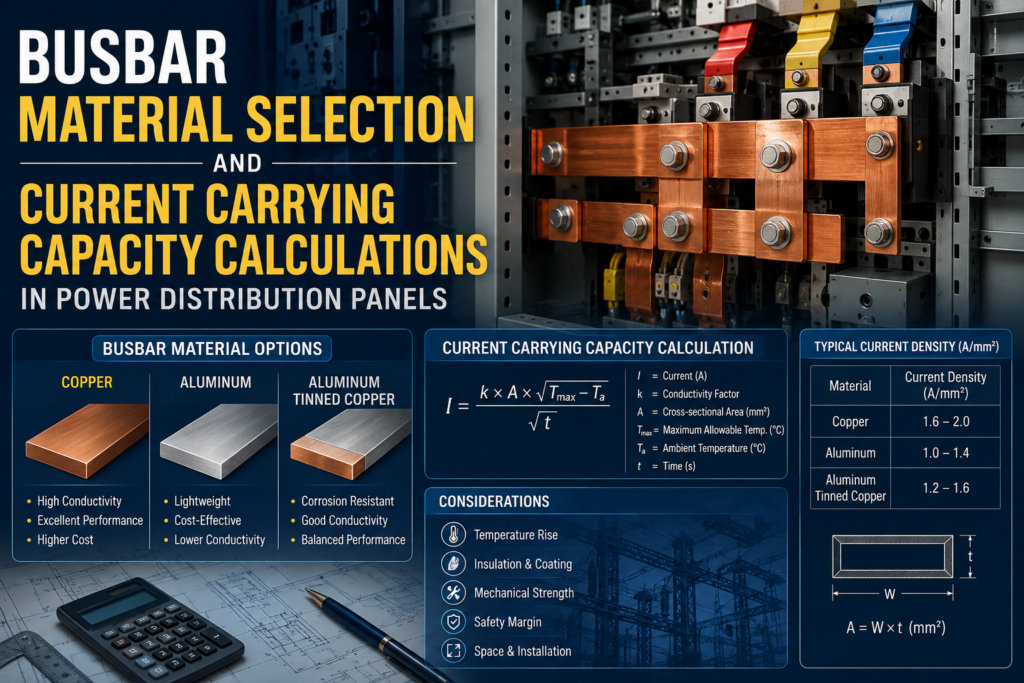
One of the first design decisions in busbar system design for power distribution panels involves choosing the appropriate conductor material. The two most commonly used materials are copper busbars and aluminum busbars.
Copper Busbars
Copper is widely used in high-performance power distribution panels because of its excellent electrical conductivity and mechanical strength.
Key technical characteristics include:
- High electrical conductivity (~58 MS/m)
- Superior thermal conductivity
- High short circuit withstand capability
- Compact busbar dimensions for the same current rating
Because of these advantages, copper busbars are commonly used in high-current industrial distribution panels and critical electrical infrastructure.
Aluminum Busbars
Aluminum busbars are sometimes selected where cost and weight reduction are priorities.
Important characteristics include:
- Lower density compared to copper
- Reduced material cost
- Larger cross-sectional area required for the same current capacity
Although aluminum is less conductive than copper, properly designed aluminum busbar systems can still provide reliable performance in many power distribution applications.
Current Carrying Capacity Calculations in Busbar Design
The busbar current-carrying capacity, often referred to as ampacity, determines how much current the busbar can safely conduct without exceeding permissible temperature limits.
Busbar sizing calculations consider multiple thermal and electrical parameters to ensure safe operation.
Key parameters used in busbar current calculations include:
- Rated current of the power distribution system
- Ambient temperature within the electrical panel
- Permissible temperature rise of the conductor
- Busbar material resistivity
- Installation configuration and spacing
As current flows through the busbar, electrical resistance generates heat according to I²R losses. If the busbar cross-sectional area is insufficient, excessive heating can occur, which may damage insulation and reduce system reliability.
Therefore, accurate busbar current capacity calculations ensure that power distribution panels operate within safe thermal limits.
Thermal Performance and Heat Dissipation in Busbar Systems
Thermal management is a critical aspect of busbar design in power distribution panels. High current flow results in resistive heating, and if heat is not dissipated effectively, busbar temperatures may exceed safe operating limits.
Engineers, therefore evaluate the thermal equilibrium of busbars by considering:
- convection cooling inside the panel enclosure
- Radiation heat transfer between conductors
- airflow within the switchgear cabinet
In many industrial power distribution panels, busbars are spaced strategically to allow sufficient airflow and reduce heat accumulation.
Proper busbar layout design therefore, contributes significantly to maintaining safe operating temperatures under full load conditions.
Mechanical Strength and Short Circuit Withstand Capability
Busbars inside power distribution panels must also withstand the mechanical forces generated during short circuit conditions.
When fault currents flow through conductors, powerful electromagnetic forces are generated between busbars. These forces can cause bending, vibration, or displacement if the busbars are not properly supported.
Therefore, busbar design for industrial distribution panels includes structural considerations such as:
- rigid busbar supports
- adequate spacing between phases
- insulation barriers
- high mechanical strength materials
These design features ensure that the busbar system can withstand both thermal stress and mechanical stress during fault events.
Voltage Drop and Efficiency Considerations
Another important factor in busbar current calculations is voltage drop. Excessive voltage drop across busbars can reduce the efficiency of the power distribution panel and affect downstream equipment performance.
Busbar resistance depends on:
- conductor material
- cross-sectional area
- length of the conductor
By increasing the busbar cross-sectional area or selecting materials with higher conductivity, engineers can reduce voltage losses and improve overall system efficiency.
Efficient busbar system design in power distribution panels therefore supports stable voltage delivery across the electrical network.
Synchro Electricals: Precision-Engineered Power Distribution Panels
Synchro Electricals specializes in designing and manufacturing high-quality power distribution panels with optimized busbar systems. The company focuses on engineering panels that support reliable current flow, efficient heat dissipation, and strong short circuit withstand capability.
Each power distribution panel from Synchro Electricals is developed with carefully calculated busbar current-carrying capacity and material selection, ensuring dependable performance in demanding industrial environments.
With expertise in power systems engineering and industrial electrical panel manufacturing, Synchro Electricals provides robust electrical solutions that support safe and efficient power distribution across multiple industries.
Reliable Busbar Design as the Foundation of Electrical Panel Performance
The reliability of any power distribution panel ultimately depends on the quality of its busbar system. Proper busbar material selection and current-carrying capacity calculations ensure that electrical panels can safely handle high load currents without overheating or mechanical instability.
By carefully balancing electrical conductivity, thermal performance, and structural strength, engineers can design busbar systems that support long-term reliability in industrial power distribution networks.
For modern power systems, accurate busbar current calculations and optimized busbar design remain essential for building safe, efficient, and durable electrical infrastructure.