In heavy industrial power systems, electrical faults are not hypothetical events—they are design realities that must be anticipated and engineered for. Large transformers, parallel feeders, high-capacity motors, and captive generation significantly increase prospective fault currents at the low-voltage level. In such environments, the Power Control Center (PCC) panel becomes the first line of defense against catastrophic electrical failure.
The adequacy of a PCC panel is therefore defined not just by its current rating, but by its PCC Panel Short Circuit Rating and the integrity of its busbar system under extreme fault conditions. Improper evaluation of short-circuit withstand capability or incorrect busbar sizing can lead to mechanical deformation, insulation failure, or complete panel destruction within milliseconds of a fault.
Understanding PCC Panel Short Circuit Rating in Heavy Industry
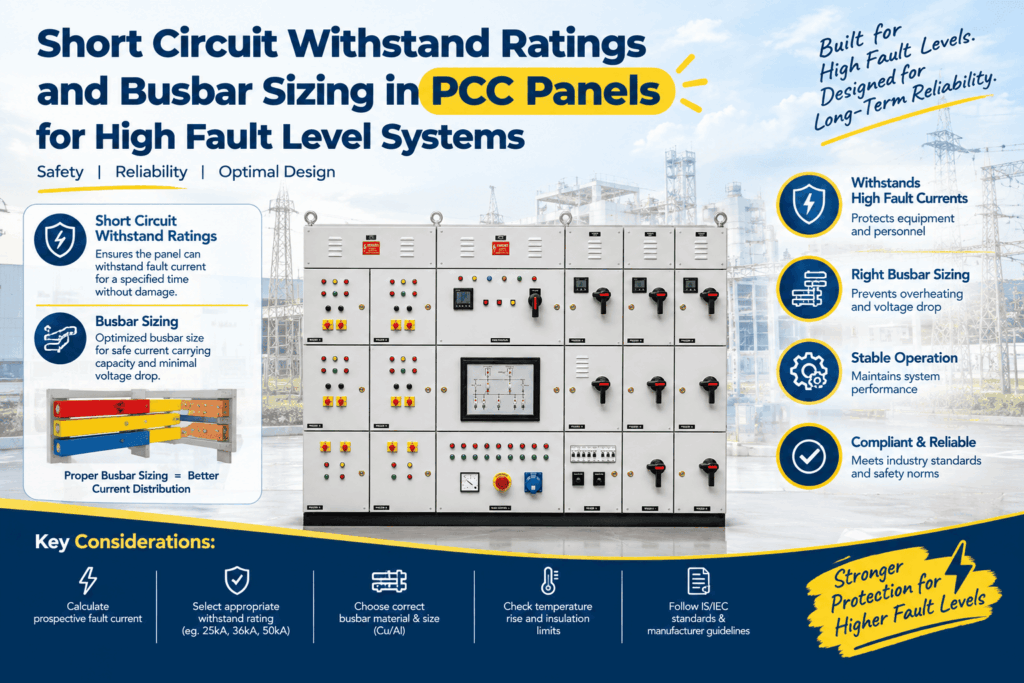
The PCC Panel Short Circuit Rating represents the panel’s ability to withstand thermal and electromechanical stresses caused by short-circuit currents for a specified duration, typically 1 second or 3 seconds. In heavy industry, fault levels at PCC incomers can easily exceed 50kA due to high transformer capacities and low system impedance.
Short-circuit rating is not limited to the breaker interrupting capacity alone. It applies to the entire current-carrying structure of the PCC panel, including busbars, supports, insulation systems, and interconnections. A breaker may successfully interrupt a fault, but if the busbar system cannot withstand the initial fault forces, severe damage occurs before protection even operates.
Electromechanical Forces During Short-Circuit Events
When a short circuit occurs, extremely high currents flow through the PCC panel busbars almost instantaneously. These currents generate strong electromagnetic forces proportional to the square of the fault current. In high fault level systems, these forces attempt to repel or attract busbars violently, stressing supports and joints.
Simultaneously, thermal energy is released due to I²R losses, rapidly increasing conductor temperature. If busbar sizing and spacing are inadequate, thermal expansion and mechanical stress combine to cause permanent deformation or insulation breakdown.
This dual stress—mechanical and thermal—is the primary reason why PCC Panel Short Circuit Rating must be evaluated holistically rather than as a nominal figure.
Busbar Sizing Philosophy for High Fault Level PCC Panels
Busbar sizing in PCC panels for heavy industry extends beyond continuous current capacity. While current rating determines steady-state operation, short-circuit performance dictates survival under fault conditions.
Correct busbar sizing considers cross-sectional area, material conductivity, phase spacing, and support arrangement. Copper busbars are commonly preferred in high fault level applications due to superior mechanical strength and thermal performance. However, material choice alone is insufficient without proper spacing and rigid support design.
Inadequate busbar sizing may pass routine current tests but fail catastrophically during a real short-circuit event, rendering the PCC panel unsafe and unusable.
PCC Panel Short Circuit Rating and Standards Compliance
Short-circuit withstand ratings are validated through design calculations and type testing in accordance with international standards such as IEC 61439. These standards specify temperature rise limits, mechanical integrity requirements, and fault duration criteria.
However, in heavy industry, reliance on minimum standard compliance is often insufficient. Fault levels may be close to or exceed standard test values, particularly in plants with parallel transformers or on-site generation. In such cases, conservative design margins and verified busbar configurations become essential.
Engineering judgment plays a critical role in translating standard requirements into real-world reliability.
Coordination Between Breakers and Busbar Withstand Capability
A common misconception is that a high-interrupting-capacity breaker alone ensures short-circuit safety. In reality, the breaker clearing time directly affects the thermal stress imposed on the busbar system. Even a fast-acting breaker allows peak fault current to flow during the first half-cycle.
Therefore, the busbar system must be capable of withstanding the peak short-circuit current as well as the thermal energy until fault clearance. This coordination between breaker characteristics and PCC Panel Short Circuit Rating is a critical aspect of protection and panel design in heavy industry.
Impact of High Fault Levels on Panel Longevity and Safety
Repeated exposure to near-fault conditions, even without full short circuits, accelerates mechanical fatigue and insulation aging in PCC panels. Poorly designed busbar systems may not fail immediately but degrade progressively, increasing the risk of arc faults and internal flashovers.
From a safety perspective, insufficient short-circuit withstand capability increases arc-flash energy levels, endangering personnel during fault events. Proper busbar sizing and robust short-circuit design reduce fault energy propagation and improve overall plant safety.
Engineering Approach of Synchro Electricals
Synchro Electricals designs PCC panels for heavy industry with short-circuit performance as a primary engineering criterion. Fault level analysis, busbar force calculations, and thermal withstand verification are integrated into the design process rather than treated as post-design checks.
Each PCC panel is engineered to meet the required PCC Panel Short Circuit Rating under actual site conditions, ensuring mechanical integrity, electrical safety, and long-term reliability in high fault level systems.
Conclusion
In heavy industrial power systems, short-circuit events define the true robustness of electrical infrastructure. A PCC panel that cannot withstand fault stresses compromises not only equipment but also plant safety and continuity.
Proper evaluation of PCC Panel Short Circuit Rating, combined with disciplined busbar sizing and structural design, ensures that PCC panels remain stable under extreme electrical stress. In high fault level environments, short-circuit withstand capability is not an optional enhancement—it is a fundamental design requirement.
Frequently Asked Questions
1. What does the short-circuit rating of a PCC panel represent?
The short-circuit rating indicates the ability of a PCC (Power Control Center) panel and its components—such as busbars, supports, insulation, and switching devices—to withstand the thermal and mechanical stresses produced by a specified fault current for a defined duration.
2. Is the circuit breaker’s interrupting capacity enough to ensure PCC panel short-circuit safety?
No. The circuit breaker’s interrupting capacity is only one part of the overall short-circuit protection system. The panel’s busbars, supports, connections, and other components must also be adequately rated to withstand the prospective fault current and associated peak electrodynamic forces until the protective device clears the fault.
3. How does busbar sizing affect the short-circuit withstand capability of a PCC panel?
Busbar cross-sectional area, material, configuration, spacing, and support arrangement all influence the panel’s short-circuit withstand capability. Proper design helps the busbar system withstand both the thermal effects of fault current and the mechanical forces generated during a short circuit.
4. Why can high short-circuit fault levels occur in industrial electrical systems?
High prospective fault currents can occur when the electrical system has low impedance, such as near large transformers, utility sources, parallel feeders, or significant generation capacity. The available fault level depends on the complete upstream and downstream network configuration.
5. Can repeated short-circuit events affect the long-term reliability of a PCC panel?
Yes. A significant short-circuit event can subject busbars, supports, connections, insulation, and switching components to substantial thermal and mechanical stress. After a major fault, the panel should be inspected and tested to determine whether any components require repair or replacement.
6. How is the required short-circuit rating of a PCC panel determined?
The required rating is generally determined through a short-circuit study based on factors such as the utility fault level, transformer impedance, generator contribution, cable and busbar impedance, and system configuration. The panel’s withstand and switching ratings should then be selected accordingly.
7. What is the difference between short-time withstand current and peak withstand current?
Short-time withstand current refers to the RMS fault current that equipment can withstand for a specified duration, such as one second. Peak withstand current refers to the maximum instantaneous current the equipment can withstand during the initial peak of a fault. Both are important when evaluating a panel’s short-circuit performance.
8. Why are busbar supports important for PCC panel short-circuit protection?
During a short circuit, high electrodynamic forces can act between conductors. Properly designed and spaced busbar supports help maintain the required conductor position and mechanical integrity under these forces.
9. Can a PCC panel be designed for a specific short-circuit level?
Yes. PCC panels can be engineered according to the calculated prospective fault level and project requirements. The selection of busbars, breakers, supports, insulation, enclosures, and other components should be coordinated with the required short-circuit withstand and applicable standards.
10. Which standards are relevant to PCC panel short-circuit performance?
The applicable standards depend on the project, equipment type, and installation location. For low-voltage switchgear and controlgear assemblies, IEC 61439 is a key reference for design and verification requirements, including short-circuit withstand performance. Additional national or project-specific standards may also apply.