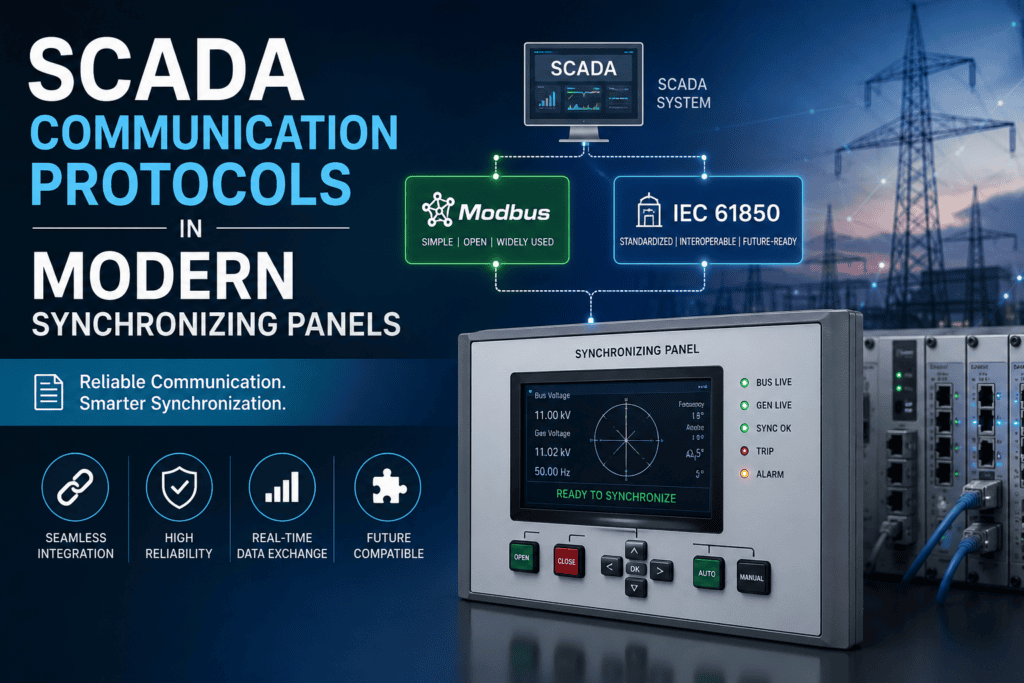
In today’s smart power plants and utility-scale power generation systems, synchronizing panels are no longer standalone control units. They are integrated into plant-wide SCADA (Supervisory Control and Data Acquisition) systems that enable centralized monitoring, automation, and real-time control of generators, switchgear, and power distribution infrastructure.
Modern SCADA synchronizing panels rely on industrial communication protocols to exchange operational data between generator controllers, PLCs, protection relays, and supervisory control systems. Among the most widely implemented protocols in synchronizing panels are Modbus communication protocols and IEC-61850 substation communication standards.
For power plants operating multiple generators and complex electrical networks, the implementation of reliable SCADA communication protocols in synchronizing panels ensures seamless generator coordination, faster fault diagnostics, and improved operational efficiency.
The Digital Layer of Generator Synchronization Systems
Traditional synchronizing panels primarily performed generator synchronization functions such as voltage matching, frequency matching, and phase alignment before connecting generators to the busbar.
However, modern power plants demand far greater operational visibility. Operators must continuously monitor generator parameters such as:
- Real power output (kW)
- Reactive power (kVAR)
- Voltage and frequency stability
- Load sharing between generators
- Breaker status and synchronization events
To achieve this level of control, synchronizing panels in smart power plants integrate with SCADA platforms through industrial communication networks.
These SCADA-enabled synchronizing panels transmit operational data to control rooms, enabling centralized supervision of generator systems across large industrial facilities and utility networks.
Communication Architecture in SCADA Synchronizing Panels
In modern power generation facilities, synchronizing panels form a critical node within the SCADA communication architecture. Multiple intelligent devices inside the panel communicate with each other through industrial protocols.
Typical devices connected within a SCADA synchronizing panel network include:
- Generator controllers
- PLC-based synchronizing systems
- protection relays
- energy meters
- circuit breaker monitoring modules
- SCADA gateways
These devices continuously exchange operational data with the central SCADA server, enabling real-time visualization of generator performance and electrical system status.
Industrial communication protocols such as Modbus RTU, Modbus TCP/IP, and IEC-61850 enable this seamless integration between synchronizing panels and SCADA systems.
Modbus Communication Protocol in Synchronizing Panels
One of the most widely used industrial protocols in SCADA synchronizing panels is Modbus. Originally developed for industrial automation systems, Modbus remains a reliable communication standard for exchanging data between electrical devices.
In synchronizing panels, Modbus communication protocols allow generator controllers and protection relays to transmit operational data to SCADA systems.
Two common variants of Modbus are used in power generation applications:
Modbus RTU
Modbus RTU operates over serial communication networks such as RS-485. It is widely used in industrial environments due to its simplicity, reliability, and ability to connect multiple devices on a single communication bus.
In generator synchronizing panels, Modbus RTU is often used for communication between PLC controllers, protection relays, and digital meters.
Modbus TCP/IP
Modbus TCP/IP operates over Ethernet networks, enabling faster communication and integration with modern SCADA platforms.
In large power plants and smart utility infrastructures, Modbus TCP allows synchronizing panels to communicate directly with SCADA servers, data historians, and remote monitoring systems.
The simplicity and interoperability of Modbus communication protocols make them highly suitable for synchronizing panel applications.
IEC-61850: Advanced Communication for Smart Substations
While Modbus remains widely used, many modern smart power plants and utility substations are adopting IEC-61850 communication protocols for advanced automation.
IEC-61850 is an international standard specifically developed for substation automation systems and smart grid communication.
Unlike traditional communication protocols, IEC-61850 uses object-oriented data models and high-speed Ethernet communication, enabling faster and more structured data exchange between intelligent electronic devices (IEDs).
In synchronizing panels integrated with smart grid systems, IEC-61850 enables several advanced capabilities:
- high-speed peer-to-peer communication between protection devices
- event-driven messaging through GOOSE communication
- standardized device data models for interoperability
- improved scalability for complex electrical networks
Because of these features, IEC-61850 is increasingly used in modern SCADA synchronizing panels deployed in large utility power plants.
Data Visibility and Remote Control in Smart Power Plants
Integrating SCADA communication protocols with synchronizing panels significantly enhances operational visibility across power generation facilities.
Operators can remotely monitor generator parameters such as:
- generator loading and load sharing status
- synchronization events and breaker operation
- alarm conditions and protection trips
- power quality parameters
Through SCADA interfaces, engineers can also perform remote commands such as generator start/stop operations, load adjustments, and breaker control.
This level of automation is essential for smart power plants and distributed energy systems, where centralized monitoring improves both reliability and operational efficiency.
Reliability and Cybersecurity Considerations
Because SCADA synchronizing panels operate within critical power infrastructure, communication reliability and cybersecurity are essential design considerations.
Communication networks must ensure:
- low latency data transmission
- redundancy for communication links
- secure network access control
- protection against cyber threats
Modern IEC-61850-based power automation systems often incorporate secure Ethernet networks and network segmentation to protect critical control systems.
Ensuring secure and reliable SCADA communication in synchronizing panels is therefore essential for maintaining the stability of power generation systems.
Synchro Electricals: Synchronizing Panels for Smart Power Systems
Synchro Electricals designs advanced synchronizing panels engineered for modern power generation facilities and smart utility infrastructure. These panels are built to support seamless integration with SCADA communication systems using industrial protocols such as Modbus and IEC-61850.
Each synchronizing panel from Synchro Electricals is designed to support reliable generator synchronization, intelligent load sharing, and real-time communication with supervisory control systems.
With strong expertise in industrial electrical panel manufacturing and power system automation, Synchro Electricals provides robust solutions for smart power plants, distributed generation facilities, and utility-scale power networks.
Intelligent Communication as the Foundation of Modern Power Control
As power generation systems become more complex and interconnected, communication between electrical devices becomes increasingly important.
By integrating SCADA communication protocols such as Modbus and IEC-61850, modern synchronizing panels enable centralized monitoring, advanced automation, and improved generator coordination.
For smart power plants and utility infrastructures, deploying SCADA-enabled synchronizing panels with robust communication protocols ensures greater reliability, faster fault response, and efficient management of power generation assets.