
Synchronizing Panels in Oil & Gas Facilities: Reliable Power Management for Hazardous Locations

Power reliability in the oil and gas sector isn’t just an operational requirement – it’s a safety one. Offshore platforms, refineries, LNG terminals, petrochemical complexes, upstream drilling facilities – a power interruption in any of these doesn’t just disrupt processes. It hits production targets and creates serious safety concerns simultaneously.

Most oil and gas facilities run multiple power sources to keep operations continuous – diesel generators, gas generators, utility feeders, and emergency backup systems. Managing all of that efficiently requires advanced synchronizing panels for oil and gas applications.

A well-designed synchronizing panel keeps multiple generators running together safely, distributes loads effectively, and maintains uninterrupted power across critical systems. In hazardous environments where reliability isn’t negotiable, these panels form an important part of the overall power management system for oil and gas facilities.

Why Power Continuity Matters More in Oil and Gas Operations

Oil and gas plants aren’t like commercial facilities. Compressors, pumps, process control systems, emergency shutdown systems, safety instrumentation – all of it depends on stable electrical power, continuously.

Even a short interruption affects production processes and triggers significant operational losses. That’s why most facilities run multiple generators in parallel rather than betting everything on a single power source.

Connecting multiple generators to a common electrical network isn’t straightforward, though. Voltage, frequency, and phase angle all have to match before a generator can be safely connected. That coordination is exactly what the generator synchronizing panel handles.

Without proper synchronization, severe electrical and mechanical stresses hit the power distribution system fast.

Operating Multiple Generators as One Power System

The core job of a synchronizing panel for oil and gas facilities is seamless operation between multiple power sources.

When an additional generator is needed, the panel monitors generator parameters continuously and adjusts them until synchronization conditions are met. Once voltage, frequency, and phase sequence match the live busbar, the breaker closes automatically, and the generator joins the system.

Modern automatic synchronizing panels also handle load distribution between generators — a process known as load sharing. This prevents one generator from running hard while others sit underutilised.

For refineries, offshore platforms, and petrochemical plants where power demand shifts throughout the day, effective load sharing improves fuel efficiency and extends generator life.

Designing Synchronizing Panels for Hazardous Locations

Electrical equipment in oil and gas facilities has to perform reliably in some of the harshest industrial conditions that exist. Explosive atmospheres, corrosive environments, extreme temperatures, continuous vibration – all of it influences how equipment gets designed.

Synchronizing panels used in hazardous locations are engineered with that reality built in from the start.

Key design requirements typically include:

  • Integration with hazardous area electrical systems
  • Robust enclosure construction
  • High-reliability control components
  • Redundant power management architecture
  • Advanced protection and monitoring systems

Depending on facility classification, synchronizing panels may also interface with explosion-proof equipment and hazardous area instrumentation. That scope makes oil and gas synchronizing panels a different animal entirely compared to standard commercial generator control panels.

SCADA Integration and Centralized Power Management

Modern oil and gas facilities run on automation and centralised monitoring. Synchronizing panels for oil and gas applications are now routinely integrated with plant-wide SCADA and distributed control systems (DCS).

That integration gives operators real-time visibility across:

  • Generator loading
  • Busbar status
  • Breaker position
  • Fuel consumption trends
  • Power quality parameters

Informed decisions get made faster when the data is all in one place. Synchronizing panels with SCADA integration also support remote operation, event logging, alarm management, and predictive maintenance programs – capabilities that matter a great deal in remote or unmanned installations.

Protection Strategies for Critical Power Systems

Electrical faults in oil and gas environments need to be detected and isolated quickly. Letting a fault develop in a critical power system isn’t an option.

Modern generator synchronizing panels carry multiple protection functions built specifically for these applications – protecting generators, switchgear, and connected loads from abnormal conditions before they escalate.

Protection schemes commonly built into oil and gas synchronizing panels include overcurrent protection, reverse power protection, under-frequency protection, over-voltage protection, and busbar protection.

Combined with intelligent control algorithms, these protection systems maintain stability across the entire industrial power distribution network.

Engineering Synchronizing Panels for Demanding Applications

At Synchro Electricals, we design and manufacture synchronizing panels for industrial power management applications across demanding sectors, including oil and gas, infrastructure, utilities, and process industries.

Our engineering focus sits on reliable generator synchronization, accurate load sharing, advanced protection coordination, and seamless SCADA integration. Robust panel construction combined with intelligent control technology is what delivers dependable power management in environments where reliability is critical, and failure isn’t an acceptable outcome.

The Backbone of Reliable Power Generation

Oil and gas facilities run around the clock, often in remote and unforgiving locations where power reliability simply cannot be compromised. Synchronizing multiple generators, distributing load efficiently, and responding quickly to changing operating conditions – that’s what keeps continuous production possible.

It’s why synchronizing panels for oil and gas facilities remain a key component of modern power management systems. Safe generator operation, intelligent load sharing, centralised control – these panels deliver the reliability that hazardous industrial locations demand.

FAQs

  1. 1. What is the purpose of a synchronizing panel in an oil and gas facility? 

    It safely connects multiple generators to a common busbar and manages load sharing between power sources – keeping the facility’s electrical system stable and continuous.

  2. 2. Why are synchronizing panels important in hazardous locations? 

    Because power failures in these environments don’t just cost money – they affect safety. These panels keep critical equipment running without interruption in conditions where that matters most.

  3. 3. Can synchronizing panels support automatic load sharing?

    Yes. Modern automatic synchronizing panels continuously balance electrical loads across multiple generators without manual intervention.

  4. 4. Are synchronizing panels integrated with SCADA systems?

    Most modern synchronizing panels support full SCADA and DCS integration for centralised monitoring, remote operation, and alarm management.

  5. 5. Where are synchronizing panels commonly used in the oil and gas sector? 

    Refineries, offshore platforms, LNG terminals, petrochemical plants, drilling facilities, and pipeline infrastructure – anywhere multiple power sources need to be managed reliably.

Capacitor Bank Switching Transients and Harmonic Mitigation in APFC Panels

Power factor correction has become a standard requirement across industrial plants, commercial buildings, utilities, and infrastructure projects. APFC panels (Automatic Power Factor Correction Panels) are designed to improve power factor and reduce utility penalties, but their performance depends heavily on how they interact with the electrical network.

In modern facilities where VFDs, UPS systems, servo drives, solar inverters, and automation equipment are common, simply installing capacitor banks is no longer enough. Switching transients and harmonic distortion both need to be addressed for the system to hold up long-term. That’s what makes APFC harmonic mitigation an important consideration in modern power distribution systems — not a nice-to-have, but part of getting the design right.

The Instant Impact of Capacitor Bank Switching

Every time a capacitor bank switches ON inside an APFC panel, a sudden charging current rushes into the capacitor. That surge creates a short-duration electrical disturbance — a switching transient.

The event itself lasts a fraction of a second. The problem is what that voltage and current spike does to sensitive equipment connected elsewhere on the network. In large industrial facilities running multiple capacitor stages, frequent switching adds up. Contactors, capacitors, and protection devices all absorb that stress over time.

This is why switching device selection and capacitor bank configuration get careful attention when engineers are designing industrial APFC panels.

Why Harmonics and APFC Panels Must Be Considered Together

Most industrial and commercial facilities today run a substantial number of non-linear loads. Variable frequency drives, rectifiers, UPS systems, CNC machines – all of them generate harmonic currents that distort the normal power waveform.

Those harmonics and capacitor banks don’t coexist quietly.

Capacitors naturally attract higher-frequency currents, which puts them directly in the path of harmonic overload. Under certain conditions the electrical system hits resonance, and when that happens, current through the capacitor bank climbs to levels it was never designed for. Overheating follows. Then capacitor failure, nuisance tripping, and shortened panel life.

This is why modern APFC panel design can’t focus only on reactive power compensation. Power quality and harmonic distortion have to be part of the same conversation.

Identifying Harmonic Risks Before They Become Problems

Before specifying an automatic power factor correction panel, engineers typically run a power quality assessment of the facility. The goal is to find out whether standard capacitor banks are appropriate or whether harmonic levels in the system demand additional mitigation.

That assessment usually covers:

  • Total Harmonic Distortion (THD) levels
  • Type of connected loads
  • Existing power factor performance
  • System short-circuit capacity
  • Capacitor bank sizing requirements

Working through this upfront is what prevents the APFC panel from creating resonance conditions in the very network it was installed to improve.

How Detuned Reactors Protect Capacitor Banks

The most widely used solution for harmonic mitigation in APFC panels is the detuned reactor.

Connected in series with the capacitor bank, a detuned reactor shifts the resonance frequency away from the dominant harmonics present in the system. Instead of the capacitors amplifying harmonic currents, the circuit limits their impact before damage occurs.

The practical benefits stack up:

  • Improved capacitor life
  • Reduced thermal stress
  • Better power quality
  • Lower risk of resonance
  • Enhanced reliability of APFC systems

For manufacturing plants, commercial complexes, and infrastructure facilities carrying significant non-linear loads, detuned APFC panels are typically the right call rather than the cautious one.

Designing APFC Panels for Modern Industrial Applications

Today’s industrial APFC panels have to do more than correct power factor. System stability, equipment protection, and harmonic management all sit inside the same design brief.

At Synchro Electricals, capacitor bank sizing, harmonic levels, switching frequency, and power quality requirements all feed into how we design APFC panels for industrial power distribution systems. Power factor correction should improve the network, not introduce new problems into it.

Proper switching technology combined with effective harmonic mitigation strategies is what allows APFC panels to perform reliably over years of operation in demanding industrial environments — not just at commissioning.

Conclusion

Capacitor banks remain essential for improving power factor and reducing energy losses. But the way they interact with harmonics can’t be treated as a secondary concern. Without proper engineering, switching transients and resonance conditions quietly degrade both the APFC panel and the wider electrical system around it.

Careful analysis, sound capacitor bank design, and detuned reactors for harmonic mitigation are what allow facilities to achieve genuine power factor correction without paying for it in power quality.

As industrial electrical networks keep evolving, APFC harmonic mitigation, reliable capacitor bank switching, and intelligent panel design will stay at the centre of efficient and stable power distribution — because the loads driving harmonic distortion aren’t going away.

FAQs

  1. 1. What causes switching transients in APFC panels? 

    When capacitor banks are energised or disconnected, a sudden surge of charging current creates temporary voltage and current disturbances in the network. That’s the switching transient.

  2. 2. Why do harmonics affect capacitor banks? 

    Capacitors pull in higher-frequency harmonic currents naturally. In a harmonic-rich environment that leads to overheating, resonance conditions, and capacitor failure well ahead of design life.

  3. 3. What is harmonic mitigation in APFC panels?

    It’s the use of solutions like detuned reactors to reduce harmonic distortion and protect capacitor banks from the resonance and thermal stress that harmonics cause.

  4. 4. What is a detuned APFC panel? 

    A panel that combines capacitors and series-connected reactors to shift the resonance frequency away from dominant harmonics – improving power quality and protecting the capacitor bank in environments where harmonic levels are significant.

  5. 5. Where are APFC panels commonly installed?

    Manufacturing plants, commercial buildings, utility facilities, infrastructure projects, and industrial power distribution systems – anywhere reactive power compensation and power factor correction are required.

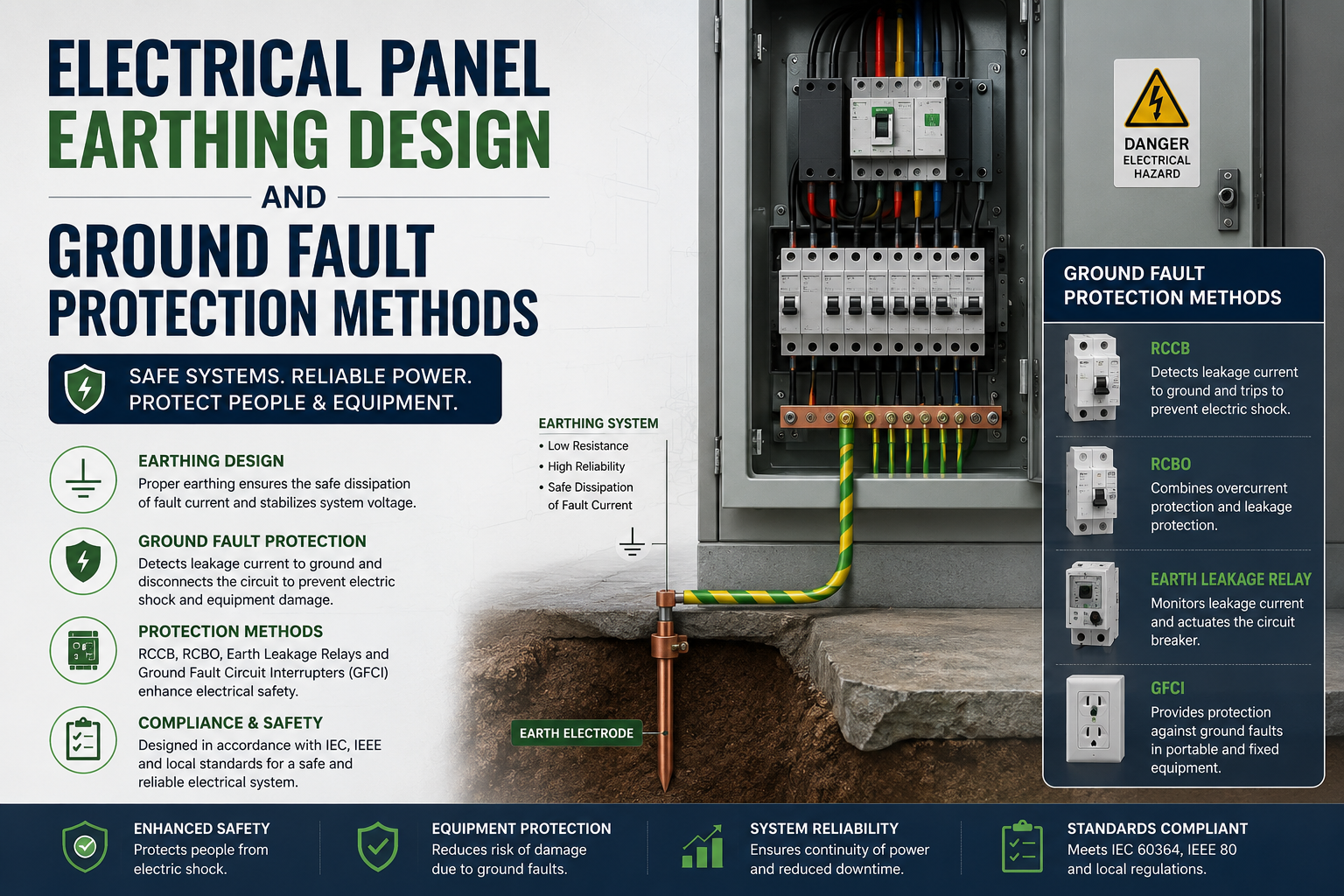
Electrical Panel Earthing Design and Ground Fault Protection Methods

A well-designed electrical system is only as safe as its grounding and fault protection strategy. Circuit breakers and protection relays get most of the attention during panel design, but electrical panel earthing design is what actually provides a safe path for fault currents and keeps both equipment and personnel out of danger.

In utilities, infrastructure projects, manufacturing facilities, and commercial installations, electrical control panels are critical points of power distribution and system control. A ground fault in a panel without an effective earthing system means fault current starts finding its own way to earth – through equipment frames, enclosures, cable trays, anything conductive nearby. That’s when things get dangerous.

This is why electrical panel earthing design and ground fault protection methods are treated as non-negotiable requirements in modern power systems engineering.

When Electricity Finds the Wrong Path

Normal operation is simple enough – current flows through designated conductors and returns through the intended circuit path. A ground fault is what happens when that current escapes. It moves toward earth through equipment frames, panel enclosures, cable trays, or whatever conductive structure is closest.

Even a relatively small ground fault creates dangerous touch voltages on metallic surfaces. In higher-capacity systems, the fault currents involved are large enough to cause serious damage to switchgear, cables, and electrical control panels.

An effective electrical panel grounding system gives fault current a low-resistance path to earth – controlled, intentional, and fast enough that protective devices can detect and clear the fault before it develops further. Without that, protective devices may not operate correctly, and hazardous conditions persist.

Earthing Is More Than Connecting a Wire to the Ground

A lot of installations treat earthing as a single connection to a ground rod. That’s not earthing design — that’s a starting point at best.

Proper electrical panel earthing design requires a coordinated approach across multiple grounding components. Inside an electrical control panel, every exposed metallic part needs to be bonded together and tied into the facility’s earthing network. The result is an equipotential system that keeps voltage differences under control during fault conditions.

How well that system performs depends on soil resistivity, conductor sizing, grounding electrode configuration, and the integrity of bonding throughout the installation. Poor grounding raises system impedance, slows down fault current return, and delays fault clearing – all of which make a dangerous situation worse.

Designing Earthing Systems for Reliable Fault Current Dissipation

Earthing system design starts with one question: what is the maximum fault current this installation could see? Grounding conductors have to carry that current safely for as long as it takes protective devices to operate.

Engineers typically work through:

  • Fault current levels within the electrical network
  • Ground conductor sizing requirements
  • Earthing electrode resistance values
  • Bonding between panel components and structural elements

A properly designed grounding system improves safety and adds to the overall reliability of electrical control panels used in utility and infrastructure projects. For critical installations – substations, water treatment facilities, transportation infrastructure – achieving low earth resistance values isn’t optional, it’s a core design objective.

How Ground Fault Protection Complements Earthing Design

Earthing handles the fault current once a fault exists. Ground fault protection is what catches it early.

Modern electrical control panels incorporate ground fault protection schemes that monitor current flow continuously. When leakage current appears, the protection system acts before the fault grows into something larger.

Common ground fault protection methods in use today include:

  • Residual current monitoring
  • Earth fault relays
  • Ground fault circuit interrupters (GFCI)
  • Differential protection systems

Which method gets selected depends on voltage level, system configuration, and the operational demands of the specific installation. The point is that earthing systems and ground fault protection devices have to work together – one provides the path, the other triggers the response. Neither does the full job alone.

The Challenge of Ground Faults in Large Infrastructure Projects

Utilities and infrastructure facilities run extensive electrical networks across large geographic areas. Long cable runs, multiple distribution points, and varying soil conditions all make grounding systems considerably more complex than in a standard commercial installation.

Ground fault protection in these environments requires careful coordination so that the protective device closest to the fault operates first. That selectivity matters – it contains the problem, keeps healthy sections of the network running, and avoids shutdowns that affect far more than the faulted circuit.

As infrastructure projects rely more heavily on automation and digital control systems, effective electrical panel grounding and protection systems become even more critical. Sensitive electronics can be affected by grounding issues well before any major fault occurs, which means problems show up in the control system before they’re traceable to a grounding deficiency.

Building Safer Electrical Control Panels

At Synchro Electricals, reliable earthing is a core part of electrical panel performance — not a compliance checkbox at the end of a project. During the design of electrical control panels, our engineering team evaluates grounding arrangements, conductor sizing, bonding requirements, and protection coordination to ensure fault current is managed safely from the start.

Integrating effective electrical panel earthing design with appropriate ground fault protection methods is how we deliver panels that hold up operationally and electrically across demanding utility and infrastructure applications.

A Foundation for Electrical Safety

Most electrical problems that could have been prevented trace back to grounding issues that nobody caught until a fault made them obvious. A properly engineered electrical panel earthing system gives fault current somewhere safe to go, protective devices something to work with, and personnel a meaningful layer of protection.

Pair that with well-coordinated ground fault protection methods and the electrical control panel holds up – under normal conditions and abnormal ones. For utilities, infrastructure projects, and industrial facilities, getting grounding right from the design stage remains one of the highest-value decisions in the entire electrical system.

FAQs

  1. 1. What is the purpose of earthing in an electrical control panel?

    Earthing gives fault current a safe, controlled path to ground – protecting equipment from damage and keeping personnel away from dangerous touch voltages.

  2. 2. Why is electrical panel earthing design important?

    Because a poorly designed earthing system slows fault clearing, raises touch voltage risks, and undermines the reliability of the entire panel. Getting it right at the design stage prevents problems that are much harder to fix later.

  3. 3. What causes a ground fault in an electrical system?

    A ground fault happens when current leaves its intended path and flows to earth through equipment, exposed metal parts, or structural elements that weren’t designed to carry it.

  4. 4. What devices are used for ground fault protection?

    Earth fault relays, residual current devices, GFCIs, and differential protection systems are the most common. Selection depends on the voltage level and configuration of the specific installation.

  5. 5. How does grounding improve electrical panel safety?

    It gives fault current a defined, low-resistance path back to earth, which lets protective devices operate quickly, isolate the fault, and stop the hazardous condition before it causes harm.

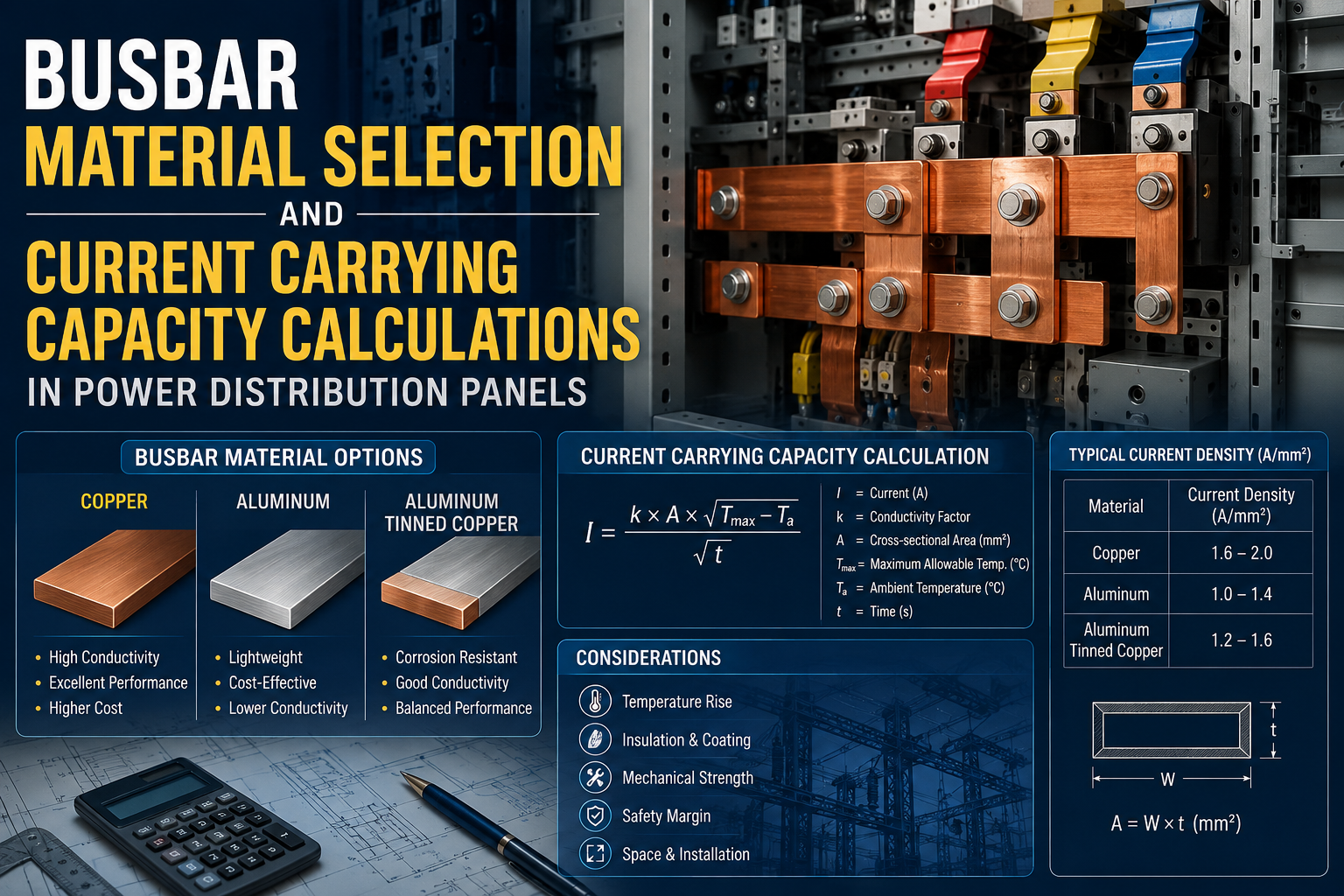
Busbar Material Selection and Current Carrying Capacity Calculations in Power Distribution Panels

In modern power systems engineering, the performance and safety of power distribution panels depend heavily on the design of the busbar system. Busbars act as the primary electrical conductors inside switchboards and distribution panels, carrying large currents from incoming feeders to outgoing circuits.

Selecting the correct busbar material and performing accurate busbar current-carrying capacity calculations are critical design tasks in industrial electrical engineering. Poor busbar design can lead to overheating, voltage drop, mechanical deformation, and even catastrophic panel failures.

For engineers designing industrial power distribution panels, understanding the electrical, thermal, and mechanical characteristics of busbars is essential for ensuring reliable power delivery in high-load environments.

The Electrical Backbone of Power Distribution Panels

Inside every industrial power distribution panel, busbars function as the central pathway through which electrical energy flows. Unlike cables, busbars provide a rigid conductor structure that supports high current capacity with lower impedance and improved thermal performance.

Busbars distribute power between key components such as:

  • Incoming circuit breakers
  • Outgoing feeder breakers
  • protection relays
  • switchgear assemblies

Because these conductors carry large currents continuously, their design must ensure both efficient current transfer and thermal stability. This makes busbar material selection and current-carrying capacity calculations fundamental aspects of power distribution panel engineering.

Copper vs Aluminum: Engineering Considerations in Busbar Material Selection

One of the first design decisions in busbar system design for power distribution panels involves choosing the appropriate conductor material. The two most commonly used materials are copper busbars and aluminum busbars.

Copper Busbars

Copper is widely used in high-performance power distribution panels because of its excellent electrical conductivity and mechanical strength.

Key technical characteristics include:

  • High electrical conductivity (~58 MS/m)
  • Superior thermal conductivity
  • High short circuit withstand capability
  • Compact busbar dimensions for the same current rating

Because of these advantages, copper busbars are commonly used in high-current industrial distribution panels and critical electrical infrastructure.

Aluminum Busbars

Aluminum busbars are sometimes selected where cost and weight reduction are priorities.

Important characteristics include:

  • Lower density compared to copper
  • Reduced material cost
  • Larger cross-sectional area required for the same current capacity

Although aluminum is less conductive than copper, properly designed aluminum busbar systems can still provide reliable performance in many power distribution applications.

Current Carrying Capacity Calculations in Busbar Design

The busbar current-carrying capacity, often referred to as ampacity, determines how much current the busbar can safely conduct without exceeding permissible temperature limits.

Busbar sizing calculations consider multiple thermal and electrical parameters to ensure safe operation.

Key parameters used in busbar current calculations include:

  • Rated current of the power distribution system
  • Ambient temperature within the electrical panel
  • Permissible temperature rise of the conductor
  • Busbar material resistivity
  • Installation configuration and spacing

As current flows through the busbar, electrical resistance generates heat according to I²R losses. If the busbar cross-sectional area is insufficient, excessive heating can occur, which may damage insulation and reduce system reliability.

Therefore, accurate busbar current capacity calculations ensure that power distribution panels operate within safe thermal limits.

Thermal Performance and Heat Dissipation in Busbar Systems

Thermal management is a critical aspect of busbar design in power distribution panels. High current flow results in resistive heating, and if heat is not dissipated effectively, busbar temperatures may exceed safe operating limits.

Engineers, therefore evaluate the thermal equilibrium of busbars by considering:

  • convection cooling inside the panel enclosure
  • Radiation heat transfer between conductors
  • airflow within the switchgear cabinet

In many industrial power distribution panels, busbars are spaced strategically to allow sufficient airflow and reduce heat accumulation.

Proper busbar layout design therefore, contributes significantly to maintaining safe operating temperatures under full load conditions.

Mechanical Strength and Short Circuit Withstand Capability

Busbars inside power distribution panels must also withstand the mechanical forces generated during short circuit conditions.

When fault currents flow through conductors, powerful electromagnetic forces are generated between busbars. These forces can cause bending, vibration, or displacement if the busbars are not properly supported.

Therefore, busbar design for industrial distribution panels includes structural considerations such as:

  • rigid busbar supports
  • adequate spacing between phases
  • insulation barriers
  • high mechanical strength materials

These design features ensure that the busbar system can withstand both thermal stress and mechanical stress during fault events.

Voltage Drop and Efficiency Considerations

Another important factor in busbar current calculations is voltage drop. Excessive voltage drop across busbars can reduce the efficiency of the power distribution panel and affect downstream equipment performance.

Busbar resistance depends on:

  • conductor material
  • cross-sectional area
  • length of the conductor

By increasing the busbar cross-sectional area or selecting materials with higher conductivity, engineers can reduce voltage losses and improve overall system efficiency.

Efficient busbar system design in power distribution panels therefore supports stable voltage delivery across the electrical network.

Synchro Electricals: Precision-Engineered Power Distribution Panels

Synchro Electricals specializes in designing and manufacturing high-quality power distribution panels with optimized busbar systems. The company focuses on engineering panels that support reliable current flow, efficient heat dissipation, and strong short circuit withstand capability.

Each power distribution panel from Synchro Electricals is developed with carefully calculated busbar current-carrying capacity and material selection, ensuring dependable performance in demanding industrial environments.

With expertise in power systems engineering and industrial electrical panel manufacturing, Synchro Electricals provides robust electrical solutions that support safe and efficient power distribution across multiple industries.

Reliable Busbar Design as the Foundation of Electrical Panel Performance

The reliability of any power distribution panel ultimately depends on the quality of its busbar system. Proper busbar material selection and current-carrying capacity calculations ensure that electrical panels can safely handle high load currents without overheating or mechanical instability.

By carefully balancing electrical conductivity, thermal performance, and structural strength, engineers can design busbar systems that support long-term reliability in industrial power distribution networks.

For modern power systems, accurate busbar current calculations and optimized busbar design remain essential for building safe, efficient, and durable electrical infrastructure.

FAQs

  1. 1. What is a busbar in a power distribution panel?

    A busbar is a conductive metal strip used in power distribution panels to carry and distribute large electrical currents between incoming and outgoing circuits.

  2. 2. Which material is commonly used for busbars in electrical panels?

    Copper and aluminum are the most commonly used busbar materials, with copper offering higher conductivity and mechanical strength.

  3. 3. How is busbar current carrying capacity calculated?

    Busbar current capacity is calculated based on conductor cross-sectional area, material conductivity, permissible temperature rise, and ambient operating conditions.

  4. 4. Why is busbar sizing important in power distribution panels?

    Proper busbar sizing prevents overheating, reduces voltage drop, and ensures safe operation of the electrical distribution system.

  5. 5. What factors influence busbar performance in electrical panels?

    Material selection, cross-sectional area, thermal conditions, mechanical strength, and short circuit withstand capability all influence busbar performance.

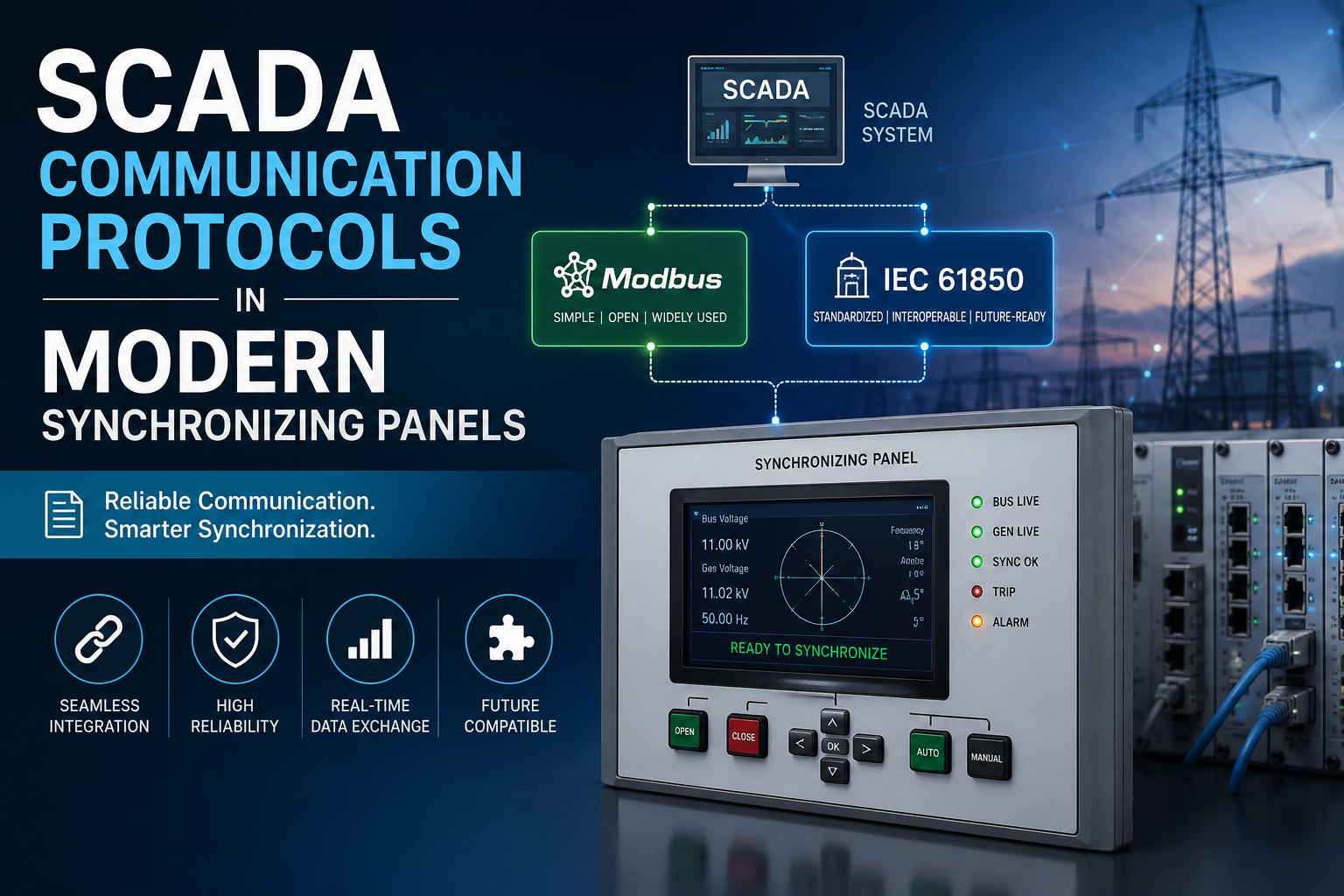
SCADA Communication Protocols in Modern Synchronizing Panels (Modbus / IEC-61850)

In today’s smart power plants and utility-scale power generation systems, synchronizing panels are no longer standalone control units. They are integrated into plant-wide SCADA (Supervisory Control and Data Acquisition) systems that enable centralized monitoring, automation, and real-time control of generators, switchgear, and power distribution infrastructure.

Modern SCADA synchronizing panels rely on industrial communication protocols to exchange operational data between generator controllers, PLCs, protection relays, and supervisory control systems. Among the most widely implemented protocols in synchronizing panels are Modbus communication protocols and IEC-61850 substation communication standards.

For power plants operating multiple generators and complex electrical networks, the implementation of reliable SCADA communication protocols in synchronizing panels ensures seamless generator coordination, faster fault diagnostics, and improved operational efficiency.

The Digital Layer of Generator Synchronization Systems

Traditional synchronizing panels primarily performed generator synchronization functions such as voltage matching, frequency matching, and phase alignment before connecting generators to the busbar.

However, modern power plants demand far greater operational visibility. Operators must continuously monitor generator parameters such as:

  • Real power output (kW)
  • Reactive power (kVAR)
  • Voltage and frequency stability
  • Load sharing between generators
  • Breaker status and synchronization events

To achieve this level of control, synchronizing panels in smart power plants integrate with SCADA platforms through industrial communication networks.

These SCADA-enabled synchronizing panels transmit operational data to control rooms, enabling centralized supervision of generator systems across large industrial facilities and utility networks.

Communication Architecture in SCADA Synchronizing Panels

In modern power generation facilities, synchronizing panels form a critical node within the SCADA communication architecture. Multiple intelligent devices inside the panel communicate with each other through industrial protocols.

Typical devices connected within a SCADA synchronizing panel network include:

  • Generator controllers
  • PLC-based synchronizing systems
  • protection relays
  • energy meters
  • circuit breaker monitoring modules
  • SCADA gateways

These devices continuously exchange operational data with the central SCADA server, enabling real-time visualization of generator performance and electrical system status.

Industrial communication protocols such as Modbus RTU, Modbus TCP/IP, and IEC-61850 enable this seamless integration between synchronizing panels and SCADA systems.

Modbus Communication Protocol in Synchronizing Panels

One of the most widely used industrial protocols in SCADA synchronizing panels is Modbus. Originally developed for industrial automation systems, Modbus remains a reliable communication standard for exchanging data between electrical devices.

In synchronizing panels, Modbus communication protocols allow generator controllers and protection relays to transmit operational data to SCADA systems.

Two common variants of Modbus are used in power generation applications:

Modbus RTU

Modbus RTU operates over serial communication networks such as RS-485. It is widely used in industrial environments due to its simplicity, reliability, and ability to connect multiple devices on a single communication bus.

In generator synchronizing panels, Modbus RTU is often used for communication between PLC controllers, protection relays, and digital meters.

Modbus TCP/IP

Modbus TCP/IP operates over Ethernet networks, enabling faster communication and integration with modern SCADA platforms.

In large power plants and smart utility infrastructures, Modbus TCP allows synchronizing panels to communicate directly with SCADA servers, data historians, and remote monitoring systems.

The simplicity and interoperability of Modbus communication protocols make them highly suitable for synchronizing panel applications.

IEC-61850: Advanced Communication for Smart Substations

While Modbus remains widely used, many modern smart power plants and utility substations are adopting IEC-61850 communication protocols for advanced automation.

IEC-61850 is an international standard specifically developed for substation automation systems and smart grid communication.

Unlike traditional communication protocols, IEC-61850 uses object-oriented data models and high-speed Ethernet communication, enabling faster and more structured data exchange between intelligent electronic devices (IEDs).

In synchronizing panels integrated with smart grid systems, IEC-61850 enables several advanced capabilities:

  • high-speed peer-to-peer communication between protection devices
  • event-driven messaging through GOOSE communication
  • standardized device data models for interoperability
  • improved scalability for complex electrical networks

Because of these features, IEC-61850 is increasingly used in modern SCADA synchronizing panels deployed in large utility power plants.

Data Visibility and Remote Control in Smart Power Plants

Integrating SCADA communication protocols with synchronizing panels significantly enhances operational visibility across power generation facilities.

Operators can remotely monitor generator parameters such as:

  • generator loading and load sharing status
  • synchronization events and breaker operation
  • alarm conditions and protection trips
  • power quality parameters

Through SCADA interfaces, engineers can also perform remote commands such as generator start/stop operations, load adjustments, and breaker control.

This level of automation is essential for smart power plants and distributed energy systems, where centralized monitoring improves both reliability and operational efficiency.

Reliability and Cybersecurity Considerations

Because SCADA synchronizing panels operate within critical power infrastructure, communication reliability and cybersecurity are essential design considerations.

Communication networks must ensure:

  • low latency data transmission
  • redundancy for communication links
  • secure network access control
  • protection against cyber threats

Modern IEC-61850-based power automation systems often incorporate secure Ethernet networks and network segmentation to protect critical control systems.

Ensuring secure and reliable SCADA communication in synchronizing panels is therefore essential for maintaining the stability of power generation systems.

Synchro Electricals: Synchronizing Panels for Smart Power Systems

Synchro Electricals designs advanced synchronizing panels engineered for modern power generation facilities and smart utility infrastructure. These panels are built to support seamless integration with SCADA communication systems using industrial protocols such as Modbus and IEC-61850.

Each synchronizing panel from Synchro Electricals is designed to support reliable generator synchronization, intelligent load sharing, and real-time communication with supervisory control systems.

With strong expertise in industrial electrical panel manufacturing and power system automation, Synchro Electricals provides robust solutions for smart power plants, distributed generation facilities, and utility-scale power networks.

Intelligent Communication as the Foundation of Modern Power Control

As power generation systems become more complex and interconnected, communication between electrical devices becomes increasingly important.

By integrating SCADA communication protocols such as Modbus and IEC-61850, modern synchronizing panels enable centralized monitoring, advanced automation, and improved generator coordination.

For smart power plants and utility infrastructures, deploying SCADA-enabled synchronizing panels with robust communication protocols ensures greater reliability, faster fault response, and efficient management of power generation assets.

FAQs

  1. 1. What is a SCADA synchronizing panel?

    A SCADA synchronizing panel is a generator control panel integrated with a SCADA system to monitor and control generator synchronization, load sharing, and breaker operations remotely.

  2. 2. Why are communication protocols used in synchronizing panels?

    Communication protocols allow synchronizing panels to exchange real-time data with SCADA systems, enabling centralized monitoring and control of generator operations.

  3. 3. What is the difference between Modbus and IEC-61850?

    Modbus is a simple industrial communication protocol widely used for device communication, while IEC-61850 is an advanced standard designed specifically for smart substations and power system automation.

  4. 4. Which protocol is commonly used in synchronizing panels?

    Modbus RTU and Modbus TCP/IP are commonly used in synchronizing panels, while IEC-61850 is increasingly adopted in modern smart grid and utility applications.

  5. 5. How does SCADA integration improve generator synchronization systems?

    SCADA integration allows operators to monitor generator performance, control synchronization operations remotely, and quickly detect faults in power generation systems.

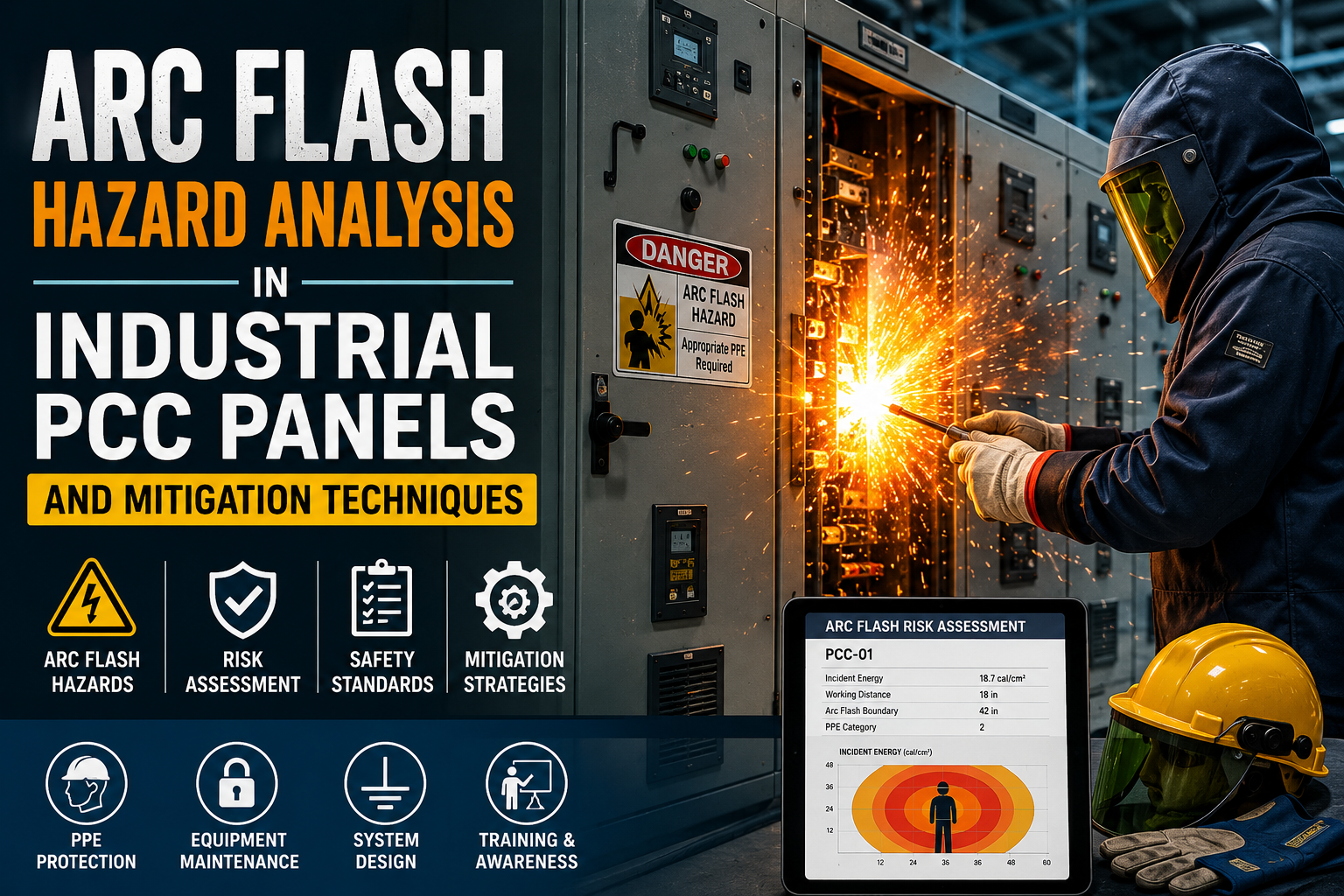
Arc Flash Hazard Analysis in Industrial PCC Panels and Mitigation Techniques

Industrial manufacturing facilities operate large electrical distribution networks where PCC panels (Power Control Center panels) manage high-current power flow from transformers to multiple downstream feeders. In such environments, one of the most severe electrical safety risks is an arc flash event inside electrical panels.

An arc flash occurs when electrical current deviates from its intended path and travels through ionized air between conductors or between a conductor and ground. The resulting arc produces extremely high temperatures, intense light, and explosive pressure waves that can severely damage equipment and pose serious danger to personnel.

For this reason, arc flash hazard analysis in industrial PCC panels has become an essential part of modern industrial electrical safety engineering. Proper analysis helps identify potential arc flash risks and enables engineers to implement effective arc flash protection in PCC panels.

When Electrical Energy Escapes Control: The Physics of Arc Flash

An arc flash event is essentially an uncontrolled electrical discharge that releases massive thermal energy within milliseconds. Temperatures inside an arc flash can exceed 20,000°C, which is hotter than the surface of the sun.

Inside industrial PCC panels, arc flashes can occur due to several conditions:

  • insulation failure between conductors
  • loose electrical connections
  • equipment aging or contamination
  • accidental contact with live parts
  • equipment faults during maintenance

When a fault occurs, high current flows through the arc path, rapidly vaporizing metal conductors and creating a plasma channel. This process generates intense heat, high-pressure blast waves, and molten metal particles.

Understanding these phenomena is the first step in performing an accurate arc flash hazard analysis for PCC panels in industrial facilities.

Quantifying the Risk: What Arc Flash Hazard Analysis Measures

An arc flash hazard analysis evaluates the severity of potential arc flash incidents within an electrical system. In industrial PCC panels, this analysis focuses on determining the amount of incident energy that workers may be exposed to during an arc flash event.

Key parameters evaluated during arc flash analysis in power distribution panels include:

  • available short circuit current
  • system voltage levels
  • clearing time of protective devices
  • conductor spacing and panel configuration
  • working distance from the electrical equipment

Using these parameters, engineers calculate the incident energy level (cal/cm²) at different locations in the electrical system.

The calculated incident energy helps determine the required arc flash protection category and personal protective equipment (PPE) needed for safe operation and maintenance.

Fault Current and Protection Speed: Critical Factors in Arc Flash Severity

Two electrical parameters strongly influence the magnitude of an arc flash hazard in PCC panels.

Available Fault Current

The higher the available fault current at the PCC panel, the more energy is released during an arc flash event. Industrial facilities with large transformers and high-capacity power systems often experience very high fault current levels.

Protective Device Clearing Time

The time required for circuit breakers or protection relays to interrupt the fault current plays a major role in arc flash severity. Longer clearing times allow the arc to persist longer, significantly increasing incident energy.

For this reason, modern arc flash protection strategies in PCC panels focus heavily on reducing the fault clearing time through advanced protection systems.

Engineering Techniques for Arc Flash Mitigation

Once an arc flash hazard analysis is completed, engineers can implement multiple strategies to reduce risk within industrial PCC panels.

High-Speed Protection Relays

Advanced protection relays can detect arc faults almost instantly and trigger circuit breaker tripping within milliseconds. Faster interruption significantly reduces arc flash energy levels.

Zone Selective Interlocking (ZSI)

ZSI technology allows upstream and downstream protective devices to communicate with each other. This coordination enables faster fault isolation within the affected zone while maintaining system selectivity.

Arc Flash Detection Systems

Some modern PCC panels include optical arc flash detection systems that use light sensors and current detection to identify arc events immediately. These systems can trip breakers extremely quickly, limiting arc energy.

Remote Switching and Monitoring

Remote operation of industrial PCC panels allows operators to perform switching operations from a safe distance, reducing personnel exposure to arc flash hazards.

These mitigation techniques significantly enhance arc flash protection in industrial power distribution systems.

Panel Design Strategies That Reduce Arc Flash Risk

Apart from protective devices, the physical design of industrial PCC panels also influences arc flash risk.

Electrical engineers implement several design practices to improve safety:

  • segregated busbar compartments to limit arc propagation
  • insulated busbar systems to prevent accidental contact
  • arc-resistant panel enclosures
  • improved cable management and conductor spacing

These design improvements help contain arc energy and reduce the likelihood of arc flash incidents within power control center panels.

Synchro Electricals: Designing Safer PCC Panels for Industrial Power Systems

Synchro Electricals manufactures industrial PCC panels designed with advanced safety considerations for modern manufacturing facilities. The company integrates reliable protection systems, robust busbar designs, and intelligent panel configurations to enhance arc flash protection in PCC panels.

Each PCC panel from Synchro Electricals is engineered to support high fault current environments while maintaining safe electrical operation. By incorporating modern protection technologies and optimized panel design, these panels help reduce electrical hazards in industrial power distribution networks.

With strong expertise in industrial electrical panels and power distribution systems, Synchro Electricals provides reliable solutions that prioritize both operational efficiency and electrical safety.

Strengthening Electrical Safety in Industrial Power Distribution

As industrial electrical systems continue to grow in capacity and complexity, the importance of arc flash hazard analysis in PCC panels becomes even more critical.

Through accurate incident energy calculations, improved protection coordination, and advanced mitigation techniques, engineers can significantly reduce arc flash risks in industrial facilities.

Implementing strong arc flash protection strategies in PCC panels not only protects personnel and equipment but also ensures the long-term reliability of industrial power distribution systems.

FAQs

  1. 1. What is an arc flash in a PCC panel?

    An arc flash is an electrical discharge through air between conductors that generates extremely high temperatures and pressure, posing serious risks in industrial electrical panels.

  2. 2. Why is arc flash hazard analysis important for PCC panels?

    Arc flash hazard analysis helps determine the potential incident energy levels during electrical faults and identifies safety measures needed to protect personnel and equipment.

  3. 3. What factors influence arc flash severity in electrical panels?

    Available fault current, system voltage, protective device clearing time, and equipment configuration all influence the severity of an arc flash event.

  4. 4. How can arc flash hazards be reduced in industrial PCC panels?

    Mitigation techniques include fast protection relays, arc flash detection systems, zone selective interlocking, and improved panel design.

  5. 5. What is the purpose of arc flash protection in PCC panels?

    Arc flash protection systems detect and interrupt electrical faults quickly, minimizing incident energy and improving safety in industrial power distribution systems.

Welcome to Synchro Electricals

We provide trusted, high-performance electrical solutions tailored for every industry.

Apply For Job