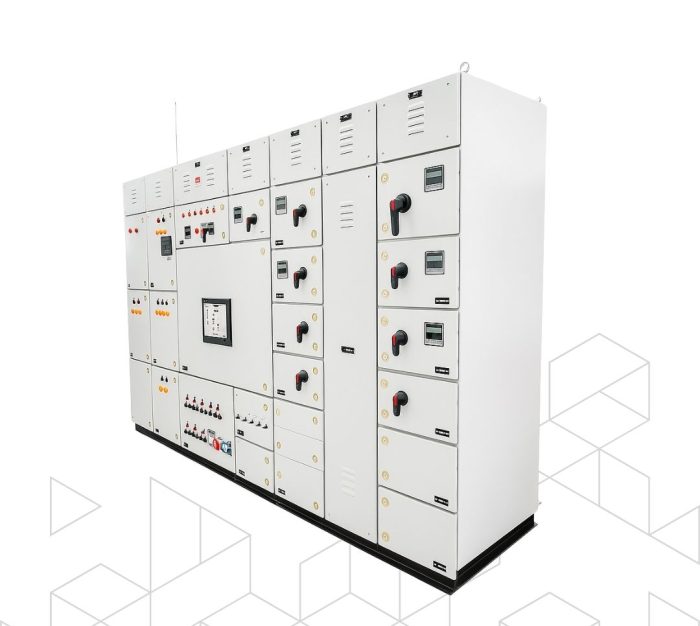
Harmonic Impact Analysis of Inverter-Based Loads on ACDB Panel Design

The rapid growth of renewable energy systems has fundamentally changed the electrical behavior of power distribution networks. Unlike conventional rotating machines, inverter-based sources such as solar PV inverters, battery energy storage systems, and hybrid power converters introduce non-linear current characteristics into the AC network. These characteristics significantly affect the design and performance of AC Distribution Boards (ACDBs).

In modern renewable installations, understanding Harmonics in ACDB Panels is no longer optional. Harmonic distortion directly influences thermal performance, protection reliability, metering accuracy, and long-term equipment life. For engineers, harmonic impact analysis has become a critical design step rather than a post-commissioning concern.

Nature of Harmonics in Inverter-Dominated Systems

Inverter-based loads generate current waveforms that deviate from pure sinusoidal form due to high-frequency switching. While modern PWM techniques improve waveform quality, residual harmonic components remain unavoidable. These harmonics are typically of odd order and increase in magnitude as inverter penetration rises.

In renewable energy plants, multiple inverters operate in parallel and feed common AC buses through ACDB panels. The harmonic currents from individual inverters do not simply cancel out; instead, they often accumulate, leading to elevated Total Harmonic Distortion (THD) levels at the distribution point.

At the ACDB level, this harmonic accumulation becomes electrically significant.

Why ACDB Panels Are Sensitive to Harmonic Stress

ACDB panels act as the aggregation point for inverter outputs. As such, they are exposed to the combined harmonic spectrum of the system. Harmonic currents increase RMS current levels without increasing useful power transfer, leading to additional thermal stress in busbars, cables, and switching devices.

Unlike upstream transformers, which may be designed with harmonic derating in mind, ACDB panels are often constrained by space, compact layouts, and standardized ratings. If harmonic effects are not considered during design, overheating and insulation degradation may occur even when apparent load current remains within nominal limits.

This makes harmonic impact analysis essential for reliable ACDB operation.

Thermal and Electrical Implications of Harmonics

Harmonic currents cause non-uniform heating due to skin effect and proximity effect, particularly at higher frequencies. Busbars experience increased resistive losses, while circuit breakers and contactors may operate closer to their thermal limits. In extreme cases, nuisance tripping occurs due to elevated internal temperatures rather than true overload conditions.

Additionally, harmonics distort voltage waveforms across the ACDB, affecting downstream equipment performance. Protection relays calibrated for sinusoidal conditions may misinterpret distorted signals, reducing selectivity and accuracy. Metering devices may also report incorrect power and energy values if harmonic distortion exceeds their measurement capability.

These effects accumulate over time, accelerating aging of panel components.

Impact of Harmonics on Protection and Coordination

Protection systems within ACDB panels are typically designed around fundamental frequency assumptions. Harmonics alter current wave shapes, potentially affecting the response of thermal and magnetic trip elements. Electronic protection units offer better tolerance but still require correct configuration based on harmonic levels.

In renewable energy systems with high inverter penetration, coordination between protective devices must consider harmonic heating rather than just short-circuit current. Failure to do so can result in either delayed tripping under fault conditions or unnecessary tripping during normal operation.

Thus, harmonic behavior directly influences protection philosophy at the ACDB level.

Design Considerations for Harmonic-Resilient ACDB Panels

Effective ACDB design begins with quantifying expected harmonic levels through system studies. Inverter specifications, operating modes, and diversity factors must be evaluated to estimate worst-case harmonic current flow.

Once harmonic levels are understood, busbar sizing is adjusted not just for nominal current but for increased RMS current under harmonic loading. Thermal margins become more important than absolute current ratings. Selection of circuit breakers and isolators must also account for continuous operation under distorted waveforms.

In many cases, integration of harmonic mitigation devices such as passive filters or line reactors upstream of the ACDB reduces stress on the panel itself. However, even with mitigation, panel design must assume residual harmonics.

System-Level Perspective on Harmonics

Harmonics do not originate or terminate at the ACDB; they are a system-wide phenomenon. Poor grounding practices, inadequate cable segregation, and improper layout can amplify harmonic effects through resonance and circulating currents.

From a system perspective, ACDB panels must be designed as part of a coordinated harmonic management strategy rather than isolated distribution components. This includes coordination with inverter manufacturers, transformer design, and grid interconnection requirements.

Ignoring this system context often leads to localized overheating and unexplained operational issues.

Engineering Approach of Synchro Electricals

Synchro Electricals approaches ACDB panel design with harmonic behavior as a fundamental input parameter. Harmonic impact analysis, thermal derating considerations, and protection compatibility are integrated into the design process from the early engineering stage.

Rather than relying on standard panel configurations, Synchro Electricals evaluates inverter characteristics, system topology, and operating conditions to ensure that ACDB panels remain electrically and thermally stable throughout their service life in renewable energy environments.

Conclusion

As renewable energy systems become increasingly inverter-dominated, harmonic distortion has emerged as a defining factor in power distribution reliability. ACDB panels, positioned at the convergence point of inverter outputs, are particularly vulnerable to harmonic stress if not designed accordingly.

A thorough understanding of Harmonics in ACDB Panels enables engineers to design distribution systems that remain thermally stable, electrically reliable, and protection-coordinated under real operating conditions. Harmonic impact analysis is no longer a refinement—it is a core requirement for modern renewable energy infrastructure.

FAQs

What causes harmonics in renewable energy systems?

Harmonics are generated by inverter switching actions and non-linear current draw inherent to power electronic converters.

Why are ACDB panels more affected by harmonics than other equipment?

They aggregate multiple inverter outputs, causing harmonic currents to accumulate at a single point.

Can harmonics cause ACDB overheating without overload?

Yes. Harmonics increase RMS current and losses even when fundamental current is within rated limits.

Do electronic breakers eliminate harmonic issues?

They improve tolerance but do not remove harmonic heating or distortion effects.

Is harmonic analysis necessary for all solar plants?

It becomes critical as inverter capacity and system size increase, especially in industrial and utility-scale installations.

Dielectric Strength and Insulation Coordination in VCB Panels for 11kV & 33kV Systems

In power transmission networks, medium-voltage switchgear operates at the intersection of high electrical stress and strict reliability requirements. At voltage levels such as 11kV and 33kV, failures are rarely caused by thermal overload alone; they are far more often the result of insulation breakdown due to transient overvoltages. Within this context, dielectric strength and insulation coordination become central design considerations for VCB panels.

For engineers working in transmission and substation environments, VCB Insulation Coordination is not an abstract standard-driven exercise. It directly determines whether a panel survives lightning impulses, switching surges, and abnormal grid events without flashover, internal damage, or catastrophic failure.

Understanding Dielectric Stress in Medium-Voltage Systems

Dielectric stress refers to the electrical stress imposed on insulation systems when voltage is applied across conductive parts. In 11kV and 33kV networks, insulation is subjected not only to normal operating voltage but also to temporary and transient overvoltages that may far exceed nominal values.

Lightning strikes on overhead lines, switching operations, capacitor bank energization, and fault clearing events all introduce steep-front voltage impulses. These impulses stress air insulation, solid insulation, and internal clearances simultaneously. If the dielectric strength of any insulation path is insufficient, breakdown occurs long before protective devices can respond.

In VCB panels, where compact construction and high component density are common, managing dielectric stress becomes especially critical.

Dielectric Strength as a Design Parameter in VCB Panels

Dielectric strength is the ability of insulation to withstand applied voltage without electrical breakdown. In VCB panels, this strength must be adequate across all insulation media: vacuum interrupters, air clearances, solid insulation, and interface points such as bushings and terminations.

Vacuum interrupters inherently offer excellent dielectric recovery after current interruption. However, the surrounding insulation system must be designed to the same standard. Weak external insulation can negate the advantages of the vacuum bottle, leading to flashover across terminals, phase-to-phase faults, or phase-to-earth failures.

At 33kV levels in particular, dielectric margins become tighter, and design tolerances shrink significantly.

Insulation Coordination: More Than Withstand Voltage

Insulation coordination is the systematic selection of insulation levels so that equipment responds predictably to overvoltages. The objective is not to make insulation infinitely strong, but to ensure that insulation strength is properly matched with surge protection devices and system characteristics.

In VCB panels, insulation coordination involves aligning the panel’s Basic Insulation Level (BIL) with expected overvoltage stresses and surge arrester performance. During a lightning impulse, the arrester should clamp the voltage to a level below the insulation withstand capability of the panel. If this coordination is incorrect, either unnecessary insulation failure or excessive equipment cost results.

This balance is particularly important in transmission systems where switching surges may dominate over lightning impulses, especially at 33kV.

Role of Clearances and Creepage in Medium-Voltage Panels

Air clearance and creepage distance are fundamental contributors to insulation performance. Clearances determine impulse withstand capability, while creepage distances influence long-term performance under contamination and humidity.

In power transmission environments, airborne pollution, moisture, and temperature variation can significantly reduce surface insulation strength. VCB panels designed without adequate creepage margins may pass factory tests but fail prematurely in service.

Proper insulation coordination, therefore requires considering not only voltage level, but also environmental conditions, enclosure design, and service location.

Testing and Standards Governing Insulation Coordination

Dielectric performance in VCB panels is validated through standardized tests such as power-frequency withstand tests and lightning impulse tests. These tests simulate real-world stresses and verify that insulation paths behave as intended under extreme conditions.

For 11kV and 33kV systems, test levels are defined by international and national standards. However, compliance alone does not guarantee field reliability. The way insulation is arranged, supported, and protected within the panel plays a decisive role in long-term performance.

Engineering judgment is required to interpret standards in the context of actual grid behavior.

Consequences of Poor Insulation Coordination

When insulation coordination is inadequate, failures tend to be sudden and severe. Flashover within a VCB panel can damage interrupters, busbars, and adjacent equipment simultaneously. In transmission networks, such failures often lead to extended outages due to the time required for isolation, repair, and re-energization.

Additionally, repeated near-breakdown events accelerate insulation aging, reducing service life even if immediate failure does not occur. From a utility perspective, this represents both a reliability risk and a long-term asset management issue.

Engineering Approach of Synchro Electricals

Synchro Electricals approaches VCB panel design with insulation coordination as a core engineering discipline rather than a compliance checklist. Dielectric stress analysis, clearance optimization, and coordination with surge protection systems are integrated into the design process from the outset.

By focusing on real operating conditions in power transmission environments, Synchro Electricals ensures that VCB panels maintain dielectric integrity under both normal and transient stresses at 11kV and 33kV levels.

Conclusion

In power transmission systems, insulation failure is rarely forgiving. At 11kV and 33kV, the margin between stable operation and catastrophic breakdown is defined by dielectric strength and insulation coordination.

Effective VCB Insulation Coordination ensures that VCB panels withstand lightning impulses, switching surges, and environmental stress without compromising reliability. By treating insulation coordination as a system-level engineering problem rather than a test requirement, utilities and transmission operators can achieve safer, more resilient medium-voltage networks.

FAQs

What is insulation coordination in VCB panels?

It is the systematic alignment of insulation strength with expected overvoltages and surge protection levels to prevent insulation breakdown.

Why is insulation coordination critical at 33kV?

Higher voltage increases dielectric stress and reduces design margins, making proper coordination essential for reliability.

Do vacuum interrupters alone ensure insulation safety?

No. External insulation paths must be equally robust to prevent flashover outside the interrupter.

How do environmental conditions affect insulation performance?

Humidity, pollution, and temperature reduce surface insulation strength, requiring higher creepage distances.

Is standard compliance sufficient for insulation reliability?

Compliance is necessary but not sufficient; real-world grid behavior must be considered during design.

Transient Stability Analysis of Generator Synchronizing Panels in Grid-Connected Operations

In utility-scale power systems, generator synchronization is no longer a simple act of matching voltage and frequency before closing a breaker. Modern grids are dynamic, heavily loaded, and often stressed by fluctuating demand, renewable integration, and network disturbances. In this environment, the ability of a generator to remain stable immediately after synchronization — known as transient stability — becomes a defining factor in reliable power generation.

At the heart of this challenge lies the synchronizing panel. Far beyond a basic control interface, the synchronizing panel directly influences generator synchronizing stability during the most critical moments of grid interaction. When poorly designed or inadequately configured, it can become the weak link that leads to generator tripping, mechanical stress, or even widespread grid disturbances.

Transient Stability in Practical Power System Terms

Transient stability refers to a generator’s ability to maintain synchronism with the grid following a sudden disturbance. These disturbances occur frequently in real operating conditions: a short circuit on the transmission network, sudden load changes, switching operations, or the parallel connection of large generators.

During such events, the balance between mechanical input torque and electrical output torque is momentarily disrupted. The generator rotor accelerates or decelerates rapidly, and if corrective control is not applied within a very short time window, the rotor angle may drift beyond stable limits. Unlike steady-state instability, which develops gradually, transient instability unfolds within fractions of a second — making fast, intelligent control absolutely essential.

Why Synchronizing Panels Matter Beyond Breaker Closing

In many installations, synchronizing panels are still treated as devices that simply permit safe breaker closure. This narrow view overlooks their influence on generator behavior during and immediately after synchronization.

The moment a generator is connected to the grid is one of the most electrically stressful events in its operating life. If phase angle alignment is inaccurate or frequency convergence is poorly controlled, the generator experiences severe transient currents and torque shocks. Even if the breaker closes successfully, instability may develop moments later as the generator struggles to settle into synchronous operation.

A properly engineered synchronizing panel manages this transition carefully, ensuring the generator enters the grid smoothly and remains stable as electrical and mechanical forces equalize.

Transient Events That Threaten Generator Synchronizing Stability

In grid-connected operations, transient instability does not arise from a single cause but from a combination of fast-changing system conditions. Grid faults reduce terminal voltage abruptly, weakening electrical torque and allowing rotor acceleration. Sudden load rejection causes the opposite effect, forcing rapid deceleration. Weak grids exacerbate both scenarios by delaying voltage and frequency recovery.

In multi-generator environments, poor load sharing after synchronization can introduce power oscillations, commonly referred to as hunting. These oscillations place repetitive mechanical stress on shafts and couplings while simultaneously disturbing grid frequency stability.

In all these cases, the synchronizing panel’s control logic determines whether the generator stabilizes quickly or loses synchronism entirely.

How Synchronizing Panels Influence Transient Behavior

Advanced synchronizing panels actively shape generator response during transient conditions rather than reacting passively. Before synchronization, the panel ensures tight control over speed ramping, excitation coordination, and phase alignment. This minimizes the initial disturbance at breaker closure.

Immediately after synchronization, the panel’s load-sharing logic becomes critical. Controlled load pickup prevents sudden torque imbalances, allowing the generator to settle smoothly into steady operation. During grid disturbances, coordination between the synchronizing panel and protection relays determines whether corrective action is attempted or an orderly disconnection is initiated.

This combination of precision control and intelligent decision-making is what sustains generator synchronizing stability under real-world operating stress.

Control Logic That Separates Stable Systems from Unstable Ones

In utility and power plant applications, the quality of control logic embedded within the synchronizing panel is often more important than the hardware itself. High-speed digital controllers allow synchronization decisions to be made in milliseconds, which is essential during transient events.

Modern panels track phase angle movement continuously rather than relying on static thresholds. They adapt synchronization windows based on grid conditions and generator behavior. Integration with the governor and automatic voltage regulator ensures that mechanical and electrical responses remain coordinated throughout transient events.

Without this level of control sophistication, even well-designed generators can become vulnerable during grid disturbances.

Digital Synchronizing Panels and Transient Stability Analysis

Digital synchronizing panels have transformed how utilities approach transient stability. They provide detailed event records that allow engineers to analyze synchronization behavior after disturbances. Oscillation trends, frequency response, and breaker timing can all be studied to refine settings and improve future performance.

This analytical capability is particularly valuable in modern grids with high renewable penetration, where system inertia is lower and transient events propagate faster than in conventional networks.

Why Utilities Cannot Ignore Transient Stability

From a utility perspective, generator instability is never an isolated incident. A single loss of synchronism can trigger protection cascades, reduce available generation, and compromise grid reliability. Regulatory frameworks increasingly emphasize stability, performance and fault ride-through capability, making advanced synchronization control a compliance requirement rather than a design option.

Synchronizing panels designed with transient stability in mind help utilities protect assets, maintain grid integrity, and meet evolving grid code requirements.

Engineering Approach of Synchro Electricals

Synchro Electricals approach synchronizing panels as dynamic control systems rather than static switching devices. Their designs focus on precise synchronization tolerances, fast response logic, and robust coordination with protection systems. This engineering philosophy ensures stable generator behavior during transient events across a wide range of grid conditions, including weak grids and multi-generator configurations.

Conclusion

Transient stability is one of the most critical yet misunderstood aspects of grid-connected generator operation. While mechanical design and protection systems play their roles, it is the synchronizing panel that governs the generator’s behavior during the most vulnerable moments of operation.

By applying rigorous transient stability principles and deploying synchronizing panels engineered for dynamic grid behavior, utilities and power plant operators can significantly enhance generator synchronizing stability, reduce operational risk, and ensure long-term reliability in an increasingly complex power system.

FAQs

What makes transient stability different from steady-state stability?

Transient stability concerns short-duration disturbances and requires extremely fast control response, whereas steady-state stability deals with slow, gradual changes.

Can poor synchronization damage generator equipment?

Yes. Improper synchronization can cause severe torque shock, mechanical stress, and accelerated component wear

Are digital synchronizing panels essential for modern grids?

In most utility applications, yes. Their speed, adaptability, and diagnostic capability are critical for transient stability management.

Is transient stability more critical in weak grids?

Absolutely. Weak grids recover slowly, increasing the risk of loss of synchronism without advanced control logic.

Do synchronizing panels work with protection systems during faults?

Yes. Proper coordination ensures corrective action is attempted before safe disconnection when stability cannot be maintained.

How PCC Panels Are Evolving with Smart Metering and IoT Integration in Industrial Power Systems

In today’s rapidly digitizing industrial landscape, Power Control Center (PCC) panels are no longer just about circuit protection and load management—they are becoming intelligent, connected systems. With the advent of smart metering, IoT integration, and real-time monitoring, modern PCC panels are revolutionizing how industries manage energy. In this blog, we’ll explore how PCC panel manufacturers are adapting to the digital era and how these innovations are reshaping industrial power systems.

What is a PCC Panel and Why is it Critical?

A PCC panel or Power Control Center panel is an essential component of any industrial electrical setup. It manages power distribution from the transformer to various load points, protecting machinery, equipment, and infrastructure. Industries such as manufacturing, steel, automotive, textile, oil & gas, and large commercial units depend on industrial PCC panels for smooth, safe operations.

Whether it’s an LT PCC panel, MCC PCC panel, or an integrated PCC MCC control panel, these systems are responsible for:

  • Distributing power across all operational units

  • Monitoring voltage, current, and power factor

  • Protecting systems against overload, short circuits, and surges

  • Ensuring uninterrupted production cycles

The Shift: Traditional PCC to Smart PCC Panels

In the past, electrical PCC panels were largely analog—relying on manual operations, discrete wiring, and offline monitoring. Today, industries demand real-time data, predictive maintenance, and remote control—this is where IoT and smart metering come in.

Smart Metering in PCC Panels

Smart metering technology allows for precise energy monitoring and automated reporting. Integrated into modern PCC panels, smart meters offer:

  • Real-time power usage tracking

  • Load balancing analytics

  • Detection of harmonic distortion and energy loss

  • Transparent billing and energy audit reports

This not only ensures operational efficiency but helps industries save on energy costs and reduce downtime.

IoT Integration: The Industrial Game-Changer

IoT-enabled PCC panels take smart functionality to the next level. Using sensors, cloud-based dashboards, and machine learning, these panels can:

  • Predict equipment failure before it happens

  • Monitor temperature, voltage, and current continuously

  • Automate switching and power flow based on real-time demand

  • Integrate with SCADA or ERP systems for centralized control

IoT transforms a traditional PCC electrical panel into a self-monitoring, self-reporting unit that enhances both safety and performance.

Advantages of Smart PCC Panels for Industrial Applications

With smart metering and IoT capabilities, PCC panels for industrial applications now offer a broad range of benefits:

  • Reduced energy wastage through accurate load management

  • Improved uptime with predictive maintenance alerts

  • Remote access for monitoring and diagnostics from any location

  • Data-driven decisions for energy optimization and cost control

  • Enhanced safety through early fault detection and alerts

Common Industries Benefiting from Smart PCC Panels

Smart PCC panels are becoming the norm in sectors such as:

  • Large commercial units with variable load conditions

  • Pharmaceuticals requiring clean, uninterrupted power

  • Food processing plants where uptime is critical

  • Steel and heavy machinery operations needing advanced protection

  • Renewable energy sectors integrating grid feedback systems

What Makes Synchro Electricals a Leading PCC Panel Manufacturer?

At Synchro Electricals, we stay ahead of the curve by designing smart PCC panels that are tailored for modern industrial needs. Here’s what sets us apart:

Certified Quality

Our panels meet all necessary IEC and IS standards, ensuring safety, reliability, and long-term performance.

Integrated Smart Solutions

We offer advanced smart metering and IoT-enabled PCC panels, compatible with modern SCADA systems and cloud platforms.

Custom-Engineered Panels

From LT PCC panels to PCC MCC combinations, every panel is custom-designed to meet your plant’s unique electrical load and power flow needs.

Industrial-Grade Components

We use top-tier components and proven wiring practices, ensuring long life, minimal maintenance, and low energy loss.

Proudly Made in India

As a trusted PCC panel manufacturer in India, we combine innovation with local expertise—delivering premium-quality panels across diverse sectors.,

The Future of Power Control: Smarter, Safer, and More Connected

The future of industrial power control lies in intelligent, data-driven systems. As energy efficiency and automation become key business drivers, industries that adopt smart PCC panels with IoT and metering will gain a competitive edge in both performance and sustainability.

If you’re planning an upgrade or new installation, trust Synchro Electricals—your reliable partner in building the next generation of industrial PCC panels.

FAQs

1. What is a PCC panel in electrical systems?

A PCC (Power Control Center) panel is used to distribute power to various loads and equipment in an industrial or commercial setup. It controls and monitors the main power source with built-in protection features.

2. How is IoT used in PCC panels?

IoT-enabled PCC panels can monitor voltage, current, energy usage, fault detection, and temperature in real-time via cloud-connected sensors, enabling predictive maintenance and remote diagnostics.

3. What are the benefits of smart metering in PCC panels?

Smart metering provides accurate energy monitoring, power factor correction, load optimization, and detailed analytics—helping businesses reduce energy costs and improve system efficiency.

4. Can existing PCC panels be upgraded for IoT integration?

Yes, legacy PCC panels can often be retrofitted with IoT modules, smart meters, and communication interfaces like Modbus, Ethernet, or Wi-Fi for real-time monitoring.

5. Why choose a smart PCC panel for industrial power management?

Smart PCC panels reduce downtime, improve energy efficiency, enable data-driven decisions, and offer remote access—making them ideal for Industry 4.0-ready facilities.

6. What are the typical applications of PCC panels?

PCC panels are used in manufacturing plants, refineries, data centers, commercial buildings, hospitals, and other facilities requiring robust power distribution and protection.

Welcome to Synchro Electricals

We provide trusted, high-performance electrical solutions tailored for every industry.

Apply For Job