Choosing the Right ACDB/DCDB Panel for 5kW to 1MW Solar Systems – A Technical Sizing Guide

As solar power continues to revolutionize the energy landscape across industries, the importance of choosing the right ACDB (AC Distribution Board) and DCDB (DC Distribution Board) panels becomes undeniable. Whether you’re installing a 5kW rooftop solar system or managing a 1MW industrial solar plant, proper panel selection ensures maximum safety, reliability, and energy efficiency.

In this guide, we’ll break down the sizing, technical parameters, and smart considerations for selecting ACDB/DCDB panels for solar systems, while highlighting how Synchro Electricals leads as a top ACDB/DCDB panel manufacturer in India.

Understanding ACDB and DCDB Panels in Solar Systems

ACDB (AC Distribution Board) and DCDB (DC Distribution Board) panels are critical junctions in a solar power system.

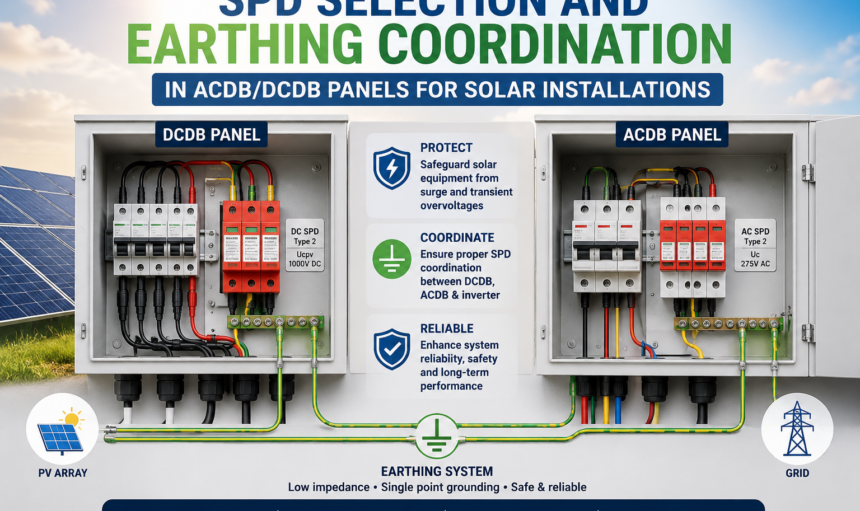
  • DCDB: Connects multiple solar panel strings and channels their DC output to the inverter. It includes DC MCBs, SPD, fuses, and disconnects to protect against overcurrent and surges.
  • ACDB: Receives AC output from the inverter and feeds it to the load or utility grid. It incorporates AC MCBs, isolators, SPD, and energy meters for safety and monitoring.

Together, these panels form the solar panel protection box—safeguarding both components and personnel.

How to Size ACDB/DCDB Panels from 5kW to 1MW

For 5kW to 10kW Solar Systems (Residential/Small Commercial)

  • DCDB Box for 5kW Solar System:
    • Input Strings: 1 to 2
    • Voltage Rating: 600V–1000V DC
    • Protection: DC MCB, Fuse Holders, Surge Protection Device (SPD), DC Disconnect
    • Cable Entry: Cable glands suitable for 4–6 mm² PV cable
  • ACDB for 10kW Solar System:
    • Output Voltage: 230V/415V AC
    • Key Components: AC MCB, SPD, Energy Meter, Isolator
    • Enclosure: Weatherproof polycarbonate or powder-coated metal

These smaller systems benefit from compact ACDB/DCDB boxes, engineered for cost-effectiveness and ease of installation.

For 50kW to 100kW Solar Systems (Medium Industrial/EPC Projects)

  • DCDB Sizing:
    • Input Strings: 6–12
    • Voltage Rating: 1000V DC
    • Components: SPD Type II, String Monitoring, Disconnect Switches
  • ACDB Sizing:
    • Output Voltage: 415V AC (3-phase)
    • Inbuilt Energy Meters for Load/Export Monitoring
    • Cable Support: 16mm² to 70mm² AC cables
    • Ideal for: Solar EPC companies, MSMEs, educational institutions

At this scale, having custom-built DCDBs and ACDBs with accurate string tracking and load balancing is essential.

For 500kW to 1MW Solar Plants (Utility/Industrial)

  • DCDB for 1MW Solar Plant:
    • Input Strings: 20+
    • Voltage: 1000V–1500V DC
    • Surge Protection: Type I & II SPDs
    • Busbar Rating: 250A–400A Copper/Aluminium
    • Monitoring: Optional SCADA integration, individual string monitoring
  • ACDB for Industrial Solar:
    • 3-phase 415V output
    • Inbuilt MCCB (Moulded Case Circuit Breakers), CTs, and metering
    • Integration: Synchronization panels, utility metering
    • Material: IP65-rated enclosures, indoor/outdoor application

Industrial solar systems demand rugged ACDB & DCDB panel assemblies—built for load fluctuation and adverse conditions.

Why Sizing Accuracy Matters

Improperly sized or substandard ACDB/DCDB panels can lead to:

  • Overheating and equipment failure
  • Energy loss due to voltage drop
  • Inadequate protection against lightning and faults
  • Warranty voids on solar inverters/modules

This is why working with an experienced solar ACDB DCDB manufacturer is crucial to ensuring safety and long-term ROI.

What Makes Synchro Electricals a Trusted Manufacturer?

At Synchro Electricals, we’re not just another ACDB/DCDB panel manufacturer—we’re your partner in clean energy excellence.

Certified Quality

All our solar panels and components are certified, rigorously tested for safety, insulation, and environmental conditions.

Full Product Range

We’re among the top solar panel protection box suppliers and PV junction box manufacturers in India—serving residential to 1MW+ systems.

Tailored Engineering

From a DCDB box for 5kW systems to ACDB panels for 1MW solar EPCs, we customize every enclosure for cable size, voltage ratings, and busbar capacities.

Made in India

Proudly built in India, our ACDB/DCDB products offer global standards with cost-efficiency for EPCs, OEMs, and industrial solar developers.

Final Thoughts

Whether you’re setting up a 5kW rooftop project or a large-scale 1MW solar farm, selecting the right ACDB/DCDB box isn’t just about capacity—it’s about performance, safety, and long-term durability.

With decades of electrical expertise, Synchro Electricals delivers technically superior ACDB and DCDB panels, fully compliant with modern solar infrastructure requirements.

Need help choosing the right panel for your solar project?
Talk to Synchro Electricals today—India’s leading solar ACDB DCDB manufacturer for industries, EPCs, and OEMs.

FAQs

What is the function of ACDB and DCDB in a solar power system?

ACDB (AC Distribution Board) distributes the AC output from the inverter to the load/grid, while DCDB (DC Distribution Board) manages and protects the DC input from solar panels before it enters the inverter.

How do I size an ACDB/DCDB for a 5kW to 1MW solar plant?

Sizing depends on system capacity, string configuration, voltage/current ratings, protection requirements (MCB, SPD, isolators), and cable specifications. Each capacity range has specific design norms.

Is there a difference in panel requirements for on-grid vs off-grid solar systems?

Yes, on-grid systems need synchronization with the utility grid via suitable ACDBs, whereas off-grid systems may require battery integration and additional protection in DCDBs.

Can a single panel serve both ACDB and DCDB functions?

In small systems (5–10kW), combined ACDB/DCDB units are possible. For larger setups, separate panels are ideal for safety, maintenance, and scalability.

What protection devices are used in ACDB and DCDB panels?

Key devices include MCBs, MCCBs, surge protection devices (SPDs), fuses, isolators, and monitoring meters to safeguard against faults, overcurrent, and surges.

Are ACDB and DCDB panels customizable for different system sizes?

Yes, panels can be custom-designed based on system size, number of strings, site conditions, and client requirements, especially for capacities ranging from 100kW to 1M

Is DCDB required for a 600V solar PV string?

Yes. A 600V string requires a DCDB with: 600V DC fuse/MCB Type II DC SPD 600–1000V DC isolator UV-resistant enclosure (IP65)

Which DCDB rating is used for a 1000V solar system?

For 1000V systems, use a DCDB with: 1000–1200V DC fuse/MCB Type I+II SPD (1000V DC) 1000V DC isolator Min. 4–8 strings support (commonly required for 50kW–100kW)

What is the specification of ACDB for a 415V 3-phase inverter?

A 415V ACDB generally includes: 415V AC MCCB/MCB (60A/100A depending on inverter output) AC SPD Type II Energy meter (optional) AC Isolator Earthing & surge-protection system

How to size DC fuses for a 1500V PV system?

The fuse rating must match: 1500V DC voltage 1.25 × Isc (short-circuit current) Minimum fuse rating: 1500V DC, 20–32A Used in large solar farms (500kW–1MW).

What SPD is required for a 1500V DCDB?

A Type II or Type I+II SPD rated for: Ucpv = 1500V DC High lightning protection level (Iimp) Thermal disconnect mechanism

What DCDB rating is used for 1MW solar farms?

Up to 20–32 strings 1500V DC fuses SPD Type I+II 1500V isolator 400A copper busbar SCADA-ready monitoring

What is the ACDB specification for 100kW on-grid?

Inverter output: 415V 3-phase 100A MCCB AC SPD Type II CT-based energy meter Earthing & surge arrestors

Which DCDB is used for 50kW solar systems?

8–12 strings 1000V DC fuse DC SPD Type II 1000V isolator Busbar based combiners

What ACDB is required for a 10kW solar system?

230V/415V output AC MCB 40A AC SPD Type II 4-pole isolator Energy meter (optional)

What DCDB is required for a 5kW solar system?

1–2 PV strings 600–800V DC rating DC MCB 20–25A DC SPD Type II DC isolator 600V IP65 box

What is the short-circuit rating of ACDB?

ACDB must match inverter’s AC short circuit output (KA rating). Common: 10kA / 16kA / 25kA MCCB for 415V 3-phase systems.

How do I select cable size for DCDB to inverter?

Follow formula: Cable Size (mm²) = 1.25 × DC Current × Distance × Resistivity Factor Common sizes: 4–6 mm² (residential) 10–16 mm² (commercial) 25–70 mm² (industrial)

Do we need SPD on both AC and DC sides?

Yes. DC SPD protects PV strings from lightning surges. AC SPD protects inverter output & grid connection.

How Advanced ACDB DCDB Panels from Synchro Electricals Lead the Way in India’s C&I Solar Boom

The landscape of energy consumption in India is undergoing a monumental transformation, and ACDB DCDB panels are playing a critical role in enabling this shift. With a surging demand for sustainable power and a clear national commitment to renewable energy, Commercial & Industrial (C&I) solar installations are no longer a niche market; they are a driving force for economic growth and environmental stewardship. From sprawling factory rooftops to large-scale commercial complexes, businesses across the nation are increasingly turning to solar to reduce operational costs, enhance energy independence, and meet their sustainability goals.

However, harnessing the sun’s immense power effectively and reliably requires more than just high-quality solar panels. The true backbone of any efficient and safe solar photovoltaic (PV) system lies in its crucial protective and distribution components: ACDB and DCDB panels.

The best solar acdb dcdb manufacturer in india this is precisely where Synchro Electricals Pvt. Ltd., a name synonymous with excellence in electrical solutions since our establishment in Rajkot, Gujarat in 2018, is leading the way. We are not just manufacturers; we are innovators, committed to designing, testing, and commissioning advanced ACDB/DCDB panels that form the indispensable heart of India’s burgeoning C&I solarsector.

Beyond Basic Protection: The Synchro Electricals Advantage

Many might view ACDB/DCDB panels as mere enclosures for circuit breakers. At Synchro Electricals, we see them as sophisticated guardians of your solar investment and critical enablers of peak system performance. Our advanced panels go far beyond basic protection, offering a suite of features that address the unique demands of the Indian C&I environment:

  1. Robust Design for Indian Conditions: India’s diverse climate, from scorching summers to monsoon humidity, demands equipment that can withstand extreme conditions. Our ACDB/DCDB panels are engineered with high-grade, UV-resistant, and corrosion-proof materials (like IP65/IP67 rated enclosures) ensuring longevity and consistent performance, even in challenging industrial environments. This durability minimizes maintenance cycles and extends the operational life of the entire solar plant.

  2. Optimized Power Distribution & Efficiency: The core function of these panels is to efficiently collect and distribute power. Our designs meticulously optimize internal layouts, minimize cable runs, and incorporate high-quality busbars and connectors to reduce power losses. This translates directly into higher energy yields from your solar array, maximizing your return on investment.

  3. Enhanced Safety Features: Safety is paramount in any electrical installation. Synchro Electricals’ ACDB/DCDB panels are equipped with multi-layered safety mechanisms. This includes:
    • High-quality MCBs/MCCBs and SPDs (Surge Protection Devices): Protecting against overcurrents, short circuits, and lightning strikes, safeguarding both equipment and personnel.
    • Reverse Polarity Protection: A critical feature to prevent damage during installation errors.
    • Proper Isolation Switches: Enabling safe maintenance and troubleshooting without system-wide shutdowns.
    • Arc Fault Circuit Interrupters (AFCIs – where applicable): An increasingly vital technology to detect and mitigate dangerous arc faults.

  4. Compliance and Reliability at its Core: Our panels are designed and manufactured in strict adherence to national and international standards (such as IEC and relevant BIS standards). Each unit undergoes rigorous testing and quality checks in our Rajkot facility, ensuring unparalleled reliability and peace of mind for our clients. Our meticulous design, testing, and commissioning process guarantees that every panel performs exactly as specified, minimizing unexpected system interruptions.

  5. Scalability and Customization: The C&I sector is incredibly diverse, with varying energy demands and site-specific challenges. Synchro Electricals excels in providing customizable ACDB/DCDB solutions. Whether it’s a small commercial rooftop or a multi-megawatt industrial ground-mount system, we design panels that perfectly match the inverter capacity, string configurations, and protection requirements of your unique project. This flexibility makes us the preferred partner for a wide array of solar developers and EPCs.

  6. Seamless Integration and Monitoring: Our panels are designed for straightforward integration with solar inverters and monitoring systems. This allows for real-time performance tracking, fault detection, and predictive maintenance, giving operators granular control over their solar assets and ensuring maximum uptime.

Synchro Electricals: Powering India’s Green Future from Rajkot

The rapid growth of C&I solar in India signifies a profound shift towards sustainable energy. As businesses continue to embrace solar power, the demand for reliable, efficient, and safe electrical infrastructure will only intensify.

At Synchro Electricals Pvt. Ltd., situated at the heart of Gujarat’s industrial prowess in Rajkot, we are proud to be at the forefront of this revolution. By providing state-of-the-art ACDB/DCDB panels, we empower solar developers, EPCs, and end-users with the confidence that their solar installations are not just generating power, but doing so safely, efficiently, and reliably for years to come.

Choosing Synchro Electricals means choosing a partner committed to excellence in electrical distribution panels, a partner dedicated to the success of your C&I solar project, and a partner leading the way in building a more sustainable and energy-independent India. Contact us today to discuss how our advanced solutions can elevate your next solar venture.

FAQs

1. What are ACDB and DCDB panels, and why are they critical in solar power systems?

ACDB (AC Distribution Board) and DCDB (DC Distribution Board) panels are essential components in solar systems. DCDB collects power from solar panels, while ACDB distributes the converted AC power to the grid or load. Together, they ensure safe, efficient, and organized power flow.

2. How are Synchro Electricals’ panels different from conventional DBs in the solar industry?

Synchro Electricals designs panels with advanced safety features, custom engineering, and high-quality components like SPD (Surge Protection Devices), isolators, and MCBs tailored to India's demanding C&I (Commercial & Industrial) environments.

3. Why are Synchro's ACDB/DCDB panels gaining traction in India’s C&I solar boom?

C&I users demand high reliability, fast deployment, and strict safety compliance. Synchro’s panels are pre-tested, custom-built, and ready-to-integrate, reducing project delays and ensuring smooth solar plant commissioning.

4. Do Synchro Electricals’ panels comply with Indian and international standards?

Yes. Synchro ensures its panels adhere to IS/IEC standards and follow MNRE and DISCOM guidelines for solar installations, giving EPCs and developers assurance on safety and legal compliance.

5. Can Synchro’s panels be customized for different inverter capacities and project scales?

Absolutely. Synchro provides fully customized ACDB/DCDB solutions that match the site’s inverter configuration, voltage ratings, string counts, and monitoring needs—ideal for small to large C&I setups.

Get in Touch

Ready to power your next Commercial & Industrial (C&I) solar project with reliable, high-performance ACDB/DCDB panels? Or do you need a trusted partner for your electrical distribution panel requirements?

At Synchro Electricals Pvt. Ltd., based in Rajkot, Gujarat, we’re here to help you achieve your energy goals. Our team of experts is ready to discuss your specific needs, provide detailed information on our advanced solutions, and offer tailored guidance.

Reach out to us today:

Let’s build a more efficient and sustainable future, together!

Commercial & Industrial (C&I) Solar Growth in India: The Importance of Advanced ACDB/DCDB Panels

India is experiencing a renewable energy revolution, and at the forefront of this transformation is the Commercial & Industrial (C&I) solar sector. As businesses aim to reduce electricity costs and meet sustainability goals, solar energy adoption among commercial and industrial units has witnessed a remarkable surge.

However, the success and safety of these solar systems rely on more than just photovoltaic (PV) panels and inverters. One critical, yet often overlooked, component is the ACDB (Alternating Current Distribution Board) and DCDB (Direct Current Distribution Board). These panels play a crucial role in power distribution, system protection, and efficient monitoring.

Let’s explore the growth of the C&I solar segment in India and why advanced ACDB/DCDB panels are pivotal to the long-term reliability and performance of solar systems.

The Rise of C&I Solar in India

1. Policy Push and Cost Competitiveness

India’s energy demand is expected to double by 2040. In response, the Indian government has laid a strong foundation for solar adoption through supportive policies like:

  • Accelerated depreciation benefits
  • GST relief on solar components
  • Open access solar policies
  • Green energy corridors
  • Renewable purchase obligations (RPOs)

Alongside this, the cost of solar installation has dropped significantly in the last decade, making it a cost-competitive option for industries and businesses compared to grid electricity.

2. High Commercial Tariffs Drive Solar Adoption

Many Indian states have high electricity tariffs for commercial and industrial users, ranging from ₹7 to ₹12 per unit. In contrast, solar energy offers power at ₹2.5 to ₹4 per unit, generating 30-60% savings on electricity bills. This economic benefit has led major industries, manufacturing units, corporate parks, and warehouses to invest in rooftop and open-access solar systems.

3. Net Metering and Grid Integration

With policies allowing net metering, businesses can sell excess power back to the grid, further improving ROI. As more C&I units opt for grid-tied solar systems, the importance of system safety, power quality, and effective energy monitoring increases.

Understanding ACDB & DCDB Panels in Solar Systems

What is a DCDB (Direct Current Distribution Board)?

The DCDB panel receives DC power from solar panels and routes it to the inverter. It helps in:

  • String-level protection using fuses or MCBs
  • Monitoring of individual string currents
  • SPD (Surge Protection Device) for overvoltage protection

   Isolation of strings during maintenance

What is an ACDB (Alternating Current Distribution Board)?

  The ACDB panel is installed after the inverter. It manages the distribution of AC power to the grid or local loads and provides:

  • Overcurrent and short-circuit protection
  • Energy metering and load balancing
  • SPD and isolators to ensure safe grid injection

  Seamless integration with net meters

Both these boards act as protective backbones, ensuring that power flows safely, equipment remains unharmed, and operators are protected from faults or overloads.

Why Advanced ACDB/DCDB Panels Matter in the C&I Segment

C&I solar systems are typically large—ranging from 50 kW to multiple MWs. With scale comes complexity. Here’s why advanced, high-quality ACDB/DCDB panels are non-negotiable:

1. Enhanced System Safety

Industrial environments are susceptible to power surges, short circuits, and high-load fluctuations. Poor-quality panels can:

  • Fail under high temperatures or current loads
  • Cause fire hazards
  • Lead to inverter and module damage

Advanced panels use high-grade copper bus bars, certified breakers, flame-retardant enclosures, and branded surge protection devices to ensure maximum safety.

2. Real-Time Monitoring and Diagnostics

Modern ACDB/DCDB units integrate IoT-enabled monitoring systems, allowing:

  • String-level performance tracking
  • Energy data logging
  • Remote fault detection
  • Preventive maintenance scheduling

This intelligent monitoring helps O&M teams quickly detect performance issues and ensure 99%+ uptime, critical for ROI in large C&I systems.

3. Customization as per Project Needs

No two C&I projects are alike. Factors like:

  • Rooftop or ground-mounted layout
  • Inverter capacity
  • Number of strings
  • Export-import metering requirements

All demand custom-designed ACDB/DCDB panels tailored for specific site conditions. Advanced manufacturers offer modular, scalable designs for seamless integration.

4. Ease of Commissioning and Maintenance

Professionally manufactured panels come pre-wired, pre-tested, and tagged for faster on-site commissioning. Labels, testing ports, and breaker layouts are optimized for easy access, ensuring quick troubleshooting and safety compliance.

5. Compliance with International Standards

Modern C&I projects demand bankability and compliance. Investors, EPCs, and DISCOMs prefer panels that follow:

  • IEC/IS standards
  • BIS certifications
  • IP65/IP67 protection levels
  • Type-tested assemblies

Using advanced ACDB/DCDB panels ensures that the overall project passes audits, safety checks, and performance guarantees with ease.

Synchro Electricals: Powering C&I Solar with Smart Panels

As India transitions into a green economy, panel manufacturers like Synchro Electricals Pvt. Ltd., based in Rajkot, Gujarat, are leading the charge in offering premium-quality ACDB/DCDB panels for solar EPCs and industries.

Founded in 2018, Synchro Electricals specializes in:

  • Custom ACDB/DCDB solutions for rooftop and ground-mounted projects
  • Panels tested to international safety and performance standards
  • Dedicated support for project commissioning and documentation

Whether you’re an EPC contractor, solar consultant, or industrial consumer, partnering with a reliable panel manufacturer ensures system longevity, safety, and higher yield.

 Contact Synchro Electricals
+91 96019 65426
Plot No. 35 to 40, Ravaki Rev. Sur. No. 670, Pushti Parishar Industrial Area, Near Maa Khodal Ind-1, Ravki, Taluka Lodhika, Rajkot, Gujarat, India – 360004

Closing Insights

The C&I solar boom in India is not just about clean power—it’s about smart, safe, and scalable solutions. As system sizes and complexity grow, advanced ACDB and DCDB panels are no longer optional—they are essential.

From ensuring safety and performance to enabling smart monitoring, these panels are the backbone of a reliable solar installation. Investing in quality from the start saves costs, minimizes risks, and maximizes returns.

For industries eyeing a sustainable future with solar, the choice is clear: Prioritize panel quality, partner with experts, and power your growth with confidence.

FAQ

Q1: Can we use a standard electrical panel instead of an ACDB/DCDB in solar systems?

No. ACDB/DCDB panels are specifically designed for solar applications with surge protection, DC isolation, and monitoring features not found in standard panels.

Q2: What certifications should an ACDB/DCDB panel have?

Panels should comply with IEC/IS standards, offer IP65/IP67 ingress protection, and undergo type testing to ensure reliability in industrial settings.

Q3: How often should ACDB/DCDB panels be maintained?

Regular maintenance every 6 months is recommended, including thermal scans, cleaning, and checking for loose connections or component degradation.

Q4: Are ACDB/DCDB panels useful in off-grid solar setups?

Yes. They manage battery and inverter connections, protect components, and ensure the system works efficiently even without grid support.

Q5: How do I choose the right ACDB/DCDB panel for my C&I project?

Work with expert manufacturers like Synchro Electricals, who analyze your inverter ratings, string configuration, and site conditions to offer the most optimized solution.


Why ACDB/DCDB Panels Matter for Net Metering & Grid-Tied Solar

Solar power has shifted from being a niche green option to a mainstream energy solution for homes and businesses across the globe. Among the most popular configurations is the grid-tied solar system paired with net metering, which allows solar users not only to generate their own electricity but also to export surplus energy back to the grid, earning credits in return. But behind the scenes of this smart energy exchange lies an often overlooked yet critical component: the ACDB (Alternating Current Distribution Board) and DCDB (Direct Current Distribution Board) panels.

At Synchro Electrical, we specialize in manufacturing high-quality ACDB/DCDB panels designed to maximize safety, reliability, and efficiency for solar power systems. This post will explore why these panels matter so much for net metering and grid-tied solar setups, and why partnering with a trusted manufacturer like Synchro Electrical can make all the difference in your solar journey.

What Are ACDB and DCDB Panels?

To understand their importance, it’s key to grasp what ACDB and DCDB panels actually do.

  • DCDB (Direct Current Distribution Board): This panel manages the direct current electricity generated by your solar panels before it reaches the inverter. It consolidates multiple strings of solar panels, providing overcurrent protection through fuses or circuit breakers, and includes isolator switches to safely disconnect sections during maintenance or fault conditions.
  • ACDB (Alternating Current Distribution Board): Once the inverter converts DC to AC electricity, the ACDB distributes this current to your home’s electrical system and the utility grid. It houses circuit breakers and switches to protect the system from overloads, short circuits, and provides a point of isolation for maintenance.In essence, these distribution boards act as the nerve centers of your solar power system, controlling the flow of electricity and ensuring safety for both your property and the grid.

 Why ACDB/DCDB Panels Are Crucial for Net Metering & Grid-Tied Solar

Grid-tied solar systems with net metering rely on safe, efficient, and reliable power exchange between your solar panels, home, and the grid.    Here’s why ACDB/DCDB panels are so essential in this setup:

 1. Safety First

 Solar power systems handle high voltages and currents, especially on the DC side before inversion. DC electricity behaves differently from AC and can be more challenging to interrupt safely. The DCDB panel is specially designed to handle these unique electrical characteristics, preventing dangerous arcs and electrical faults.

On the AC side, the ACDB ensures the power fed into your home and the grid is protected from short circuits, overloads, and other anomalies. Both boards are equipped with isolators and protective devices to shut down parts of the system swiftly during emergencies, preventing fires and equipment damage.

2. Compliance with Standards and Regulations

Utility companies and local electrical codes have stringent requirements for grid-tied solar installations, especially when net metering is involved. Properly designed ACDB and DCDB panels are often mandatory for certification and approval.

Synchro Electrical’s panels are engineered to meet and exceed these regulatory requirements, ensuring your system is compliant and eligible for net metering benefits without delays or hassles.

 3. Efficient Power Management

Having dedicated distribution boards for DC and AC enables better organization of your solar system’s electrical infrastructure. The DCDB  consolidates multiple solar panel strings, balancing load and simplifying wiring. The ACDB manages power distribution to your home circuits and the grid, enhancing system efficiency.

 This separation also makes it easier to monitor performance, detect faults, and optimize energy flow, contributing to maximizing your solar  investment.

 4. Simplified Maintenance and Troubleshooting

 Solar systems need occasional maintenance and sometimes troubleshooting. ACDB and DCDB panels provide clear points of isolation and protection, allowing technicians to safely work on specific sections without shutting down the entire system.

 This minimizes downtime and lowers the risk to maintenance personnel, ultimately saving you time and money.

 5. Longevity and Reliability

 A well-designed distribution board protects sensitive equipment like inverters from electrical surges and faults. By using robust panels like  those from Synchro Electrical, you extend the lifespan of your solar system components and ensure stable, uninterrupted solar power  generation.

Why Choose Synchro Electrical for Your ACDB/DCDB Panels?

 At Synchro Electrical, we bring decades of experience crafting distribution boards tailored  specifically for solar power applications. Here’s  what sets us apart:

  • Customized Solutions: We understand that every solar installation is unique. Our panels can be customized to match your system’s size, specifications, and local code requirements.
  • Quality Craftsmanship: We use premium materials and rigorous quality control to ensure our panels deliver superior performance and safety.
  • Expert Support: Our team offers technical guidance from design through installation and maintenance, ensuring your project runs smoothly.
  • Compliance Assurance: We stay up to date on evolving regulations and standards, so you don’t have to worry about compliance issues.

 Partnering with Synchro Electrical means you get distribution boards that aren’t just boxes of wires and breakers they’re engineered  components that make your solar system safer, smarter, and more reliable.

 Real-World Applications of ACDB/DCDB Panels in Grid-Tied Projects

  1. Residential Rooftop Solar in Gujarat
    A 5 kW net-metered system used Synchro’s DCDB with SPD and MC4 connectors to ensure smooth inverter performance and grid export.
  2. Industrial Solar Plant in Maharashtra (100 kW)
    Customized ACDB panels with built-in energy metering and auto-reconnect features allowed for seamless load balancing and monitoring.
  3. Institutional Net-Metering System in Rajasthan High-reliability ACDBs helped sync a 50 kW system with the DISCOM grid, meeting all state  compliance norms.

  Closing Insights 

 In the complex dance of solar energy, where your home and the grid exchange power, ACDB and DCDB panels act as the choreographers, managing flow, safety, and balance. Choosing the right distribution boards  like those from Synchro Electrical  is one of the smartest moves you can make on your solar journey.

 Ready to upgrade or install your solar distribution boards? Reach out to Synchro Electrical today and power your future with confidence.

   Contact Synchro Electricals
   +91 96019 65426
    Plot No. 35 to 40, Ravaki Rev. Sur. No. 670, Pushti Parishar Industrial Area,
    Near Maa Khodal  Ind-1, Ravki, Taluka Lodhika, Rajkot,Gujarat,India 360004
    https://synchroelectricals.com/

 FAQ

Q1: Can I install a grid-tied solar system without ACDB/DCDB panels?

Technically, some small systems might operate without dedicated ACDB or DCDB panels, but it’s strongly discouraged. These panels ensure safety, compliance, and system efficiency. Skipping them may void warranties, fail inspections, or cause serious hazards.

Q2: What’s the difference between ACDB and DCDB?

DCDB handles direct current from solar panels before it reaches the inverter. ACDB manages alternating current after the inverter, distributing power to your home and grid. Both have protection and isolation features but operate on different electrical currents.

Q3: How do these panels affect net metering?

Net metering requires your system to safely export surplus power back to the grid. ACDB and DCDB panels provide the necessary safety and control points, ensuring your system meets utility and regulatory standards to qualify for net metering programs.

Q4: Are Synchro Electrical panels compatible with all inverter brands?

Yes. Our panels are designed with universal compatibility in mind. We work closely with system integrators and installers to ensure seamless integration regardless of inverter brand

Q5: How do I know if my existing solar setup needs ACDB/DCDB upgrades?

If your system lacks proper distribution boards or you’re experiencing frequent electrical

Role of ACDB and DCDB Panels in Solar Power Distribution Systems

Introduction to Solar Power Distribution

Understanding Solar Power Systems

Solar energy has emerged as a key alternative in today’s energy ecosystem, and it’s no longer just about installing solar panels. A solar power system comprises several intricate components, and each part plays a crucial role in ensuring seamless energy conversion, safety, and load management. From photovoltaic (PV) panels that capture sunlight to inverters that convert it into usable electricity, the system is highly dynamic. However, something often overlooked in this ecosystem is the significance of power distribution, particularly through ACDB (Alternating Current Distribution Board) and DCDB (Direct Current Distribution Board) panels.

In large-scale solar installations, especially in B2B environments such as commercial buildings, factories, and warehouses, the need for structured and safe energy distribution becomes critical. Here’s where DCDB and ACDB come into play. These panels aren’t just metal boxes filled with wires and switches; they are the backbone of power, safety, and distribution in solar systems.

Importance of Efficient Power Distribution

Why does distribution matter? Imagine a solar plant without proper channeling—power output becomes erratic, the risk of system failure increases, and any fault can bring down the entire operation. In B2B scenarios, this downtime translates into revenue loss and customer dissatisfaction. ACDB and DCDB panels regulate, protect, and route the power safely to its destination. Their role becomes even more significant when the solar setup is grid-connected or hybrid, where multiple sources and outputs need synchronized control.

For businesses, efficient power distribution is about cost-effectiveness, safety, and reliability. That’s exactly why Synchro Electricals emphasizes the design and engineering of customized ACDB and DCDB panels, tailored to client-specific solar needs.

Introduction to ACDB and DCDB

Let’s get into definitions. The DCDB (Direct Current Distribution Board) manages the power right from the solar PV panels. It collects, isolates, and protects DC power before it reaches the inverter. On the other hand, the ACDB (Alternating Current Distribution Board) comes into play after the inverter converts DC into AC. It ensures safe delivery of this usable electricity to various loads or into the grid.

In essence, both ACDB and DCDB for solar systems are vital checkpoints in the power flow, like intelligent security gates that validate, record, and protect every unit of energy passing through.

What is a DCDB (Direct Current Distribution Board)?

Components of a DCDB

The DCDB, or Direct Current Distribution Board, serves as the heart of the DC circuit in any solar installation. It typically houses:

  • Fuse holders 
  • Surge protection devices (SPD) 
  • Circuit breakers 
  • Isolation switches 
  • Monitoring devices

Each of these components is critical. Fuses prevent overcurrent from damaging equipment. SPDs protect against voltage spikes caused by lightning or sudden grid fluctuations. Isolators are used for maintenance without shutting down the whole system.

At Synchro Electricals, every DCDB panel is constructed using high-quality industrial components that meet IEC and BIS standards. For B2B clients, this ensures long-term safety, durability, and compliance with procurement and tender requirements.

Working Mechanism of DCDB in Solar Systems

Here’s how it works: Solar panels generate DC electricity. This raw power is not directly usable—it needs to be converted into AC by the inverter. But before reaching the inverter, the current is routed through the DCDB. The panel acts as a checkpoint where the power is consolidated, protected, and monitored.

Any fault, like short circuits or overvoltage, is caught here. The isolation mechanism enables safe repair or part replacement without shutting down the entire array. For large commercial or industrial solar installations, DCDBs are often custom-configured to manage multiple strings of solar panels simultaneously.

At Synchro Electricals, DCDBs are designed for scalability, allowing businesses to easily expand their solar infrastructure.

DCDB for Safety and Maintenance

One of the most critical roles of a DCDB is safety. Without it, a fault in one solar string could cascade into system-wide failure. With properly engineered DCDBs, such as those provided by Synchro Electricals, energy flow is precisely segmented. Each string has dedicated fuses and isolators, enabling precise fault localization and isolation.

Routine maintenance also becomes easier. Technicians can disconnect faulty strings without affecting the rest of the system. For B2B clients like EPC contractors and solar OEMs, this translates into lower operational costs and higher system uptime.

What is an ACDB (Alternating Current Distribution Board)?

Components and Configuration of ACDB

The ACDB is deployed after the inverter stage. It handles the alternating current output and ensures it is safely distributed either to a load or fed into the utility grid. A standard ACDB from Synchro Electricals includes:

  • MCBs (Miniature Circuit Breakers) 
  • MCCBs (Molded Case Circuit Breakers) 
  • SPD (Surge Protection Devices) 
  • Energy meters 
  • Contactors

These elements help in isolating circuits, protecting against electrical faults, and enabling effective energy metering. Synchro Electricals designs these panels specifically for industrial use, focusing on compact design, modularity, and ease of access.

Role of ACDB in Load Distribution

Once the inverter does its job, the ACDB ensures that the alternating current is divided appropriately across loads or exported to the grid. For instance, in a commercial office setup, the ACDB might direct power to lighting systems, HVAC units, or server rooms. In a factory, it might feed conveyor belts, machinery, and control systems.

The ACDB not only distributes but also protects. It’s the guardian that checks every line before the power is passed forward. For businesses, this means reduced risk of electrical fires, improved energy efficiency, and minimal downtime.

Integration of ACDB in Grid-Tied and Off-Grid Systems

ACDBs vary slightly based on the application:

  • In grid-tied systems, it synchronizes with the utility grid. 
  • In off-grid or hybrid systems, it often includes features like automatic changeover switches and additional metering units.

Synchro Electricals specializes in both configurations. Our custom-built ACDB panels are optimized for utility compliance and come ready with documentation and wiring diagrams, making them ideal for B2B projects with strict technical requirements.

ACDB and DCDB for Solar System – How They Work Together

Sequential Flow of Power through DCDB and ACDB

The sequence is clear:

  1. Solar panels generate DC.
  2. DC flows into DCDB – protected, consolidated, and isolated.
  3. From DCDB, power goes into the inverter.
  4. An inverter converts DC to AC.
  5. AC flows into ACDB – distributed, protected, and monitored.

This flow ensures that from generation to load connection or grid feeding, every bit of power is accounted for and secured.

Centralized vs Decentralized Power Distribution

Some installations go for centralized DCDB and ACDB panels, especially in smaller systems or single-location setups. Others choose decentralized models—each module or building section has its own panel. Synchro Electricals supports both with modular, scalable designs perfect for B2B use cases.

Coordination Between DC and AC Panels

Synchro Electricals ensures that both panels are designed in sync, matching voltage capacities, protection mechanisms, and system logic. This results in fewer compatibility issues, smoother commissioning, and easier troubleshooting for technical teams.

ACDB and DCDB – Safety and Protection Functions

Surge Protection and Overload Prevention

In solar installations, especially in industrial environments, electrical surges are a constant threat. These surges may arise from lightning, sudden voltage spikes from the utility grid, or internal faults. A reliable ACDB and DCDB system serves as the first line of defense against such events.

The DCDB is equipped with DC-rated surge protection devices (SPDs) and fuses. These components protect the solar panels and the inverter from high-voltage damage. Similarly, the ACDB contains AC-rated SPDs and circuit breakers that shield the internal load and grid equipment. Without these protective layers, a simple voltage spike could cause severe equipment failure or even fire hazards.

Synchro Electricals prioritizes protection. Our panels come integrated with Class I and Class II SPDs as per IEC 61643-1 standards, ensuring complete surge protection for both AC and DC circuits.

Fault Isolation and System Reliability

Fault isolation is another critical aspect of safety. A solar power system without proper isolation zones is prone to total shutdowns if even a single component fails. That’s where properly engineered ACDB and DCDB panels shine. Each incoming and outgoing line is isolated and monitored individually.

DCDB panels, for instance, have string-level fuses and isolators, enabling technicians to disconnect a faulty PV string without affecting others. Likewise, ACDB panels contain circuit-wise MCBs or MCCBs, allowing maintenance of one load section while the rest remain operational.

This isolation reduces the risk of cascading failures and enhances the reliability of the entire power distribution system—a must-have in mission-critical industrial operations.

Ensuring Operational Safety with Synchro Electricals Panels

Safety doesn’t happen by accident; it’s designed into the system. At Synchro Electricals, we adhere to the highest standards of electrical safety while building our ACDB and DCDB panels. Our panels are enclosed in dust-proof and waterproof enclosures (IP65/IP66 rating), ensuring they withstand harsh industrial environments.

We also incorporate safety labels, lockable doors, thermal management features, and earthing kits to make sure every component works harmoniously to prevent accidents. For our B2B clients, this attention to detail translates into fewer incidents, better compliance, and peace of mind.

Components and Specifications of Solar ACDB DCDB

Key Electrical Components

Both ACDB and DCDB panels are composed of a variety of electrical components. These are carefully selected based on current rating, voltage compatibility, and system design. Here are the typical components found in high-quality panels by Synchro Electricals:

For DCDB:

  • DC Fuse holders with fuse links
  • Surge Protection Devices (DC SPD)
  • DC Isolator switches
  • PV combiner with terminal blocks
  • Monitoring units for current/voltage

For ACDB:

  • MCBs (Miniature Circuit Breakers)
  • MCCBs (Molded Case Circuit Breakers)
  • AC Surge Protection Devices (SPD)
  • Energy meters (digital or analog)
  • Contactors for switching loads
  • Cable glands and busbars

Each component plays a role not just in operation, but also in safety, maintenance, and monitoring of the solar distribution system.

Technical Ratings and Industrial Standards

Synchro Electricals manufactures panels that are compliant with the most stringent industrial standards. Our DCDB panels are tested for up to 1000V DC, ideal for high-power solar applications, while our ACDB panels are compatible with 230V/415V AC, depending on the system design.

We also conform to:

  • IEC 61439-2 (Low-voltage switchgear and control gear assemblies)
  • IEC 60364 (Electrical installations of buildings)
  • IEC 61643 (Surge protective devices)
  • BIS and ISO certification requirements

By following these standards, we ensure the panels not only work efficiently but also pass any third-party inspections often required in B2B procurement and EPC project tendering.

Custom Solutions by Synchro Electricals

One of the biggest challenges in solar distribution is that no two projects are alike. That’s why Synchro Electricals offers complete customization of ACDB and DCDB panels. Whether you need a dual-input dual-output DCDB for a hybrid system or a multi-load ACDB for a grid-connected industrial plant, we’ve got you covered.

We work closely with solar EPC contractors, commercial installers, and industrial engineers to provide:

  • Tailor-made enclosures (MS, SS, Polycarbonate)
  • Customized busbar and terminal configurations
  • Remote monitoring features
  • Ready-to-install prewired panels

Our focus is always on delivering scalable and practical solutions that match your project specifications and reduce on-site installation time.

Installation and Configuration Best Practices

Sizing and Load Calculation

Installing ACDB and DCDB panels correctly starts with sizing. Undersized components will overheat and fail, while oversized ones add unnecessary cost. Load calculation is done by evaluating the total connected load, the number of strings, voltage and current ratings, and potential future expansion.

At Synchro Electricals, we offer engineering support to calculate:

  • Maximum current from each PV string
  • Total output voltage and required circuit rating
  • Proper fuse sizing and cable cross-section
  • Current carrying capacity of busbars

Correct sizing ensures long-term performance, reduces energy loss, and avoids equipment damage.

Layout and Wiring Guidelines

The physical layout of the panel should be compact yet allow easy access to all components for maintenance. Clear labeling, color-coded wiring, and safe separation of AC and DC lines are vital.

Our ACDB and DCDB panels follow strict internal wiring standards:

  • AC and DC sections are kept physically and electrically isolated.
  • Ferrules and cable tags are used for traceability.
  • Terminals are clearly marked for string number and phase indication.
  • Earth terminals are provided for all metallic parts and surge protection.

In addition, we recommend installing panels away from direct sunlight and moisture, using appropriate mounting brackets, and grounding all equipment effectively.

Commissioning Process

The commissioning of solar panels is not complete without verifying the ACDB and DCDB units. Testing includes:

  • Continuity and insulation resistance
  • Proper fuse, SPD, and MCB operation
  • Voltage and current measurement from all inputs/outputs
  • Earthing and bonding verification

Synchro Electricals panels come with pre-commissioning checklists, test reports, and user manuals to simplify this phase for EPC and operations teams.

Benefits of Using High-Quality ACDB and DCDB Panels

Improved System Longevity

A well-designed ACDB and DCDB panel extends the life of your entire solar system. Proper protection means inverters, batteries, and panels face fewer electrical shocks, and the system as a whole functions under optimal conditions.

Synchro Electricals uses top-tier materials—from UV-resistant enclosures to industrial-grade breakers—that can last 10+ years in tough environments. For B2B clients, this translates to fewer replacements, reduced maintenance costs, and better long-term ROI.

Enhanced Performance and Monitoring

Smart panels by Synchro Electricals come with built-in monitoring options like voltage/current meters, data loggers, and communication ports. This real-time data helps businesses:

  • Identify underperforming strings or circuits
  • Detect faults before they escalate
  • Track energy yield for analytics and reporting

Performance monitoring is especially crucial in large commercial solar farms, where one faulty string can affect overall output.

ROI for Commercial and Industrial Applications

In B2B solar projects, return on investment (ROI) is a core metric. High-quality ACDB and DCDB panels lower downtime, reduce the risk of catastrophic failures, and enable efficient energy use. That means faster payback periods and higher energy savings.

Synchro Electricals also supports clients in applying for government incentives and certifications, further boosting the financial viability of the solar investment.

Synchro Electricals: Trusted Partner for Solar ACDB DCDB Solutions

Company Profile and Mission

Synchro Electricals is a leading manufacturer and supplier of premium ACDB and DCDB panels tailored for solar applications. With decades of experience in electrical engineering, we’ve carved a niche in serving B2B clients across commercial, industrial, and institutional sectors.

Our mission is simple: to deliver power distribution solutions that are safe, scalable, and future-ready.

Product Range and B2B Services

We offer an extensive catalog of:

  • Standard and customized ACDB and DCDB panels
  • Hybrid inverter-compatible boards
  • Weatherproof IP-rated enclosures
  • Turnkey solar electrical kits

Our B2B services include:

  • Technical consultation
  • Pre-sales engineering design
  • On-site installation guidance
  • After-sales maintenance and support

Whether you’re a solar EPC, OEM, or infrastructure provider, Synchro Electricals is the partner you can trust for reliable solar ACDB DCDB solutions.

Custom Engineering and After-Sales Support

We don’t just sell panels—we engineer solutions. Our technical team collaborates with clients to design, simulate, and build panels that match the site-specific requirements. And our job doesn’t end at delivery. We provide:

  • Remote and on-site troubleshooting
  • Spare parts and upgrades
  • Preventive maintenance packages

This full-circle service ensures that your solar system operates at peak efficiency year after year.

Challenges and Solutions in ACDB DCDB Implementation

Common Installation Pitfalls

Even with high-quality components, incorrect installation can undermine the performance and safety of ACDB and DCDB panels. Common mistakes made by inexperienced installers or underqualified contractors include:

  • Improper cable termination: Loose or wrongly sized lugs can cause overheating and arcing.
  • Lack of proper grounding: This leads to electric shock risks and increases susceptibility to surges.
  • Overcrowding inside enclosures: Cramped wiring causes poor heat dissipation and complicates maintenance.
  • Incorrect ratings: Using MCBs or SPDs that don’t match the system voltage or current can lead to immediate failure.
  • Mixing AC and DC wiring: This can result in short circuits and confusion during troubleshooting.

At Synchro Electricals, we guide our B2B clients with pre-installation documentation and diagrams to avoid these pitfalls from day one.

Smart Configuration Practices

Installing an ACDB and DCDB is not just about connecting cables. Smart configuration involves:

  • Dividing the load into logical segments for better control.
  • Select components with proper derating for temperature rise.
  • Allowing room for expansion with extra terminals and circuit slots.
  • Using monitoring devices that integrate with SCADA or cloud systems.
  • Ensuring enclosure orientation for natural cooling and ease of access.

Synchro Electricals offers preconfigured boards tailored for rooftop, ground-mount, hybrid, and off-grid solar setups, ensuring your solar system is plug-and-play ready and optimized from the start.

Compliance, Certification, and Quality Assurance

Regulatory Compliance Standards

Any solar installation intended for commercial or industrial use must comply with national and international safety norms. Our ACDB and DCDB panels comply with:

  • IS/IEC 61439: For low-voltage switchgear assemblies.
  • IS/IEC 61643: For surge protective devices.
  • CE certification (for export models).
  • ROHS-compliant: Ensuring environmentally safe material use.
  • Factory Acceptance Testing (FAT) and third-party inspection documentation.

For our B2B clients, this means our panels can be used confidently in tender bids, audits, and government-incentivized solar projects.

In-House Quality Testing

Before any ACDB or DCDB panel leaves our factory, it undergoes rigorous multi-stage testing:

  • Visual Inspection: Ensuring no wiring faults or loose components.
  • Dielectric Strength Test: Verifying insulation integrity.
  • Continuity Test: Ensuring all circuits are properly connected.
  • SPD Functionality Check: Testing surge arrestors under simulated fault conditions.
  • Load Simulation Test: Running panels under load to identify weak links.

We maintain complete test records and deliver them along with every order, ensuring full transparency for EPC and procurement teams.

Case Studies and Real-World Applications

Industrial Rooftop Installations

One of our B2B clients—a large textile mill in Gujarat—installed a 1 MW rooftop solar system. Synchro Electricals supplied custom ACDB and DCDB panels, which helped:

  • Minimize downtime through smart string-level monitoring.
  • Optimize inverter efficiency with proper load distribution.
  • Meet the industrial safety norms required for their ISO certification.

Within the first year, their power bills dropped by over 60%, and they recovered the panel cost through energy savings alone.

Ground-Mount Solar Farms

For a 5 MW ground-mount project in Rajasthan, Synchro Electricals provided outdoor-rated DCDBs with aluminum enclosures, Class I SPDs, and real-time monitoring systems. The client, an EPC company, reported:

  • Faster commissioning due to plug-and-play design.
  • Reduced cable loss through centralized ACDB units.
  • Better asset management with fault isolation features.

This large-scale deployment highlights the importance of robust panel design in harsh environmental conditions.

Hybrid and Off-Grid Solutions

We also engineered custom panels for a hybrid solar-diesel microgrid in Africa. The panels were configured to switch between PV, generator, and battery inputs seamlessly using smart contactors and programmable relays. This helped the remote community:

  • Reduce diesel consumption by 70%.
  • Enjoy uninterrupted power supply.
  • Monitor system performance remotely.

These examples showcase how Synchro Electricals empowers B2B clients with real-world-ready ACDB and DCDB solutions.

Future Trends in Solar ACDB and DCDB Systems

Integration with IoT and Cloud Monitoring

As solar systems become smarter, ACDB and DCDB panels are evolving too. Future-ready panels include IoT-enabled features like:

  • Remote monitoring via Wi-Fi or GSM.
  • Predictive maintenance alerts.
  • Load analytics to optimize usage.
  • Cloud-based dashboards for EPCs and asset managers.

Synchro Electricals is already integrating these features into our premium B2B offerings, giving clients actionable insights at their fingertips.

Modular and Scalable Designs

Another emerging trend is modular panel design. Instead of replacing the entire board, clients can now upgrade or expand panels by adding modules. This is particularly useful for growing businesses with plans for system scaling.

Our modular panels:

  • Reduce upgrade costs.
  • Simplify inventory management.
  • Accelerate project timelines.

AI and Predictive Maintenance

Advanced B2B solar clients are now demanding more than just protection—they want intelligence. AI-based diagnostics integrated into ACDB and DCDB systems can:

  • Detect early signs of component fatigue.
  • Predict potential failures before they occur.
  • Schedule timely interventions to prevent shutdowns.

Synchro Electricals invests heavily in AI-driven control logic to bring this vision to life.

Conclusion

ACDB and DCDB panels may seem like modest components in a solar power system, but they are the backbone of safety, performance, and efficiency. From string-level protection to grid interfacing, these boards manage every watt of power flowing through your system. For commercial and industrial users, choosing the right panel means fewer failures, lower maintenance, and faster ROI.

At Synchro Electricals, we don’t just manufacture panels—we engineer confidence. Our deep focus on safety, compliance, customization, and support ensures that every B2B client receives a solution that’s tailor-made for their needs. Whether it’s a rooftop unit or a utility-scale plant, our ACDB and DCDB panels deliver the reliability and performance modern solar systems demand.

FAQs

What is the difference between ACDB and DCDB in solar systems?

DCDB manages DC output from solar panels to the inverter, while ACDB handles AC output from the inverter to the load or grid. Both are essential for safe and efficient solar power distribution.

Why is surge protection important in ACDB and DCDB panels?

Surge protection prevents damage from voltage spikes caused by lightning or faults. Without it, critical solar components can fail, leading to system shutdowns.

Can I use generic panels instead of custom-built ACDB and DCDB units?

Generic panels may not meet the voltage/current ratings or layout needs of your solar project. Custom panels from Synchro Electricals ensure better safety, compatibility, and long-term performance.

Are ACDB and DCDB panels mandatory for commercial solar projects?

Yes, they are required for system protection and compliance with electrical safety regulations. Inspections and certifications also mandate their use.

How can Synchro Electricals support B2B solar installers and EPCs?

We offer design consultation, custom fabrication, pre-assembled panels, documentation, and after-sales support, making us a one-stop partner for all solar ACDB DCDB needs.

Welcome to Synchro Electricals

We provide trusted, high-performance electrical solutions tailored for every industry.

Apply For Job