
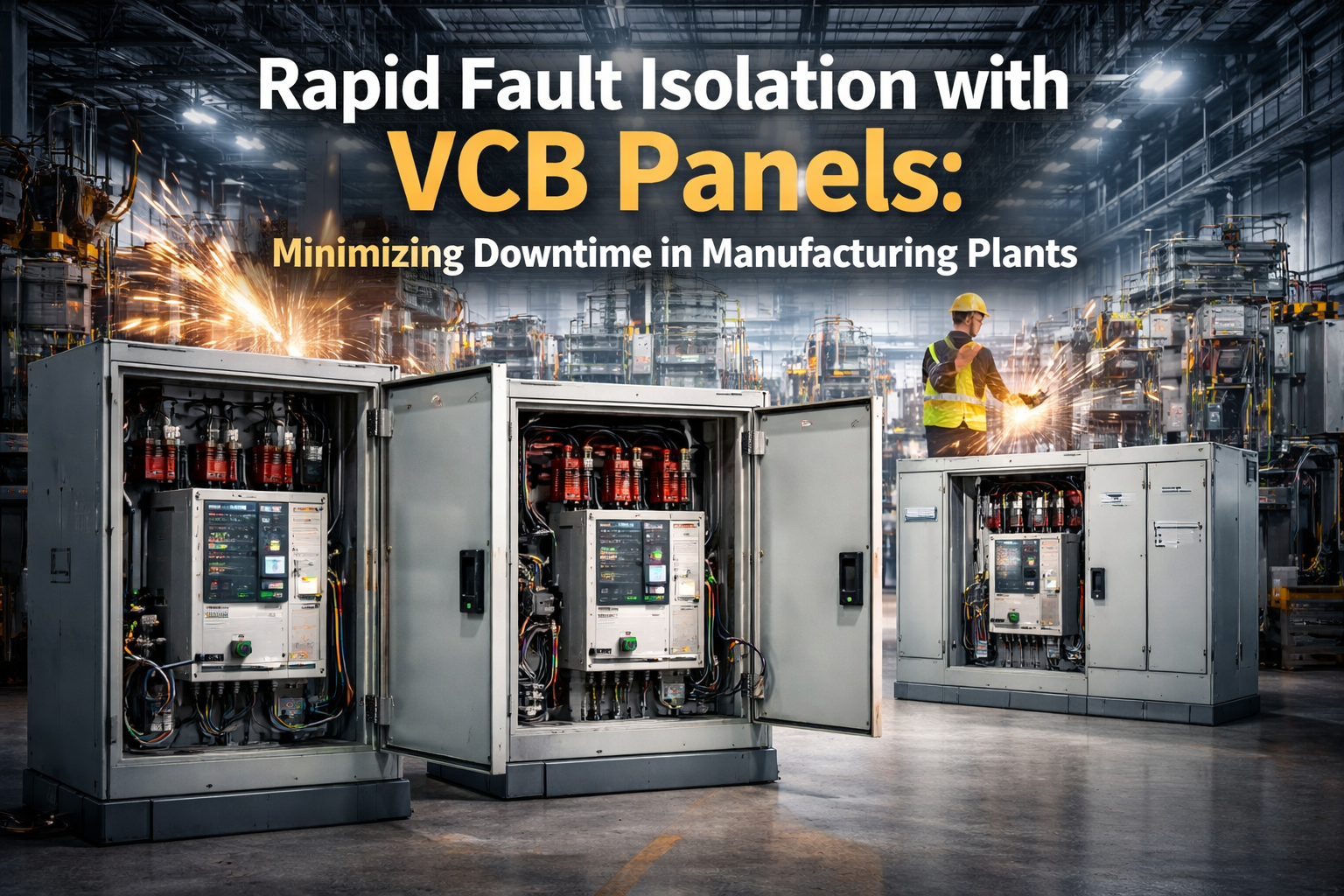
Rapid Fault Isolation with VCB Panels: Minimizing Downtime in Manufacturing Plants

In manufacturing plants, electrical downtime is never just an electrical issue. It disrupts production schedules, damages in-process material, affects safety systems, and leads to significant financial losses. As plants become more automated and power-intensive, even a minor electrical fault can cascade into large-scale operational disruption if not handled correctly.

This is why VCB panel fault isolation has become a critical requirement in modern manufacturing plants. Vacuum Circuit Breaker (VCB) panels are no longer installed only for switching and protection—they are deployed to ensure that faults are isolated rapidly, precisely, and without shutting down the entire facility.

Why Fault Isolation Speed Matters in Manufacturing Plants

Manufacturing environments operate with interconnected systems: motors, conveyors, robotics, furnaces, compressors, and control systems all rely on stable power. When a fault occurs, the speed at which the system reacts determines how much of the plant is affected.

Slow or poorly coordinated fault isolation often results in:

  • Entire production lines tripping for a localized issue
  • Extended restart times after faults
  • Damage to sensitive equipment due to prolonged fault exposure
  • Increased maintenance and troubleshooting effort

Effective VCB panel fault isolation ensures that only the faulty section is disconnected, allowing the rest of the plant to continue operating safely.

How VCB Panels Enable Rapid Fault Isolation

VCB panels are designed to interrupt fault currents quickly and reliably, even under high fault levels common in manufacturing plants. The vacuum interrupter extinguishes the arc rapidly, allowing the breaker to open cleanly and minimize electrical stress on the system.

More importantly, modern VCB panels are configured to work with selective protection schemes. This means that when a fault occurs, the nearest VCB panel isolates the issue instead of triggering upstream shutdowns. In manufacturing plants, this selectivity is essential to prevent unnecessary production losses.

With proper design, VCB panel fault isolation becomes a controlled, localized response rather than a plant-wide emergency.

Manufacturing Plant Scenarios Where Fault Isolation Is Critical

Manufacturing facilities experience a wide range of electrical stresses. Large motor starting currents, frequent switching operations, and variable loads increase the likelihood of faults. In such environments, a single fault should not stop unrelated processes.

For example, a fault in a motor feeder supplying one production line should not impact auxiliary systems or parallel lines. VCB panels installed at strategic distribution points allow faults to be isolated close to their origin, preserving uptime across the rest of the facility.

This capability makes VCB panel fault isolation particularly valuable in continuous process industries where shutdowns are costly and restart times are long.

Operational Benefits of VCB Panel Fault Isolation

From an operational perspective, rapid fault isolation improves plant resilience. Maintenance teams can identify and address faults without dealing with widespread outages. Operators regain control faster, and production losses are minimized.

VCB panel fault isolation also enhances equipment protection. Shorter fault durations reduce thermal and mechanical stress on cables, motors, and switchgear. Over time, this translates into longer equipment life and fewer unplanned failures.

For plant managers, this reliability directly supports productivity targets and operational efficiency.

Supporting Safety and Compliance in Manufacturing Plants

Safety is a major concern in manufacturing environments where personnel work near energized equipment. Delayed fault isolation increases arc energy and raises the risk of injury during fault events.

By enabling rapid interruption and precise isolation, VCB panel fault isolation helps reduce arc flash exposure and supports safer working conditions. This is especially important during maintenance activities, where controlled isolation is required to protect personnel.

In addition, reliable fault isolation supports compliance with electrical safety standards and internal plant safety policies.

Designing VCB Panels for Manufacturing Conditions

Manufacturing plants present harsh electrical environments. High temperatures, dust, vibration, and continuous operation demand robust switchgear design. VCB panels used in these settings must be engineered for durability, frequent operation, and consistent performance.

Fault isolation capability is not just about the breaker—it depends on the overall panel design, protection coordination, and integration with the plant’s power distribution system. Well-designed VCB panels ensure that isolation happens where intended, without unintended consequences elsewhere in the network.

Designing for Continuity, Not Just Protection

In modern manufacturing, electrical systems are expected to support business continuity, not just basic protection. VCB panel fault isolation plays a key role in achieving this by allowing plants to continue operating even when faults occur.

Instead of treating faults as shutdown events, manufacturing plants can treat them as manageable incidents—isolated, addressed, and resolved with minimal disruption. This shift in approach is only possible with reliable fault isolation at the switchgear level.

Building Fault-Resilient Manufacturing Power Systems

Synchro Electricals designs VCB panels with a strong focus on fault isolation performance for manufacturing plants. By aligning panel design with real operational conditions, their VCB solutions support fast fault clearance, selective isolation, and long-term system reliability.

This approach ensures that VCB panel fault isolation contributes directly to uptime, safety, and operational confidence in demanding industrial environments.

Conclusion

In manufacturing plants, electrical faults are inevitable—but widespread downtime is not. Rapid and selective VCB panel fault isolation allows faults to be contained quickly, protecting equipment, safeguarding personnel, and keeping production running.

As manufacturing operations become more complex and power-dependent, VCB panels designed for fast fault isolation are no longer optional. They are a critical element in building resilient, efficient, and future-ready manufacturing facilities.

FAQs

1. What is VCB panel fault isolation in manufacturing plants?

VCB panel fault isolation refers to the ability of a VCB panel to quickly disconnect only the faulty section of the electrical system, preventing unnecessary shutdown of the entire plant.

2. Why is rapid VCB panel fault isolation important for production continuity?

Fast fault isolation limits downtime by allowing unaffected production lines and auxiliary systems to continue operating safely.

3. How do VCB panels isolate faults more effectively than older switchgear?

VCB panels interrupt fault currents quickly and support selective isolation, ensuring faults are cleared close to their source.

4. Can VCB panel fault isolation reduce maintenance time?

Yes. Localized fault isolation makes it easier for maintenance teams to identify, access, and repair issues without restoring power to the entire plant.

5. Does VCB panel fault isolation improve safety in manufacturing environments?
Absolutely. Rapid isolation reduces arc energy and electrical exposure, creating safer conditions for plant personnel.


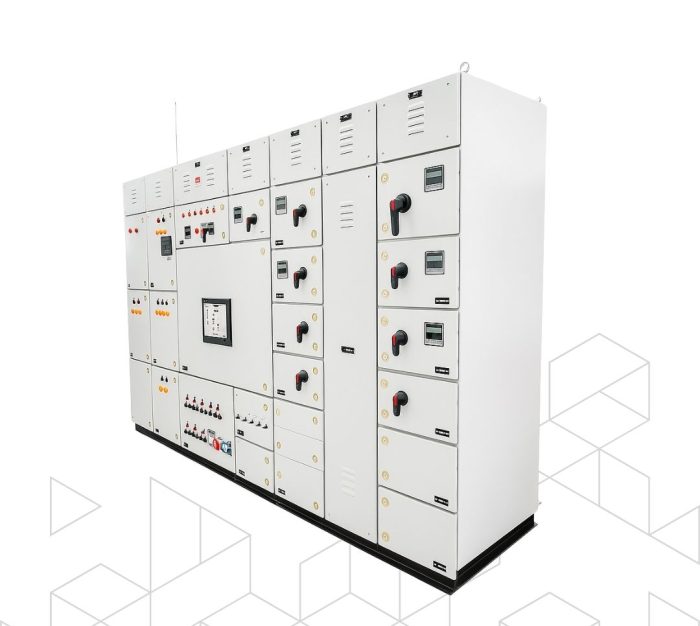
Selective Coordination and Protection Scheme Design in PCC Panels for Industrial Facilities

In modern manufacturing plants, electrical power systems operate under high fault levels, dense load concentration, and increasingly complex operating modes. As automation, large motor drives, and redundant supply arrangements become standard, the role of the Power Control Center (PCC) panel extends far beyond power distribution. It becomes the primary decision point for fault isolation, system stability, and personnel safety. Within this context, selective coordination is not an optional design enhancement—it is a fundamental requirement.

For technical professionals, understanding PCC Panel Protection Coordination begins with recognizing how faults behave in industrial power systems and how protection decisions propagate through the electrical network.

Fault Behavior in Industrial Power Distribution Systems

When a fault occurs within a manufacturing facility, fault current does not remain localized by default. It flows upstream through multiple protective devices, each capable of detecting the same abnormal condition. In an uncoordinated system, several breakers may respond simultaneously, causing widespread loss of supply even when the fault is limited to a single feeder.

At the PCC level, fault current magnitudes are typically at their highest due to proximity to transformers or utility incomers. This makes protection decisions at this point especially critical. A poorly coordinated response can result in upstream breaker operation, disconnecting entire production areas instead of isolating only the affected circuit.

Selective coordination exists to control this behavior intentionally.

Selective Coordination Defined at the PCC Level

Selective coordination is the deliberate arrangement of protective device characteristics so that, for any given fault, only the device closest to the fault operates while upstream devices remain closed. At the PCC panel, this coordination must extend across incomers, bus couplers, and outgoing feeders.

Unlike theoretical textbook systems, real manufacturing plants contain motors with high inrush currents, drives that distort current waveforms, and operating modes that alter available fault current. Protection coordination must therefore be dynamic in concept, even if implemented through static settings.

At its core, selective coordination is achieved by carefully managing time–current relationships between devices while ensuring fault clearing remains fast enough to protect equipment and personnel.

Why Coordination Becomes Complex in Manufacturing Facilities

Manufacturing plants introduce coordination challenges that are rarely present in simpler installations. Large induction motors demand protection that tolerates starting currents without nuisance tripping. Variable frequency drives introduce harmonics that influence sensing accuracy. Parallel feeders and redundant supplies alter fault current paths, making intuitive coordination unreliable.

Additionally, many plants operate with multiple power sources, such as grid supply supplemented by DG sets. Fault levels change significantly between operating modes, meaning coordination that works under grid supply may fail under generator operation if not designed holistically.

These realities make default breaker settings inadequate for industrial PCC panels.

Protection Scheme Design Philosophy in PCC Panels

Effective PCC Panel Protection Coordination begins with system-level thinking. The PCC panel is not designed in isolation; it must be coordinated with upstream utility protection and downstream MCCs and distribution boards.

Design starts with accurate short-circuit analysis under all operating conditions. From this, protective device ratings and interrupting capacities are selected. Coordination studies then align long-time, short-time, instantaneous, and earth-fault elements so discrimination is preserved across the fault current spectrum.

Electronic trip units and digital relays are essential in this process. Their adjustable characteristics allow fine-tuning of response times, enabling engineers to balance speed and selectivity rather than sacrificing one for the other.

Achieving Practical Protection Coordination

In practice, coordination is an iterative engineering process rather than a one-time calculation. Time–current curves are analyzed to verify separation between downstream and upstream devices. Settings are validated against motor starting conditions and transient load behavior. Coordination is then rechecked under alternate supply scenarios, such as DG operation or transformer outages.

The PCC panel must also account for mechanical interlocking and operational logic. Bus coupler behavior, incomer transfer schemes, and maintenance modes all influence protection response and must be considered during design.

Coordination that exists only on paper but fails under real operating conditions offers no practical value.

Advanced Coordination Techniques in Critical Plants

In high-reliability manufacturing environments, traditional time grading alone may not provide acceptable fault clearance times. Advanced techniques such as zone-selective interlocking allow downstream devices to trip instantaneously while upstream devices restrain, achieving both speed and selectivity.

Logic-based protection schemes further enhance coordination by adapting responses based on system configuration. These approaches are particularly valuable where fault energy reduction and arc-flash mitigation are design priorities.

Safety, Reliability, and Compliance Implications

Poor coordination increases arc-flash incident energy by delaying fault clearing at high current levels. Properly coordinated PCC panels reduce this risk while maintaining operational continuity. From a compliance perspective, insurers and safety auditors increasingly expect documented coordination studies as part of industrial electrical design.

For plant operators, the benefit is tangible: faults are isolated quickly, downtime is contained, and electrical assets experience less stress over their service life.

Engineering Perspective of Synchro Electricals

Synchro Electricals approaches PCC panel design as a protection engineering discipline rather than an assembly exercise. Coordination studies, operating mode analysis, and application-specific protection logic form the foundation of every PCC solution. This ensures that protection performance in the field matches design intent, even under complex industrial conditions.

Conclusion

Selective coordination is the difference between controlled fault isolation and widespread production disruption. In manufacturing plants, where electrical complexity and uptime requirements continue to rise, PCC Panel Protection Coordination must be treated as a core design responsibility.

By applying rigorous protection scheme design at the PCC level, industrial facilities can achieve safer operation, higher reliability, and predictable system behavior under fault conditions. Coordination is not a setting—it is an engineered outcome.

FAQs

1. What is selective coordination in a PCC panel?

Selective coordination is the intentional grading of protective devices so that only the breaker nearest to a fault operates, while upstream devices remain closed.

2. Why is selective coordination critical in manufacturing plants?

Manufacturing facilities have high fault levels and sensitive production loads; poor coordination can cause plant-wide shutdowns from localized faults.

3. Can thermal-magnetic breakers achieve proper coordination?

In most industrial systems, no. Adjustable electronic trip units or digital relays are required to manage complex fault and load conditions accurately.

4. Does protection coordination change during DG operation?

Yes. DG operation alters fault current levels and direction, requiring coordination to be validated under both grid and generator modes.

5. How does protection coordination affect arc-flash safety?

Proper coordination reduces fault clearing time at higher current levels, directly lowering arc-flash incident energy and improving personnel safety.


Welcome to Synchro Electricals

We provide trusted, high-performance electrical solutions tailored for every industry.

Apply For Job