
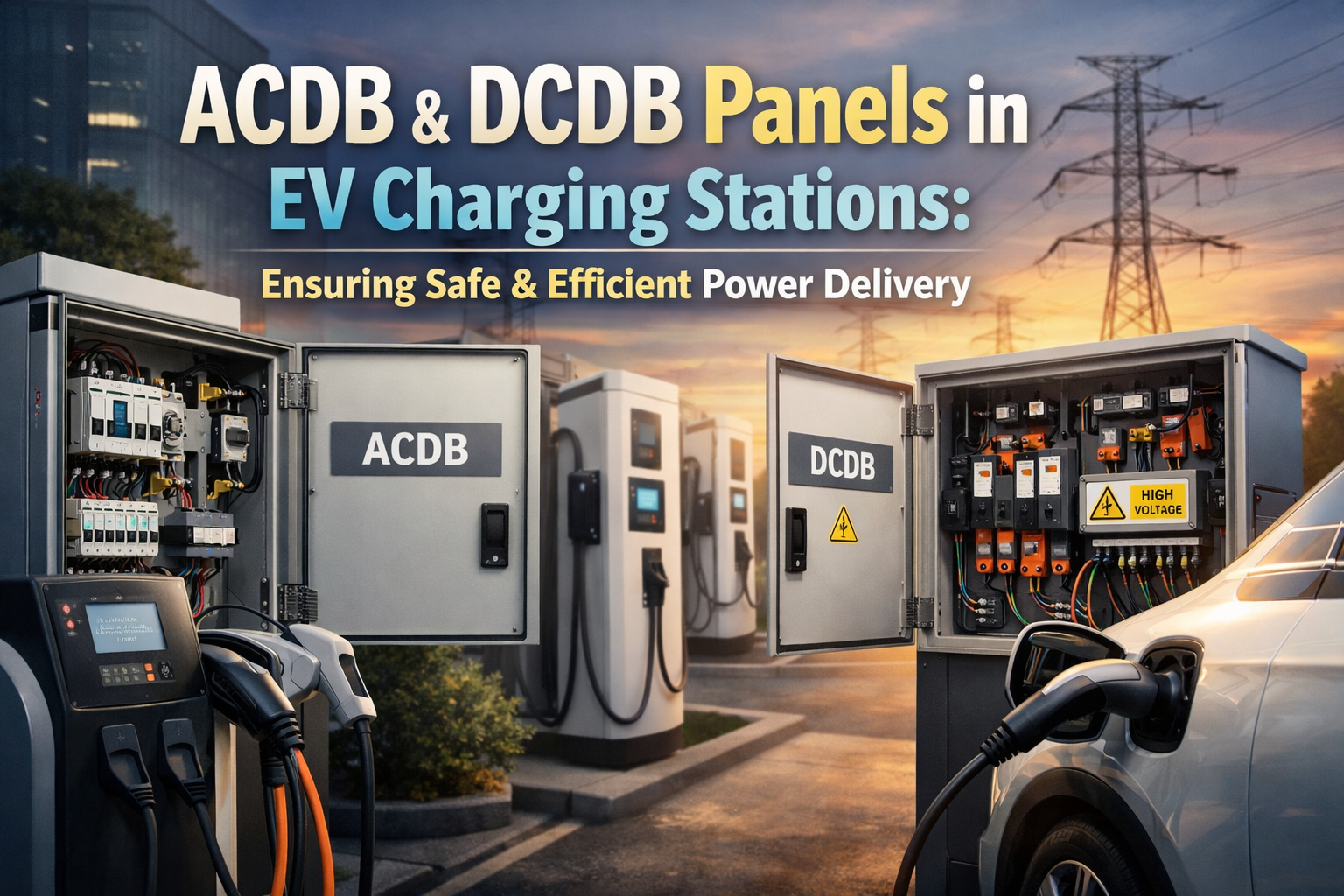
EV charging stations are no longer experimental infrastructure. They are now permanent, high-load electrical installations operating in public spaces, commercial premises, highways, and fleet depots. As charging capacities increase and fast chargers become standard, the electrical backbone behind these stations must handle continuous demand, thermal stress, and strict safety requirements.
In this environment, ACDB DCDB panels for EV charging are not secondary components. They define how power enters the site, how it is controlled, and how safely it reaches every charging point. Poorly designed distribution panels lead to frequent trips, overheating, inefficient energy use, and operational downtime—issues that directly affect charger availability and user trust.
How Power Distribution Shapes EV Charging Performance
Every EV charging station operates with a mix of AC and DC power. Incoming grid supply is managed on the AC side, while fast chargers rely heavily on DC distribution after conversion. This dual nature makes power management in EV charging stations fundamentally different from conventional electrical installations.
ACDB DCDB panels for EV charging provide the structured separation and coordination required to manage this mixed power environment. ACDB panels regulate and protect incoming AC supply, while DCDB panels handle high-current DC distribution to chargers. When these panels are designed as part of a single system rather than isolated units, power delivery becomes predictable, efficient, and safe.
Challenges Unique to EV Charging Stations
EV charging stations face electrical challenges that typical commercial buildings do not. Chargers operate for long durations at high current levels, often simultaneously. Fast-charging hubs experience rapid load fluctuations as vehicles connect and disconnect. Outdoor installations add environmental stress such as heat, dust, and moisture.
Without dedicated ACDB DCDB panels for EV charging, these conditions lead to uneven load distribution, frequent protective trips, and accelerated component wear. Distribution panels must be designed to support continuous operation while maintaining thermal stability and electrical safety.
ACDB & DCDB Panels as the Control Layer of EV Infrastructure
Rather than viewing ACDB and DCDB panels as simple distribution points, EV infrastructure treats them as control layers. These panels determine how power is prioritized, isolated, and expanded as charging demand grows.
ACDB panels ensure stable power flow from the grid to chargers and auxiliary systems such as lighting, monitoring, and payment terminals. DCDB panels manage DC outputs with precise isolation, ensuring that a fault in one charging line does not disrupt the entire station. Together, ACDB DCDB panels for EV charging enable selective operation, allowing stations to remain partially active even during faults or maintenance.
Impact on Safety, Reliability, and User Experience
For EV charging operators, safety and uptime directly influence reputation and revenue. Public charging stations must operate safely under all conditions while remaining accessible to users at all hours.
Well-engineered ACDB DCDB panels for EV charging reduce risks associated with electrical faults, overheating, and uncontrolled energy flow. They also improve reliability by ensuring consistent voltage and current delivery, which directly affects charging speed and equipment lifespan. From the user’s perspective, this translates into dependable charging sessions and minimal downtime.
Supporting Scalable EV Charging Networks
EV infrastructure is expanding rapidly. Charging stations installed today are often expected to support additional chargers, higher power ratings, or new charging technologies in the future. Power distribution systems must be designed with this scalability in mind.
ACDB DCDB panels for EV charging allow structured expansion by providing spare feeders, modular layouts, and clear separation between AC and DC systems. This approach enables operators to upgrade charging capacity without redesigning the entire electrical system, saving time and capital costs.
Design Considerations for Modern EV Charging Stations
Effective ACDB and DCDB panels are designed around real operating conditions rather than theoretical loads. Thermal management, fault isolation, and accessibility for maintenance are key factors. Panels must support frequent switching operations and continuous current flow without degradation.
In EV charging environments, panel reliability is just as important as charger technology itself. Distribution failures often result in multiple chargers going offline simultaneously, amplifying operational losses.
Delivering Infrastructure-Grade Power Distribution for EV Charging
Synchro Electricals develops ACDB DCDB panels for EV charging with a clear focus on infrastructure reliability and long-term performance. Designs are aligned with real-world EV charging conditions, ensuring safe power delivery, efficient operation, and readiness for future expansion.
Conclusion
EV charging stations depend on more than chargers alone. Behind every reliable charging point is a power distribution system capable of handling continuous demand, mixed AC/DC operation, and strict safety expectations.
By investing in well-designed ACDB DCDB panels for EV charging, operators create infrastructure that is safe, scalable, and ready for the next phase of electric mobility. In a rapidly evolving EV ecosystem, robust power distribution is not just supportive—it is foundational.