
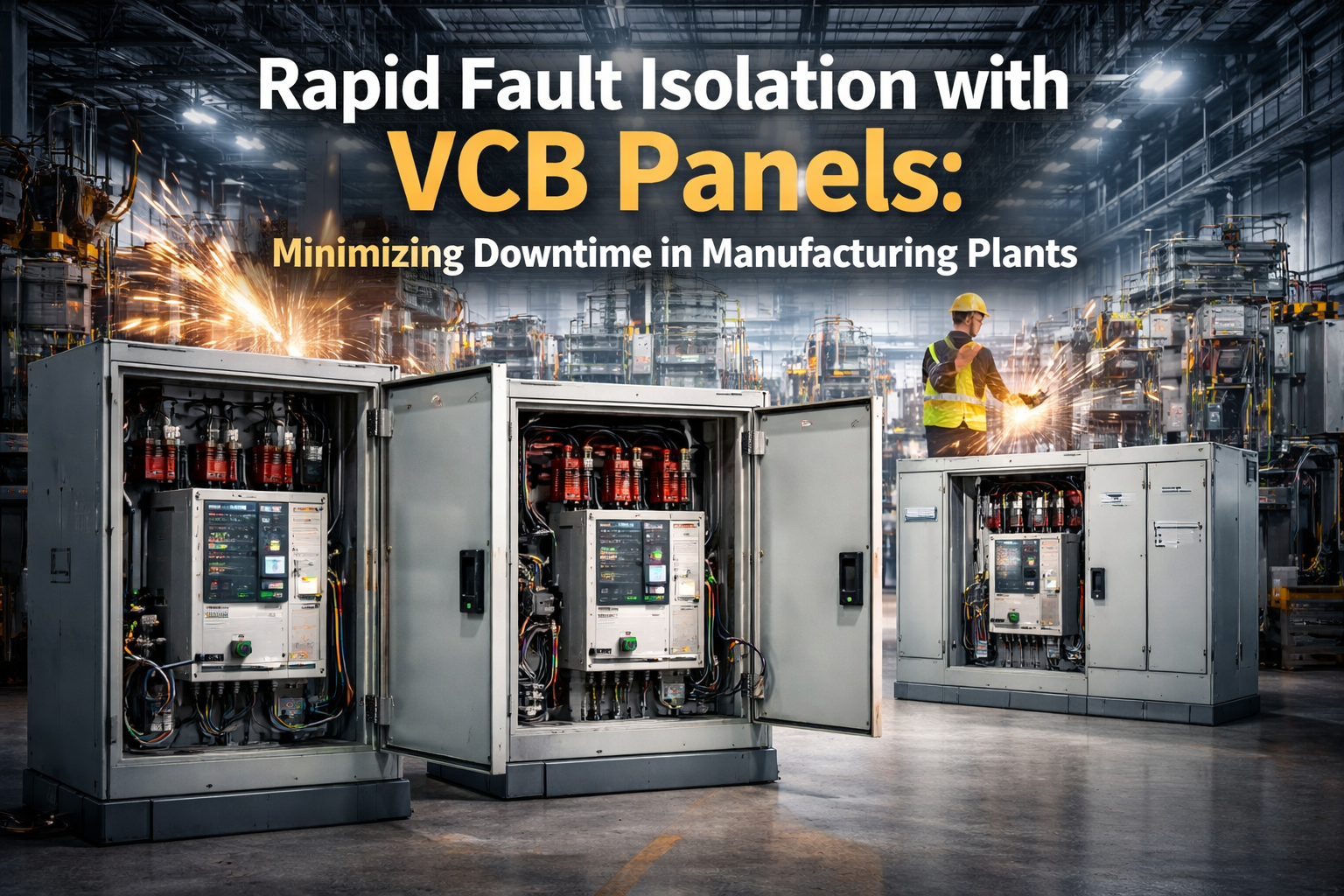
Rapid Fault Isolation with VCB Panels: Minimizing Downtime in Manufacturing Plants

In manufacturing plants, electrical downtime is never just an electrical issue. It disrupts production schedules, damages in-process material, affects safety systems, and leads to significant financial losses. As plants become more automated and power-intensive, even a minor electrical fault can cascade into large-scale operational disruption if not handled correctly.

This is why VCB panel fault isolation has become a critical requirement in modern manufacturing plants. Vacuum Circuit Breaker (VCB) panels are no longer installed only for switching and protection—they are deployed to ensure that faults are isolated rapidly, precisely, and without shutting down the entire facility.

Why Fault Isolation Speed Matters in Manufacturing Plants

Manufacturing environments operate with interconnected systems: motors, conveyors, robotics, furnaces, compressors, and control systems all rely on stable power. When a fault occurs, the speed at which the system reacts determines how much of the plant is affected.

Slow or poorly coordinated fault isolation often results in:

  • Entire production lines tripping for a localized issue
  • Extended restart times after faults
  • Damage to sensitive equipment due to prolonged fault exposure
  • Increased maintenance and troubleshooting effort

Effective VCB panel fault isolation ensures that only the faulty section is disconnected, allowing the rest of the plant to continue operating safely.

How VCB Panels Enable Rapid Fault Isolation

VCB panels are designed to interrupt fault currents quickly and reliably, even under high fault levels common in manufacturing plants. The vacuum interrupter extinguishes the arc rapidly, allowing the breaker to open cleanly and minimize electrical stress on the system.

More importantly, modern VCB panels are configured to work with selective protection schemes. This means that when a fault occurs, the nearest VCB panel isolates the issue instead of triggering upstream shutdowns. In manufacturing plants, this selectivity is essential to prevent unnecessary production losses.

With proper design, VCB panel fault isolation becomes a controlled, localized response rather than a plant-wide emergency.

Manufacturing Plant Scenarios Where Fault Isolation Is Critical

Manufacturing facilities experience a wide range of electrical stresses. Large motor starting currents, frequent switching operations, and variable loads increase the likelihood of faults. In such environments, a single fault should not stop unrelated processes.

For example, a fault in a motor feeder supplying one production line should not impact auxiliary systems or parallel lines. VCB panels installed at strategic distribution points allow faults to be isolated close to their origin, preserving uptime across the rest of the facility.

This capability makes VCB panel fault isolation particularly valuable in continuous process industries where shutdowns are costly and restart times are long.

Operational Benefits of VCB Panel Fault Isolation

From an operational perspective, rapid fault isolation improves plant resilience. Maintenance teams can identify and address faults without dealing with widespread outages. Operators regain control faster, and production losses are minimized.

VCB panel fault isolation also enhances equipment protection. Shorter fault durations reduce thermal and mechanical stress on cables, motors, and switchgear. Over time, this translates into longer equipment life and fewer unplanned failures.

For plant managers, this reliability directly supports productivity targets and operational efficiency.

Supporting Safety and Compliance in Manufacturing Plants

Safety is a major concern in manufacturing environments where personnel work near energized equipment. Delayed fault isolation increases arc energy and raises the risk of injury during fault events.

By enabling rapid interruption and precise isolation, VCB panel fault isolation helps reduce arc flash exposure and supports safer working conditions. This is especially important during maintenance activities, where controlled isolation is required to protect personnel.

In addition, reliable fault isolation supports compliance with electrical safety standards and internal plant safety policies.

Designing VCB Panels for Manufacturing Conditions

Manufacturing plants present harsh electrical environments. High temperatures, dust, vibration, and continuous operation demand robust switchgear design. VCB panels used in these settings must be engineered for durability, frequent operation, and consistent performance.

Fault isolation capability is not just about the breaker—it depends on the overall panel design, protection coordination, and integration with the plant’s power distribution system. Well-designed VCB panels ensure that isolation happens where intended, without unintended consequences elsewhere in the network.

Designing for Continuity, Not Just Protection

In modern manufacturing, electrical systems are expected to support business continuity, not just basic protection. VCB panel fault isolation plays a key role in achieving this by allowing plants to continue operating even when faults occur.

Instead of treating faults as shutdown events, manufacturing plants can treat them as manageable incidents—isolated, addressed, and resolved with minimal disruption. This shift in approach is only possible with reliable fault isolation at the switchgear level.

Building Fault-Resilient Manufacturing Power Systems

Synchro Electricals designs VCB panels with a strong focus on fault isolation performance for manufacturing plants. By aligning panel design with real operational conditions, their VCB solutions support fast fault clearance, selective isolation, and long-term system reliability.

This approach ensures that VCB panel fault isolation contributes directly to uptime, safety, and operational confidence in demanding industrial environments.

Conclusion

In manufacturing plants, electrical faults are inevitable—but widespread downtime is not. Rapid and selective VCB panel fault isolation allows faults to be contained quickly, protecting equipment, safeguarding personnel, and keeping production running.

As manufacturing operations become more complex and power-dependent, VCB panels designed for fast fault isolation are no longer optional. They are a critical element in building resilient, efficient, and future-ready manufacturing facilities.

FAQs

1. What is VCB panel fault isolation in manufacturing plants?

VCB panel fault isolation refers to the ability of a VCB panel to quickly disconnect only the faulty section of the electrical system, preventing unnecessary shutdown of the entire plant.

2. Why is rapid VCB panel fault isolation important for production continuity?

Fast fault isolation limits downtime by allowing unaffected production lines and auxiliary systems to continue operating safely.

3. How do VCB panels isolate faults more effectively than older switchgear?

VCB panels interrupt fault currents quickly and support selective isolation, ensuring faults are cleared close to their source.

4. Can VCB panel fault isolation reduce maintenance time?

Yes. Localized fault isolation makes it easier for maintenance teams to identify, access, and repair issues without restoring power to the entire plant.

5. Does VCB panel fault isolation improve safety in manufacturing environments?

Absolutely. Rapid isolation reduces arc energy and electrical exposure, creating safer conditions for plant personnel.


Dielectric Strength and Insulation Coordination in VCB Panels for 11kV & 33kV Systems

In power transmission networks, medium-voltage switchgear operates at the intersection of high electrical stress and strict reliability requirements. At voltage levels such as 11kV and 33kV, failures are rarely caused by thermal overload alone; they are far more often the result of insulation breakdown due to transient overvoltages. Within this context, dielectric strength and insulation coordination become central design considerations for VCB panels.

For engineers working in transmission and substation environments, VCB Insulation Coordination is not an abstract standard-driven exercise. It directly determines whether a panel survives lightning impulses, switching surges, and abnormal grid events without flashover, internal damage, or catastrophic failure.

Understanding Dielectric Stress in Medium-Voltage Systems

Dielectric stress refers to the electrical stress imposed on insulation systems when voltage is applied across conductive parts. In 11kV and 33kV networks, insulation is subjected not only to normal operating voltage but also to temporary and transient overvoltages that may far exceed nominal values.

Lightning strikes on overhead lines, switching operations, capacitor bank energization, and fault clearing events all introduce steep-front voltage impulses. These impulses stress air insulation, solid insulation, and internal clearances simultaneously. If the dielectric strength of any insulation path is insufficient, breakdown occurs long before protective devices can respond.

In VCB panels, where compact construction and high component density are common, managing dielectric stress becomes especially critical.

Dielectric Strength as a Design Parameter in VCB Panels

Dielectric strength is the ability of insulation to withstand applied voltage without electrical breakdown. In VCB panels, this strength must be adequate across all insulation media: vacuum interrupters, air clearances, solid insulation, and interface points such as bushings and terminations.

Vacuum interrupters inherently offer excellent dielectric recovery after current interruption. However, the surrounding insulation system must be designed to the same standard. Weak external insulation can negate the advantages of the vacuum bottle, leading to flashover across terminals, phase-to-phase faults, or phase-to-earth failures.

At 33kV levels in particular, dielectric margins become tighter, and design tolerances shrink significantly.

Insulation Coordination: More Than Withstand Voltage

Insulation coordination is the systematic selection of insulation levels so that equipment responds predictably to overvoltages. The objective is not to make insulation infinitely strong, but to ensure that insulation strength is properly matched with surge protection devices and system characteristics.

In VCB panels, insulation coordination involves aligning the panel’s Basic Insulation Level (BIL) with expected overvoltage stresses and surge arrester performance. During a lightning impulse, the arrester should clamp the voltage to a level below the insulation withstand capability of the panel. If this coordination is incorrect, either unnecessary insulation failure or excessive equipment cost results.

This balance is particularly important in transmission systems where switching surges may dominate over lightning impulses, especially at 33kV.

Role of Clearances and Creepage in Medium-Voltage Panels

Air clearance and creepage distance are fundamental contributors to insulation performance. Clearances determine impulse withstand capability, while creepage distances influence long-term performance under contamination and humidity.

In power transmission environments, airborne pollution, moisture, and temperature variation can significantly reduce surface insulation strength. VCB panels designed without adequate creepage margins may pass factory tests but fail prematurely in service.

Proper insulation coordination, therefore requires considering not only voltage level, but also environmental conditions, enclosure design, and service location.

Testing and Standards Governing Insulation Coordination

Dielectric performance in VCB panels is validated through standardized tests such as power-frequency withstand tests and lightning impulse tests. These tests simulate real-world stresses and verify that insulation paths behave as intended under extreme conditions.

For 11kV and 33kV systems, test levels are defined by international and national standards. However, compliance alone does not guarantee field reliability. The way insulation is arranged, supported, and protected within the panel plays a decisive role in long-term performance.

Engineering judgment is required to interpret standards in the context of actual grid behavior.

Consequences of Poor Insulation Coordination

When insulation coordination is inadequate, failures tend to be sudden and severe. Flashover within a VCB panel can damage interrupters, busbars, and adjacent equipment simultaneously. In transmission networks, such failures often lead to extended outages due to the time required for isolation, repair, and re-energization.

Additionally, repeated near-breakdown events accelerate insulation aging, reducing service life even if immediate failure does not occur. From a utility perspective, this represents both a reliability risk and a long-term asset management issue.

Engineering Approach of Synchro Electricals

Synchro Electricals approaches VCB panel design with insulation coordination as a core engineering discipline rather than a compliance checklist. Dielectric stress analysis, clearance optimization, and coordination with surge protection systems are integrated into the design process from the outset.

By focusing on real operating conditions in power transmission environments, Synchro Electricals ensures that VCB panels maintain dielectric integrity under both normal and transient stresses at 11kV and 33kV levels.

Conclusion

In power transmission systems, insulation failure is rarely forgiving. At 11kV and 33kV, the margin between stable operation and catastrophic breakdown is defined by dielectric strength and insulation coordination.

Effective VCB Insulation Coordination ensures that VCB panels withstand lightning impulses, switching surges, and environmental stress without compromising reliability. By treating insulation coordination as a system-level engineering problem rather than a test requirement, utilities and transmission operators can achieve safer, more resilient medium-voltage networks.

FAQs

What is insulation coordination in VCB panels?

It is the systematic alignment of insulation strength with expected overvoltages and surge protection levels to prevent insulation breakdown.

Why is insulation coordination critical at 33kV?

Higher voltage increases dielectric stress and reduces design margins, making proper coordination essential for reliability.

Do vacuum interrupters alone ensure insulation safety?

No. External insulation paths must be equally robust to prevent flashover outside the interrupter.

How do environmental conditions affect insulation performance?

Humidity, pollution, and temperature reduce surface insulation strength, requiring higher creepage distances.

Is standard compliance sufficient for insulation reliability?

Compliance is necessary but not sufficient; real-world grid behavior must be considered during design.

Welcome to Synchro Electricals

We provide trusted, high-performance electrical solutions tailored for every industry.

Apply For Job