
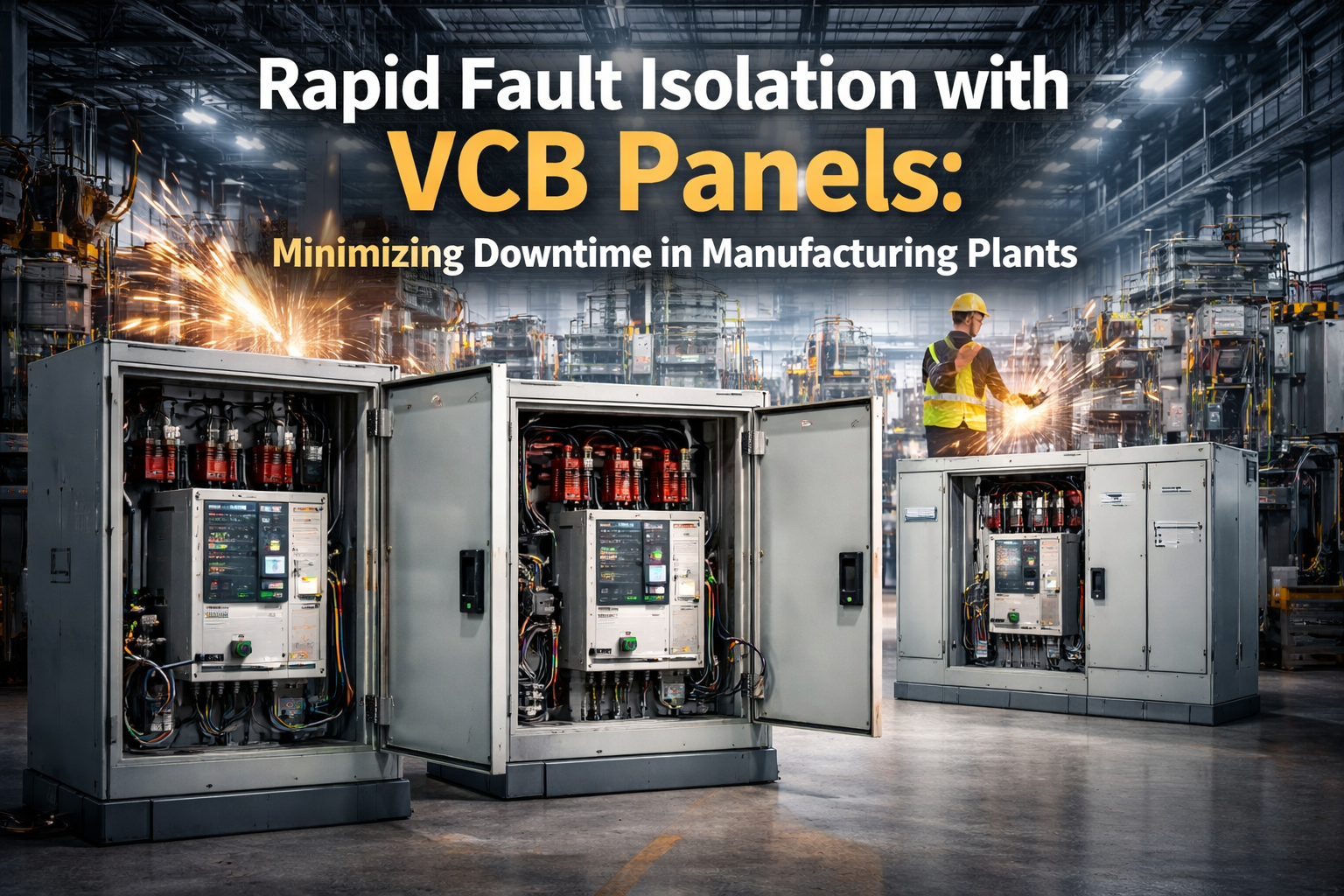
In manufacturing plants, electrical downtime is never just an electrical issue. It disrupts production schedules, damages in-process material, affects safety systems, and leads to significant financial losses. As plants become more automated and power-intensive, even a minor electrical fault can cascade into large-scale operational disruption if not handled correctly.
This is why VCB panel fault isolation has become a critical requirement in modern manufacturing plants. Vacuum Circuit Breaker (VCB) panels are no longer installed only for switching and protection—they are deployed to ensure that faults are isolated rapidly, precisely, and without shutting down the entire facility.
Why Fault Isolation Speed Matters in Manufacturing Plants
Manufacturing environments operate with interconnected systems: motors, conveyors, robotics, furnaces, compressors, and control systems all rely on stable power. When a fault occurs, the speed at which the system reacts determines how much of the plant is affected.
Slow or poorly coordinated fault isolation often results in:
- Entire production lines tripping for a localized issue
- Extended restart times after faults
- Damage to sensitive equipment due to prolonged fault exposure
- Increased maintenance and troubleshooting effort
Effective VCB panel fault isolation ensures that only the faulty section is disconnected, allowing the rest of the plant to continue operating safely.
How VCB Panels Enable Rapid Fault Isolation
VCB panels are designed to interrupt fault currents quickly and reliably, even under high fault levels common in manufacturing plants. The vacuum interrupter extinguishes the arc rapidly, allowing the breaker to open cleanly and minimize electrical stress on the system.
More importantly, modern VCB panels are configured to work with selective protection schemes. This means that when a fault occurs, the nearest VCB panel isolates the issue instead of triggering upstream shutdowns. In manufacturing plants, this selectivity is essential to prevent unnecessary production losses.
With proper design, VCB panel fault isolation becomes a controlled, localized response rather than a plant-wide emergency.
Manufacturing Plant Scenarios Where Fault Isolation Is Critical
Manufacturing facilities experience a wide range of electrical stresses. Large motor starting currents, frequent switching operations, and variable loads increase the likelihood of faults. In such environments, a single fault should not stop unrelated processes.
For example, a fault in a motor feeder supplying one production line should not impact auxiliary systems or parallel lines. VCB panels installed at strategic distribution points allow faults to be isolated close to their origin, preserving uptime across the rest of the facility.
This capability makes VCB panel fault isolation particularly valuable in continuous process industries where shutdowns are costly and restart times are long.
Operational Benefits of VCB Panel Fault Isolation
From an operational perspective, rapid fault isolation improves plant resilience. Maintenance teams can identify and address faults without dealing with widespread outages. Operators regain control faster, and production losses are minimized.
VCB panel fault isolation also enhances equipment protection. Shorter fault durations reduce thermal and mechanical stress on cables, motors, and switchgear. Over time, this translates into longer equipment life and fewer unplanned failures.
For plant managers, this reliability directly supports productivity targets and operational efficiency.
Supporting Safety and Compliance in Manufacturing Plants
Safety is a major concern in manufacturing environments where personnel work near energized equipment. Delayed fault isolation increases arc energy and raises the risk of injury during fault events.
By enabling rapid interruption and precise isolation, VCB panel fault isolation helps reduce arc flash exposure and supports safer working conditions. This is especially important during maintenance activities, where controlled isolation is required to protect personnel.
In addition, reliable fault isolation supports compliance with electrical safety standards and internal plant safety policies.
Designing VCB Panels for Manufacturing Conditions
Manufacturing plants present harsh electrical environments. High temperatures, dust, vibration, and continuous operation demand robust switchgear design. VCB panels used in these settings must be engineered for durability, frequent operation, and consistent performance.
Fault isolation capability is not just about the breaker—it depends on the overall panel design, protection coordination, and integration with the plant’s power distribution system. Well-designed VCB panels ensure that isolation happens where intended, without unintended consequences elsewhere in the network.
Designing for Continuity, Not Just Protection
In modern manufacturing, electrical systems are expected to support business continuity, not just basic protection. VCB panel fault isolation plays a key role in achieving this by allowing plants to continue operating even when faults occur.
Instead of treating faults as shutdown events, manufacturing plants can treat them as manageable incidents—isolated, addressed, and resolved with minimal disruption. This shift in approach is only possible with reliable fault isolation at the switchgear level.
Building Fault-Resilient Manufacturing Power Systems
Synchro Electricals designs VCB panels with a strong focus on fault isolation performance for manufacturing plants. By aligning panel design with real operational conditions, their VCB solutions support fast fault clearance, selective isolation, and long-term system reliability.
This approach ensures that VCB panel fault isolation contributes directly to uptime, safety, and operational confidence in demanding industrial environments.
Conclusion
In manufacturing plants, electrical faults are inevitable—but widespread downtime is not. Rapid and selective VCB panel fault isolation allows faults to be contained quickly, protecting equipment, safeguarding personnel, and keeping production running.
As manufacturing operations become more complex and power-dependent, VCB panels designed for fast fault isolation are no longer optional. They are a critical element in building resilient, efficient, and future-ready manufacturing facilities.
FAQs
1. What is VCB panel fault isolation in manufacturing plants?
2. Why is rapid VCB panel fault isolation important for production continuity?
3. How do VCB panels isolate faults more effectively than older switchgear?
4. Can VCB panel fault isolation reduce maintenance time?
5. Does VCB panel fault isolation improve safety in manufacturing environments?