Building Panels That Survive International EPC Scrutiny: A Practical Guide
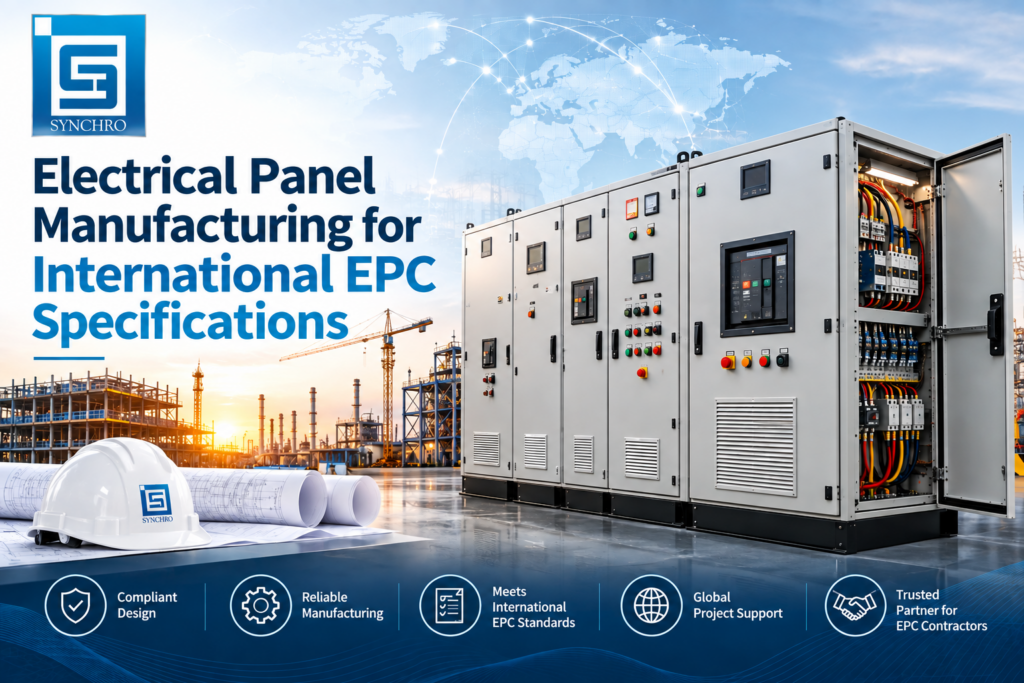
On a large EPC project, the panel room is where schedule, safety, and specification collide. A single non-compliant enclosure can delay energization by weeks, and consultants often reject a full lot over a missing test certificate rather than a real defect. That is why Electrical Panel Manufacturing for international EPC work is less about fabrication and more about proof: proof of design, proof of testing, and proof that every unit matches what was approved. This guide covers the standards, panel types, workflow, and documentation that global EPC contractors expect, and how Synchro Electricals approaches each stage.
Why International EPC Specifications Are Different
Domestic projects often accept a manufacturer’s standard design. International EPC specifications rarely do. They typically arrive as thick technical datasheets that dictate:
- Approved vendor lists for breakers, relays, meters, and PLCs
- Design verification evidence, not just a nameplate claim
- Form of separation, busbar material, and enclosure finish
- Inspection and test plans with witness points for the client or a third-party inspector
- Documentation packages in a fixed format and revision control
A manufacturer who treats these as paperwork gets caught out at factory acceptance. A manufacturer who builds them into the process ships on time.
Common Question Asked:
What does SITC mean in a turnkey project?
SITC stands for supply, installation, testing, and commissioning, meaning one party is responsible from manufacture through handover in a turnkey project.
Standards That Govern International Panel Projects
Most EPC specifications reference a short list of standards. Knowing which one applies to your destination market saves expensive rework.
| Standard | Scope | Why EPC Specs Cite It |
|---|---|---|
| IEC 61439 | Low-voltage switchgear and controlgear assemblies | Defines design verification and routine verification for assemblies |
| UL 508A | Industrial control panels (North America) | Requires short circuit withstand capacity (SCCR) marking |
| IEC 60529 | Enclosure protection codes | Sets the ingress protection ip rating (dust and water) |
| IEC/TR 61641 | Arc fault testing of low-voltage assemblies | Supports personnel safety claims |
| IEC 62271 | High-voltage switchgear and controlgear | Applies to MV panels using a vacuum circuit breaker |
Confirm the exact edition and any client amendments before design freeze. Specifications often pin a particular revision.
What a Type Tested Panel Actually Means
The phrase type tested panel is used loosely in the market. Under IEC 61439, the assembly manufacturer must verify the design through testing, calculation, or approved design rules, and then perform routine verification on every unit built. The key performance characteristics include:
- Temperature rise limits at rated current
- Dielectric properties (power-frequency withstand and impulse)
- Short circuit withstand capacity of busbars and functional units
- Fault level rating coordination with upstream protection
- Clearances and creepage distances
- Ingress protection ip rating of the enclosure
Ask any panel builder for the verification report of the exact busbar system and enclosure combination you are buying. A certificate for a different frame size does not cover yours.
Panel Types Commonly Called Out in EPC Scopes
Most industrial and commercial EPC packages combine several panel families. Each has its own design traps.
| Panel Type | Typical Role | Key Specification Points |
|---|---|---|
| Power distribution panel | Feeds downstream loads from the main incomer | Busbar rating, form of separation, breaker discrimination |
| MCC panel (motor control center) | Starts, protects, and controls motors | Withdrawable units, thermal management, coordination type |
| VFD panel | Houses each variable frequency drive | Harmonic mitigation, cooling, cable entry |
| APFC panel | Automatic power factor correction | Detuned reactors, capacitor duty, controller settings |
| Synchronizing panel | Paralleling generators or sources | Phase and frequency matching, load sharing logic |
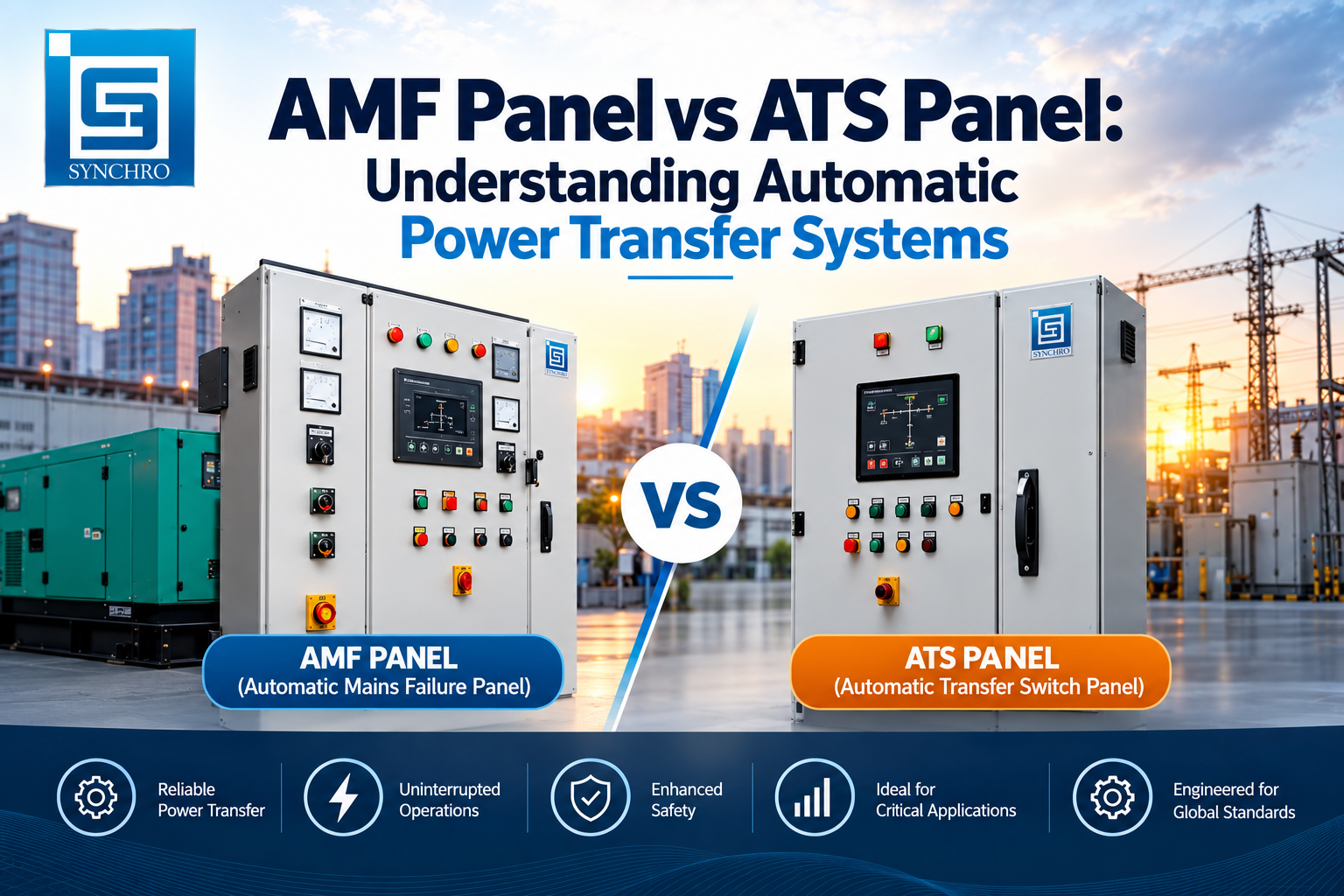
| AMF panel | Automatic mains failure changeover | Automatic transfer switch ats logic, interlocks |
| Automation control panel | PLC automation and process control | I/O spare capacity, communication protocols, segregation |
| Solar ACDB | AC combining and protection for solar plants | Surge protection devices, weatherproof enclosure |
| Lighting control panel | Building and industrial lighting circuits | Circuit protection, contactor or DMX interface |
Bus-based feeders are also frequent in these scopes. A sandwich bus duct is often specified where space is tight and current ratings are high, and the choice between copper and aluminium conductors should be justified in the design note.
How Electrical Panel Manufacturing Moves From Drawings to Dispatch
A disciplined workflow is what separates a reliable supplier from a risky one. In practice, the sequence looks like this:
- Specification review and clarification. Every deviation from the tender documents is listed and answered before drawings begin.
- Design and drawing approval. General arrangement, single-line diagram, schematics, and bill of materials go to the client or consultant for sign-off.
- Material approval. Breakers, relays, meters, and terminals are matched to the approved vendor list.
- Fabrication and busbar work. Sheet metal, powder coating, busbar cutting, and plating follow the approved drawings.
- Wiring and assembly. Cable colors, ferrules, and labels follow the specification exactly.
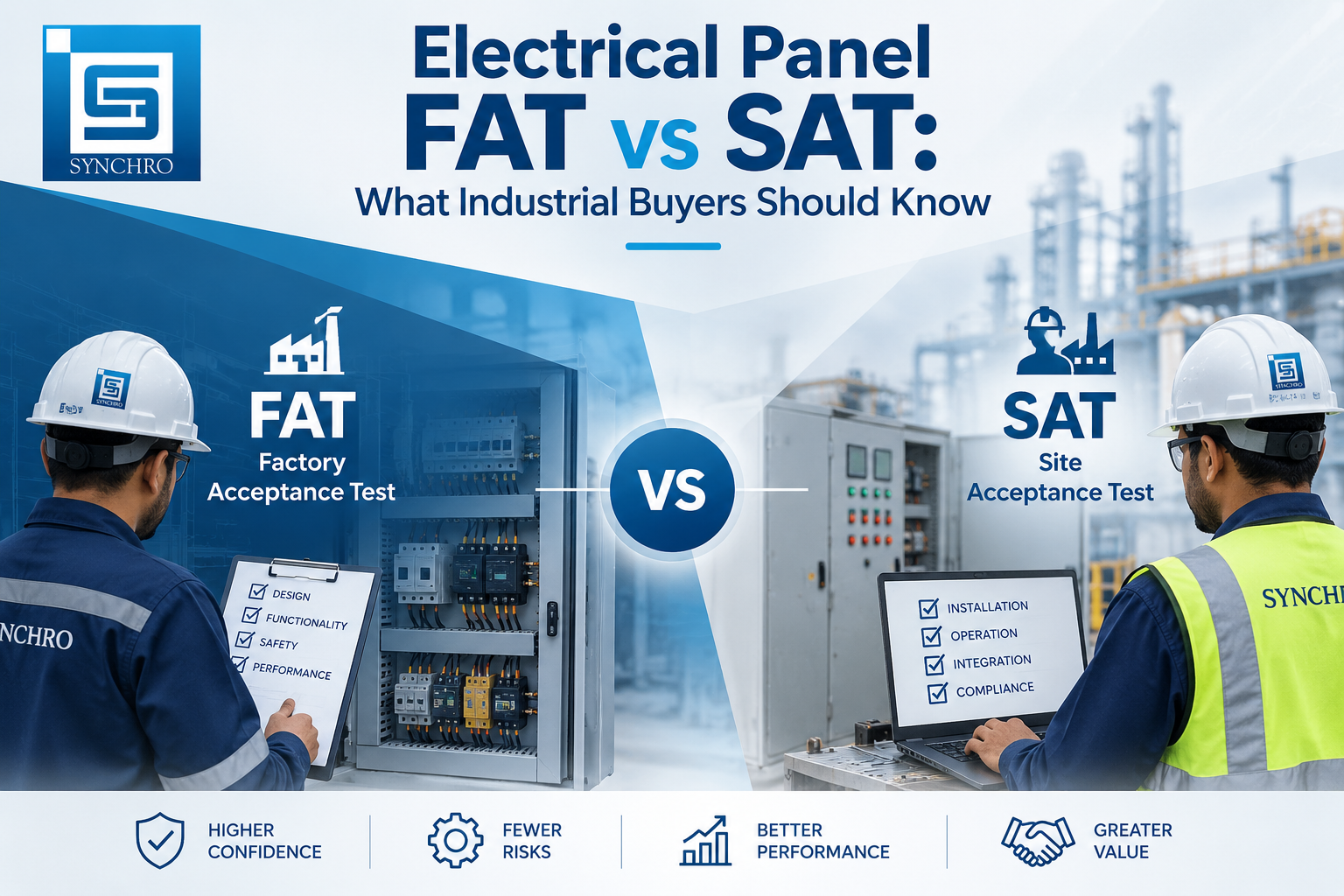
- Routine verification and FAT. Insulation resistance, functional checks, and interlock tests are performed, often with client witnesses.
- Packing and dispatch. Export packing, moisture protection, and shipping documentation are prepared for the destination.
Skipping step 1 is the most common root cause of late rejections.
Documentation EPC Contractors Expect
Panels do not get accepted on hardware alone. A typical package includes:
- Approved drawings with as-built revisions
- Design verification reports and type test certificates
- Quality assurance plan and inspection test plan
- Material test certificates for copper, steel, and critical components
- Factory acceptance test reports
- Operation and maintenance manuals, spare parts lists, and warranty terms
Missing paperwork is the easiest rejection reason to avoid, and the most common one to see.
Common Mistakes That Cause Rejection
- Quoting a fault level rating that is not supported by a verified busbar system
- Substituting a breaker brand without written approval
- Ignoring derating for high ambient temperatures common in Middle East and African projects
- Leaving no spare capacity for I/O or future feeders
- Underestimating energy monitoring requirements, such as meter class and communication protocol
- Treating harmonics as an afterthought in VFD panel and APFC panel designs
The Value of a Turnkey Approach
Splitting panel supply, site work, and commissioning across multiple vendors creates gaps that nobody owns. A turnkey project model closes those gaps. With SITC (supply, installation, testing, and commissioning) under one contract, the party who builds the panel is accountable for how it performs on site. Strong electrical project management links the factory schedule to site readiness, and expert electrical contractors handle installing electrical panels and cable termination against the same approved drawings.
Choosing the Right Manufacturing Partner
When you evaluate a supplier, look past brochures and ask for evidence:
- Verification reports for the exact panel types in your scope
- Sample ITPs and FAT reports from comparable projects
- A clear change control process for specification deviations
- In-house capability across motor control, power correction, and industrial automation
- Willingness to host client and third-party inspections
Synchro Electricals works in exactly this space, building distribution, motor control, power factor correction, synchronizing, and automation panels for industrial and commercial projects. As an electrical panel manufacturer, the aim is to make specification compliance visible early, so approvals move faster and site surprises stay rare. Verify any supplier’s current certifications and references against your own project requirements before award.
Conclusion
International EPC work rewards manufacturers who treat compliance as a process, not a last-minute exercise. Electrical Panel Manufacturing that follows IEC 61439 or UL 508A, documents its design verification, and tests every unit before dispatch removes the biggest sources of delay and dispute. If you are preparing an EPC tender, start by mapping your panel scope against the standards and documents above, then talk to a manufacturer that can support both the factory and the site. Synchro Electricals is ready to discuss your specification and turn it into a build plan.
FAQS:-
1.What is the difference between IEC 61439 and UL 508A?
IEC 61439 is an international standard for low-voltage assemblies and focuses on design and routine verification. UL 508A applies to industrial control panels in North America and centers on component listing and SCCR marking.
2.What does type tested panel mean?
It means the assembly design has been verified against the relevant standard, through testing, calculation, or approved design rules, for temperature rise, dielectric strength, and short-circuit performance.
3.What is a VFD panel used for?
A VFD panel houses a variable frequency drive along with protection, filters, and controls so an AC motor can run at adjustable speed, saving energy and reducing mechanical stress.
4.Why do EPC projects require an approved vendor list?
It keeps spare parts, maintenance, and quality consistent across the plant and ensures each component meets the client’s reliability expectations.
5.What is an MCC panel?
An MCC panel (motor control center) groups motor starters, protection, and control devices in one structure, often with withdrawable units for easier maintenance.
6.When is an APFC panel needed?
An APFC panel is needed where inductive loads cause a low power factor. It switches capacitor steps automatically to maintain the target value and avoid utility penalties.
7.How does a synchronizing panel work?
A synchronizing panel matches voltage, phase, and frequency between generators or a generator and the grid before closing the breaker, then manages load sharing between sources.
8.What is an AMF panel?
An AMF panel detects mains failure, starts the generator, and transfers the load automatically, then reverses the process when the mains return.
9.What is a power distribution panel?
A power distribution panel receives incoming power and divides it among feeders and sub-distribution boards, with protection for each circuit.
10.What IP rating should an outdoor panel have?
Many outdoor installations specify IP54 to IP65 depending on dust, rain, and washdown exposure. Always follow the project specification, since the ingress protection ip rating requirement varies.