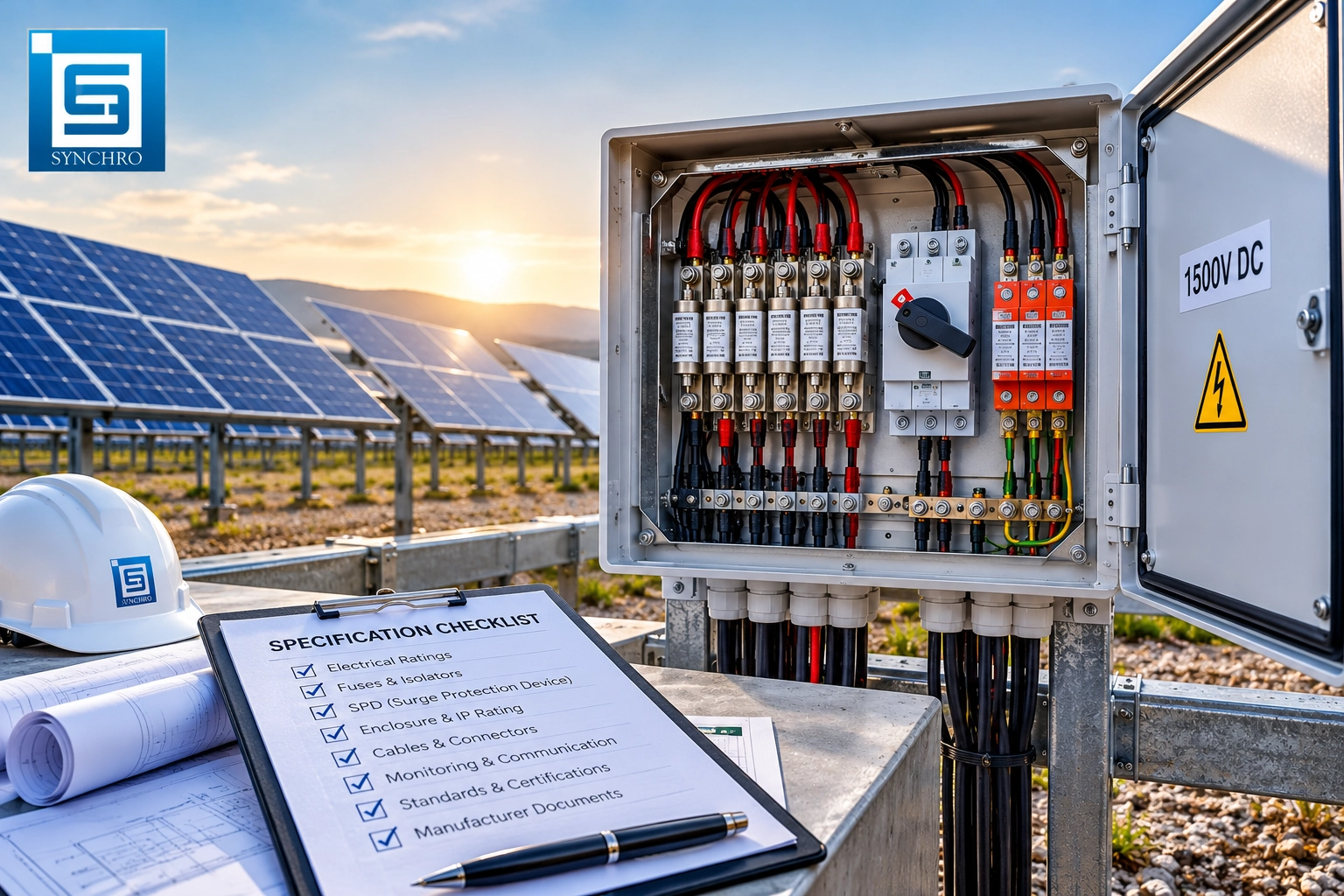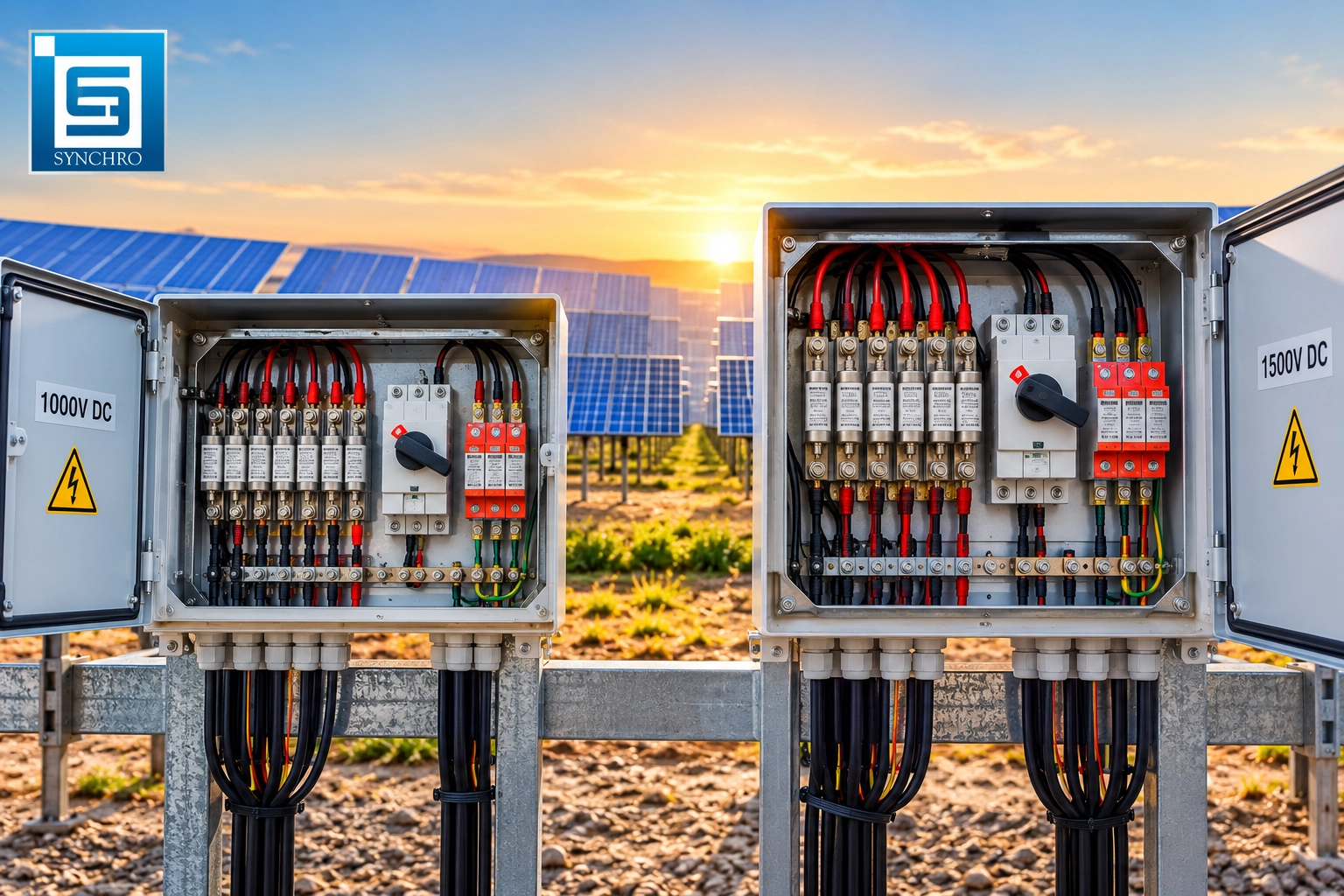
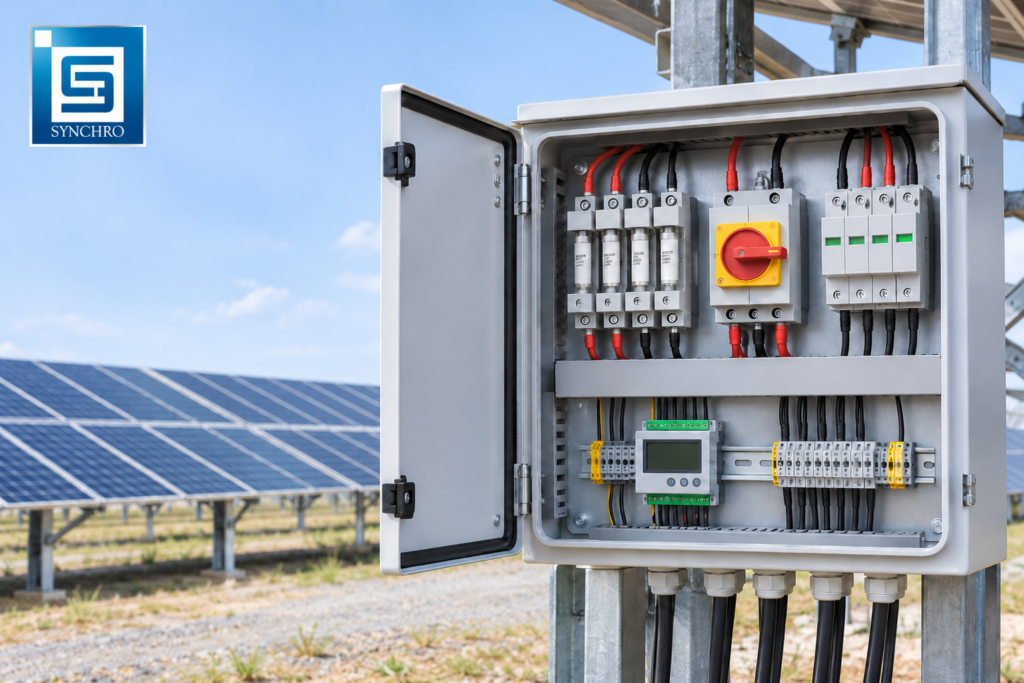
In a 1500V combiner box, three components carry almost all the protection duty: the string fuses, the main isolator and the surge protective device. Get these three right and the box will protect the plant for its life. Get any one wrong and the box becomes the fault.
This guide walks through how to select each one, the rules behind the numbers, and a complete worked example. It reflects how the engineering team at Synchro Electricals selects components for our string combiner boxes and the 1500VDC Solar DCDB Panel.
Start With the Array Data
Before choosing anything, collect:
- module Voc, Isc and Voc temperature coefficient (datasheet)
- module maximum series fuse rating (datasheet)
- bifacial gain, if using bifacial modules
- modules per string and strings per combiner box
- lowest and highest site temperatures
- system earthing arrangement and inverter requirements
- lightning exposure and any external lightning protection system
Part 1: Selecting 1500V gPV String Fuses
Why fuses are needed
When many strings are paralleled, a fault in one string lets the healthy strings drive reverse current into it. With three or more strings in parallel, that current can exceed what the module can survive. String fuses stop this.
Fuse class
Use gPV fuses to IEC 60269-6. They are designed to interrupt the low, steady overcurrents a PV array produces under fault. Ordinary gG fuses are not designed for this duty.
Fuse rating
IEC 62548 gives the rule for string overcurrent protection:
1.5 × Isc(module) ≤ fuse rating ≤ 2.4 × Isc(module), and the rating must not exceed the module’s maximum series fuse rating.
For bifacial modules, use the module current including expected rear-side gain, or the method in the module manufacturer’s installation manual. A fuse sized for front-side current only can blow on bright days with high ground reflection.
Temperature derating
Fuse ratings are given at a reference temperature. Inside a combiner box in direct sun, the internal temperature can be much higher. Apply the fuse manufacturer’s derating curve for the expected internal temperature, and check that the derated rating stays above the normal string current.
Physical format
1500V gPV fuses are physically longer than 1000V fuses (for example 10×85 mm formats versus 10×38 mm at 1000V). The fuse holders must be rated for 1500V DC as well. A 1500V fuse in a 1000V holder is not a 1500V circuit.
Part 2: Selecting the 1500V DC Isolator
Utilisation category
Choose a switch-disconnector rated DC-PV2 under IEC 60947-3 at 1500V. DC-PV2 covers switching PV circuits under load, which is what happens when an O&M technician isolates a combiner box at midday.
Current rating
The isolator must carry the combined current of all strings continuously. A common design approach is at least 1.25 × the combined Isc of the connected strings (including bifacial gain), after derating for the internal temperature of the enclosure.
Voltage and poles
The isolator’s rated voltage must cover the maximum string voltage at the lowest site temperature. Some isolators reach 1500V by connecting several poles in series. Follow the manufacturer’s wiring diagram exactly; an incorrect series connection reduces the voltage the isolator can break.
Other features
- visible or reliable position indication
- padlocking in the OFF position for safe maintenance
- auxiliary contact for monitoring, if the plant has an SMB or SCADA
Part 3: Selecting the 1500V PV SPD
Standard
Use a PV DC SPD tested to IEC 61643-31, which covers SPDs for the DC side of PV installations up to 1500V DC. Apply it following IEC 61643-32.
Ucpv
Ucpv must be at or above the maximum string open-circuit voltage at the lowest site temperature. Check the manufacturer’s application guidance for any additional margin.
Type
Type 2 where only induced surges are expected.
Type 1 or Type 1+2 where partial lightning current can enter the DC system.
Our detailed guide is Type 1 vs Type 2 SPD in solar DCDB.
Up, In and ISCPV
Up below the inverter’s DC impulse withstand voltage, allowing for lead length.
In suited to the expected surge frequency.
ISCPV (short-circuit current rating) at or above the array’s short-circuit current at that point.
Worked Example: 24-String 1500V Combiner Box
| Input | Value |
|---|---|
| Modules per string | 26 |
| Module Voc (STC) | 50.5 V |
| Voc temperature coefficient | −0.25 %/°C |
| Lowest site temperature | 5 °C |
| Module Isc (STC) | 14.0 A |
| Bifacial gain allowance | 10% |
| Module maximum series fuse rating | 30 A |
| Strings per combiner box | 24 |
| Step | Calculation | Result |
|---|---|---|
| String Voc at STC | 26 × 50.5 V | 1,313 V |
| Cold correction factor | 1 + 0.0025 × (25 − 5) | 1.05 |
| Maximum string Voc | 1,313 × 1.05 | about 1,379 V, within 1500V class |
| Fuse lower limit | 1.5 × 14.0 A | 21 A |
| Fuse upper limit | 2.4 × 14.0 A, capped at 30 A | 30 A |
| Bifacial string current | 14.0 × 1.10 | 15.4 A |
| Fuse choice | Next standard gPV rating that clears 1.5 × Isc and bifacial current after derating, within 30 A | 25 A gPV, 1500V |
| Combined Isc with bifacial gain | 24 × 15.4 A | 369.6 A |
| Isolator minimum | 1.25 × 369.6 A, before temperature derating | about 462 A; choose a 500 A DC-PV2 1500V isolator, then confirm derating |
| SPD Ucpv | At or above 1,379 V | 1500V-class PV SPD |
This example is illustrative. Real designs must use the actual datasheets, the module manufacturer’s fusing guidance and the component manufacturers’ derating curves.
Coordination Checks
- ☐ Every DC component rated 1500V DC on its rating plate
- ☐ Fuse rating between 1.5 and 2.4 × Isc and within the module series fuse rating
- ☐ Fuse derated for internal enclosure temperature
- ☐ Isolator DC-PV2, current rating after derating at or above 1.25 × combined Isc
- ☐ SPD Ucpv at or above maximum string Voc; Up below inverter withstand
- ☐ Busbars and terminals rated for the isolator current
- ☐ Cable sizes coordinated with fuse and isolator ratings
Why Work With Synchro Electricals
Synchro Electricals selects fuses, isolators and SPDs from your actual module datasheet, string layout and site temperatures. We name every component’s make, model and rating on the BOM, submit drawings for approval before ordering, and test every unit before dispatch with a test report. Our quality system is ISO 9001:2015 certified (certificates). For a full specification template, see our 1500V combiner box specification checklist.
Conclusion
Selecting protection for a 1500V combiner box is a calculation, not a catalogue choice. Size the gPV fuse within 1.5–2.4 × Isc and the module limit, size the DC-PV2 isolator for combined current after derating, and choose an SPD whose Ucpv covers the cold-morning string voltage. Then make sure every component, including the holders and terminals, is rated for 1500V DC.
Share your module datasheet and string layout, and our engineers will return a component selection with the calculations.
FAQs
1. What fuse is used for 1500V solar strings?
A gPV fuse to IEC 60269-6, rated for 1500V DC, sized between 1.5 and 2.4 times the module Isc and within the module’s maximum series fuse rating.
2. Can a gG fuse be used in a solar combiner box?
No. gG fuses are not designed to interrupt the low, steady fault currents of PV arrays. Use gPV fuses.
3. How do bifacial modules affect fuse sizing?
Bifacial modules produce extra current from the rear side. Include that gain in the current used for fuse and isolator sizing, following the module manufacturer’s guidance.
4. What does DC-PV2 mean?
DC-PV2 is a utilisation category in IEC 60947-3 for switch-disconnectors used in PV DC circuits, covering switching under PV load.
5. How is a 1500V DC isolator sized?
For voltage, at or above the maximum string Voc at the lowest temperature. For current, commonly at least 1.25 × the combined Isc of the connected strings, after temperature derating.
6. Why do fuses blow in combiner boxes without a fault?
Common causes are fuses sized without bifacial gain, insufficient temperature derating, or loose fuse holders causing local heating.
7. What SPD is used in a 1500V combiner box?
A PV DC SPD tested to IEC 61643-31 with Ucpv covering the maximum string voltage. The Type depends on lightning exposure.
8. Do I need fuses on both positive and negative?
It depends on the system earthing and inverter requirements. Floating systems commonly fuse both poles.
9. Are 1500V fuses physically larger?
Yes. They usually use longer formats, such as 10×85 mm, and need 1500V-rated holders.
10. How hot does a combiner box get inside?
In direct sun, the internal temperature can be well above ambient. Use component derating curves for the expected internal temperature.
11. What is the IEC 62548 fuse rule?
The string fuse rating should be at least 1.5 times and no more than 2.4 times the module Isc, and must not exceed the module’s maximum series fuse rating.
12. Can I use a 1000V isolator in series to get 1500V?
Only if the manufacturer specifies that series configuration for 1500V DC-PV2 duty. Follow their wiring diagram exactly.
13. What is ISCPV on an SPD?
It is the PV short-circuit current rating: the array short-circuit current the SPD can withstand safely if it fails.
14. How often should combiner box fuses be checked?
At each preventive maintenance visit, or continuously through string current monitoring, which shows a blown fuse as a string with zero current.
15. Can Synchro Electricals select components for our design?
Yes. Share your datasheets and layout, and our engineers will propose ratings and makes with calculations. Contact us.