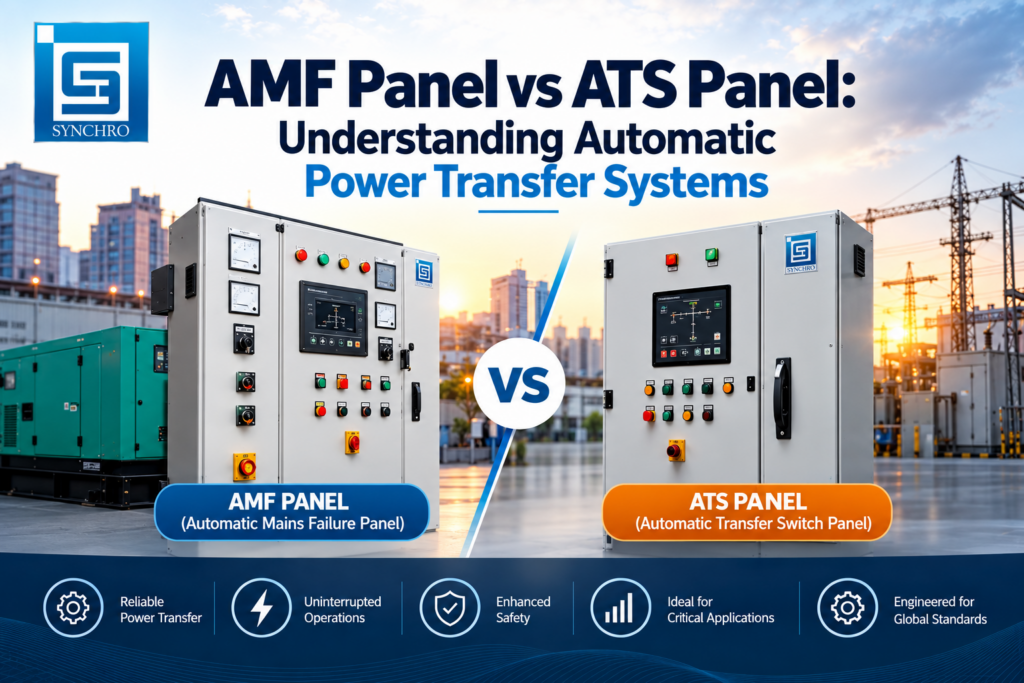
AMF Panel vs ATS Panel: Understanding Automatic Power Transfer Systems
When the grid drops at 2 a.m., nobody wants to walk to the generator room with a torch. Yet many small facilities still handle outages that way. The fix is an automatic power transfer system, and your first decision is the AMF Panel vs ATS Panel question. Do you need a panel that starts the generator and switches the load, or one that only moves the load between two live sources?
Suppliers often use the two terms as if they mean the same thing. They overlap, but they are not identical. Choose wrongly and you either pay for features you never use, or find out on outage day that nothing starts the generator. This guide comes from the panel-building side, from the team at Synchro Electricals. It explains how each panel works, where each fits, and what to check before you order.
COMMON QUESTION ASKED:-
What Is an Automatic Power Transfer System?
An automatic power transfer system detects a loss or degradation of the normal supply, usually utility mains. It shifts the load to an alternate source, typically a diesel generator or a second feeder. Once mains is stable again, it brings the load back.
Done well, this is one of the most dependable backup power solutions for a building or plant. It also forms the backbone of any uninterrupted power supply plan that includes a generator. A generator needs several seconds to start and stabilise. A UPS bridges that gap for sensitive equipment, and the transfer system carries the site through the long outage.
What Is an AMF Panel?
An automatic mains failure (AMF) panel does three jobs. It watches the mains, commands the generator, and moves the load. Think of it as both the brain and the muscle of a standby system.
How an AMF Panel Works, Step by Step
- The controller continuously reads mains voltage, frequency and phase sequence.
- If readings leave the set limits, a mains-fail delay timer starts. This prevents a nuisance start during a momentary dip.
- When the timer expires, the controller sends a start command and the generator cranks. It usually gets a set number of attempts.
- The controller checks that generator voltage and frequency are healthy before accepting any load.
- Interlocked contactors or breakers transfer the load to the generator.
- When mains returns and stays stable for a set period, the load transfers back. The generator then runs through a cool-down and stops.
Core Components of an AMF Panel
Three building blocks define the design. The controller monitors the mains and manages generator start and stop. The automatic start module initiates the generator when the mains fails. The switchgear does the physical transfer through contactors or breakers. A well-built assembly adds protective relays, indication and neat control wiring around them. These features are the heart of modern generator control systems.
What Is an ATS Panel?
The automatic transfer switch (ATS) is the device that physically moves a load between two sources. An ATS panel houses that switching hardware, its sensing and control logic, and the mechanical and electrical interlocking. The interlocking makes sure the two sources are never connected together unintentionally.
A basic ATS panel does not run the generator. If the generator already has its own auto-start controller, or if both sources are utility feeders, the ATS simply waits for a healthy source and switches. Many ATS panels also include a simple start-signal contact. At that point they behave much like an AMF panel, and naming varies by supplier. Always define the exact scope in your specification.
Types of Transfer You Should Know
- Open transition: the switch breaks the first source before making the second. It is simple, reliable and the most common choice.
- Delayed transition: a deliberate pause lets motor and transformer residual voltages decay before reconnecting.
- Closed transition: the sources briefly overlap so there is no interruption. This needs a sync-check, and it is where a synchronizing panel enters the picture (more on that below).
For healthcare loads, see our detailed article on ATS panels for hospitals and emergency power transfer.
AMF Panel vs ATS Panel: Side-by-Side Comparison
| Feature | AMF panel | ATS panel |
|---|---|---|
| Primary role | Monitors mains, starts and stops the generator, transfers the load | Transfers the load between two available sources |
| Generator start command | Built in | Only if a start-signal contact is included |
| Typical sources | Mains plus a generator | Mains plus a generator, or two utility feeders |
| Control complexity | Higher, with timers, crank logic and engine protections | Lower, focused on sensing and switching |
| Best for | Unmanned or remote sites and single-generator standby | Sites where the generator has its own controller, or dual-feeder setups |
| Cost | Usually higher | Usually lower |
| Remote monitoring | Common, with power monitoring and control options | Available on advanced models |
Which One Do You Need?
- One generator, no auto-start controller, fully automatic operation wanted: choose an AMF panel.
- Generator with its own auto-start controller, or two utility feeders: an ATS panel is usually enough and more economical.
- Unmanned telecom, pumping or remote sites: choose AMF, ideally with remote alarms.
- Hospitals and data centres: either type can work. Design it with a UPS, redundancy and tested transfer times.
- Two or more generators sharing one bus: you need paralleling, which means a synchronizing panel on top of the transfer logic.
When You Also Need a Synchronizing Panel
A single standby generator never needs synchronization. Multiple generators do. Generator synchronization means matching voltage, frequency and phase angle before the sets connect to a common bus. That match also lets them share the load proportionally. A synchronizing panel handles this load sharing, and it enables closed-transition transfers back to the grid. If your project may grow from one generator to several, plan the layout now to save costly rework later.
Design Factors to Check Before You Order
Most disputes on site trace back to a few overlooked details:
- Ratings: size the current rating on connected load with margin. Voltage and current ratings follow the application and the power sources involved.
- Motor loads: starting currents can be several times running current. Where large motors are involved, review the MCC panel and VFD panel arrangement so motor control behaves well after transfer.
- Fault level: the panel must withstand the available short-circuit current. Read how fault-level calculations influence switchgear selection.
- Pole configuration: whether to switch the neutral (3-pole vs 4-pole) depends on how neutrals and earthing are arranged. Settle it with your electrical designer before ordering.
- Breaker choice: the circuit breaker type, whether MCCB or ACB, and its mechanical and electrical interlocks should suit the duty.
- Standards: assemblies are commonly built to IEC 61439, and transfer switching equipment falls under IEC 60947-6-1. Ask for type tested panel evidence rather than a verbal assurance.
- Distribution fit: a transfer panel usually feeds a wider PCC panel or power distribution panel, so confirm incomer ratings match.
- Wiring quality: neat, labelled control wiring makes faults far faster to trace. See these panel wiring design best practices.
Testing: Don’t Skip the Outage Simulation
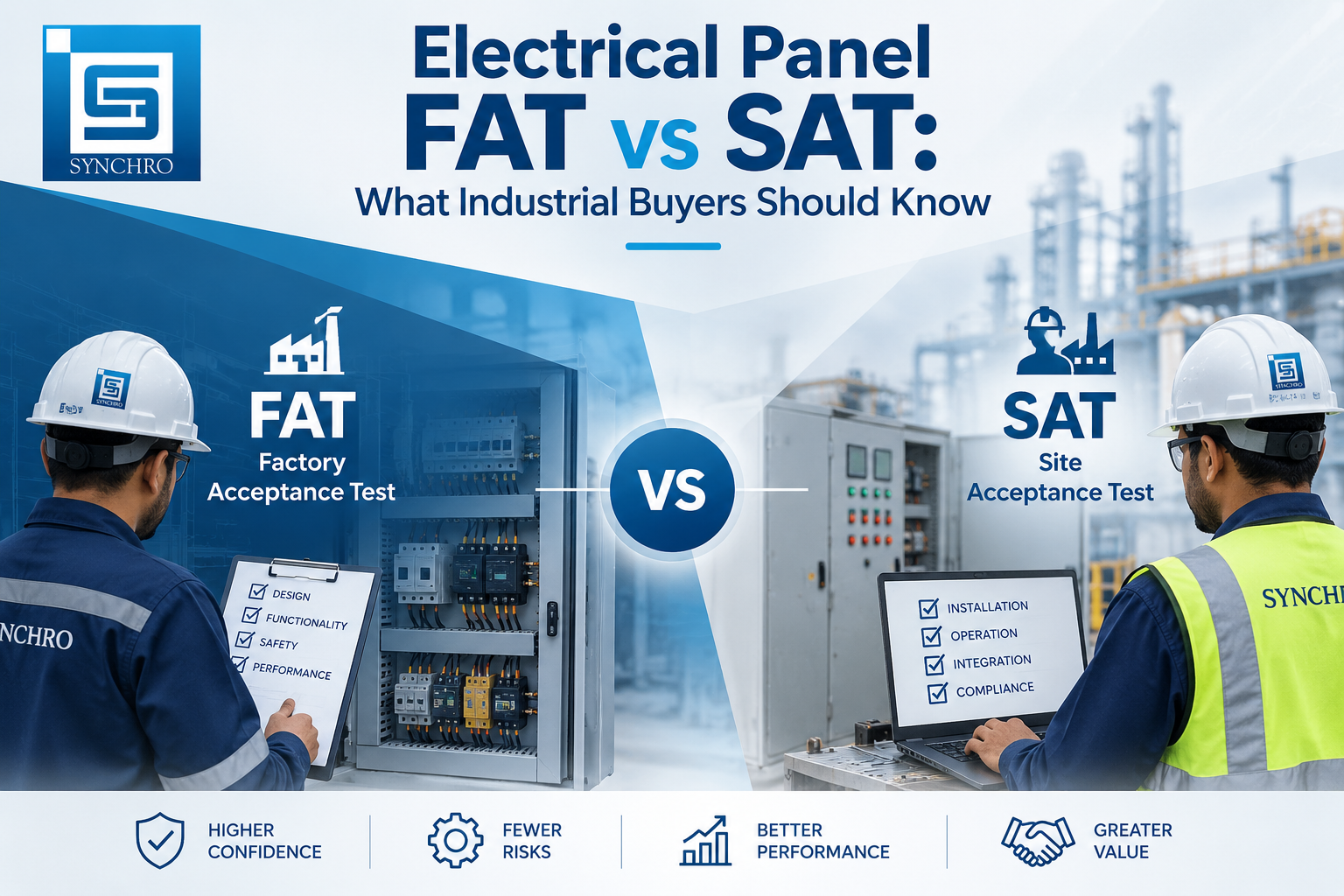
A transfer system that has never been tested is a hope, not a system. A proper factory acceptance test switches off the mains, runs the whole start-transfer-retransfer-stop sequence, and verifies timers and interlocks. Site testing then repeats it with the real generator and real load. Our guide to electrical panel FAT vs SAT explains what to witness and what to sign off. Many facilities also exercise the system on a regular schedule, commonly monthly. Follow the generator manufacturer’s advice and your site policy.
Why Work With Synchro Electricals
As an electrical panel manufacturer based in Rajkot, Gujarat, Synchro Electricals has built LT and HT panels for industrial, solar and infrastructure projects since 2018. Here is how we work:
- Design approval first: technical drawings go to you for approval before manufacturing begins.
- Every panel tested: high-voltage, insulation and functional tests are done, and a test report ships with each order.
- Verifiable quality: see our certifications, including ISO 9001:2015.
- Honest timelines: our site quotes typically 3 to 6 weeks for standard panels and 6 to 10 weeks for custom-designed ones, confirmed in writing at order.
Browse the wider product range or contact our engineering team with your generator rating and load details. We will recommend the right configuration.
Conclusion
The AMF Panel vs ATS Panel decision comes down to one question: who starts the generator? If you want the panel to do it, along with monitoring and protection, choose AMF. If another controller already handles the engine, or you are switching between two feeders, an ATS panel does the job cleanly. Whichever route you take, get the ratings, fault level, interlocking and testing right, and the system will perform on the day you need it. Share your requirements with Synchro Electricals and our engineers will help you specify it properly.
FAQS:-
1.What does AMF stand for?
AMF stands for Automatic Mains Failure. The panel detects a mains failure and automatically starts the generator and transfers the load.
2.What does ATS stand for?
ATS stands for Automatic Transfer Switch. It moves the electrical load between two power sources and returns it when the normal source recovers.
3.Are AMF and ATS panels the same thing?
No. They overlap, but an AMF panel also controls the generator, while a basic ATS panel only transfers the load between sources.
4.Can an ATS panel start a generator?
Only if it includes a start-signal contact or a generator control function. Otherwise the generator needs its own auto-start controller.
5.Which costs more?
An AMF panel usually costs more because it adds generator control logic, timers and engine protections. Final pricing depends on ratings and options.
6.How fast is the changeover?
The switching itself takes a fraction of a second to a few seconds. Total time without supply is longer because the generator must start and stabilise, commonly around 10 to 30 seconds depending on the set and timer settings.
7.Do I still need a UPS?
For sensitive loads such as servers and medical equipment, yes. A UPS covers the gap while the generator starts, since transfer systems cannot provide zero interruption.
8.What is the difference between open and closed transition?
Open transition breaks the first source before making the second. Closed transition briefly overlaps them to avoid interruption and requires synchronization.
9.Can an AMF panel work with two generators?
Yes, but you need paralleling and a synchronizing panel to match the sets and share the load.
10.Where are these panels typically used?
They are used in hospitals, data centres, telecom sites, industrial plants, commercial buildings and remote installations where continuity matters.