A vague combiner box specification invites the cheapest possible box. Bidders fill each gap with the lowest-cost option: a smaller enclosure, an unnamed SPD, fuses without a stated class, no test documents. Then the EPC’s quality team discovers the gaps at inspection, or worse, the O&M team finds them two summers later.
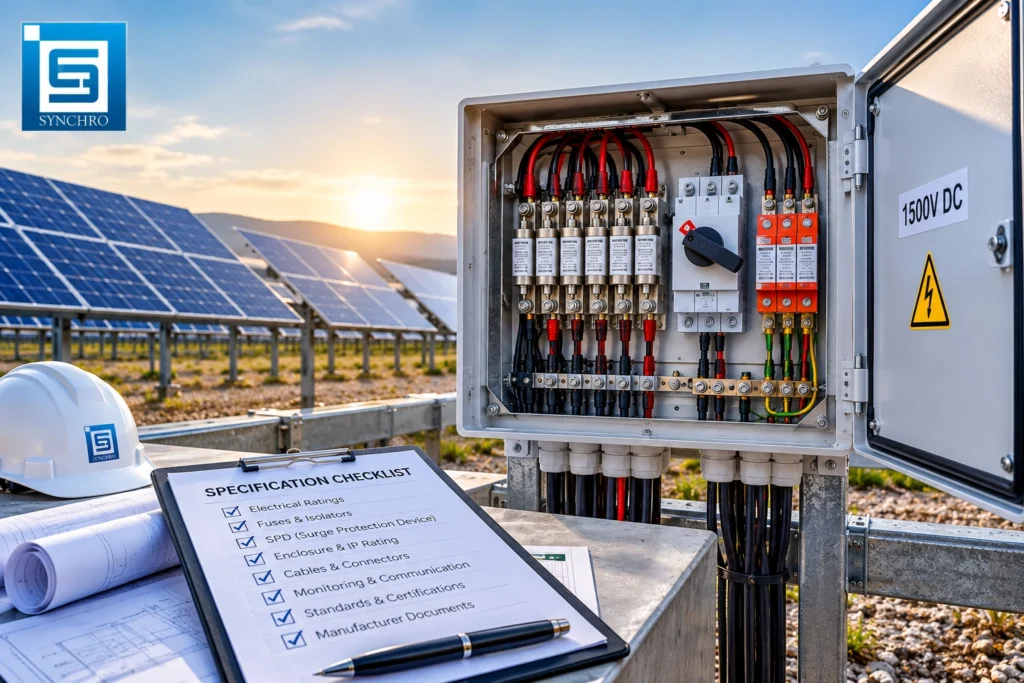
This checklist helps tender teams write, or review, a 1500V string combiner box (SCB) specification that leaves no room for guessing. It reflects what our engineering team at Synchro Electricals asks for when an RFQ arrives without enough detail.
How to Use This Checklist
Work through each section and fill in the project value. Where you do not know the value, ask the design team before the tender goes out. A clarification after award costs time; a missing specification costs quality.
1. General and Site Data
| Parameter | What to specify | Why it matters |
|---|---|---|
| Applicable standards | IEC 61439-2 (assembly), IEC 60269-6 (gPV fuses), IEC 60947-3 (isolator), IEC 61643-31 (SPD), IEC 62548 (PV array design) | Sets the baseline for every component |
| Site location | State, district, coastal or inland | Corrosion, dust and lightning exposure |
| Ambient temperature | Maximum and minimum, with solar radiation | Derating of fuses and isolators; cold-weather Voc |
| Altitude | Metres above sea level | Insulation derating above certain altitudes |
| Pollution level | Dust, salt, industrial | Creepage distances |
| Quantity and delivery schedule | Units and phased dates | Production planning |
2. Electrical Ratings
| Parameter | What to specify | Typical note |
|---|---|---|
| Maximum system voltage | 1500V DC | Must cover cold-weather string Voc |
| Number of inputs | For example 16, 24 or 32 | From inverter and layout design |
| Number of outputs | Usually 1 (positive and negative) | Match DC cable design |
| String Isc | From module datasheet, including bifacial gain if applicable | Bifacial modules raise current |
| Rated output current | Sum of string currents with margin | Sets isolator and busbar rating |
| Short-time withstand | If required by design | Needed for busbar design |
| Earthing arrangement | Floating, negative-earthed, etc. | Decides single- or double-pole fusing |
3. Components
| Component | Specify | Check at review |
|---|---|---|
| String fuses | gPV, 1500V DC, IEC 60269-6, rating in amps | Rating between 1.5 and 2.4 × Isc and within module series fuse rating |
| Fuse holders | 1500V DC, touch-safe | Same voltage class as fuse |
| Fusing | Positive only or positive and negative | Depends on earthing arrangement |
| Main isolator | 1500V DC, DC-PV2 per IEC 60947-3, current rating | Current at site temperature, not just catalogue value |
| SPD | PV DC SPD per IEC 61643-31, Type 1+2 or Type 2, Ucpv, In, Up | Ucpv covers maximum string voltage; Up below inverter withstand |
| Busbars | Material, plating, current rating | Tinned copper common |
| Terminals | Input cable size range, output cable size | Must accept the actual cable sizes |
| Approved makes | List of acceptable brands for fuses, isolator, SPD | Avoids substitutions |
4. Enclosure
| Parameter | What to specify |
|---|---|
| Material | GRP/FRP, polycarbonate or powder-coated metal |
| IP rating | IP65 or higher for outdoor use |
| UV resistance | UV-stabilised material, test evidence |
| Impact rating | IK rating if required |
| Ventilation | Breather or vent with IP maintained, to control condensation |
| Mounting | Pole, structure or wall mounting arrangement |
| Cable entry | Glands sized for input and output cables, bottom entry |
| Door | Lockable, with earthing link if metallic |
| Labelling | Warning labels, input numbering, rating plate, QR or serial number |
5. Monitoring (if Required)
Monitoring turns a combiner box into a string monitoring box. If it is required, specify:
- per-string current measurement (sensor type and accuracy)
- voltage measurement at the output
- SPD status and isolator status inputs
- enclosure temperature measurement, if needed
- communication: RS485 Modbus RTU, addressing and baud rate
- auxiliary supply: self-powered from the strings or external
- integration test with the plant SCADA
See also our guide on choosing between SCB and SMB.
6. Testing and Inspection
| Test | Where | Requirement |
|---|---|---|
| Visual and dimensional check | Factory | Against approved GA and BOM |
| Insulation resistance | Factory, every unit | Recorded value per unit |
| Dielectric (power-frequency withstand) test | Factory, every unit | As per IEC 61439 for the rated insulation voltage |
| Polarity and continuity | Factory, every unit | All inputs to output |
| Functional check of monitoring | Factory | Communication and readings verified |
| Type test or design verification evidence | Documents | Temperature rise and IP test evidence for the design |
| Factory acceptance test (FAT) | Factory, sample basis | Witnessed by the EPC or owner’s engineer |
Our post on electrical panel FAT vs SAT explains how to plan inspections.
7. Documents
- GA drawing with dimensions and mounting details
- Single-line and wiring diagram
- BOM with make, model, and rating of every component
- Component datasheets and certificates (fuse, isolator, SPD, enclosure)
- Test reports per unit or per batch
- Design verification documents
- Installation and O&M manual
- Warranty terms
Common Gaps We See in Tender Specifications
| Gap | Consequence |
|---|---|
| Only “1500V combiner box, 24 input” written | Every bidder quotes a different box |
| Fuse rating left to the bidder | Fuses chosen without bifacial gain, causing nuisance blowing |
| SPD Type and Ucpv not stated | Under-rated SPDs that fail early |
| No approved makes | Unknown component brands |
| Enclosure “IP65” with no UV requirement | Brittle enclosures after a few summers |
| No test document requirement | No proof of factory testing |
Why Work With Synchro Electricals
Synchro Electricals manufactures string combiner boxes, string monitoring boxes and the 1500VDC Solar DCDB Panel in Rajkot, Gujarat, under an ISO 9001:2015 certified quality system. When an RFQ is incomplete, our engineers send back a clarification list rather than guessing. We submit drawings and the full BOM for approval before ordering components, test every unit before dispatch, and welcome witnessed FATs at our factory.
Conclusion
A complete 1500V combiner box specification covers seven areas: site data, electrical ratings, components, enclosure, monitoring, testing and documents. Fill each one before the tender goes out and every bid you receive will be comparable, every box will be checkable, and the cheapest offer will no longer win by leaving things out.
Send us your tender specification for a technical review and quote.
FAQs
1. What should a 1500V combiner box specification include?
Site data, electrical ratings, fuse and isolator details, SPD details, enclosure, monitoring requirements, testing and documentation.
2. What is the standard for string combiner boxes?
The assembly is usually specified to IEC 61439-2, with components to IEC 60269-6 (fuses), IEC 60947-3 (isolators) and IEC 61643-31 (SPDs). Array design follows IEC 62548.
3. How is the string fuse rating chosen?
Between 1.5 and 2.4 times the module Isc, within the module’s maximum series fuse rating, with allowance for bifacial gain where applicable.
4. What is a 16 in 1 out combiner box?
A combiner box that takes 16 string inputs, protects each with fuses, and combines them into one DC output to the inverter.
5. Should both positive and negative be fused?
It depends on the system earthing. In floating systems, fusing both poles is common. Follow the inverter and design requirements.
6. Which SPD Type is specified for utility combiner boxes?
Often Type 1+2 or Type 2, depending on the lightning risk assessment. Ucpv must cover the maximum string voltage.
7. What IP rating is needed for an outdoor combiner box?
IP65 or higher is common, with a UV-stabilised enclosure and condensation control.
8. What is the difference between SCB and SMB?
An SCB (string combiner box) combines and protects strings. An SMB (string monitoring box) does the same and also measures string currents and communicates them to SCADA.
9. What tests should be done on combiner boxes before dispatch?
Visual and dimensional checks, insulation resistance, dielectric withstand, polarity and continuity, and functional checks of monitoring if fitted.
10. Should approved makes be listed in the tender?
Yes. Listing acceptable brands for fuses, isolators and SPDs prevents substitutions and makes bids comparable.
11. Does bifacial gain affect combiner box design?
Yes. Bifacial modules produce extra current from the rear side, which affects fuse, isolator and cable ratings.
12. What documents should come with combiner boxes?
GA drawing, wiring diagram, BOM with makes, component certificates, test reports, design verification documents and an O&M manual.
13. Can a combiner box be witnessed at the factory?
Yes. A factory acceptance test on sample units is common practice for EPC projects.
14. Why do combiner box enclosures crack?
Usually because the material is not UV-stabilised for long-term outdoor exposure.
15. Can Synchro Electricals review our combiner box specification?
Yes. Send us your specification, and our engineers will return clarifications and a technical offer.