Indian utility-scale solar has moved to 1500V DC. Along with it, a piece of equipment that used to be unusual has become standard: the 800Vac panel. If your plant uses 1500V string inverters, there is a good chance their AC output is 800V. Every one of those inverter outputs has to be collected, protected, and fed to a transformer. That is the 800Vac panel’s job.
This guide explains what an 800Vac panel is, why the voltage is 800V and not 415V, what goes inside, and what EPC teams should check when they specify one.
Where the 800Vac Panel Sits in a 1500V Plant
A typical block in a string-inverter plant looks like this:
- PV strings at up to 1500V DC feed a string inverter, either directly or through a DC combiner.
- Each string inverter converts DC to AC and outputs 800V AC (three-phase, usually without neutral).
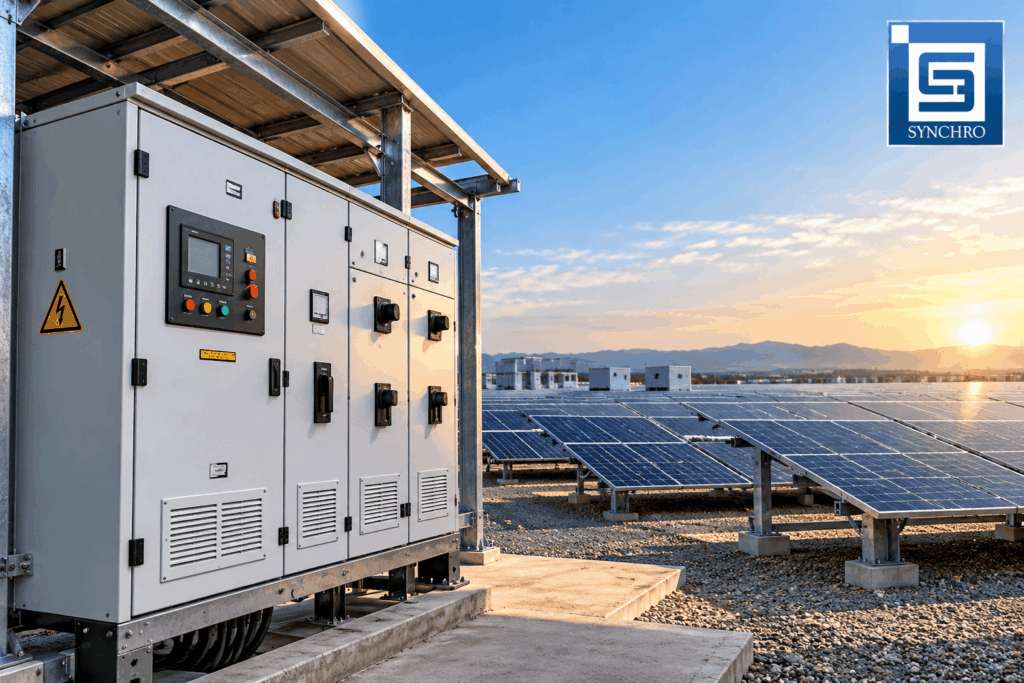
- The outputs of several inverters run to an 800Vac panel, also called an AC combiner panel or LT panel.
- The panel combines them onto a busbar, protects each incoming feeder, and feeds the low-voltage side of the inverter-duty transformer.
- The transformer steps the voltage up (for example to 11kV or 33kV) for the plant’s collection system.
In central-inverter plants, the combination happens on the DC side, in string combiner boxes. In string-inverter plants it moves to the AC side, which is why the 800Vac panel has become so common.
Why 800V and Not 415V?
For the same power, a higher voltage means a lower current. Lower current means smaller cables, smaller busbars and lower resistive losses.
| Inverter output | Current at 415V | Current at 800V |
|---|---|---|
| 100 kW | 139 A | 72 A |
| 250 kW | 348 A | 180 A |
| 300 kW | 417 A | 217 A |
| 3 MW block (combined) | about 4,170 A | about 2,165 A |
Currents are calculated as power ÷ (1.732 × voltage) at unity power factor.
At 800V, a 3MW block carries roughly half the current it would at 415V. That makes busbars, cables and the transformer’s LV side smaller and cheaper. Cable losses, which rise with the square of current, drop sharply. It also matches the 1500V DC side: an inverter working from a 1500V DC input naturally produces a higher AC output voltage.
What Is Inside an 800Vac Panel
| Section | Typical components | What to check |
|---|---|---|
| Incoming feeders | One MCCB (or fused switch) per inverter | Rated operational voltage of 800V AC; breaking capacity at 800V, not at 415V |
| Busbar | Copper or aluminium main busbar | Current rating at site ambient; short-time withstand rating |
| Outgoing | ACB or MCCB to transformer LV | Rated at 800V AC; protection relay or release settings coordinated with the transformer |
| Surge protection | AC SPD rated for 800V systems | Continuous operating voltage suitable for 800V |
| Metering | Multifunction meters, CTs | Meter rated for 800V or fed through suitable PTs |
| Auxiliary supply | Auxiliary transformer for control and lighting | Most control devices are not 800V-rated, so a step-down supply is needed |
| Enclosure | Indoor or outdoor, IP rated | IP rating, ventilation and heat rise at site temperature |
One detail often missed: a breaker’s breaking capacity falls as voltage rises. A breaker frame that interrupts a high fault current at 415V will have a lower rating at 690V or 800V, and some frames are not rated at 800V at all. Every switching device must have a declared rating at the panel’s operating voltage.
Why Type Testing Matters for 800Vac Panels
An 800Vac panel combines several hundred kilowatts to several megawatts on one busbar, right next to a transformer. If a short circuit happens, the fault current is high. The panel has to carry that current for a set time without the busbars bending, supports breaking or the enclosure failing. It must also stay within temperature limits while running at full output in a hot inverter room or outdoors.
That is why EPC specifications for 800Vac panels usually require design verification to IEC 61439, including temperature-rise and short-circuit withstand verification. Read our guide on type-tested 800Vac panels and IEC 61439 (activate once live) and our general IEC 61439 verification guide.
800Vac Panel vs Conventional LT Panel
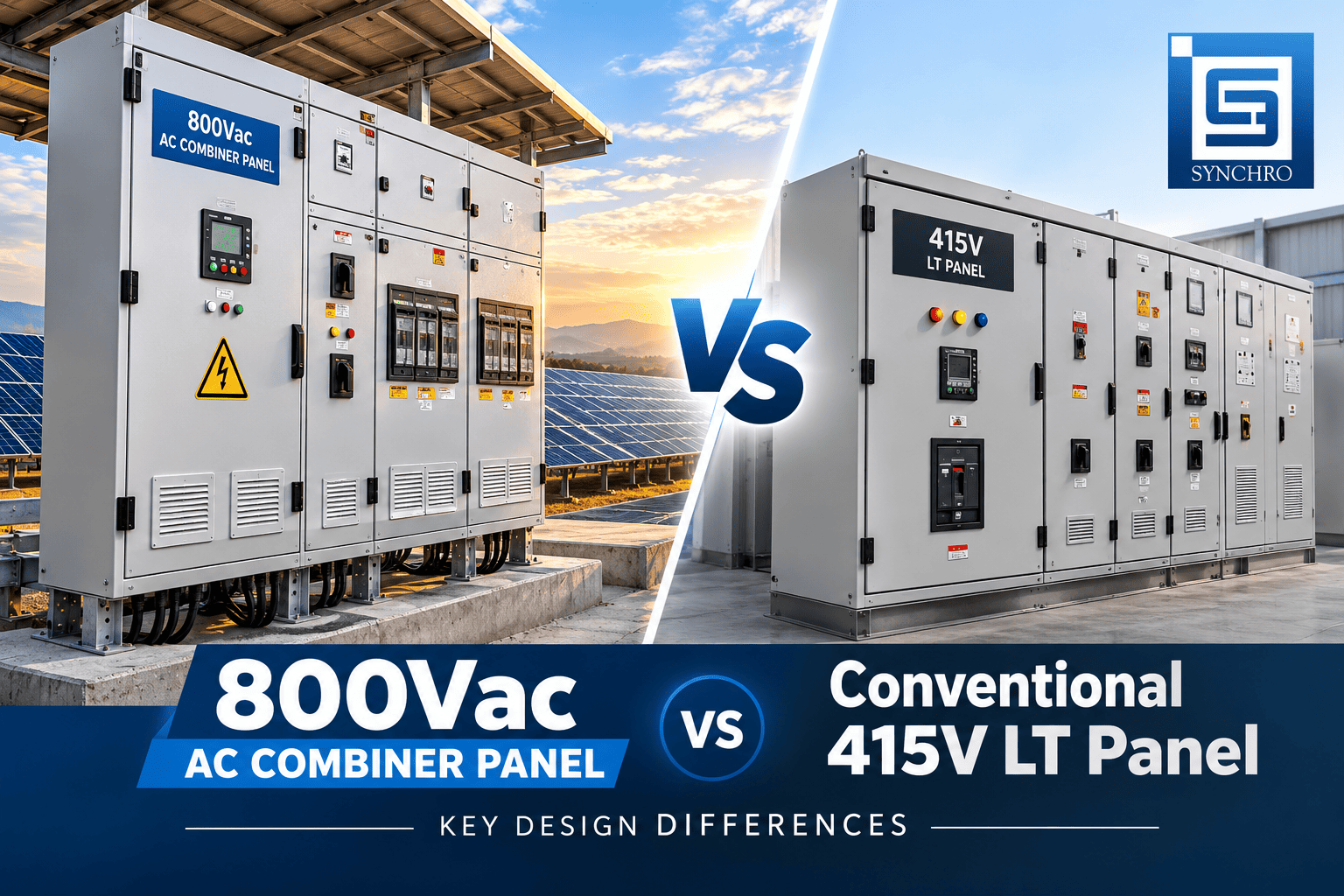
An 800Vac panel looks similar to a 415V LT panel, but the design is different in several ways: device ratings, insulation, clearances, the auxiliary supply, and the absence of a neutral. Our detailed comparison is in 800Vac AC combiner panel vs 415V LT panel (activate once live).
What EPC Teams Should Specify
- Number of incoming inverters and each inverter’s maximum output current
- Transformer rating and LV fault level
- Busbar rating and short-time withstand current
- Required design verification (IEC 61439) and test documents
- Indoor or outdoor installation, IP rating and site ambient temperature
- Metering, communication (Modbus/RS485) and SCADA interface
- Cable entry (top or bottom) and cable sizes
- Space for future inverters, if expansion is planned
Why Work With Synchro Electricals
Synchro Electricals manufactures the 800VAC Solar Type Tested Panel for utility-scale and large C&I solar plants. The panel is type-tested to IEC 61439, test documents are shared with buyers on request, and our certifications are published on our certificate page. We also build the DC side of 1500V plants, including the 1500VDC Solar DCDB Panel and string combiner boxes.
Our process: drawings and BOM approved by you before components are ordered, testing before dispatch with a test report, and technical support during installation and commissioning. See an example in our 800Vac solar panel case study.
Conclusion
The 800Vac panel is the AC heart of a 1500V string-inverter plant. It collects inverter outputs at a voltage that roughly halves the current compared with 415V, which saves copper and cuts losses. Because it carries a large share of the plant’s power next to a transformer, the panel must be built from devices rated at 800V and verified for heat and short-circuit performance.
Planning a 1500V plant? Share your SLD and inverter details and our team will prepare a technical proposal.
FAQs
1. What is an 800Vac panel?
An 800Vac panel is an AC combiner or LT panel that collects the 800V AC outputs of several string inverters, protects each feeder and feeds the low-voltage side of a transformer.
2. Why do solar plants use 800V AC?
For the same power, 800V carries about half the current of 415V. That means smaller cables and busbars and lower losses. Many 1500V DC string inverters output 800V AC.
3. Is an 800Vac panel the same as an AC combiner box?
They do the same job. “AC combiner box” usually means a smaller outdoor unit; “800Vac panel” usually means a larger floor-standing panel feeding a transformer.
4. What is the relationship between 1500V DC and 800V AC?
A 1500V DC string inverter typically produces a three-phase AC output of around 800V. The 800Vac panel collects these outputs.
5. Does an 800Vac panel have a neutral?
Many 800V string inverter systems run as three-phase, three-wire without a distributed neutral. Follow the inverter and transformer design.
6. Can I use 415V breakers in an 800Vac panel?
No. Every switching device must be rated for 800V AC operation, with a declared breaking capacity at that voltage.
7. What breaker is used in an 800Vac panel?
Usually MCCBs on each inverter incomer and an ACB or large MCCB on the outgoing feeder to the transformer, all rated for 800V AC.
8. Does an 800Vac panel need type testing?
Most utility and EPC specifications require design verification to IEC 61439, including temperature rise and short-circuit withstand, because the panel carries high power and fault levels.
9. How many inverters can connect to one 800Vac panel?
It depends on inverter size, transformer rating and busbar design. Panels commonly combine anything from a few to a dozen or more inverters per block.
10. Where is an 800Vac panel installed?
Usually next to the inverter-duty transformer, either indoors in an inverter room or outdoors in an IP-rated enclosure.
11. What is the difference between central and string inverter plant panels?
Central-inverter plants combine strings on the DC side using string combiner boxes. String-inverter plants combine on the AC side using 800Vac panels.
12. How do you power control circuits in an 800Vac panel?
Through an auxiliary transformer or separate auxiliary supply, because most control devices are not rated for 800V.
13. What surge protection does an 800Vac panel need?
An AC SPD rated for 800V systems, selected to the site’s surge exposure and the inverters’ withstand.
14. What information is needed to quote an 800Vac panel?
The SLD, inverter count and model, transformer rating and fault level, busbar rating, verification requirements, IP rating, metering and SCADA needs.
15. Does Synchro Electricals make 800Vac panels?
Yes. Synchro Electricals manufactures the 800VAC Solar Type Tested Panel. Contact us with your project details.