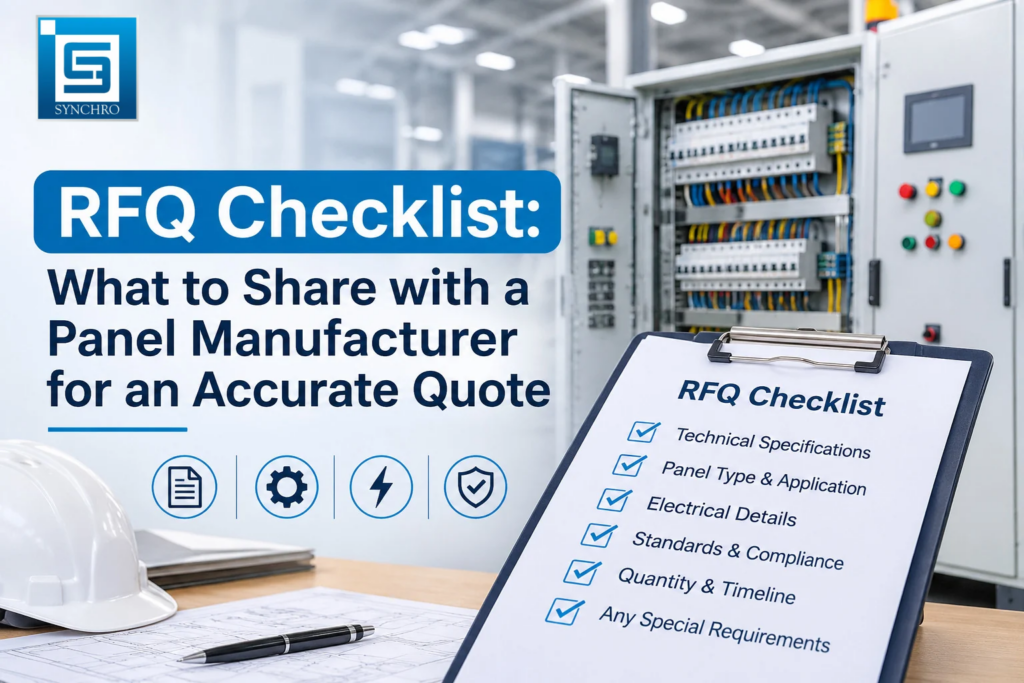
“Please quote for a 24-input combiner box” or “Need price for ACDB DCDB 5kW” are the kinds of RFQs panel manufacturers receive every day. They usually lead to one of two outcomes. Either the manufacturer sends back a list of questions and the quote takes longer, or the manufacturer makes assumptions and the quote looks good until the drawings arrive.
An RFQ with the right information gets an accurate, comparable quote quickly. This checklist covers what to share for any electrical panel, plus the extra details needed for solar ACDB/DCDB boxes, combiner boxes and 800Vac panels. It is written by the engineering team at Synchro Electricals, from the questions we most often have to ask.
Why a Complete RFQ Matters
| Incomplete RFQ | Complete RFQ |
|---|---|
| Each supplier assumes different ratings | Every quote is for the same panel |
| Quotes cannot be compared | Like-for-like comparison |
| Clarification rounds delay the quote | Faster response |
| Gaps discovered at drawing stage | Drawings approved quickly |
| Cheapest quote wins by leaving things out | Quality and price both visible |
Part 1: Information for Every Panel RFQ
Project information
- Project name, location and end use (industrial, solar, commercial, infrastructure, government)
- Indoor or outdoor installation
- Site conditions: ambient temperature range, altitude, coastal or dusty location
- Quantity and required delivery schedule (single or phased)
Technical information
- Single-line diagram (SLD), even a draft
- System voltage, frequency, number of phases and earthing system
- Fault level at the panel location (kA and duration)
- Incomer and outgoing details: type, rating and number
- Busbar rating and material preference
- Required IP rating and form of separation (where applicable)
- Metering, protection relays and communication needs
- Cable entry (top or bottom) and cable sizes
- Approved makes list for major components
- Applicable standards (for example IEC 61439) and the specification document
Quality and documentation
- Required tests and whether FAT will be witnessed
- Type test or design verification evidence required
- Documents needed for approval and handover
Commercial
- Delivery location and terms (ex-works, delivered, or Incoterms for export)
- Payment terms expected
- Warranty requirement
- Installation, supervision or commissioning support needed
Part 2: Extra Details for Solar ACDB/DCDB Boxes
- Inverter make and model (and number of MPPTs)
- Module datasheet (Voc, Isc, temperature coefficient)
- Modules per string and strings per MPPT
- Single-phase or three-phase grid connection
- DISCOM or scheme requirements
- Enclosure material preference (polycarbonate, FRP or metal)
- Quantity per system-size band, for bulk orders
- Labelling requirements (band, serial number, your branding if needed)
See our ACDB and DCDB sizing guide for why each of these matters.
Part 3: Extra Details for String Combiner and Monitoring Boxes
- Maximum system voltage (1000V, 1100V or 1500V DC)
- Number of inputs and outputs
- Module Isc, including bifacial gain if applicable, and module maximum series fuse rating
- Fusing: positive only, or positive and negative
- SPD Type requirement and lightning protection details
- Monitoring: per-string current, voltage, SPD status, communication protocol
- Mounting arrangement on the structure
See the 1500V combiner box specification checklist.
Part 4: Extra Details for 800Vac Panels
- Number of inverters and each inverter’s maximum output current
- Transformer rating, LV voltage and fault level
- Outgoing breaker type and protection requirements
- Auxiliary supply arrangement
- SCADA signals and communication protocol
- IEC 61439 design verification requirements
- Indoor or outdoor enclosure, IP rating and design ambient
Read what an 800Vac panel is and 800Vac vs 415V LT panel design differences.
Part 5: Extra Details for Industrial LT Panels
For PCC, MCC, APFC and AMF/ATS panels, also share:
- Load list with motor ratings and starter types (MCC)
- Transformer and DG ratings (PCC, AMF)
- Target power factor and kVAR (APFC)
- Changeover logic (AMF/ATS)
If You Don’t Have Every Detail
That is normal at early stages. Send what you have, mark the unknowns, and ask the manufacturer to state their assumptions in the offer. A good manufacturer will list assumptions clearly, so you can compare offers fairly and correct them before ordering.
Why Work With Synchro Electricals
Synchro Electricals responds to enquiries within 24 hours. When an RFQ is incomplete, our engineers send a short clarification list or state assumptions clearly in the offer. After order, drawings are submitted for approval before components are ordered, and every order is tested before dispatch with a test report. We are an ISO 9001:2015 certified manufacturer in Rajkot, Gujarat (certificates). See our full product range, or read how EPC contractors can source electrical panels from India.
Conclusion
An accurate quote starts with an accurate RFQ. Share the SLD, ratings, site conditions, quantities and standards, plus the product-specific details for solar boxes and 800Vac panels. You will get faster, comparable quotes, and the panel that arrives will be the panel you meant to buy.
Send your RFQ to our team or call +91 96019 65426.
FAQs
1. What should an electrical panel RFQ include?
Project details, SLD, system voltage and fault level, incomer and outgoing details, busbar rating, IP rating, approved makes, standards, tests, documents, quantities and commercial terms.
2. Why do panel quotes vary so much?
Usually because suppliers assume different ratings, makes and scope. A complete RFQ makes quotes comparable.
3. What do I need to send for an ACDB/DCDB quote?
Inverter model, module datasheet, string layout, grid type, DISCOM requirements, enclosure preference and quantities per system size.
4. What details are needed for a combiner box quote?
System voltage, input and output count, module Isc and fuse rating limit, fusing scheme, SPD requirement, monitoring needs and mounting.
5. What information is needed for an 800Vac panel quote?
Inverter count and output current, transformer rating and fault level, outgoing protection, auxiliary supply, SCADA needs and verification requirements.
6. Can I send an RFQ without an SLD?
Yes, but the quote will rest on assumptions. A draft SLD, even hand-drawn, makes the quote much more accurate.
7. Should I list approved component makes?
Yes. It prevents substitutions and makes offers comparable.
8. What is a fault level and why is it needed?
It is the maximum short-circuit current at the panel location. It decides breaker breaking capacity and busbar short-circuit rating.
9. How long does it take to get a panel quote?
It depends on complexity and completeness. Synchro Electricals responds to enquiries within 24 hours.
10. Should site conditions be included in the RFQ?
Yes. Temperature, dust, coastal exposure and altitude affect component derating, enclosure choice and insulation.
11. What commercial details should an RFQ include?
Delivery location and terms, payment terms, warranty and any installation or commissioning support needed.
12. Do I need to specify tests in the RFQ?
Yes. State required routine tests, witnessed FAT and design verification evidence, as these affect scope and cost.
13. What happens if my RFQ has missing information?
A good manufacturer will ask clarifying questions or list assumptions in the offer for you to confirm.
14. Can one RFQ cover several panel types?
Yes. List each panel type with its own details and quantities.
15. How do I send an RFQ to Synchro Electricals?
Use our contact page, email info@synchroelectricals.in, or call +91 96019 65426.