Industrial power distribution systems operate under demanding electrical conditions. Manufacturing plants, processing industries, utilities, and heavy industrial facilities require switchgear solutions that can handle high fault levels, continuous operation, and strict safety standards. As electrical infrastructure evolves, many facilities are transitioning from traditional breaker panels to modern vacuum circuit breaker solutions.
When evaluating VCB panels vs conventional breakers, industrial engineers often focus on safety, reliability, and operational performance. Vacuum circuit breaker (VCB) panels are increasingly used in industrial power distribution networks, medium-voltage switchgear systems, and critical infrastructure facilities because they offer enhanced protection and faster fault interruption compared to older breaker technologies.
Understanding the differences between VCB panels vs conventional breakers helps plant operators and electrical engineers select the right switchgear for modern industrial environments.
How Industrial Switchgear Has Evolved
Traditional breaker panels were widely used in older industrial power distribution systems, particularly where electrical networks were smaller and fault levels were lower. These breaker panels relied on oil-based or air-based interruption mechanisms to clear electrical faults.
Modern industrial facilities, however, operate with larger transformers, heavy machinery, automation systems, and higher short-circuit levels. These changes have driven the adoption of vacuum circuit breaker panels in medium-voltage switchgear systems.
When comparing VCB panels vs conventional breakers, the main difference lies in how faults are interrupted. VCB panels use vacuum interrupters to extinguish arcs quickly and efficiently, which improves both safety and performance in industrial electrical networks.
Safety Considerations in Industrial Power Distribution
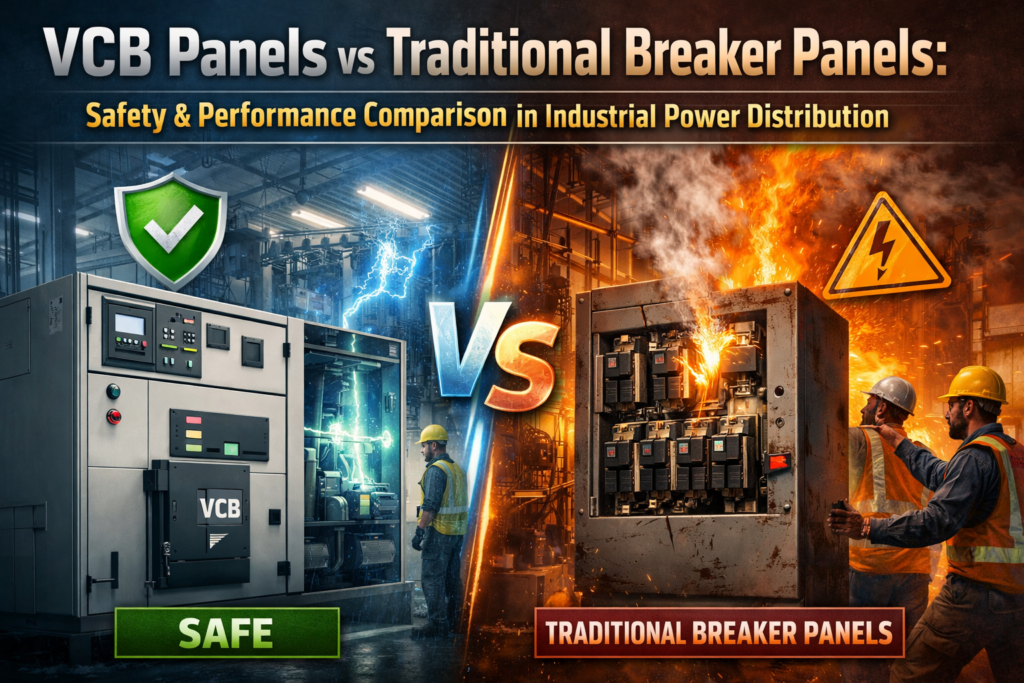
Safety is one of the primary reasons industries upgrade from traditional breaker panels to vacuum circuit breaker panels. Electrical faults in industrial power distribution systems can generate high arc energy, which poses serious risks to equipment and personnel.
VCB panels improve safety in several ways because the vacuum interrupter extinguishes arcs faster and contains the arc within a sealed environment. In comparison, conventional breaker panels may allow longer arc duration, increasing thermal stress on equipment.
When examining VCB panels vs conventional breakers, industrial engineers often highlight the following safety advantages of VCB technology:
- Faster arc extinction in medium-voltage circuits
- Reduced risk of arc flash in industrial switchgear systems
- Improved operational safety for maintenance personnel
- Better containment of fault energy inside switchgear panels
These features make VCB panels a preferred choice in modern industrial power distribution infrastructure.
Performance Differences in Industrial Electrical Systems
Performance is another key factor when comparing VCB panels vs conventional breakers. Industrial facilities require switchgear that can operate reliably under heavy electrical loads and frequent switching operations.
Traditional breaker panels may struggle in environments with frequent fault clearing or high switching cycles. VCB panels, on the other hand, are designed to handle repeated operations without significant wear.
In industrial medium-voltage distribution systems, VCB panels provide advantages such as improved switching reliability and reduced maintenance requirements. Because the arc is extinguished in vacuum, there is minimal contact erosion, which extends the service life of the breaker.
This improved durability makes VCB panels particularly valuable in industries with high operational demand.
Maintenance and Operational Efficiency
Maintenance is a major operational consideration in industrial facilities. Electrical switchgear that requires frequent servicing increases maintenance costs and production downtime.
In the comparison of VCB panels vs conventional breakers, vacuum circuit breaker panels typically require less maintenance because the interruption mechanism does not rely on oil or air insulation systems. Traditional breaker panels may require periodic oil replacement, contact maintenance, or cleaning to maintain reliable operation.
Industrial facilities, therefore, often favor VCB panels for their lower maintenance burden and longer operational lifespan.
Applications Across Industrial Power Distribution
Both types of breaker panels are used in industrial environments, but their applications vary depending on power system requirements.
Typical industrial environments where VCB panels are increasingly used include:
- Medium-voltage distribution in manufacturing plants
- Industrial substations and power distribution networks
- Process industries such as steel, cement, and petrochemicals
- Large motor control and heavy equipment power systems
These environments demand reliable protection systems capable of handling high electrical stress, which is why VCB panels are widely adopted.
Choosing Between VCB Panels and Conventional Breakers
Selecting between VCB panels vs conventional breakers depends on factors such as system voltage, fault levels, and long-term operational requirements. Older facilities with lower electrical demand may still operate effectively with traditional breaker panels, while modern industrial plants typically require the advanced protection capabilities of VCB switchgear.
As industrial power distribution systems become more complex, the need for faster fault clearing, higher safety standards, and improved reliability continues to increase.
Supporting Modern Industrial Power Infrastructure
Synchro Electricals develops vacuum circuit breaker panels designed for modern industrial power distribution environments. Their solutions support reliable fault interruption, improved operational safety, and long-term performance across manufacturing plants, processing industries, and infrastructure facilities.
Conclusion
The comparison of VCB panels vs conventional breakers highlights how industrial switchgear technology has evolved to meet the demands of modern power distribution systems. While traditional breaker panels served earlier industrial networks effectively, vacuum circuit breaker panels now offer improved safety, reliability, and operational efficiency.
For industries operating under heavy electrical loads and strict safety requirements, VCB panels provide a robust solution for protecting equipment and maintaining stable industrial power distribution.
Frequently Asked Questions
1. What is the main difference between VCB panels and conventional circuit breakers?
VCB (Vacuum Circuit Breaker) panels use vacuum interrupters to extinguish the electrical arc when the breaker opens. Conventional breakers may use different interruption technologies, including air, oil, or other insulating media. VCBs are commonly used in medium-voltage applications because of their compact design and reliable interruption performance.
2. Are VCB panels safer than conventional breaker systems?
VCB technology eliminates the need for oil as the arc-extinguishing medium and provides effective arc interruption within the vacuum interrupter. However, overall switchgear safety depends on the complete system design, protection settings, enclosure, interlocking, installation, operation, and maintenance—not only on the interruption technology.
3. Do VCB panels require less maintenance than conventional breakers?
VCBs generally require less routine maintenance than oil circuit breakers because they do not require inspection or maintenance of an oil interruption medium. Maintenance requirements still include checking mechanical mechanisms, electrical connections, insulation, protection systems, and the condition and operation of the vacuum interrupter.
4. Where are VCB panels commonly used?
VCB panels are widely used in medium-voltage electrical distribution systems, industrial substations, manufacturing plants, commercial facilities, infrastructure projects, utility installations, and other applications requiring medium-voltage switching and protection.
5. Can an existing industrial plant be upgraded from conventional breakers to VCB panels?
Yes, an existing system can potentially be upgraded to VCB-based switchgear. However, the feasibility depends on the existing voltage level, fault level, busbar arrangement, protection system, available space, cable connections, equipment ratings, and overall switchgear configuration. A detailed technical assessment is recommended before replacement.
6. What are the advantages of using VCB panels in medium-voltage systems?
VCB panels can offer reliable arc interruption, compact switchgear construction, reduced dependence on maintenance-intensive interruption media, and suitable switching performance for many medium-voltage applications. Their suitability should be evaluated based on the specific electrical system and operating requirements.
7. What voltage levels are VCB panels typically used for?
VCBs are primarily used in medium-voltage systems. The applicable voltage range depends on the specific VCB and switchgear design, manufacturer specifications, and relevant electrical standards.
8. What protection functions can be integrated with a VCB panel?
Depending on the application, VCB panels can incorporate protection functions such as overcurrent, earth-fault, under-voltage, over-voltage, and other protection schemes through suitable protective relays and control systems.
9. What factors should be considered when selecting a VCB panel?
Important factors include rated voltage, continuous current, short-circuit breaking capacity, short-time withstand current, insulation level, protection requirements, busbar configuration, environmental conditions, operating mechanism, and applicable standards.
10. Can Synchro Electricals provide customized VCB panels for industrial applications?
Yes. VCB panels can be engineered according to project-specific requirements, including voltage level, current rating, fault level, incoming and outgoing feeder configuration, protection scheme, metering requirements, communication needs, and site conditions.