When designing an industrial power distribution system, choosing between a bus duct and traditional cable distribution is not simply a matter of comparing the price per metre. The right solution depends on load current, route length, available space, voltage drop, installation conditions, future expansion, maintenance requirements, and the overall lifecycle cost.
Short answer: Neither bus duct nor cable distribution is universally better. Bus duct is often the stronger choice for high-current, compact, and expandable industrial power distribution, while cables can be more practical for smaller loads, complex routes, short connections, and applications where flexibility is more important than power density.
For industrial projects, the best approach is to evaluate the complete electrical distribution path rather than selecting a system based only on initial material cost.
What Is Bus Duct Distribution?
A bus duct, also called a busway or busbar trunking system, is an enclosed power distribution system that uses copper or aluminium conductors inside a protective enclosure.
Instead of installing multiple large cables along a route, a bus duct provides a compact, engineered path for distributing electrical power from a transformer, generator, switchgear, or main distribution panel to downstream loads.
Low-voltage busbar trunking systems are covered by IEC 61439-6, which addresses their construction, technical characteristics and verification requirements.
Modern sandwich bus duct systems can include:
- Copper or aluminium conductors
- Insulation between conductors
- Protective metallic enclosure
- Jointing systems
- Supports and mounting arrangements
- Tap-off units for connecting loads
- Accessories for bends, changes in direction and terminations
This modular construction makes bus duct particularly useful where high current needs to be distributed through a defined industrial route.
What Is Cable Distribution?
Cable distribution uses individual insulated power cables to carry electricity between the source and the load. Depending on the project, cables may be installed on cable trays, ladders, trunking or inside conduits.
A typical industrial cable distribution system can include:
- Power cables
- Cable trays or ladders
- Cable glands
- Cable lugs and terminations
- Supports and clamps
- Junction or termination boxes
- Protective earthing conductors
Cable systems are familiar, widely available and highly flexible. They can be routed around equipment, structures and difficult building layouts.
For smaller feeders, final circuits and applications where routes change frequently or do not follow a predictable path, cable distribution can remain the more practical option.
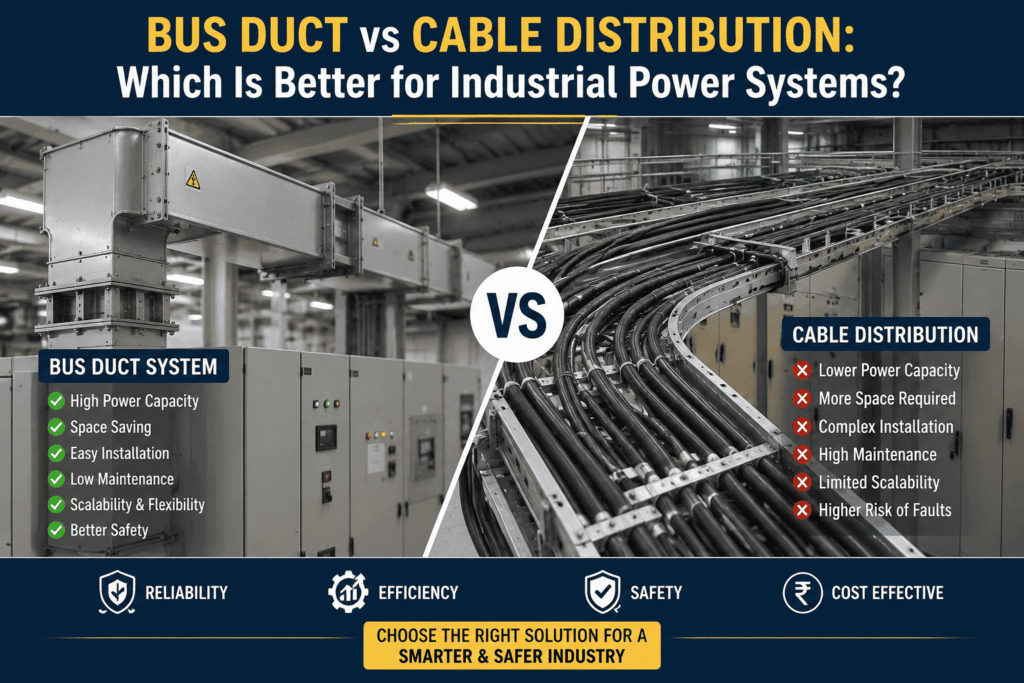
Bus Duct vs Cable Distribution: Key Differences
The decision becomes clearer when both systems are compared against the factors that actually affect industrial electrical performance.
| Factor | Bus Duct | Cable Distribution |
|---|---|---|
| High-current distribution | Excellent | Can require multiple parallel cables |
| Space requirement | Generally compact | Can require larger tray/conduit space |
| Installation | Modular and relatively fast | More field-intensive |
| Route flexibility | Best for defined routes | Highly flexible |
| Future load additions | Easier with suitable tap-off arrangements | Usually requires additional cables |
| Initial material cost | Can be higher | Often lower for smaller systems |
| Maintenance | Joint and tap-off inspection required | Cable terminations and insulation require inspection |
| Large industrial feeders | Often preferred | Practical depending on design |
| Complex routing | Less flexible | Strong advantage |
| Final circuits | Usually unnecessary | Often more practical |
| Expansion potential | High when designed for it | Depends on spare capacity and routing |
| Lifecycle evaluation | Strong for high-load applications | Strong for simpler, lower-load applications |
The important point is that bus duct vs cable distribution should be treated as an application-specific engineering decision.
1. Current Capacity and Power Density
Current carrying capacity is one of the most important factors.
As industrial loads become larger, a cable-based distribution system may require several cables in parallel to carry the required current. This increases the amount of tray space, supports, terminations and installation work.
A bus duct can provide a compact high-current distribution path using engineered busbar conductors.
This makes bus duct attractive for:
- Large manufacturing plants
- Heavy machinery areas
- Power-intensive production lines
- Utility and infrastructure projects
- Transformer-to-PCC connections
- Generator-to-PCC connections
- Large commercial and industrial facilities
However, current rating should never be selected simply because a bus duct is marketed as a high-current solution. The actual design must consider load demand, ambient temperature, installation orientation, harmonics, voltage drop, fault level and the manufacturer’s verified ratings.
2. Installation Time and Labour
Cable installation can become labour-intensive when the system requires multiple large conductors.
The installation process may involve:
- Cable drum handling
- Cable pulling
- Tray preparation
- Cable dressing
- Glanding
- Lug crimping
- Termination
- Testing and identification
Bus duct uses prefabricated sections and engineered joints, which can reduce the amount of field work when the route has been accurately designed.
This can be particularly useful when an industrial project has a tight commissioning schedule.
However, bus duct is not automatically easier in every project. Accurate measurements, proper support structures, alignment and joint installation are essential. Poor installation can compromise an otherwise well-designed system.
3. Space Utilisation
Space becomes a major design constraint in modern factories.
Multiple parallel cables can require wide cable trays, additional supports and sufficient separation between circuits. As the electrical load increases, the physical footprint can become significant.
A bus duct provides a more compact distribution route and can help reduce congestion around electrical corridors.
This is particularly valuable in:
- Manufacturing plants
- Automotive facilities
- Data centres
- Process industries
- Multi-storey industrial buildings
- Areas with restricted ceiling clearance
If electrical space is limited, bus duct can offer a significant layout advantage.
4. Voltage Drop and Electrical Efficiency
Voltage drop should be evaluated for both cable and bus duct systems rather than assuming that one technology will always perform better.
The actual result depends on:
- Conductor material
- Conductor cross-section
- Current
- Route length
- Operating temperature
- Power factor
- Installation method
- System impedance
- Number of parallel conductors
A properly engineered bus duct can provide a low-impedance distribution path and predictable electrical characteristics.
Cable systems can also provide excellent performance when correctly sized and installed.
The engineering objective should therefore be to select a system that keeps voltage drop within the project’s specified limits while maintaining acceptable thermal performance and fault withstand capability.
5. Future Expansion and Load Changes
This is one area where bus duct can have a major advantage.
Industrial plants rarely remain unchanged for their entire operating life. Production lines may be relocated, additional machines may be installed, or electrical demand may increase.
A busbar trunking system designed with appropriate tap-off points can make future load additions easier.
For example, a manufacturing plant may initially have several production machines connected along a main bus duct route. If the layout changes, additional tap-off arrangements can be incorporated where the system design permits.
Cable distribution can also be expanded, but the process may involve:
- New cable routes
- Additional tray capacity
- New cables
- New terminations
- Shutdown planning
- Additional support structures
Therefore, if future expansion is a major project requirement, it should be considered during the initial power distribution design.
6. Maintenance and Reliability
Neither system should be considered maintenance-free.
For bus duct, maintenance attention should focus on:
- Joints
- Tap-off units
- Connections
- Enclosure condition
- Supports
- Insulation condition
- Signs of overheating
- Moisture or environmental ingress
Cable systems require attention to:
- Cable insulation
- Glands
- Terminations
- Lug connections
- Tray condition
- Mechanical damage
- Overheating
- Cable support and routing
A properly designed and installed system can provide reliable service for many years. The quality of engineering, installation and preventive maintenance often matters as much as the choice between bus duct and cable.
7. Safety and Short-Circuit Performance
Industrial power systems can experience high fault currents, so short-circuit withstand capability must be evaluated during design.
For busbar trunking, the selected system should have appropriate verified characteristics for the intended application, including short-circuit performance, temperature rise, insulation and enclosure requirements.
The connection between the bus duct and the electrical panel is equally important.
For example, the main distribution system may include a PCC panel receiving power from a transformer and distributing it to industrial loads. The bus duct, switchgear and downstream feeders must be designed as a coordinated electrical system rather than as independent products.
This is why engineers should evaluate:
- Prospective short-circuit current
- Rated short-time withstand current
- Peak withstand current
- Protective-device coordination
- Earthing and bonding
- IP protection
- Temperature rise
- Clearances and creepage
- Installation environment
8. Initial Cost vs Lifecycle Cost
Cable distribution can appear less expensive when comparing only the initial material price.
But industrial projects should consider the complete installed cost.
The comparison should include:
Cable system cost
- Cable material
- Cable tray
- Supports
- Glands
- Lugs
- Terminations
- Labour
- Testing
- Future modifications
Bus duct system cost
- Bus duct sections
- Joints
- Tap-off units
- Supports
- Bends and accessories
- Installation
- Testing
- Future modifications
The most economical solution is therefore not necessarily the one with the lowest purchase price.
For high-current, long-route or frequently modified installations, the lifecycle economics of bus duct can become more attractive.
For short, simple and relatively low-current circuits, cable distribution may remain the more economical choice.
9. When Is Bus Duct Better Than Cable?
Bus duct is generally worth considering when several of the following conditions exist:
- High current demand
- Long, predictable distribution routes
- Limited installation space
- Multiple downstream loads
- Frequent future expansion
- Requirement for organised power distribution
- Need to reduce cable congestion
- High industrial operating loads
- Planned tap-off points
- New-build industrial infrastructure
In these applications, the advantages of compactness, modularity and high-current distribution can outweigh the higher initial system cost.
10. When Is Cable Distribution Better?
Cable distribution can be the better choice when:
- Loads are relatively small
- Routes are short
- Routing is irregular or difficult
- Loads are widely dispersed
- The installation is a retrofit
- Existing cable trays have adequate capacity
- Frequent route changes are expected
- The project has many small final circuits
- Bus duct installation is impractical because of site constraints
There is no engineering benefit in installing bus duct everywhere simply because it performs well in high-current applications.
Can Industrial Projects Use Both Bus Duct and Cable?
Yes. In many projects, a hybrid power distribution system can provide the best balance.
For example:
Transformer → PCC Panel → Bus Duct → MCC / Distribution Point → Cable → Individual Machines
In this arrangement, the bus duct acts as the high-capacity distribution backbone while cables handle the final connections to individual equipment.
This approach can reduce cable congestion while retaining the routing flexibility of cables near machines and smaller loads.
It also creates a more practical system architecture for large industrial facilities.
A Practical Selection Checklist for Engineers
Before deciding between bus duct and cable distribution, evaluate these questions:
1. What is the maximum design current?
Do not size the system only according to today’s average load. Consider the maximum demand and realistic future load.
2. What is the route length?
Long, high-current routes can make the physical and installation requirements of cable distribution more significant.
3. How much space is available?
Check cable tray capacity, ceiling height, electrical shaft dimensions and access requirements.
4. Will the plant expand?
If new machines or production lines are expected, future expansion should be included in the initial design.
5. What is the fault level?
The bus duct, cable, panel and protective devices must be selected for the actual fault conditions of the installation.
6. What environmental conditions exist?
Consider dust, moisture, temperature, corrosive environments, vibration, indoor/outdoor installation and required IP protection.
7. What does the complete lifecycle cost look like?
Compare material, labour, installation, maintenance, energy losses, downtime and future modification costs.
What Should You Ask a Bus Duct or Electrical Panel Manufacturer?
Before finalising a supplier, ask for technical documentation covering:
- Rated current
- Rated voltage
- Short-circuit withstand characteristics
- Temperature-rise performance
- IP rating
- Conductor material
- Enclosure material
- Joint design
- Tap-off arrangements
- Installation requirements
- Earthing arrangement
- Applicable standards
- Testing and verification documentation
- Drawings and dimensional details
- Warranty and after-sales support
For projects involving a PCC panel, MCC panel or other major switchgear, the complete distribution arrangement should be reviewed together to ensure compatibility.
Final Verdict: Bus Duct or Cable Distribution?
So, which is better: bus duct vs cable distribution?
The answer depends on the application.
Choose bus duct when high current, compact installation, predictable routes, and future expansion are major priorities.
Choose cable distribution when routing flexibility, smaller loads, short connections, or retrofit conditions are more important.
For many large industrial projects, the most effective answer is not “bus duct or cable.” It is a properly engineered combination of both.
The key is to compare the complete electrical system based on current capacity, voltage drop, fault level, installation environment, space, maintenance, expansion requirements and lifecycle cost.
Synchro Electricals provides engineered electrical distribution solutions for industrial applications, including L.T. Bus Duct/Sandwich Bus Duct and PCC power distribution systems. The right solution should always be selected according to the project’s actual electrical load, layout and operating requirements.
Frequently Asked Questions
Is bus duct better than cable distribution?
Bus duct is often better for high-current, compact and expandable industrial power distribution, while cable distribution can be better for smaller loads, complex routes and final circuits. The correct choice depends on project requirements.
Is bus duct more efficient than cable?
A properly designed bus duct can provide a low-impedance power path and efficient high-current distribution. Cable systems can also be highly efficient when correctly sized, so efficiency should be confirmed through engineering calculations rather than assumed.
Is bus duct more expensive than cable?
The initial cost of bus duct can be higher in some applications, but installation labour, space requirements, maintenance and future expansion can change the overall lifecycle cost. Cable can remain more economical for smaller or simpler installations.
Where is bus duct commonly used?
Bus duct is commonly considered for industrial plants, manufacturing facilities, power plants, commercial buildings and other installations requiring high-capacity electrical power distribution.
Can bus duct replace all industrial cables?
No. Bus duct is not intended to replace every cable circuit. It is generally most useful for main or high-capacity distribution, while cables remain practical for final feeders and equipment connections.
Which is easier to expand: bus duct or cable?
Bus duct can be easier to expand when the system has been designed with suitable tap-off points and spare capacity. Cable systems can also be expanded, but new cables, tray capacity and terminations may be required.
What standard applies to low-voltage busbar trunking systems?
IEC 61439-6 specifically addresses low-voltage busbar trunking systems, including their construction, technical characteristics and verification requirements.
What factors should be considered when selecting a bus duct?
Engineers should consider rated current, voltage, short-circuit level, temperature, voltage drop, installation orientation, IP protection, environmental conditions, future expansion and compatibility with connected switchgear.
Can bus duct and PCC panels be used together?
Yes. A bus duct can be used as part of an industrial distribution network connected to a PCC panel or other switchgear, provided the complete system is properly designed and the ratings and protection requirements are coordinated.
How do I choose between bus duct and cable for my factory?
Start with the maximum load current, route length, available space, fault level, future expansion plans and total installed/lifecycle cost. A qualified electrical engineer or manufacturer should then verify the final selection against project specifications and applicable standards.