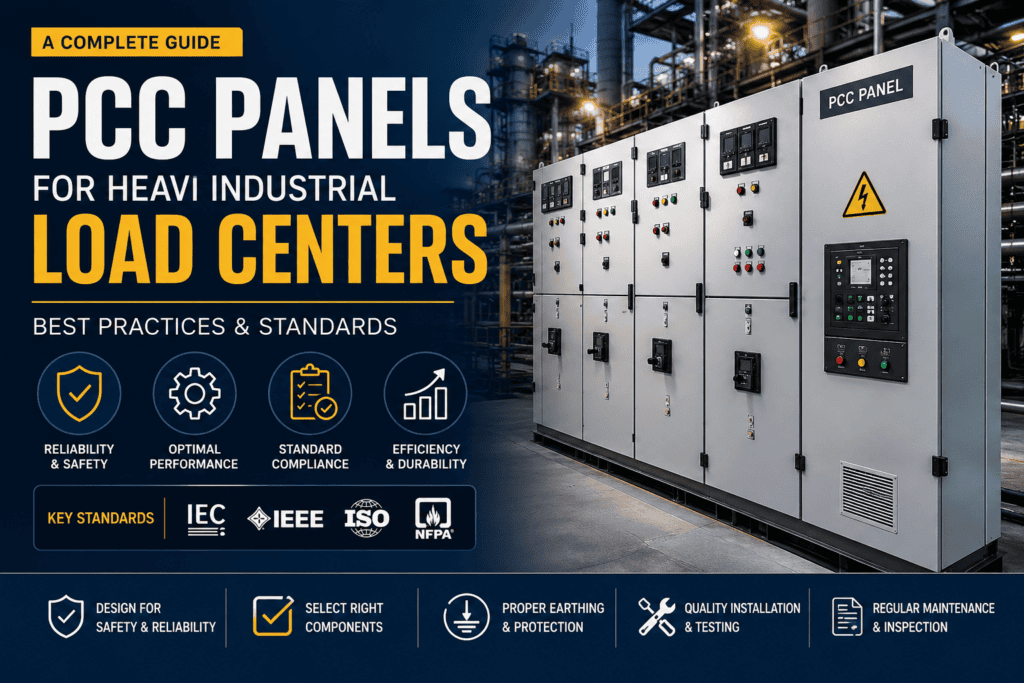
Heavy industrial facilities such as steel plants, cement manufacturing units, refineries, and large process industries operate with extremely high electrical loads. These environments require robust and reliable power distribution systems capable of handling continuous operation, high current demand, and significant fault levels. At the center of such distribution networks lies the PCC panel (Power Control Center panel).
A well-engineered PCC panel for heavy industrial load centers acts as the primary interface between incoming power sources – such as transformers or generators – and multiple downstream electrical feeders. Because these panels handle large currents and complex distribution networks, following proper PCC panel design best practices is essential for ensuring electrical safety, operational reliability, and efficient power management.
Designing industrial PCC panels involves careful consideration of electrical ratings, busbar configuration, protection systems, and compliance with international electrical standards.
PCC Panels in Heavy Industrial Power Distribution
In large industrial facilities, power is typically received from high-capacity transformers and distributed across multiple sections of the plant. The PCC panel functions as the central distribution hub that manages this power flow.
From the PCC panel, electrical power is supplied to downstream panels such as MCC panels (Motor Control Centers), distribution boards, and specialized process equipment panels. Because these feeders support critical plant operations, the PCC panel must provide reliable switching, protection, and load management capabilities.
Heavy industries often operate equipment such as large motors, compressors, furnaces, and processing machinery that demand a stable and uninterrupted power supply. A properly designed PCC panel for industrial load centers ensures balanced distribution of electrical loads while maintaining protection against overloads and short circuits.
Electrical Ratings and Fault Level Considerations
One of the most important aspects of PCC panel design for heavy industrial applications is selecting the correct electrical ratings. Industrial facilities typically operate with high transformer capacities, which can result in significant short-circuit fault levels.
The PCC panel short circuit withstand rating must be capable of handling the maximum prospective fault current within the system. If the panel components are not rated properly, severe damage may occur during fault conditions.
Engineers must evaluate several parameters when determining the electrical ratings of industrial PCC panels, including transformer capacity, system voltage, and network configuration. Circuit breakers used in PCC panels must also have sufficient interrupting capacity to safely clear electrical faults.
Ensuring proper coordination between breaker ratings and system fault levels is a critical step in developing reliable power distribution infrastructure.
Busbar System Design for High Current Distribution
The busbar system inside a PCC panel carries large electrical currents from the incoming supply to outgoing feeders. Because heavy industrial plants often require high current capacities, the design of the busbar system becomes a major engineering consideration.
Copper busbars are commonly used in industrial PCC panels due to their high electrical conductivity and strong mechanical properties. The cross-sectional area of the busbar must be carefully calculated to ensure it can handle the rated current without excessive temperature rise.
Proper spacing between busbars is also essential to prevent flashover and ensure adequate insulation between phases. In many heavy industrial power control center panels, busbars are supported using insulated supports that provide both electrical insulation and mechanical stability.
Thermal management is another important factor in PCC panel design best practices. Adequate ventilation and proper panel layout help dissipate heat generated by high current flow.
Protection and Control Integration
Protection systems are a vital component of PCC panels used in heavy industrial load centers. Industrial electrical networks are exposed to various fault conditions, including overloads, short circuits, and earth faults.
To detect and isolate these faults quickly, modern PCC panels integrate advanced protection relays and circuit breakers. These devices continuously monitor electrical parameters and trip the breaker if abnormal conditions occur.
Protection schemes implemented in industrial PCC panels typically include:
- Overcurrent protection for feeder circuits
- Short circuit protection to isolate faults
- Earth fault protection to detect leakage currents
- Protection coordination with downstream MCC panels
These protection systems ensure that faults are isolated at the appropriate location, minimizing disruption to the rest of the plant.
Compliance with Electrical Standards and Safety Guidelines
Designing reliable PCC panels for heavy industrial applications also requires strict adherence to recognized electrical standards. Standards ensure that switchgear equipment meets safety and performance requirements under demanding operating conditions.
Common standards followed in PCC panel design and manufacturing include IEC 61439, IEC 60947, and relevant national electrical standards. These standards define requirements for temperature rise limits, insulation coordination, mechanical strength, and fault withstand capability.
Compliance with these standards ensures that power control center panels used in industrial load centers can operate safely even under extreme electrical conditions.
Manufacturers such as Synchro Electricals, involved in the engineering of industrial electrical panels, typically design PCC panels following these established standards to ensure reliability in high-load industrial environments.
Building Reliable Power Infrastructure for Heavy Industry
Heavy industrial facilities depend on a continuous and reliable power supply to maintain production processes. The PCC panel serves as the backbone of industrial power distribution, managing incoming electrical power and supplying it safely to various plant loads.
By following proven PCC panel design best practices, engineers can ensure that power distribution systems remain stable, protected, and capable of supporting demanding industrial operations.
Careful attention to electrical ratings, busbar configuration, protection coordination, and compliance with industry standards allows PCC panels to deliver reliable performance in heavy industrial load centers while maintaining high levels of electrical safety.