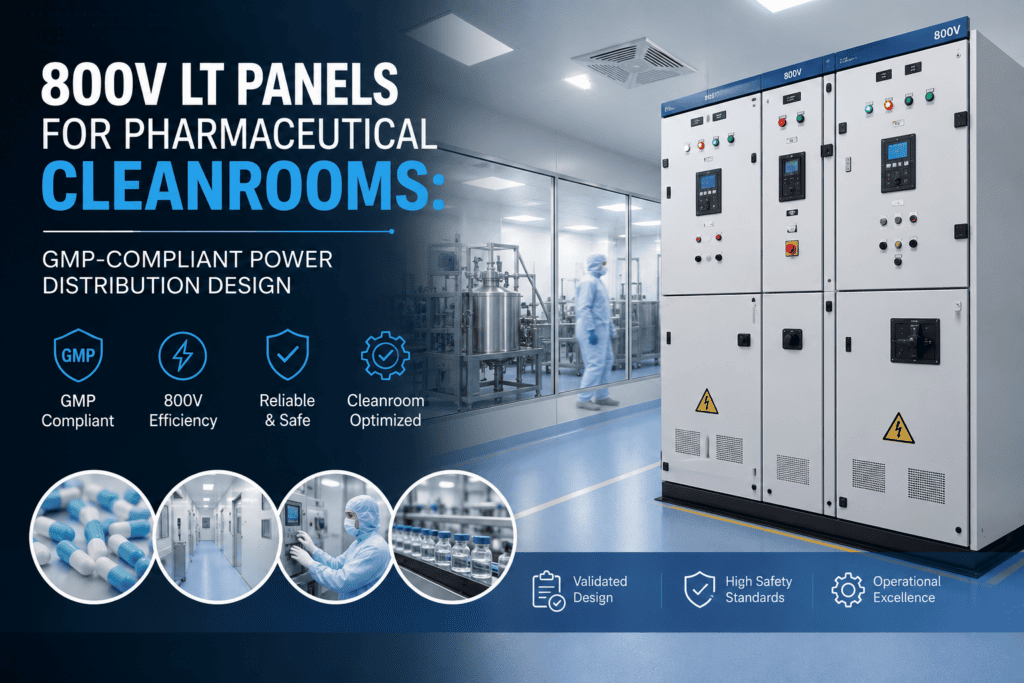
When a pharmaceutical cleanroom loses power, you do not have a downtime problem. You have a deviation.
That distinction is the whole reason 800 LT panels for pharma facilities are specified differently from panels destined for a textile mill or a cement plant. In most industries, a tripped breaker costs you production hours. In a GMP facility, the same trip collapses the differential pressure cascade, breaches the environmental envelope around an exposed product, and triggers a quality investigation that can end in a rejected batch — one that may be worth more than the entire electrical package that failed.
This guide covers how to specify, build and qualify LT electrical panels for pharmaceutical plants: what the 800 V rating actually means, which GMP clauses land on the panel builder’s desk, and the documentation your QA team will demand at qualification. It is written for plant electrical engineers, project managers and MEP consultants who have to sign the specification.
What an “800 V LT Panel” Actually Means — And What It Doesn’t
Let’s clear this up first, because the term is widely misused and getting it wrong will cost you at the tender stage.
“LT” means low tension — and under IEC 61439-1, “low voltage” extends up to 1,000 V AC. An 800 V LT panel is therefore a low-voltage assembly, fully inside the scope of the standard. It is not medium voltage. It is not a special category. It is a rated-voltage class.
Where engineers go wrong is assuming that “800 V LT panel” means the cleanroom is distributed at 800 volts. It almost never is. Indian pharmaceutical plants distribute at 415 V, three-phase, 50 Hz. So why does the 800 V number appear on the specification at all?
Three legitimate reasons:
1. Rated insulation voltage (Ui) versus rated operational voltage (Ue). These are different numbers and IEC 61439 treats them separately. A panel operating at 415 V (Ue) may carry a rated insulation voltage of 800 V or 1,000 V. That headroom governs clearance and creepage distances inside the assembly. Specifying a higher Ui buys dielectric margin — which matters in a plant where a flashover is not just an outage but a contamination event requiring an area re-qualification.
2. Captive solar tie-in. This is the big one, and it is why the term has become common in pharma tenders since 2023. Most modern string inverters output at 800 VAC, not 415 V. Any pharmaceutical plant with a rooftop or ground-mounted captive solar plant genuinely needs a true 800VAC type tested panel at the inverter output, upstream of the step-up transformer. That is real 800-volt distribution, sitting alongside the plant’s 415 V LT network.
3. Future-proofing the LT bus. Some greenfield projects specify 800 V-rated LT switchgear so the same assembly can accept a higher-voltage solar or storage tie-in later without replacing the enclosure.
The practical takeaway: when your specification says “800 V LT panel,” make sure the document states which number you mean — Ue or Ui — and whether it is the solar interface panel or the process LT board. Panel builders quote against different assumptions, and this single ambiguity is one of the most common causes of a quotation mismatch on pharmaceutical projects.
Why Pharmaceutical Power Distribution Is Not Like Any Other Industry
The pressure cascade is an electrical load
A GMP cleanroom holds its grade through airflow. EU GMP Annex 1 requires a documented Contamination Control Strategy, and the differential pressure cascade between grades is one of its load-bearing pillars — typically 10–15 Pa between adjacent classified areas, with airflow always moving from cleaner to less clean.
That cascade exists because AHU fans are turning. Those fans are driven by motors. Those motors are fed from an 800 V LT MCC panel, usually through a VFD panel.
Which means the contamination control strategy of a multi-crore facility resolves, physically, to whether a contactor picks up. An electrical engineer specifying an MCC panel for a pharmaceutical plant is not specifying a motor starter. They are specifying a component of the contamination control strategy — and Annex 1 expects that strategy to be documented, justified and holistic.
Recovery time is a regulated number
Annex 1 requires cleanroom recovery testing: after a disturbance, the room must return to its classified particle count within a defined period. If your DG changeover takes longer than the room’s tolerance, you do not merely restart the AHU. You may have to re-establish and re-document the environmental condition before production can resume.
This makes transfer time an electrical specification with a regulatory consequence. A standard AMF/ATS panel transferring in 8–10 seconds is fine for a warehouse. For a Grade C or D area with product exposed, that specification needs a documented justification tied to the room’s recovery data — not a default from the panel builder’s catalogue.
Every panel with a processor is a computerised system
This is the point that catches most panel suppliers off guard.
Revised Schedule M brought computerised system compliance and ALCOA+ data integrity into Indian GMP. If your LT panel contains an energy meter, a PLC or a communication gateway feeding data that touches a batch record or an environmental report, that panel is no longer just equipment. It is a computerised system, and it inherits audit trail, access control and data integrity expectations.
Most panel builders in India have never had to think about this. It is the single fastest way to fail an OQ.
The Regulatory Framework — What Actually Applies
As of 2026, the compliance runway has closed. Here is the accurate position:
| Framework | Status | What it puts on the panel |
| Revised Schedule M (India) | Notified 28 Dec 2023, gazetted 5 Jan 2024. Large manufacturers (turnover > ₹250 cr) complied by 28 June 2024. MSMEs who filed Form A under G.S.R. 127(E) got until 31 Dec 2025. All deadlines have now passed — this is enforcement, not transition. | PQS, QRM, qualification & validation, computerised systems, ALCOA+ data integrity, premises & equipment requirements |
| EU GMP Annex 1 | Published Aug 2022, in force 25 Aug 2023; clause 8.123 from 25 Aug 2024 | Contamination Control Strategy, pressure cascade, cleanroom recovery, qualification per Annex 15 |
| ISO 14644-1 | Current | Particle classification the panel’s HVAC loads must sustain |
| 21 CFR Part 11 / EU Annex 11 | Current (export-facing units) | Audit trails and electronic records on panel metering and PLC data |
| IEC 61439-1 / -2 | Current | The panel design standard itself — type tests, routine tests, ratings |
| IS 8623 / IS 3043 | Current | Indian equivalents for assemblies and earthing |
A note on scope, stated plainly: Annex 1 is a European requirement for sterile medicinal products. It is not Indian law. But Indian plants exporting to regulated markets — and increasingly domestic plants targeting WHO-GMP — design to it because it is the higher bar. If your facility does not export, say so in your user requirement specification rather than importing Annex 1 wholesale and paying for controls you do not need.
Design Requirements for LT Electrical Panels in Pharmaceutical Plants
1. Form of separation — specify Form 4b, and know why
Form 4b separation means every functional unit is segregated from every other, and each has its own terminal compartment separated from the busbar.
Why this matters in pharma more than anywhere else: it lets you work on one outgoing feeder while the rest of the panel stays live. In a plant where the AHU serving Grade C must not stop, the ability to isolate a single feeder without de-energising the board is not a convenience — it is what allows maintenance to happen at all without a shutdown and re-qualification.
The cost delta between Form 2 and Form 4b on a large 800 V LT PCC panel is real, typically 15–25%. Pay it. Discovering at FAT that you were quoted Form 2 against a Form 4b specification is a schedule event, and on a validated project a schedule event is expensive in ways the panel price never captures.
2. Ingress protection and enclosure design
Panels belong in the technical corridor or plant room — not inside the classified area. This is the correct default and almost always the right answer.
Where a panel must sit in or adjacent to a classified space:
- IP rating: IP54 minimum for a technical corridor; IP42 is acceptable in a dedicated panel room with its own HVAC
- Surface finish: smooth, non-shedding, cleanable. Powder coating over a seven-tank pre-treatment. No exposed fasteners that trap residue, no rough weld spatter
- Gasketing: continuous, chemically compatible with your disinfectant rotation. Sporicides are aggressive — a gasket that degrades under peracetic acid becomes a particle source
- Cable entries: sealed gland plates. An unsealed bottom entry is a direct path for bioburden and vermin. Revised Schedule M is explicit about vermin-proofing of premises
- Radius corners where cleaning is required — flat internal corners hold residue
3. Temperature rise — the mistake that shows up in May
Every watt a panel dissipates is a watt your panel-room HVAC must remove.
A 2,000 A LT panel can dissipate 4–6 kW. If nobody hands that number to the HVAC designer, the panel room runs hot, breakers derate, and you get nuisance tripping — reliably, in the second week of a Gujarat summer, three years after commissioning, with no obvious cause.
Ask your electrical control panel manufacturer for the calculated power loss per section at design load. If they cannot produce it, they have not done a temperature rise verification, and IEC 61439-1 requires one.
4. Harmonics — the AHU problem
A pharmaceutical plant is a VFD-dense environment. Every AHU, every chiller pump, every compressor. VFDs are non-linear loads, and they inject harmonic current into the LT bus.
Consequences that show up in real plants:
- Capacitor banks in an APFC panel fail early — harmonic current finds the lowest-impedance path and that is your capacitor
- Neutral conductors carry more current than any phase, from triplen harmonics
- Transformers derate and run hot
Specify detuned reactors (typically 7% / 189 Hz) on any APFC panel in a VFD-heavy plant. Standard capacitor switching without detuning in a pharma facility is a failure waiting for a date. Run a harmonic study at design stage — not after the capacitors have already blown.
5. Earthing and equipotential bonding
Pharma plants run instrumentation, PLCs, environmental monitoring systems and 4–20 mA loops that are sensitive to ground potential differences.
- Separate clean earth for instrumentation and equipment earth for power, bonded at a single point
- Design to IS 3043
- Equipotential bonding across cleanroom panel structures — a floating panel is a shock hazard and a noise source
- Document the earth pit resistance at IQ and re-test it at defined intervals; it is a number your auditor may ask for
6. Redundancy and changeover
- Dual incomer with bus coupler and mechanical + electrical interlock
- AMF/ATS transfer time specified against the room’s documented recovery data, not against a default
- Critical AHUs on the essential bus, backed by DG
- Where DG and grid must run in parallel, a synchronising panel with correct protection
7. Metering, monitoring and data integrity
This is where you separate a pharma-capable panel builder from the rest.
- Energy meters on every major feeder — Modbus TCP to the BMS/EMS
- If meter or PLC data touches a batch record, it needs an audit trail with ALCOA+ attributes: attributable, legible, contemporaneous, original, accurate — plus complete, consistent, enduring, available
- Time synchronisation across the plant. A timestamp that disagrees with the BMS is a data integrity observation
- Access control on panel HMIs — not a shared password on a sticky note
Our existing guide on smart monitoring in 800V LT panels covers the monitoring architecture in more depth.
Qualification: The Documentation Pack That Decides Your Vendor
Here is the honest situation. Most Indian panel builders can build a competent industrial LT panel. Very few can survive a pharmaceutical qualification, because qualification is a paperwork discipline and the panel shop is not built for it.
If you are buying LT electrical panels for pharmaceutical plants, this is your real selection criterion.
DQ — Design Qualification
GA drawing, single line diagram, bill of materials with make and model, compliance matrix mapping every URS line to a design feature, type test certificate from an accredited lab (CPRI, ERDA, KEMA), form of separation declaration, calculated temperature rise, Icw and Icc ratings.
FAT — Factory Acceptance Test
Routine verification per IEC 61439-1 Clause 11, witnessed by your team, at the panel builder’s works, before dispatch. Dielectric test, wiring verification, protective circuit continuity, functional check of every interlock. Get the report signed at the works. A defect found at FAT costs a day; the same defect found at site costs a fortnight.
IQ — Installation Qualification
As-built drawings, cable schedule, torque records for every busbar joint, calibration certificates with traceability for every meter and relay, material of construction certificates, earth pit resistance readings.
OQ — Operational Qualification
Breaker trip curve verification, relay setting records, interlock functional tests, changeover time measurement against specification, alarm and annunciation verification, audit trail demonstration on any computerised element.
PQ — Performance Qualification
Load test at design condition, thermal survey (thermography of every joint under load), stability over a defined observation period.
The BOM change trap: if the panel builder substitutes a component after DQ — even a like-for-like MCB — and it is not captured under change control, your as-built no longer matches your qualified design. That is a deviation before you have made a single batch. Insist on written change control from the panel builder, contractually, from the purchase order onward.
Six Mistakes We See on Pharmaceutical Projects
- Panel specified without stating Ue vs Ui. Two vendors quote two different products. The cheaper one wins. Nobody finds out until FAT.
- Temperature rise never handed to HVAC. Panel room undersized. Nuisance tripping in year three, blamed on the breakers.
- APFC installed without a harmonic study. Capacitors fail inside 18 months in a VFD-dense plant.
- Changeover time defaulted from the catalogue. Never checked against cleanroom recovery data. Discovered during a real power event, as a deviation.
- Panel treated as equipment, not a computerised system. No audit trail on the metering. Fails OQ. Re-work at site, on the critical path.
- Form 2 supplied against a Form 4b spec. Caught at FAT. Eight-week rebuild.
Every one of these is a specification failure, not a manufacturing failure. They are all preventable at the DQ stage — which is exactly why the panel builder should be in the room during design, not handed a drawing after it is frozen.
Selection Checklist for Your Panel Vendor
Before you release the purchase order, confirm your electrical panel manufacturer can produce:
- Valid type test certificate per IEC 61439-1/-2 from an accredited laboratory
- Calculated temperature rise verification at your design load
- Declared form of separation with construction detail
- Icw (short-time withstand) and Icc ratings matched to your fault level study
- Written change control procedure from PO onward
- FAT protocol they will execute and sign at their works
- Calibration certificates with NABL traceability for every instrument
- Material of construction certificates for enclosure and busbar
- Prior pharmaceutical project references — with contactable names
- Willingness to be in the room at DQ, not just at dispatch
If a vendor hesitates on any of these, that hesitation is your answer.
Why Manufacturers Work With Synchro Electricals
We are an electrical panel manufacturer in India based in Rajkot, Gujarat, with 500+ projects delivered and panels supporting over 5 GW of installed solar capacity. Our panels are built to IEC 61439 and ISO-standard manufacturing processes, and we hold type test approvals for our assemblies.
What matters on a pharmaceutical project specifically:
- Type-tested assemblies, with certification you can put in front of an auditor — see our type test certification
- PCC panels, MCC panels, VFD panels and APFC panels engineered as one coordinated LT package rather than bought piecemeal from four vendors with four earthing philosophies
- 800VAC type-tested panels for the captive solar tie-in, from the same shop as your process LT boards
- FAT at our works, witnessed by your team, with a signed report before dispatch
- Documentation built during manufacture, not reconstructed afterwards
Planning a Schedule M upgrade or a greenfield pharmaceutical facility? Send us your single line diagram and load list. We will come back with a compliance matrix against your URS — before you have committed to a design.
📞 +91 9601965426 · ✉️ info@synchroelectricals.com · Request a technical review →