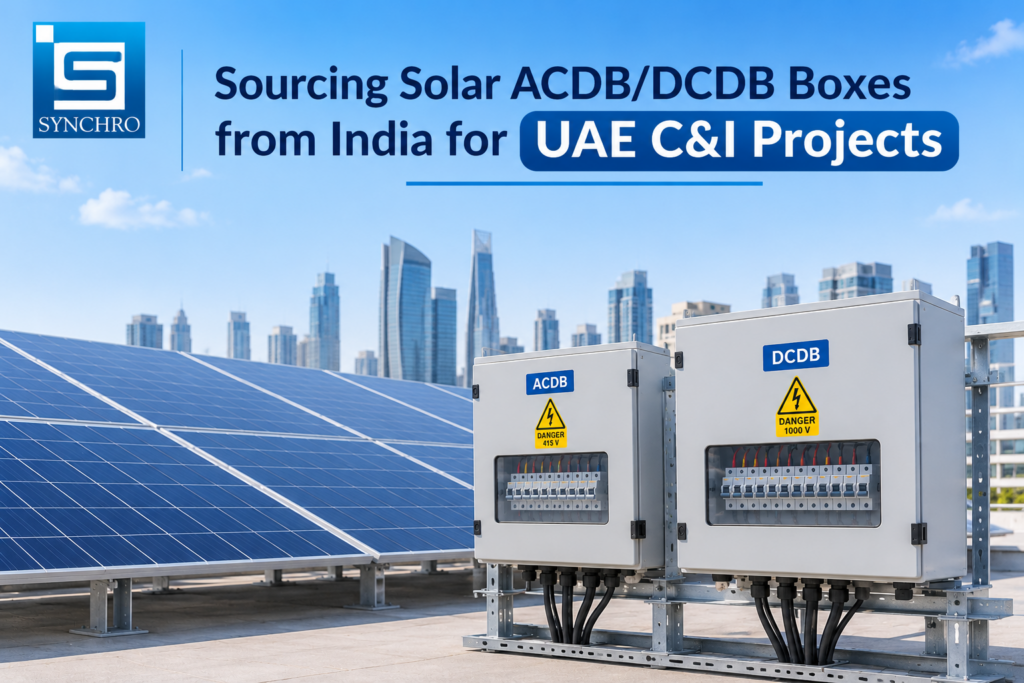
UAE commercial and industrial solar has grown steadily, driven by rooftop programmes such as DEWA’s Shams Dubai and by factories, warehouses and malls looking to cut daytime energy costs. Many UAE contractors already source electrical equipment from India, because of the short shipping distance, competitive manufacturing and familiarity with IEC-based specifications.
Sourcing solar ACDB and DCDB boxes from India works well when both sides plan for three things: Gulf climate conditions, consultant and utility approvals, and complete export documentation. This guide covers all three. It is written by Synchro Electricals, a Rajkot-based manufacturer of solar ACDB DCDB boxes for Indian and international projects.
Table of Contents
Why UAE Contractors Source From India
| Factor | What it means for a UAE contractor |
|---|---|
| Short sea route | Gujarat’s western ports are a short voyage from Jebel Ali and other UAE ports |
| IEC-based design practice | Indian panel makers commonly design to IEC standards, which UAE consultants use |
| Customisation | Boxes built to your inverter, string layout and consultant comments |
| Trade framework | The India-UAE Comprehensive Economic Partnership Agreement (CEPA), in force since 2022, can reduce duties on eligible goods with a valid certificate of origin. Confirm treatment for your HS code with your customs agent. |
| Factory access | Short flights make factory inspections and witnessed tests practical |
Electrical Basics for UAE Projects
- The UAE low-voltage supply is 400V three-phase and 230V single-phase, at 50Hz. Most C&I rooftop systems are three-phase.
- Grid connection rules, inspection requirements and equipment approvals are set by the utility in each emirate (for example DEWA in Dubai). Requirements differ between utilities.
- Consultants usually require material submittals with drawings, datasheets, test reports and compliance statements before approving equipment.
Designing ACDB/DCDB Boxes for Gulf Conditions
| Condition | Design response |
|---|---|
| Ambient temperatures that can reach about 50°C in summer | Derate breakers, fuses and isolators for internal box temperature; larger enclosures; shading or sunshields |
| Intense UV | UV-stabilised enclosures and glands, or coated metal enclosures |
| Sand and dust | IP65 or better; correctly sized glands; good door gaskets |
| Coastal humidity and salt | Corrosion-resistant hardware and plated terminals |
| Condensation from day-night swings and air conditioning | Breathers or vents that keep the IP rating |
Approvals: Plan Them Before You Order
The most common delay in export projects is not manufacturing. It is the approval cycle. Plan it as follows:- Share the specification and consultant requirements with the manufacturer at enquiry.
- Receive a material submittal: GA drawing, single-line and wiring diagram, BOM with makes and ratings, component datasheets and certificates, compliance statement.
- Submit to the consultant and collect comments.
- Revise drawings and resubmit until approved.
- Release production only after approval.
- Witness tests or review test reports before shipment.
Export Documents Checklist
- Commercial invoice and packing list
- Certificate of origin (in the form required for CEPA treatment, if claimed)
- HS code confirmed with your customs agent
- Approved drawings and BOM
- Routine test reports for every unit or batch
- Component certificates (SPD, isolator, fuses, enclosure)
- Installation and O&M manual in English
- Warranty terms
- Packing suitable for sea freight and humidity
Commercial Terms to Agree Early
| Item | Agree up front |
|---|---|
| Incoterms | For example FOB Indian port or CIF UAE port |
| Payment | Milestones linked to approval, dispatch and documents |
| Lead time | Confirmed in writing after drawing approval |
| Inspection | Witnessed FAT or review of test reports |
| Spares | Recommended spares shipped with the main order |
| Support | Remote technical support during installation and commissioning |
Beyond ACDB/DCDB
Larger UAE C&I projects may also need string combiner boxes for multi-string arrays, and PCC panels or LT panels to integrate solar into the building’s main distribution. These can be included in the same approval and shipment.Why Work With Synchro Electricals
Synchro Electricals is a Rajkot, Gujarat manufacturer of electrical panels, established in 2018, with an ISO 9001:2015 certified quality system (certificates). For UAE buyers we offer:- ACDB/DCDB boxes, combiner boxes and LT panels designed to IEC-based specifications
- full material submittals for consultant approval
- drawings approved before production and testing before dispatch with test reports
- export documentation support
- responses to enquiries within 24 hours, and remote technical support
Conclusion
Sourcing solar ACDB/DCDB boxes from India for UAE projects is practical and commonly done. The projects that go smoothly plan for Gulf heat and dust in the design, build the consultant approval cycle into the schedule, and agree documents and commercial terms before production starts. Working on a UAE C&I solar project? Send us your specification and our team will prepare a material submittal and offer.FAQs
1. Can I import solar ACDB/DCDB boxes from India to the UAE?
Yes. Many UAE contractors source electrical equipment from India. Plan for consultant approval, utility requirements and export documents.
2. What voltage is used for solar ACDBs in the UAE?
The UAE LV system is 400V three-phase and 230V single-phase at 50Hz. Most C&I systems use three-phase ACDBs.
3. Do UAE projects need consultant approval for ACDB/DCDB boxes?
Usually yes. Consultants review material submittals, including drawings, BOM, datasheets and test reports, before approving equipment.
4. Does the India-UAE CEPA reduce import duty on electrical panels?
CEPA can reduce duties on eligible goods with a valid certificate of origin. Confirm treatment for the specific HS code with your customs agent.
5. What documents are needed to ship panels from India to the UAE?
Commercial invoice, packing list, certificate of origin, approved drawings, test reports, component certificates and manuals.
6. How are ACDB/DCDB boxes designed for UAE heat?
By derating components for internal temperature, using larger or shaded enclosures, UV-resistant materials and IP65 or better sealing.
7. Which Indian ports ship to the UAE?
Gujarat’s western ports offer a short sea route to UAE ports such as Jebel Ali. Your freight forwarder will advise the best route.
8. Can UAE buyers witness tests in India?
Yes. Witnessed factory acceptance tests are common, or buyers can review test reports and photos.
9. What standards are UAE solar panels built to?
UAE consultants typically specify IEC standards, such as IEC 61439 for assemblies and IEC component standards. Utility-specific requirements also apply.
10. What is Shams Dubai?
Shams Dubai is DEWA’s programme for connecting rooftop solar systems in Dubai to the grid. Its connection requirements apply to systems in Dubai.
11. How long does the approval cycle take?
It depends on the consultant and the number of revisions. Submitting complete drawings and datasheets the first time shortens it.
12. What Incoterms are common for India-UAE panel supply?
FOB Indian port and CIF UAE port are common. Agree on terms before ordering.
13. Can you supply combiner boxes and LT panels in the same order?
Yes. Combiner boxes, ACDB/DCDB boxes and LT panels can be included in one submittal and shipment.
14. How is packing done for sea freight?
Panels should be packed to protect against moisture and handling, with clear marking, using packing suited to sea freight.
15. How do I get a quote for UAE supply?
Send your specification, consultant requirements, quantities and preferred Incoterms. We respond within 24 hours.