A busbar looks like a simple flat strip of metal. In practice, it is one of the few decisions in a panel build that affects cost, weight, heat, and long-term reliability all at once. Get the conductor material wrong and you either overpay for capacity you didn’t need or install something that runs hotter than it should for the next twenty years.
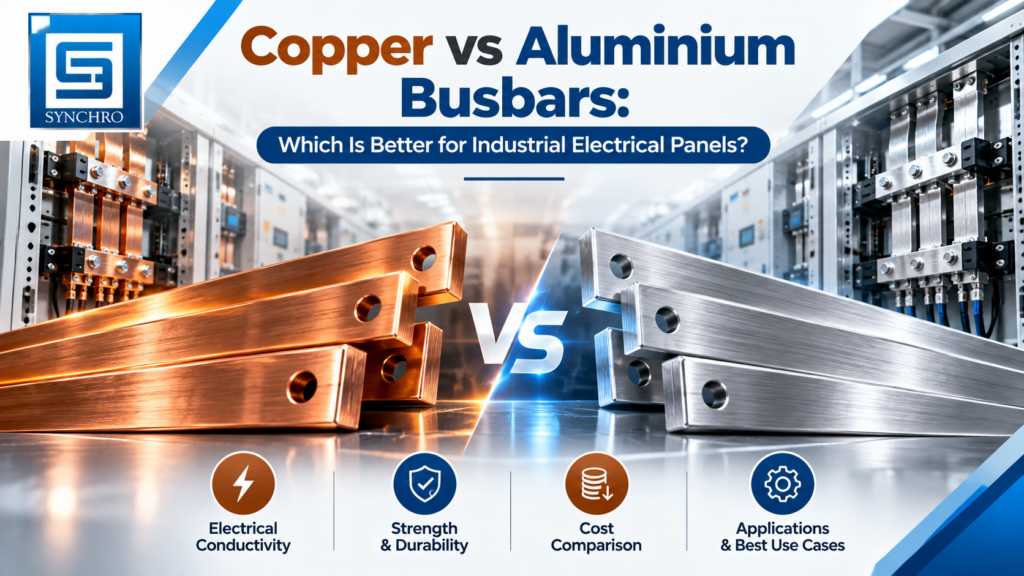
The copper vs aluminium busbars question comes up on almost every quotation for industrial electrical panels, and the honest answer is that neither metal is universally better. Each has a place depending on current rating, space, weight limits and budget. This guide walks through the real engineering differences so you can specify the right conductor instead of defaulting to whatever the last supplier used.
Why the Busbar Material Choice Matters
Busbars carry the full current of a panel, so their conductor material directly affects three things: how much current they can carry for a given cross-section, how much they heat up under load, and how much the panel weighs and costs. In industrial electrical panels, where space is tight and fault currents can be severe, these trade-offs are not academic. A poorly sized busbar is a long-term liability, whether it is in a PCC, an MCC, or any other distribution enclosure.
Copper Busbars: Properties and Where They Win
Copper has long been the default choice for busbars, and for good reason.
- Higher conductivity: copper conducts electricity more efficiently than aluminium for the same cross-sectional area, which means a copper busbar can carry more current in less space.
- Better mechanical strength: copper withstands bending, vibration and repeated thermal cycling with less fatigue than aluminium.
- Easier jointing: copper connections are less prone to the oxidation issues that affect aluminium joints, and they tolerate standard bolted connections without special plating in most cases.
- Smaller footprint: because less copper is needed to carry the same current, copper busbars suit panels where internal space is limited.
The trade-off is cost and weight. Copper is heavier and significantly more expensive per kilogram than aluminium, and copper prices can swing with global commodity markets, which affects panel quotations.
Common Question Asked:-
Are aluminium busbars safe for industrial use?
Yes, when properly sized, jointed with approved compounds and correct torque, and periodically inspected. Aluminium busbars are widely and safely used across heavy industrial and utility applications.
Aluminium Busbars: Properties and Where They Win
Aluminium has become a serious alternative, especially as copper prices have risen.
- Lower cost: aluminium is considerably cheaper than copper for the same length, which matters on large installations with long busbar runs.
- Lighter weight: aluminium weighs roughly a third of copper for the same volume, which eases structural loading on bus ducts and panel frames, and simplifies transport and installation.
- Good conductivity for the weight: aluminium conducts less efficiently than copper by volume, but its conductivity-to-weight ratio is actually better, which is part of why it dominates overhead transmission lines.
The trade-offs are real too. For the same current rating, an aluminium busbar needs a larger cross-section than copper, so it takes up more room inside the panel. Aluminium also forms a tough oxide layer on its surface almost instantly on exposure to air, and that layer is non-conductive. Joints need proper surface preparation, approved jointing compounds, and correct torque to avoid resistance build-up and overheating at the connection, which is the single most common failure point in aluminium busbar systems.
Copper vs Aluminium Busbars: Side-by-Side Comparison
| Property | Copper Busbar | Aluminium Busbar |
|---|---|---|
| Conductivity (by volume) | Higher | Lower (roughly 61% of copper) |
| Weight | Heavier | About one-third the weight of copper |
| Cost per unit length | Higher | Lower |
| Cross-section needed for same rating | Smaller | Larger |
| Jointing | Straightforward, fewer oxidation issues | Needs surface prep, jointing compound, correct torque |
| Mechanical strength | Higher, better fatigue resistance | Lower, more prone to creep under sustained load |
| Typical use in industrial electrical panels | High-density panels, tight enclosures, critical loads | Large current panels, long runs, cost-sensitive projects |
How to Decide Between Copper and Aluminium
- Tight enclosure, limited space: copper wins because it needs a smaller cross-section for the same current rating.
- Large current, long busbar runs, budget-sensitive project: aluminium is often the practical choice, provided joints are engineered and installed correctly.
- High vibration or frequent thermal cycling environment: copper’s mechanical durability makes it the safer bet.
- Weight-constrained installations, such as elevated bus ducts or rooftop panels: aluminium’s lighter weight reduces structural loading.
- Mixed approach: some projects use copper for high-density sections, such as incomers and outgoing feeders near the breaker, and aluminium for longer distribution runs, balancing cost against performance where each matters most.
Sizing and Rating: What Actually Determines Capacity
Whichever metal you choose, the busbar still has to be sized correctly. A few factors govern this in any well-engineered industrial electrical panel:
- Current rating: the continuous current the busbar must carry, with margin for future load growth.
- Voltage rating: determines insulation spacing, creepage and clearance distances between phases and to earth.
- Short-circuit withstand capacity: the busbar and its supports must survive the mechanical and thermal stress of a fault for the duration it takes the protective device to clear it. This is often the factor that actually governs busbar cross-section, not the normal running current.
- Ingress protection (IP) rating: affects how the busbar compartment is enclosed and how heat is managed inside a sealed panel.
- Ambient temperature and derating: busbars inside hot enclosures or outdoor cabinets need derating from their nameplate rating.
For panels carrying large currents through confined spaces, many projects now specify a sandwich bus duct arrangement, where closely spaced, insulated conductors in either copper or aluminium give a compact, modular installation with good heat dissipation and efficient power transmission over long runs. This approach is common in low voltage applications where a conventional cable run would be too bulky.
Standards That Govern Busbar Design
Busbars inside industrial electrical panels are not designed on judgement alone. Panel assemblies are commonly built to IEC 61439, which sets out requirements for temperature rise, short-circuit withstand and verification testing. Ask your supplier for type tested panel evidence rather than a verbal assurance, since type testing is the only way to confirm a busbar design actually survives the fault levels it is rated for. Synchro Electricals builds its panels to these standards and backs every order with a documented test report.
Installation and Maintenance Considerations
A correctly chosen conductor still needs correct installation to perform over its service life.
- Torque matters: under-tightened joints create resistance and heat; over-tightened joints can crack aluminium or deform copper. Follow the manufacturer’s torque specification exactly.
- Surface treatment: aluminium joints need an approved jointing compound and, in many designs, tin or silver plating at contact surfaces to prevent oxide buildup.
- Thermal imaging: periodic infrared scans of busbar joints catch developing hot spots before they become failures, especially on panels carrying heavy, continuous loads.
- Expansion allowance: long busbar runs need expansion joints to handle thermal growth, particularly in outdoor or high-ambient installations.
- Dissimilar metal joints: where copper and aluminium busbars must connect, use a bimetallic connector or approved jointing method to prevent galvanic corrosion at the interface.
Cost Beyond the Purchase Price
A lower sticker price on aluminium busbars does not always mean lower lifetime cost. Larger cross-sections mean bigger enclosures, which adds to panel cost. Joint maintenance on aluminium systems, done properly, adds a recurring cost that copper systems largely avoid. On the other hand, copper’s higher raw material cost is a one-time expense that is often justified on panels with long service lives and critical uptime requirements, such as those feeding motor control centres or process-critical loads. The right comparison is total cost of ownership, not just the busbar quotation line.
Where This Fits Into Your Panel Specification
Busbar material is one line item in a much larger specification. It needs to be considered alongside the PCC panel or distribution architecture it feeds into, the breaker and protection scheme protecting it, and the overall fault level of the installation. If your project involves paralleling generators or sources, the busbar sizing in your synchronizing panel also needs to account for combined fault contribution from multiple sources. And where large motors are involved, review busbar sizing against starting current profiles in your VFD panel arrangement, since starting currents can be several times the running current.
Getting the fault level calculation right before you size the busbar prevents costly rework later — our guide on how fault-level calculations influence switchgear selection walks through this in detail. And because busbar joints and terminations are one of the most common sources of field failures, it is worth reviewing electrical panel wiring design best practices alongside your busbar specification.
Why Work With Synchro Electricals
As an electrical panel manufacturer based in Rajkot, Gujarat, Synchro Electricals has built LT and HT panels for industrial, solar and infrastructure projects since 2018. For industrial electrical panels, our engineering team sizes busbars — copper or aluminium — against your actual load profile and fault level, not a generic catalogue rating.
- Design approval first: technical drawings, including busbar sizing calculations, go to you for approval before manufacturing begins.
- Every panel tested: high-voltage, insulation and functional tests are carried out, and a test report ships with every order, confirming the busbar performs as designed.
- Verifiable quality: our panels are built to IEC and IS standards, with certifications including ISO 9001:2015.
Browse the wider product range or contact our engineering team with your load and fault-level details, and we will recommend the right busbar material and sizing for your panel.
Conclusion
Neither copper nor aluminium is the universally correct answer for industrial electrical panels. Copper earns its place where space is tight, loads are critical, and long-term reliability outweighs upfront cost. Aluminium earns its place where current is high, runs are long, and budget or weight is the binding constraint. The right call depends on your current rating, fault level, available space and total cost of ownership, not on habit or whichever material your last supplier happened to stock. Share your load details with Synchro Electricals and our engineers will size the busbar correctly the first time.
Frequently Asked Questions (FAQs)
- Is copper or aluminium better for busbars?
Neither is better in every case. Copper offers higher conductivity and a smaller footprint; aluminium offers lower cost and lighter weight. The right choice depends on your current rating, space and budget.
- Why is copper more conductive than aluminium?
Copper has a lower electrical resistivity than aluminium, so for the same cross-sectional area, it allows electrons to flow more efficiently and carries more current with less resistive loss.
- How much more current can copper carry than aluminium of the same size?
Roughly, copper carries about 60% more current than an aluminium busbar of identical cross-section, though exact figures depend on busbar shape, spacing and cooling.
- Why is aluminium cheaper than copper?
Aluminium is more abundant and less costly to extract and refine than copper, and global copper prices have risen more sharply over recent years, widening the cost gap.
- Does aluminium corrode faster than copper?
Aluminium forms a non-conductive oxide layer almost immediately on exposure to air. This is not corrosion in the destructive sense, but it must be removed and properly treated at joints to maintain a low-resistance connection.
- Can copper and aluminium busbars be joined directly?
Not without precautions. Direct contact between dissimilar metals can cause galvanic corrosion in the presence of moisture. Use a bimetallic connector or an approved jointing method at the interface.
- What is a sandwich bus duct?
It is a compact busbar enclosure where conductors, either copper or aluminium, are closely spaced and insulated, giving a space-saving, modular installation suited to high-current, low voltage applications.
- How do I know what current rating my busbar needs?
Size it to the connected load with margin for growth, then verify it against the installation’s short-circuit withstand requirement, since fault current often governs the final cross-section more than running current does.
- What standards apply to busbar design in India?
Panel assemblies are commonly built to IEC 61439, which covers temperature rise, short-circuit withstand and verification testing for low-voltage switchgear and busbar systems.
- Why does short-circuit withstand capacity matter for busbar sizing?
During a fault, busbars experience intense mechanical force and heating for the time it takes protection to clear the fault. An undersized busbar can deform or fail even if it handles normal load current fine.