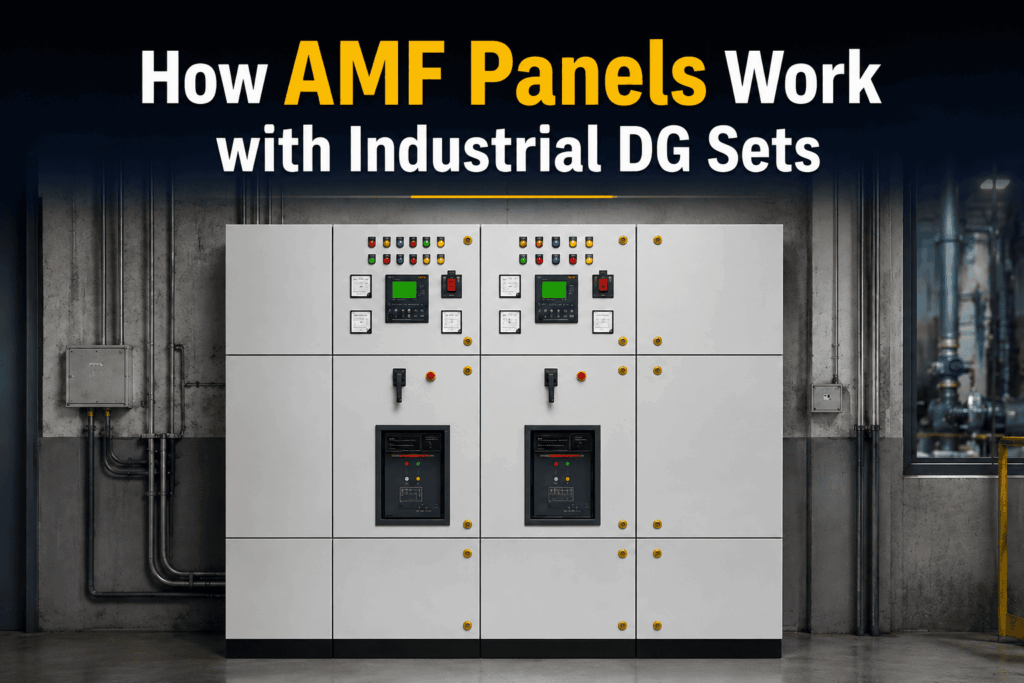
Industrial facilities cannot always afford to wait for an operator to start a diesel generator when utility power fails. Production lines, process equipment, data systems, pumps, HVAC systems and other critical loads may need backup power within seconds.
This is where an AMF panel for a DG set becomes an important part of the electrical power system.
AMF stands for Automatic Mains Failure. The panel continuously monitors the incoming utility supply and, when a defined mains failure or abnormal condition occurs, initiates the automatic start sequence of the diesel generator. Once the DG set reaches acceptable operating conditions, the system transfers the designated load to generator power. When the utility supply returns and remains stable for the configured period, the load is transferred back and the DG set can be stopped through the programmed shutdown sequence.
Synchro Electricals‘ AMF & ATS solution is designed around this basic operating principle, using a controller, automatic start module and switching/protection equipment to manage the transition between mains and backup power.
What Is an AMF Panel for a DG Set?
An AMF panel for a DG set is an electrical control and switching system that automates the response to a mains power failure.
In a typical industrial installation, the AMF system performs several functions:
- Monitors the utility power supply
- Detects mains failure or abnormal voltage conditions
- Sends a start command to the DG set
- Monitors generator availability
- Confirms that generator voltage and frequency are within configured limits
- Transfers the selected load to generator power
- Monitors the generator while it is operating
- Transfers the load back to mains when utility power is restored
- Provides a programmed cooldown and stop command
The exact sequence and settings depend on the generator controller, switching equipment, protection scheme and project requirements.
An AMF system should therefore be considered part of the complete DG power distribution system, not simply an automatic generator-start device.
How Does an AMF Panel Work with an Industrial DG Set?
The easiest way to understand the system is to follow the actual operating sequence.
Step 1: The AMF Panel Continuously Monitors Mains Power
Under normal operating conditions, the industrial facility receives power from the utility supply.
The AMF controller continuously monitors electrical parameters such as:
- Phase voltage
- Frequency
- Phase availability
- Phase sequence, where applicable
- Mains healthy/failure status
The controller uses programmed limits and time delays to determine whether the mains supply should be considered unavailable.
This is important because a very short disturbance should not necessarily start a large industrial DG set.
Step 2: The Controller Detects Mains Failure
If the utility supply fails or falls outside the configured acceptable range, the AMF controller initiates the programmed failure sequence.
A time delay can be used to prevent unnecessary DG starts caused by short-duration disturbances.
For example:
Mains abnormal → Failure timer → Mains confirmed failed → DG start command
The actual timer values should be determined according to the generator, load characteristics and project requirements rather than using one universal setting.
Step 3: The DG Set Receives the Start Command
Once mains failure is confirmed, the AMF controller sends a start signal to the diesel generator.
The DG’s engine control system then begins its starting sequence.
The automatic start module is a key part of this process. Synchro describes this module as responsible for automatically starting and stopping the backup generator during power interruptions while providing controlled start/stop operation.
Depending on the DG configuration, the starting sequence can involve:
- Starter activation
- Engine cranking
- Engine running detection
- Oil pressure confirmation
- Engine speed confirmation
- Generator voltage build-up
- Frequency stabilisation
- Generator healthy confirmation
Only after the generator is ready should the load-transfer sequence proceed.
Step 4: The AMF Panel Checks Generator Availability
Starting the engine does not mean that the load should immediately be connected.
The AMF system should confirm that the generator has reached the required operating condition.
Typical parameters may include:
- Generator voltage
- Frequency
- Phase availability
- Generator running status
- Protection status
- Engine fault status
This provides an important safety layer.
If the DG starts but does not produce acceptable electrical output, the AMF system should prevent an unsafe or unsuitable transfer according to the system’s programmed logic.
Step 5: The Load Transfers from Mains to DG
After the generator is confirmed healthy, the switching system transfers the selected load from the utility source to the generator.
This is where the ATS — Automatic Transfer Switch or equivalent switching arrangement becomes important.
A simple representation is:
Utility Supply → AMF/ATS → Industrial Load
During a mains failure:
Utility OFF → DG START → DG HEALTHY → Load transferred to DG
The AMF controller provides the logic, while the switching equipment performs the physical source transfer.
Synchro’s AMF/ATS documentation describes the controller as monitoring the mains and managing generator starting, while switchgear facilitates the transfer between sources.
Step 6: The DG Supplies the Critical Load
Once the transfer is complete, the designated load operates from the DG set.
In an industrial facility, the backup system may be designed to supply:
- Production equipment
- Pumps
- Compressors
- HVAC systems
- Emergency lighting
- Control systems
- Data and communication equipment
- Safety systems
- Critical process loads
Not every load necessarily needs to be connected to the DG.
Industrial power systems are often designed with essential and non-essential loads so that the generator capacity is used appropriately.
This is particularly important when the connected load is significantly larger than the available DG capacity.
Step 7: The AMF Panel Continues Monitoring the DG
The job of an AMF panel does not stop after transferring the load.
While the DG is operating, the control system can monitor generator and engine-related information according to the selected controller and configuration.
This can include:
- Generator voltage
- Generator frequency
- Current
- Engine running status
- Fault alarms
- Oil pressure status
- Coolant temperature
- Battery condition
- Overload condition
- Protection trips
The objective is to identify abnormal conditions and provide appropriate alarms or protective actions.
For industrial applications, this monitoring capability is particularly valuable because generator failure during an outage can interrupt critical operations.
What Happens When Mains Power Returns?
Automatic power restoration is the second major part of AMF operation.
When utility power returns, the AMF controller does not necessarily transfer the load immediately.
Instead, the system can use a programmed mains-return delay to confirm that the utility supply is stable.
The sequence generally follows:
Mains restored → Mains stability timer → Mains healthy confirmed → Load transferred to mains → DG cooldown → DG stopped
This prevents unnecessary switching caused by a utility supply that returns briefly and then fails again.
Step 8: Load Transfers Back to Mains
Once the utility supply is confirmed healthy, the switching system transfers the load back from the DG to the mains.
The DG is then removed from the load.
The exact switching sequence depends on the ATS arrangement and whether the application uses open-transition, closed-transition or another engineered transfer method.
For a conventional standby arrangement, the transfer is typically designed so that the two sources are not inadvertently connected together.
Step 9: DG Runs Through a Cooldown Period
The DG engine may continue running without load for a programmed cooldown period.
This gives the engine an opportunity to stabilise before shutdown.
After the cooldown period, the AMF controller sends the stop command.
The DG then returns to standby condition, ready for the next mains failure.
Main Components of an AMF Panel
An industrial DG set AMF panel typically contains several important electrical and control components.
1. AMF Controller
The controller acts as the logic centre of the system.
It monitors the electrical sources and manages the programmed start, transfer, return and shutdown sequences.
Synchro describes the controller as the “brain” of the AMF/ATS panel, responsible for monitoring supply status and initiating automatic switching operations.
2. Automatic Start Module
The automatic start module interfaces with the generator starting system.
Its function is to initiate and control the DG start/stop sequence based on the AMF logic.
3. Switching Equipment
The switching section is responsible for physically connecting the selected source to the load.
Depending on the design, this can involve:
- Contactors
- Circuit breakers
- Motorised switching devices
- Automatic transfer equipment
The correct device depends on the load rating, fault level, transfer requirements and system architecture.
4. Protection Devices
Protection is essential because the DG and connected loads must be protected against abnormal electrical conditions.
Depending on the design, protection can include:
- Overcurrent protection
- Short-circuit protection
- Under/over-voltage protection
- Under/over-frequency protection
- Phase failure protection
- Earth fault protection
- Generator-specific protections
The final protection scheme should be coordinated with the generator, distribution system and downstream equipment.
5. Metering and Indication
Industrial AMF panels may incorporate meters, displays, status indicators and alarms to allow operators to understand the condition of the power system.
Modern digital controllers can also provide event information and communication capabilities depending on the selected configuration.
AMF vs ATS: What Is the Difference?
AMF and ATS are closely related but they are not exactly the same thing.
AMF — Automatic Mains Failure
The AMF function detects a failure or abnormal condition in the utility supply and manages the generator start sequence and associated control logic.
ATS — Automatic Transfer Switch
The ATS performs the automatic transfer of the load between available power sources.
A simplified way to understand them is:
AMF = detection + control logic
ATS = source transfer
In a complete backup power system, both functions may operate together.
Synchro’s own AMF/ATS documentation makes this distinction by describing AMF as the logic that responds to mains failure and ATS as the switching mechanism used to transfer the load.
Why Are AMF Panels Important for Industrial DG Sets?
Industrial facilities use AMF systems because manual generator operation can introduce unnecessary delays and operational risks.
1. Faster Backup Power Response
The DG start sequence can begin automatically after a confirmed mains failure.
2. Reduced Manual Intervention
Operators do not need to manually start the generator and transfer the load during every outage.
3. Better Operational Continuity
Critical loads can receive backup power through an engineered automatic transfer sequence.
4. Improved Protection
Monitoring and protection functions help prevent unsuitable source transfer and abnormal operating conditions.
5. Controlled DG Operation
Automatic start, transfer, cooldown and shutdown sequences help standardise generator operation.
6. Suitable for Critical Industrial Applications
AMF/ATS systems are used in environments where continuity of power is important, including industrial plants, hospitals, data centres and other critical facilities.
AMF Panel vs Manual DG Changeover
| Feature | AMF Panel | Manual Changeover |
|---|---|---|
| Mains monitoring | Automatic | Manual |
| DG starting | Automatic | Operator required |
| Load transfer | Automatic | Operator required |
| Mains restoration | Automatic | Operator required |
| Response to outage | Faster and automated | Depends on operator |
| Human intervention | Low | High |
| Event monitoring | Available with suitable controller | Limited |
| Critical loads | Well suited | Less suitable |
| System complexity | Higher | Lower |
For a facility that only needs occasional backup and has an operator available, manual operation may still be acceptable.
For critical industrial operations where power continuity matters, an automated system provides a stronger operational solution.
AMF Panel Selection for an Industrial DG Set
Selecting an AMF panel for a DG set should start with the complete electrical system rather than the panel enclosure alone.
Consider the following:
1. DG Capacity
The panel and switching equipment must be selected according to the generator’s electrical rating and the actual connected/maximum demand.
2. Load Type
Industrial loads can include motors, VFDs, compressors, pumps and other equipment with starting characteristics that affect generator selection and transfer behaviour.
3. Voltage and Frequency
Confirm the generator and distribution system ratings before selecting the control and switching equipment.
4. Short-Circuit Rating
The switching and protective equipment must have suitable fault withstand and interruption capabilities for the installation.
5. Essential Load Capacity
Determine which loads actually need emergency power.
This can prevent unnecessary oversizing of the DG set.
6. Transfer Requirements
The transfer method should be selected according to the application and the requirements of the connected loads.
7. Environmental Conditions
For industrial installations, consider:
- Dust
- Moisture
- Ambient temperature
- Corrosive atmosphere
- Indoor/outdoor installation
- Enclosure protection
- Panel accessibility
8. Communication and Monitoring
If the facility uses SCADA, BMS, PLC or a central monitoring platform, communication requirements should be considered during panel design.
AMF Panel in a Typical Industrial Power Distribution System
A typical arrangement can look like this:
Utility Grid
↓
Main Incomer / Distribution System
↓
AMF + ATS System
↙︎ ↘︎
DG Set Industrial Loads
During normal operation, the load is supplied by the utility.
During a mains failure:
Mains Failure → AMF Detection → DG Start → DG Healthy → ATS Transfer → Load on DG
When the mains returns:
Mains Healthy → Return Delay → ATS Transfer to Mains → DG Cooldown → DG Stop
This sequence illustrates why the AMF panel should be treated as an important control layer within the complete industrial electrical distribution system.
AMF Panel vs Synchronizing Panel
These two systems should not be confused.
An AMF system is primarily associated with automatic response to mains failure and transfer to a standby generator.
A synchronizing panel is designed to coordinate multiple power sources, such as multiple DG sets or generator and utility sources, by matching electrical parameters before parallel operation.
For example, Synchro’s synchronizing panel documentation describes monitoring and matching parameters including voltage, frequency and phase before connecting multiple sources to a common bus.
Therefore:
Single DG standby application → AMF/ATS may be appropriate
Multiple DGs operating in parallel → Synchronizing/load-sharing system may be required
The actual architecture should be determined by the project’s operating philosophy.
Common AMF Panel Applications
AMF/ATS systems can be useful in:
- Manufacturing plants
- Process industries
- Pharmaceutical facilities
- Hospitals
- Data centres
- Commercial buildings
- Warehouses
- Telecom facilities
- Infrastructure projects
- Remote facilities
- Critical utility installations
Synchro’s AMF/ATS solution specifically identifies industrial plants, healthcare, data centres, commercial buildings and remote sites among its application areas.
How to Improve AMF and DG System Reliability
Installing an AMF panel is only one part of achieving reliable standby power.
Industrial operators should also maintain:
- DG engine health
- Battery and starting system
- Fuel system
- Cooling system
- Lubrication system
- Electrical connections
- Circuit breakers
- ATS switching mechanism
- AMF controller settings
- Generator protection settings
- Emergency stop circuits
Regular testing under controlled conditions is also important.
A standby DG that has never been tested under realistic operating conditions should not be assumed to be ready for a critical outage.
Final Takeaway
An AMF panel for a DG set automates one of the most important sequences in an industrial backup power system.
It continuously monitors the utility supply, detects a confirmed mains failure, initiates the DG start sequence, verifies generator availability, transfers the required load to backup power and manages the return to mains when the utility supply becomes stable again.
For industrial facilities, the value of an AMF panel goes beyond automatic generator starting. The panel brings together monitoring, control, switching, protection and operational logic to create a coordinated backup power system.
The correct AMF solution should be engineered around the DG capacity, load characteristics, transfer requirements, protection scheme, environmental conditions and future expansion plans.
For complex applications involving multiple DG sets, load sharing or parallel operation, a synchronizing panel and appropriate generator control architecture may be required instead of a basic AMF arrangement.
Frequently Asked Questions
What is an AMF panel for a DG set?
An AMF panel is an automatic control and switching system that detects utility power failure, starts the standby DG set and manages the transfer of the selected electrical load to generator power.
How does an AMF panel start a DG automatically?
When the AMF controller detects a confirmed mains failure, it sends a start command to the DG set. The generator starts, reaches its required operating conditions and, after the configured checks and delays, the switching system transfers the selected load to the generator.
What happens when mains power returns?
The AMF system normally confirms that the utility supply is stable for a programmed period before transferring the load back to mains. The DG can then run through a cooldown period before receiving the stop command.
What is the difference between AMF and ATS?
AMF refers to the automatic mains-failure detection and control logic, while ATS refers to the automatic switching mechanism that transfers the load between power sources.
Can an AMF panel work with any DG set?
Compatibility depends on the DG controller, starting interface, electrical ratings, protection requirements and switching arrangement. The AMF panel should be engineered and configured according to the specific DG and application.
Is an AMF panel required for every industrial DG set?
Not necessarily. Smaller or non-critical installations may use manual changeover arrangements. AMF is particularly useful where automatic backup operation and reduced response time are important.
Can an AMF panel control multiple DG sets?
A basic AMF arrangement is generally associated with automatic standby operation. Applications involving multiple DG sets operating in parallel typically require a synchronizing and load-sharing control system with suitable generator controls.
What are the main components of an AMF panel?
Typical components include an AMF controller, automatic start interface, switching equipment, circuit protection, metering, indication, relays and associated control wiring. The exact configuration varies by application.
How long does an AMF panel take to transfer power to a DG?
There is no single universal transfer time. It depends on the mains-failure detection delay, DG starting time, generator voltage/frequency stabilisation, transfer equipment and programmed settings.
How should an AMF panel be selected for an industrial application?
Consider DG capacity, maximum demand, essential loads, voltage, frequency, fault level, load type, transfer method, environmental conditions, protection requirements, communication needs and future expansion.
Does an AMF panel protect the DG set?
The AMF panel can provide control and protection functions, but the complete protection scheme depends on the DG controller, generator protection devices, circuit breakers and project design. The protection system should be properly coordinated with the entire electrical distribution network.
Can AMF and synchronizing panels be used together?
Yes. In more complex industrial power systems, AMF functionality can be integrated with generator synchronization and load-sharing systems. The architecture depends on whether the generators operate as independent standby sources or in parallel.