Medium voltage power distribution systems demand switching devices that can interrupt fault currents quickly and reliably. In modern electrical infrastructure, vacuum circuit breakers (VCBs) installed in medium voltage panels have become the preferred solution for safe and efficient fault interruption. Their superior arc quenching technology allows them to extinguish electrical arcs rapidly while maintaining long operational life.
In industrial power networks, the ability to interrupt fault currents safely is critical. During switching or fault conditions, an electrical arc forms between separating contacts inside the breaker. If this arc is not extinguished immediately, it can cause severe equipment damage and compromise system stability. This is where VCB arc quenching technology offers significant advantages compared to traditional air or oil circuit breakers.
Why Arc Interruption Matters in Medium Voltage Power Distribution
In medium voltage panels, circuit breakers perform the essential task of protecting electrical systems from overloads and short circuits. When a fault occurs, the breaker contacts open to interrupt current flow. However, because current continues momentarily through ionized particles, an arc is formed between the separating contacts.
The ability to control and extinguish this arc determines the effectiveness of the circuit breaker. Poor arc control can lead to contact erosion, excessive heat generation, and even equipment failure.
Vacuum circuit breakers in VCB panels are specifically designed to handle these conditions. Their arc-quenching mechanism ensures that the arc is extinguished almost immediately, making them highly reliable for industrial power distribution systems.
The Physics Behind VCB Arc Quenching Technology
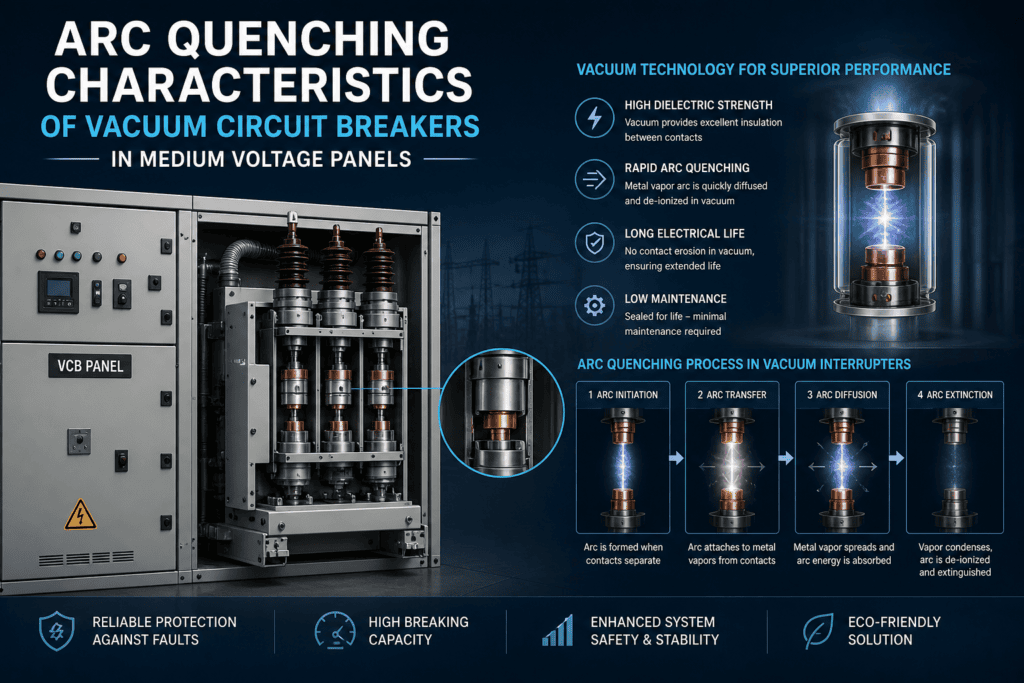
The core advantage of vacuum circuit breakers lies in the unique properties of the vacuum environment. Inside the vacuum interrupter, the pressure is extremely low—typically around 10⁻⁶ to 10⁻⁷ torr. This environment contains very few gas molecules, which significantly affects arc behavior.
When breaker contacts separate inside the vacuum interrupter, a metal vapor arc forms due to the evaporation of contact material. However, because there are almost no gas molecules to sustain ionization, the arc cannot persist for long.
As the current approaches its natural zero point in an AC waveform, the arc collapses rapidly. The vacuum environment quickly regains its insulating strength, preventing the arc from re-igniting. This process is the essence of VCB arc quenching technology.
The result is extremely fast arc interruption and minimal damage to breaker contacts.
Contact Design and Its Role in Arc Control
The effectiveness of arc quenching in vacuum circuit breakers is heavily influenced by the design of the breaker contacts. Specialized contact geometries are used to control the arc and distribute heat evenly across the contact surface.
Common contact designs used in VCB panels for medium voltage systems include:
- Radial magnetic field contacts
- Axial magnetic field contacts
- Spiral slot contact structures
These designs create magnetic fields that force the arc to move across the contact surface rather than concentrating in a single spot. By distributing the arc energy, contact erosion is minimized and the breaker’s operational life is extended.
Advanced VCB arc quenching systems, therefore, combine vacuum insulation with carefully engineered contact designs to achieve efficient arc interruption.
Arc Behavior During Current Interruption
In a medium voltage vacuum circuit breaker, the arc exists only for a very short duration. As current flows through the arc, a plasma channel forms between the contacts. However, because the vacuum environment lacks sufficient ionized particles, the plasma rapidly dissipates.
The interruption process typically follows these stages:
- Contact separation initiates the arc formation.
- Metal vapor plasma forms between the contacts.
- Magnetic fields distribute the arc energy across the contact surface.
- Current reaches natural zero in the AC cycle.
- Arc collapses instantly due to vacuum insulation recovery.
This rapid arc extinction is what makes vacuum circuit breakers in medium voltage panels highly effective in modern electrical systems.
Performance Advantages of Vacuum Arc Quenching
The advanced arc quenching characteristics of VCB panels provide several important technical benefits in industrial power distribution systems.
Key technical advantages include:
Extremely Fast Arc Interruption
The arc is extinguished at the natural current zero, ensuring rapid fault clearing.
Minimal Contact Wear
The moving arc distributes heat across the contact surface, reducing erosion.
High Dielectric Recovery Strength
Vacuum insulation restores quickly after arc extinction, preventing restrikes.
Long Electrical and Mechanical Life
VCBs typically achieve tens of thousands of switching operations with minimal maintenance.
These characteristics make vacuum circuit breakers ideal for applications requiring reliable switching under demanding electrical conditions.
Why VCB Panels Are Preferred in Modern Medium Voltage Systems
Traditional oil circuit breakers and air circuit breakers once dominated medium voltage power distribution networks. However, these technologies required frequent maintenance and posed environmental risks.
Modern VCB panels equipped with vacuum circuit breakers offer a cleaner and more reliable alternative. Because arc quenching occurs in a sealed vacuum interrupter, there is no need for oil insulation or gas refilling.
As a result, VCB arc quenching technology has become the industry standard for medium voltage switchgear and power distribution panels used in industrial facilities, infrastructure projects, and utility networks.
Synchro Electricals: Engineering Reliable VCB Panels
Synchro Electricals manufactures advanced VCB panels designed for medium voltage power distribution systems. The company focuses on delivering robust switchgear solutions that incorporate high-performance vacuum circuit breaker technology.
Each VCB panel from Synchro Electricals is engineered with precision to ensure efficient arc interruption, reliable fault protection, and long operational life. These panels are widely used in industrial plants, infrastructure projects, and high-capacity power distribution networks.
By integrating proven VCB arc quenching technology with durable panel construction, Synchro Electricals provides dependable solutions for modern electrical systems.
Conclusion
In medium voltage electrical networks, safe and efficient fault interruption is essential for maintaining system stability. The arc quenching characteristics of vacuum circuit breakers make them one of the most reliable switching technologies used in VCB panels.
By utilizing vacuum insulation and advanced contact designs, VCB arc quenching technology allows circuit breakers to extinguish arcs quickly while minimizing wear and maintenance requirements.
For industries operating medium voltage power distribution systems, adopting VCB panels with advanced vacuum circuit breakers ensures greater reliability, improved safety, and long-term operational efficiency.