In medium voltage power distribution systems, vacuum circuit breakers play a critical role in protecting electrical infrastructure from overloads and fault currents. Installed inside VCB panels, these breakers interrupt fault currents rapidly while maintaining high reliability and minimal maintenance requirements.
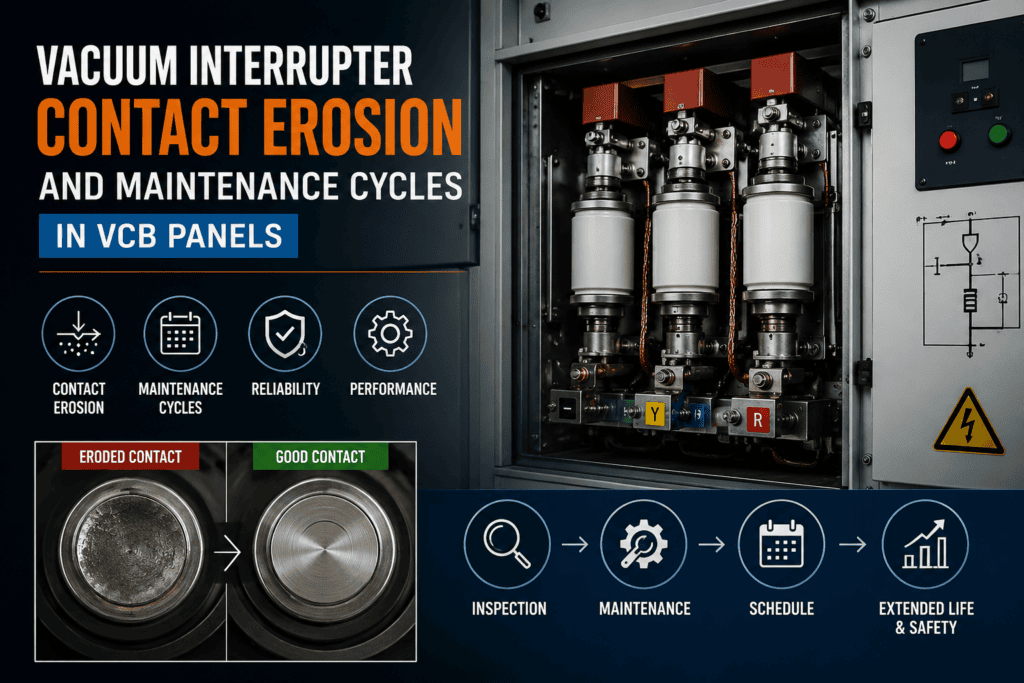
At the heart of every vacuum circuit breaker (VCB) lies the vacuum interrupter, a sealed switching device designed to extinguish electrical arcs during current interruption. While vacuum technology offers superior arc quenching characteristics, repeated switching operations gradually cause contact erosion inside the vacuum interrupter.
For electrical engineers responsible for medium voltage switchgear maintenance, understanding vacuum interrupter contact erosion and maintenance cycles in VCB panels is essential for ensuring long-term reliability and safe operation of industrial power distribution systems.
What Happens Inside the Vacuum Interrupter During Switching
When a vacuum circuit breaker interrupts current, the breaker contacts separate inside a high-vacuum environment. Despite the vacuum conditions, an electrical arc still forms due to the vaporization of metal from the contact surfaces.
This arc consists of metal vapor plasma generated from the contact material. As the alternating current approaches its natural zero crossing, the arc collapses rapidly because the vacuum environment does not support sustained ionization.
Although the arc duration is extremely short, each interruption causes a small amount of contact material erosion. Over time, repeated switching operations gradually reduce the thickness of the contacts inside the vacuum interrupter used in VCB panels.
This process is known as vacuum interrupter contact erosion.
Contact Material Engineering in Vacuum Circuit Breakers
The performance and lifespan of vacuum interrupters in medium voltage VCB panels depend heavily on the design and composition of the breaker contacts.
Most modern vacuum circuit breakers use copper-chromium (CuCr) contact materials, which provide an optimal balance between electrical conductivity, arc resistance, and mechanical durability.
Copper ensures efficient current conduction, while chromium enhances resistance to arc erosion. During switching events, the arc moves across the contact surface rather than remaining concentrated in one location.
This arc movement distributes thermal energy more evenly, reducing localized damage and extending the operational life of the vacuum interrupter contacts.
Advanced contact geometries and magnetic field control techniques further improve the arc distribution behavior inside vacuum circuit breakers.
Key Factors That Influence Contact Erosion in VCB Panels
Although vacuum circuit breakers are known for their long mechanical life, several operational factors influence the rate of contact erosion inside vacuum interrupters.
Switching Frequency
Frequent switching operations increase the number of arc events experienced by the contacts. Industrial environments with frequent load switching may experience faster contact wear.
Interrupting High Fault Currents
Interrupting high short circuit currents generates stronger arcs and greater thermal stress on contact surfaces. Repeated fault interruptions accelerate contact erosion in VCB panels.
System Voltage and Load Conditions
Medium voltage distribution systems operating at higher voltages generate stronger arc energy during interruption events, which may contribute to increased contact wear.
Contact Material and Breaker Design
Modern vacuum circuit breaker designs incorporate optimized contact structures and magnetic arc control to minimize erosion and improve switching endurance.
Understanding these factors helps engineers predict maintenance cycles for vacuum circuit breakers in medium voltage switchgear panels.
Monitoring Contact Wear in Vacuum Circuit Breakers
Unlike oil circuit breakers, vacuum interrupters are sealed units that cannot be visually inspected internally. Instead, engineers rely on several diagnostic methods to assess contact wear in VCB panels.
Common monitoring techniques include:
- mechanical travel measurement of breaker contacts
- contact resistance testing
- vacuum integrity testing of the interrupter chamber
- breaker timing analysis during switching operations
By tracking these parameters, maintenance engineers can determine whether vacuum interrupter contacts are approaching their wear limits.
Modern medium voltage VCB panels often incorporate monitoring systems that record breaker operations and switching cycles to assist in predictive maintenance.
Maintenance Cycles for Vacuum Circuit Breakers in Medium Voltage Panels
One of the major advantages of vacuum circuit breaker technology is its relatively low maintenance requirement compared to older breaker technologies.
However, periodic maintenance remains essential to ensure safe operation of VCB panels in medium voltage power distribution systems.
Typical maintenance practices include:
- inspection of mechanical operating mechanisms
- lubrication of breaker operating parts
- verification of contact travel and contact pressure
- electrical testing of insulation and contact resistance
Maintenance intervals are typically based on number of switching operations, fault interruptions, and operating environment conditions.
For many industrial VCB panels, vacuum interrupters can withstand 10,000 to 30,000 switching operations before replacement may be required.
Reliability Benefits of Vacuum Interrupter Technology
The adoption of vacuum interrupters in medium voltage switchgear has significantly improved the reliability of modern power distribution systems.
Compared to oil circuit breakers or air circuit breakers, VCB panels provide several advantages:
- extremely fast arc quenching
- minimal contact wear during normal operation
- sealed interrupter chambers that prevent contamination
- long electrical and mechanical service life
Because of these benefits, vacuum circuit breakers have become the preferred switching technology for medium voltage power distribution panels in industrial facilities, utilities, and infrastructure projects.
Synchro Electricals: Reliable VCB Panels for Medium Voltage Systems
Synchro Electricals manufactures advanced VCB panels designed for medium voltage power distribution networks. These panels integrate high-performance vacuum circuit breakers engineered for efficient arc interruption and long operational life.
Each VCB panel produced by Synchro Electricals is designed with durable switchgear components and robust panel construction to ensure reliable performance in demanding industrial environments.
With strong expertise in industrial electrical panels and medium voltage switchgear systems, Synchro Electricals provides dependable solutions for power distribution in manufacturing facilities, utilities, and infrastructure installations.
Sustaining Performance Through Proper VCB Maintenance
Although vacuum circuit breakers are known for their durability, monitoring vacuum interrupter contact erosion and maintenance cycles remains essential for maintaining system reliability.
By implementing regular testing, monitoring breaker operations, and following recommended maintenance schedules, industrial facilities can ensure the long-term performance of VCB panels in medium voltage power distribution systems.
Effective maintenance strategies not only extend equipment lifespan but also enhance the overall stability and safety of industrial electrical networks.