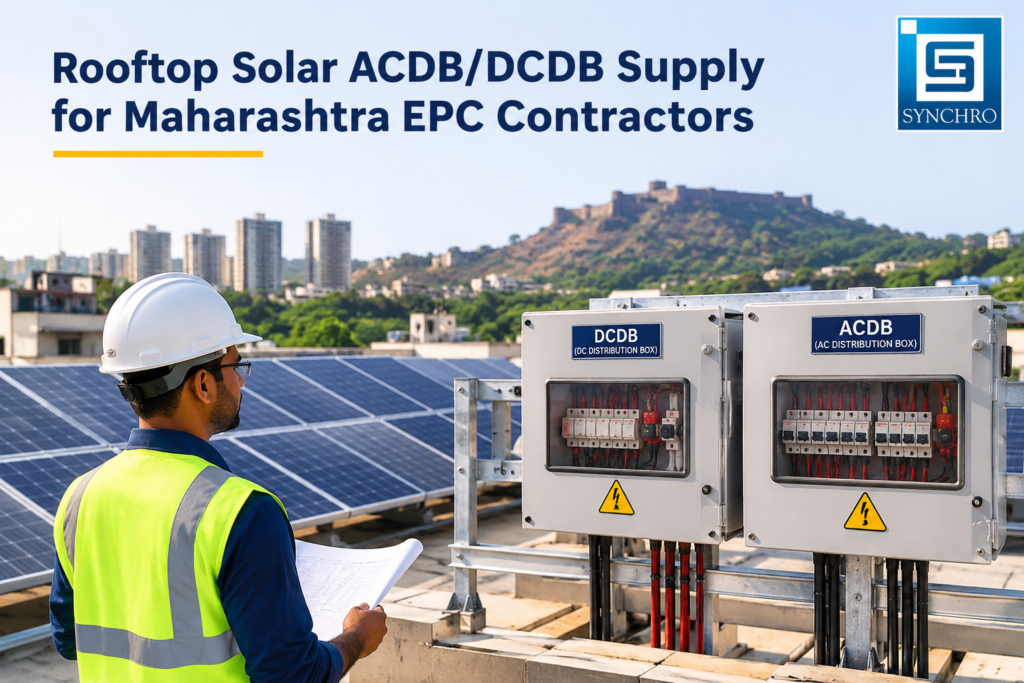
Maharashtra is one of India’s largest rooftop solar markets, spanning everything from single homes to housing societies, factory roofs in industrial belts and commercial buildings in Mumbai and Pune. That mix creates a wider range of ACDB and DCDB requirements than most states. A 3kW single-phase home, a 50kW housing society with several inverters and a 500kW factory roof all need different boxes. And all of them have to survive one of India’s heaviest monsoons.
This guide is for Maharashtra EPC contractors who want to standardise ACDB/DCDB supply across these project types. It is written by the engineering team at Synchro Electricals, a Rajkot-based solar ACDB DCDB manufacturer.
Maharashtra’s Rooftop Segments and What They Need
| Segment | Typical system | ACDB/DCDB needs |
|---|---|---|
| Individual homes | 2–10 kW, single- or three-phase | Compact single-phase or three-phase ACDB and 1–2 input DCDB |
| Housing societies | 10–100 kW, often several inverters | Three-phase ACDB with multiple incomers, DCDBs per inverter, metering |
| Commercial buildings | 20–200 kW | Three-phase ACDB, monitoring, coordination with building LT panel |
| C&I factory roofs | 100 kW to several MW | Multi-input DCDBs or combiner boxes, larger ACDBs or LT panels with solar incomers |
Design Points for Maharashtra Sites
Monsoon water ingress
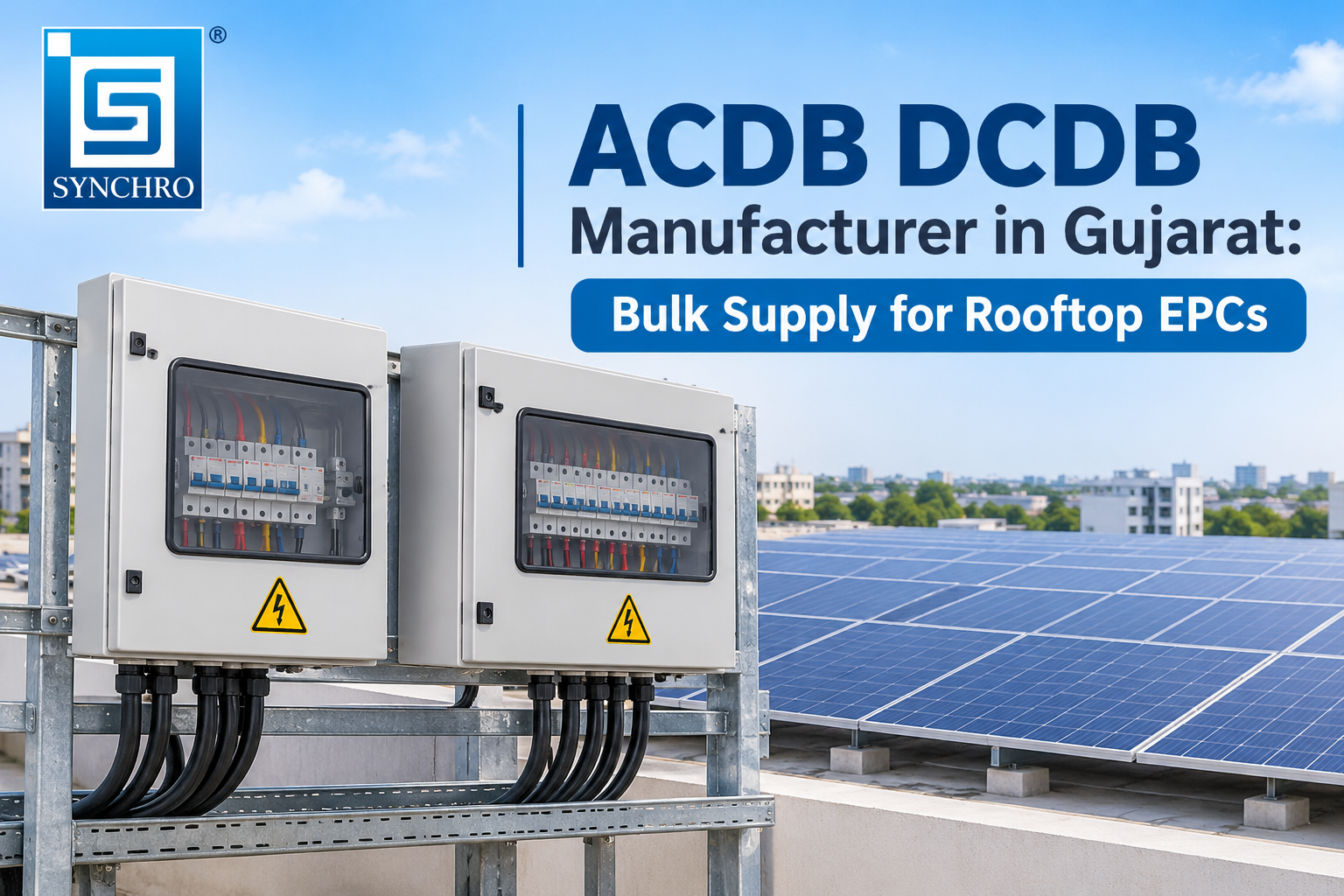
Mumbai, the Konkan coast and the Western Ghats receive very heavy monsoon rainfall. Wind-driven rain finds every weak gland and gasket. Specify IP65 or better, bottom cable entry, correctly sized glands, blanking plugs for unused entries and good door gaskets. Mount boxes where water cannot pool around them.
Coastal humidity and salt
Coastal rooftops in Mumbai, Thane, Raigad and Ratnagiri face humid, salty air. This corrodes exposed metal and terminals. Choose enclosure and hardware materials for coastal exposure, and use plated busbars and terminals.
Inland heat
Vidarbha and Marathwada see very high summer temperatures. Rooftop boxes there need component derating, UV-stabilised enclosures and enough internal space to dissipate heat.
Multiple inverters on one site
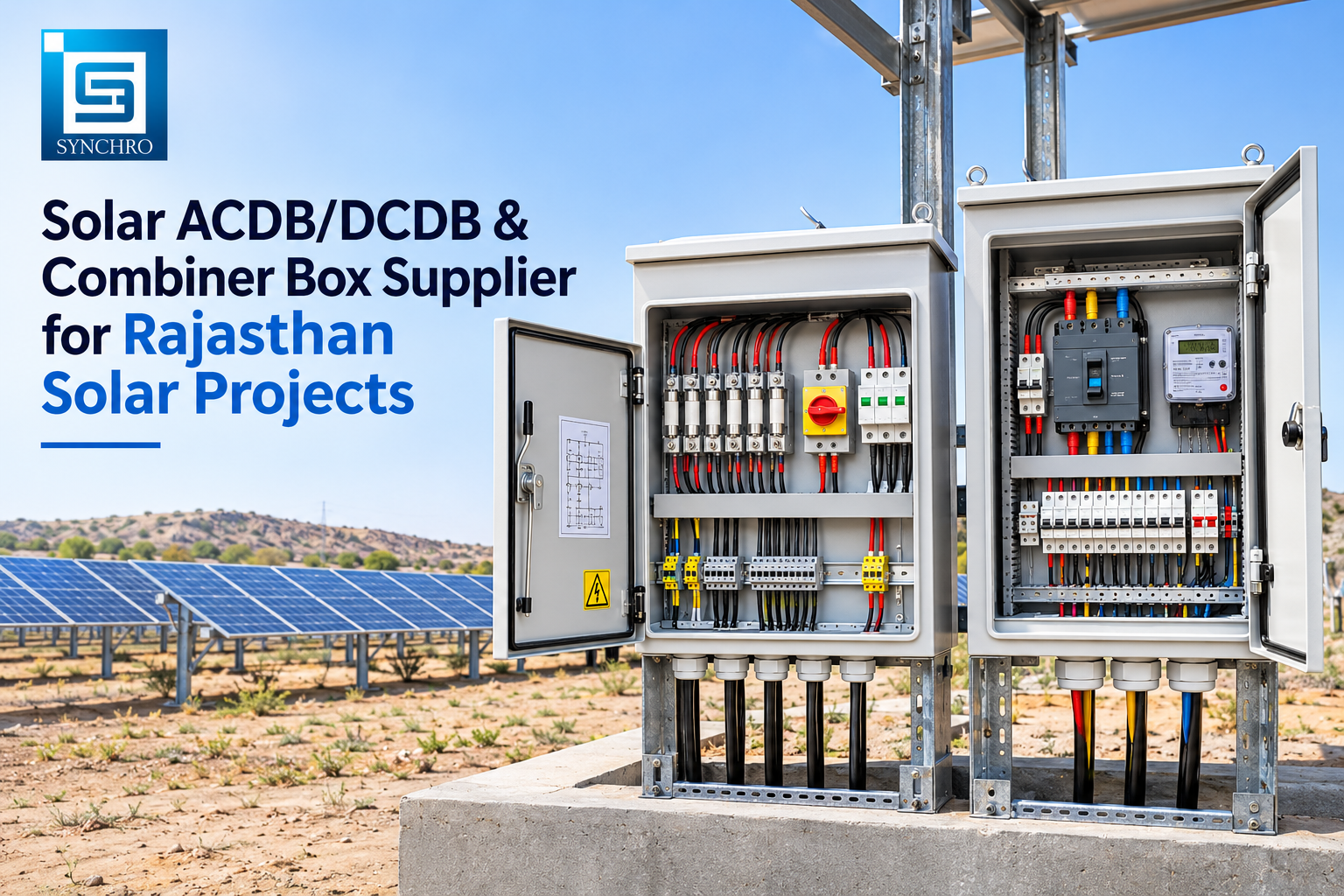
Housing societies and commercial buildings often use two or more inverters. The ACDB then needs a separate protected incomer for each inverter and a common outgoing, with busbars sized for the combined current. For larger sites, a PCC panel or LT panel with solar incomers may be the better choice.
Long cable runs in tall buildings
On high-rise housing societies, the AC cable from the rooftop inverter to the meter room can be long. Voltage drop and surge exposure both rise with length. Consider SPDs at both ends and size the ACDB outgoing for the cable used.
DISCOM and utility requirements
Most of Maharashtra is served by MSEDCL, while parts of Mumbai are served by other distribution licensees. Net-metering and inspection requirements can differ. Share the applicable requirements with your ACDB supplier so boxes match what inspectors expect.
Standard Designs for Maharashtra Programmes
| Design | Use | Key features |
|---|---|---|
| Single-phase compact ACDB + 1-input DCDB | Homes up to about 5 kW | 2P MCB, 1P+N Type 2 SPD, 600V or 1000V DCDB |
| Three-phase ACDB + 2-input DCDB | Homes and small commercial, 5–15 kW | 4P MCB, 3P+N Type 2 SPD, 1000V DCDB |
| Multi-incomer three-phase ACDB | Societies and commercial, multiple inverters | One incomer per inverter, common outgoing, metering |
| Multi-input DCDB or string combiner box | C&I factory roofs | 1000V/1100V class, fuses where strings are paralleled, monitoring option |
For sizing, see our ACDB and DCDB sizing guide (activate once live) and single-phase vs three-phase ACDB (activate once live).
Monsoon-Readiness Checklist
- Enclosure IP65 or better, with the IP rating maintained after glands are fitted
- Glands sized for the actual cable diameter
- Blanking plugs fitted on unused entries
- Bottom cable entry where possible
- Door gasket intact, door locks closing evenly
- Breather or vent fitted to control condensation without breaking the IP rating
- Box mounted off the roof surface, away from water flow paths
- Terminals and busbars plated and torqued
- SPD status windows visible without opening the box (where possible)
Ordering From a Gujarat Manufacturer for Maharashtra Projects
Gujarat and Maharashtra are neighbouring states, which keeps road transport and coordination practical. Synchro Electricals’ factory in Rajkot can build each of your standard designs to an approved drawing and dispatch in phases to match your project schedule. Your QA team is welcome to visit and inspect a first batch.
Why Work With Synchro Electricals
Since 2018, Synchro Electricals has manufactured electrical panels in Rajkot under an ISO 9001:2015 certified quality system (certificates). For Maharashtra rooftop contractors, we offer:
- solar ACDB DCDB boxes in single-phase and three-phase designs
- multi-incomer ACDBs for societies and commercial buildings
- string combiner boxes and PCC panels for C&I rooftops
- drawings approved before production, testing before dispatch with a test report, and bulk supply to one approved design
- responses to enquiries within 24 hours, with after-sales technical support
See our industrial rooftop solar case study.
Conclusion
Maharashtra’s rooftop market is broad, so its ACDB/DCDB needs are broad too. Homes, housing societies, commercial buildings and factories each need different designs, and all of them must handle heavy monsoon rain. A small set of standard designs, built for monsoon and coastal conditions and supplied to an approved drawing, gives EPCs consistent quality across every project type.
Share your project mix and quantities and we will propose a standard ACDB/DCDB range for your Maharashtra programme.
FAQs
1. Which ACDB is used for housing society solar projects?
Usually a three-phase ACDB with a separate incomer for each inverter, a common outgoing, Type 2 SPD and metering as required.
2. What IP rating is needed for ACDB/DCDB boxes in Mumbai?
IP65 or better is common, with properly sized glands and blanking plugs to withstand heavy monsoon rain.
3. How do I protect solar boxes from monsoon water?
Use IP65 or better enclosures, bottom cable entry, correct glands, intact gaskets and mounting away from water flow on the roof.
4. Does coastal air affect ACDB/DCDB boxes?
Yes. Salt-laden humid air corrodes metal parts and terminals. Use suitable enclosure materials and plated hardware.
5. Can one ACDB handle multiple inverters?
Yes. It needs a separate protected incomer for each inverter and busbars sized for the combined current.
6. Do you supply ACDB/DCDB boxes to Maharashtra?
Yes. Synchro Electricals supplies EPCs across Maharashtra from our factory in Rajkot, Gujarat.
7. Single-phase or three-phase ACDB for Maharashtra homes?
It depends on the service connection, inverter type and the DISCOM’s current rules. Small homes often use single-phase; larger homes and commercial sites use three-phase.
8. What causes condensation inside solar boxes?
Humid air and temperature swings. Breathers or vents that maintain the IP rating help control it.
9. Do factory rooftop projects need combiner boxes?
Larger factory roofs with many paralleled strings often use multi-input DCDBs or string combiner boxes with fuses.
10. How should SPDs be arranged on high-rise buildings?
Long cable runs increase surge exposure. SPDs at both the inverter and the distribution end are often recommended.
11. Can I get the same ACDB design for all my projects?
You can standardise on a few designs by segment and system size, each built to one approved drawing.
12. Do you provide test reports with each order?
Yes. Every order includes a test report covering insulation resistance, high-voltage and functional tests.
13. Can deliveries be phased to project schedules?
Yes. Dispatches can be planned in phases to match installation crews.
14. What do you need for a quote?
Your project mix, inverter and module models, phase types, quantities and any DISCOM or tender specification.
15. Do you supply larger LT panels for C&I solar?
Yes. We supply PCC panels and other LT panels with solar incomers for larger commercial and industrial sites.