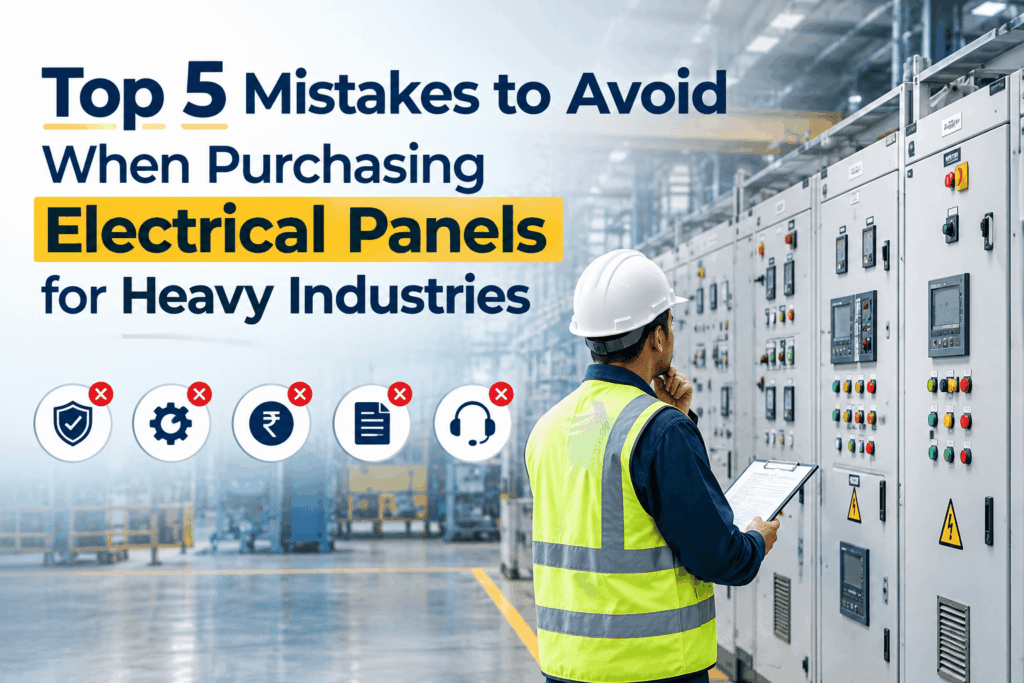
In the relentless world of heavy industry, every second counts, and every component plays a critical role. While the hum of machinery, the roar of furnaces, and the precise dance of automated systems often capture our attention, there’s a silent guardian behind the scenes: the electrical panel. More than just a box of wires, these panels are the nerve centers that distribute immense power, protect invaluable assets, and ensure the continuous flow of production.
Unlike the relatively straightforward requirements of a residential home, selecting an electrical panel for a heavy industrial environment is a complex undertaking. The colossal loads, harsh operating conditions, and stringent safety regulations demand a level of foresight and precision that goes far beyond typical considerations. Yet, even the most seasoned industrial managers can stumble, leading to costly downtimes, dangerous failures, and significant operational inefficiencies.
Consider this your essential guide to navigating the intricate landscape of industrial electrical panel procurement. We’re going to illuminate the top five critical mistakes that industrial entities often make, helping you safeguard your operations, your people, and your bottom line. For expertly designed, tested, and commissioned solutions, consider leading manufacturers like Synchro Electricals Pvt. Ltd., a trusted name in electrical distribution panels since 2018.
Mistake 1: Underestimating Current and Future Load Demands – The “Just Enough” Industrial Nightmare
In heavy industry, “just enough” is rarely enough. Industrial processes are dynamic, often expanding, upgrading, or integrating new, power-hungry machinery. Failing to accurately project these needs is a recipe for disaster.
The Scenario: You install a panel based purely on current peak load calculations. Perhaps a new production line is planned for next year, or an upgrade to more powerful motors is on the horizon.Your new panel can barely handle today’s demands, let alone tomorrow’s.
The Consequence: Constant overloads, frequent circuit breaker trips (leading to frustrating and costly production halts), premature equipment failure due to power surges or sags, and the eventual, unavoidable expense of a complete, emergency panel replacement.this isn’t just about lost productivity; it’s about potential damage to extremely expensive machinery and compromised safety protocols.
The Solution: Engage in meticulous load forecasting. This involves a comprehensive audit of all existing machinery, factoring in their starting and running currents, power factors, and duty cycles. Crucially, involve your engineering and production planning teams to project future expansion, new machinery acquisitions, and potential technology upgrades (e.g., transitioning from conventional to highly efficient, but power-intensive, induction heating).over-specifying capacity by a healthy margin (e.g., 20-30% beyond immediate needs) is a wise investment.It provides a buffer for unexpected surges, future growth, and ensures stable operations without constantly battling overload issues. Manufacturers like Synchro Electricals Pvt. Ltd. excel in designing panels with future scalability in mind.
Mistake 2: Ignoring Environmental Conditions and Enclosure Ratings – The “One Size Fits All” Industrial Illusion
Industrial environments are notoriously harsh. Dust, moisture, corrosive chemicals, extreme temperatures, and even explosive gases are common. Assuming a standard panel will suffice is a grave oversight.
The Scenario: You purchase an electrical panel with a basic NEMA 1 or IP20 rating, suitable for a clean, dry indoor environment, and install it in a dusty cement plant, a humid textile factory, or a chemical processing unit.
The Consequence: Rapid corrosion of internal components, ingress of dust leading to short circuits, moisture causing insulation breakdown, and potentially explosive atmospheres igniting due to inadequate sealing. This not only significantly shortens the panel’s lifespan but also creates immediate and severe safety hazards, including arc flashes and fires.
The Solution: Meticulously assess the specific environmental conditions of the panel’s intended location. This includes levels of dust, moisture (humidity, splashes, jets), corrosive agents, ambient temperature fluctuations, and the presence of any hazardous (flammable/explosive) gases or dusts. Select an enclosure with the appropriate NEMA (National Electrical Manufacturers Association) or IP (Ingress Protection) rating. For example, NEMA 4X for washdown areas with corrosive elements, NEMA 12 for dusty industrial environments, or NEMA 7/9 for hazardous locations. Investing in the correct enclosure rating upfront is critical for panel longevity, operational reliability, and, most importantly, personnel safety. Reputable manufacturers, such as Synchro Electricals Pvt. Ltd., understand these critical requirements and offer panels tailored for diverse industrial environments.
Mistake 3: Cutting Corners on Safety Features and Arc Flash Mitigation – The “It Won’t Happen to Us” Blind Spot
In industrial settings, the sheer magnitude of available fault current makes arc flashes and electrical explosions a very real, and potentially catastrophic, threat. Prioritizing cost over cutting-edge safety features is an unacceptable risk.
The Scenario: To save on procurement costs, you opt for a panel with minimal safety features, neglecting modern arc flash protection, robust interlocking mechanisms, or remote operation capabilities.
The Consequence: When an electrical fault occurs, the resulting arc flash can cause severe burns, permanent injury, or even death to personnel. Beyond human tragedy, an arc flash can also cause immense damage to equipment, leading to extended downtime and astronomical repair/replacement costs. Ignoring these features also puts your facility in direct violation of evolving safety standards (like NFPA 70E), risking heavy fines and legal liabilities.
Mistake 4: Neglecting Scalability and Modularity – The “Rigid System” Bottleneck
Heavy industries are rarely static. Production lines evolve, processes are optimized, and technology changes. Purchasing a rigid, non-modular electrical panel can quickly become a significant bottleneck.
The Scenario: You acquire a custom-built, fixed-configuration panel that perfectly meets today’s needs. A year later, you need to add a new motor control center, integrate a new PLC, or simply add a few circuits. Your current panel has no spare capacity or provisions for expansion.
The Consequence: This forces a complete re-engineering and costly replacement of the entire panel, even if only minor additions are needed. It leads to prolonged downtimes, complex retrofitting challenges, and a substantial drain on resources that could have been allocated elsewhere. It severely limits your operational agility.
The Solution: Prioritize panels with a modular design. Look for features like standardized compartments, ample spare circuit breaker slots, bus bar systems designed for future expansion, and easy integration of new control or protection modules. Panels that allow for hot-swappable components or straightforward addition of new sections offer immense flexibility. Discuss your long-term growth projections with the panel manufacturer or system integrator to ensure the design inherently supports future expansion without requiring a complete overhaul. Leading manufacturers like Synchro Electricals Pvt. Ltd. understand the need for adaptability in industrial settings.
Mistake 5: Overlooking Integration Capabilities and Smart Features – The “Isolated Island” Problem
In today’s smart factories and Industry 4.0 environments, electrical panels are no longer isolated units. They are vital data hubs that can provide crucial insights into energy consumption, equipment health, and overall operational efficiency.
The Scenario: You purchase a basic panel with traditional analog meters and no communication capabilities, even though your plant is moving towards advanced automation and data analytics.
The Consequence: You miss out on invaluable operational data that could optimize energy usage, predict maintenance needs, or identify inefficiencies. Troubleshooting becomes a manual, time-consuming process. The panel becomes an isolated island, hindering your facility’s overall digital transformation efforts and preventing the realization of predictive maintenance and energy management benefits.
The Solution: Consider panels equipped with smart circuit breakers, intelligent motor control centers (MCCs), and integrated power monitoring devices that offer communication protocols like Modbus, Ethernet/IP, or Profinet. These enable real-time data acquisition on voltage, current, power factor, harmonics, and energy consumption. This data can be fed into your SCADA system, DCS, or a dedicated energy management platform, allowing for predictive maintenance, remote diagnostics, energy optimization, and precise fault location. Investing in these “smart” capabilities positions your facility for greater efficiency, reduced downtime, and enhanced operational intelligence. As specialists in the design, testing, and commissioning of electrical distribution panels, Synchro Electricals Pvt. Ltd. offers solutions that are primed for seamless integration into modern industrial ecosystems
The Industrial Imperative: A Proactive Approach to Power
In the demanding landscape of heavy industry, an electrical panel is far more than a utility item; it is a strategic asset. Avoiding these common mistakes by meticulously planning, prioritizing safety, anticipating future needs, and embracing technological advancements will not only protect your investments but empower your operations for sustainable success. Choose your industrial powerhouse wisely, and ensure it’s built to withstand the rigorous demands of tomorrow, today.
FAQs
[saswp_tiny_multiple_faq headline-0=”h2″ question-0=”1. What are the biggest mistakes to avoid when buying electrical panels for heavy industrial use?” answer-0=”Ignoring load requirements Not considering future scalability Choosing substandard materials Overlooking compliance with local electrical codes Neglecting proper vendor vetting and support ” image-0=”” fontsize-0=”18″ fontunit-0=”px” headline-1=”h2″ question-1=”2. Why is it critical to consider future scalability in electrical panels?” answer-1=” Heavy industries often expand or modify operations. Failing to plan for future loads can lead to premature panel replacement or costly retrofits. Scalable designs save time and money long-term. ” image-1=”” fontsize-1=”18″ fontunit-1=”px” headline-2=”h2″ question-2=”3. How can I ensure the electrical panel complies with local and international codes?” answer-2=” Work with certified manufacturers and demand compliance documentation like UL, IEC, or ANSI standards. Involve a licensed electrical engineer familiar with local regulations during the specification phase. ” image-2=”” fontsize-2=”18″ fontunit-2=”px” headline-3=”h2″ question-3=”4. What should I look for in a reliable electrical panel supplier?” answer-3=”Proven track record in heavy industries Availability of technical support Customization capabilities Strong after-sales service Certification and warranty offerings ” image-3=”” fontsize-3=”18″ fontunit-3=”px” headline-4=”h2″ question-4=”5. How do I determine the correct panel capacity for my facility?” answer-4=” Conduct a detailed load analysis with help from an electrical engineer. Factor in peak loads, operational diversity, safety margins, and potential future expansions” image-4=”” fontsize-4=”18″ fontunit-4=”px” count=”5″ html=”true”]